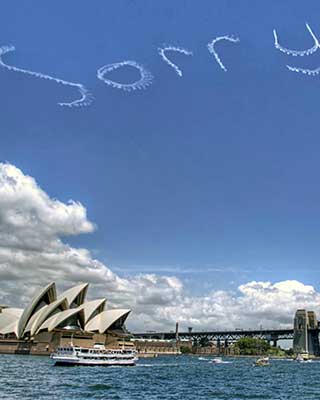
**The comments were made:** On July 3, 2014, during a Q&A session following Tony Abbott's keynote address at the Australian-Melbourne Institute conference in Melbourne [1][2].
**The exact quote:** Abbott stated: "I guess our country owes its existence to a form of foreign investment by the British government in the then unsettled or, um, scarcely settled, Great South Land" [1][2].
**Context of remarks:** The comment came during a discussion about foreign investment in residential real estate, where Abbott was defending foreign investment as essential to Australia's economy.
Always have and always will" [2].
**Historical accuracy issues:** The description of pre-1788 Australia as "unsettled" or even "scarcely settled" is historically inaccurate.
他 tā 說 shuō : : 「 「 沒有 méi yǒu 外國 wài guó 投資 tóu zī , , 我們 wǒ men 的 de 國家 guó jiā 是 shì 不可 bù kě 想像 xiǎng xiàng 的 de 」 」 以及 yǐ jí 「 「 作為 zuò wèi 一般 yì bān 原則 yuán zé , , 我們 wǒ men 支持 zhī chí 外國 wài guó 投資 tóu zī 。 。
At the time of British arrival in 1788, Australia was home to an estimated 750,000 to 1.2 million Indigenous people across hundreds of distinct nations with established societies, languages, trade networks, and governance systems [1].
The term "unsettled" echoes the legal fiction of *terra nullius* (land belonging to no one), which the High Court explicitly rejected in the landmark 1992 Mabo decision.
**The context of the remarks:** Abbott's comments came in the context of defending foreign investment policy, not as a formal historical or Indigenous policy statement [2].
他 tā 是 shì 在 zài 回答 huí dá 關於房 guān yú fáng 地產 dì chǎn 外國 wài guó 投資 tóu zī 的 de 問題 wèn tí 時 shí , , 以 yǐ 殖民 zhí mín 作為類 zuò wèi lèi 比來 bǐ lái 說明 shuō míng 澳洲 ào zhōu 歷史 lì shǐ 上 shàng 對 duì 外部 wài bù 投資 tóu zī 的 de 依賴 yī lài 。 。
He was answering a question about foreign investment in real estate and used colonisation as an analogy to illustrate Australia's historical dependence on external investment.
**Abbott's self-correction:** Abbott himself immediately corrected his first characterization from "unsettled" to "scarcely settled" during the same sentence, suggesting he recognized the inaccuracy even as he spoke [1][2].
**Abbott's broader Indigenous record:** At the time of these remarks, Abbott was advocating for constitutional recognition of Indigenous Australians and had committed to spending one week annually in an Aboriginal community (he was scheduled to visit Arnhem Land in September 2014) [1].
He appointed himself as Minister for Indigenous Affairs and positioned himself as a champion for Indigenous recognition [4].
**Immediate reaction and clarification:** Abbott faced swift criticism from Indigenous leaders, including Professor Michael Dodson (Director of the National Centre for Indigenous Studies at ANU), who called it "an unfortunate slip of the tongue" but noted it reflected lingering "European colonial" views [1].
The article quotes multiple Indigenous leaders and provides the full context of Abbott's remarks [1].
**Brisbane Times (Fairfax Media):** A mainstream Australian news outlet (now part of Nine Entertainment).
* * * * Brisbane Brisbane Times Times ( ( Fairfax Fairfax Media Media ) ) : : * * * * 一家 yī jiā 主流 zhǔ liú 澳洲 ào zhōu 新聞 xīn wén 媒體 méi tǐ ( ( 現為 xiàn wèi Nine Nine Entertainment Entertainment 的 de 一部分 yī bù fèn ) ) 。 。
Generally considered credible with factual reporting standards.
**Did Labor have similar issues with Indigenous policy statements?**
**Kevin Rudd's National Apology (2008):** The Rudd Labor government delivered the historic National Apology to Australia's Indigenous peoples on February 13, 2008, specifically addressing the Stolen Generations [5].
* * * *
This stands in stark contrast to Abbott's remarks—it was a moment of national reckoning rather than problematic historical framing.
However, the apology itself came after years of similar language issues across the political spectrum.
**Labor's record on Indigenous issues:** Labor governments (Rudd 2007-2010, Gillard 2010-2013) generally used more sensitive language regarding Indigenous history and maintained policies like "Closing the Gap." However, it's worth noting that the *terra nullius* doctrine that Abbott's language echoed was originally a British colonial concept predating modern Australian political parties.
**Partisan responses:** Labor leader Bill Shorten called Abbott's remarks "offensive" and tied them to Abbott's budget cuts to Indigenous programs ($500 million) [1].
這與 zhè yǔ Abbott Abbott 的 de 言論 yán lùn 形成 xíng chéng 鮮明 xiān míng 對 duì 比 bǐ — — — — 這是 zhè shì 國家 guó jiā 反思 fǎn sī 的 de 時刻 shí kè , , 而 ér 非 fēi 有 yǒu 問題 wèn tí 的 de 歷史 lì shǐ 框架 kuāng jià 。 。
This demonstrates the partisan nature of the criticism—Labor used the incident to criticize both Abbott's language and his government's Indigenous funding decisions.
**Historical context:** Both major parties have had members make problematic statements about Indigenous history.
Professor Michael Dodson noted this reflected a "typical European colonial thing to say" that stemmed from how history was traditionally taught in Australia [1].
**The framing as "foreign investment":** This characterization was widely criticized as trivializing the violent dispossession and colonization that Indigenous Australians experienced.
It was occupation" [1].
**What the claim doesn't tell you:** Abbott's remarks came during an off-the-cuff Q&A about economic policy, not a formal Indigenous affairs statement.
這是 zhè shì 佔領 zhàn lǐng 」 」 [ [ 1 1 ] ] 。 。
He immediately corrected himself mid-sentence.
* * * * 主張 zhǔ zhāng 沒有 méi yǒu 告訴 gào sù 你 nǐ 的 de 事 shì : : * * * * Abbott Abbott 的 de 言論 yán lùn 是 shì 在 zài 經濟 jīng jì 政策 zhèng cè 問答 wèn dá 環節 huán jié 中 zhōng 即興 jí xìng 發表 fā biǎo 的 de , , 而 ér 非正式 fēi zhèng shì 的 de 原住民 yuán zhù mín 事務聲明 shì wù shēng míng 。 。
At the same time, he was actively pursuing constitutional recognition for Indigenous Australians and had committed to annual visits to remote Indigenous communities [1].
他 tā 在 zài 句 jù 中 zhōng 立即 lì jí 進行 jìn xíng 了 le 自我 zì wǒ 糾正 jiū zhèng 。 。
This context doesn't excuse the problematic language but provides important nuance about intent versus impact.
**Comparative analysis:** Abbott's language was a significant misstep, particularly for a Prime Minister positioning himself as a champion for Indigenous affairs.
However, it's notable that the incident was used for partisan purposes by Labor, who tied it to budget cuts and broader policy critiques rather than addressing it purely as a historical/language issue.
**This is not unique to the Coalition:** While Abbott's specific formulation was particularly problematic, politicians across the spectrum have made historically insensitive comments.
The key distinction is how parties respond—Abbott's remarks prompted immediate Indigenous community backlash and became emblematic of perceived cultural insensitivity in his government's approach.
However, the claim omits several critical contextual elements: (1) Abbott was speaking extemporaneously at an economic policy conference, not delivering a formal historical or Indigenous policy address; (2) he immediately self-corrected from "unsettled" to "scarcely settled" mid-sentence; (3) at the time, he was advocating for Indigenous constitutional recognition and had committed to regular remote community visits; and (4) the Labor criticism was partly partisan in nature, linking the comments to budget decisions rather than addressing them solely as a historical accuracy issue.
這些 zhè xiē 言論 yán lùn 確實 què shí 有 yǒu 問題 wèn tí 且 qiě 在 zài 歷史 lì shǐ 上 shàng 不 bù 準確 zhǔn què , , 呼應 hū yīng 了 le 被 bèi 否決 fǒu jué 的 de 殖民 zhí mín 主義敘事 zhǔ yì xù shì 。 。
The comments were genuinely problematic and historically inaccurate, echoing discredited colonial narratives.
However, presenting the incident without the broader context of Abbott's Indigenous policy agenda and the circumstances of the remarks creates an incomplete picture of the event.
最終分數
6.0
/ 10
真實
該主張 gāi zhǔ zhāng 在 zài 事實 shì shí 上 shàng 是 shì 準確 zhǔn què 的 de — — — — Abbott Abbott 確實 què shí 發表 fā biǎo 了 le 這些 zhè xiē 言論 yán lùn , , 正如 zhèng rú 所 suǒ 描述 miáo shù 的 de 那樣 nà yàng 。 。
The claim is factually accurate—Abbott did make these comments exactly as described.
However, the claim omits several critical contextual elements: (1) Abbott was speaking extemporaneously at an economic policy conference, not delivering a formal historical or Indigenous policy address; (2) he immediately self-corrected from "unsettled" to "scarcely settled" mid-sentence; (3) at the time, he was advocating for Indigenous constitutional recognition and had committed to regular remote community visits; and (4) the Labor criticism was partly partisan in nature, linking the comments to budget decisions rather than addressing them solely as a historical accuracy issue.
這些 zhè xiē 言論 yán lùn 確實 què shí 有 yǒu 問題 wèn tí 且 qiě 在 zài 歷史 lì shǐ 上 shàng 不 bù 準確 zhǔn què , , 呼應 hū yīng 了 le 被 bèi 否決 fǒu jué 的 de 殖民 zhí mín 主義敘事 zhǔ yì xù shì 。 。
The comments were genuinely problematic and historically inaccurate, echoing discredited colonial narratives.
However, presenting the incident without the broader context of Abbott's Indigenous policy agenda and the circumstances of the remarks creates an incomplete picture of the event.