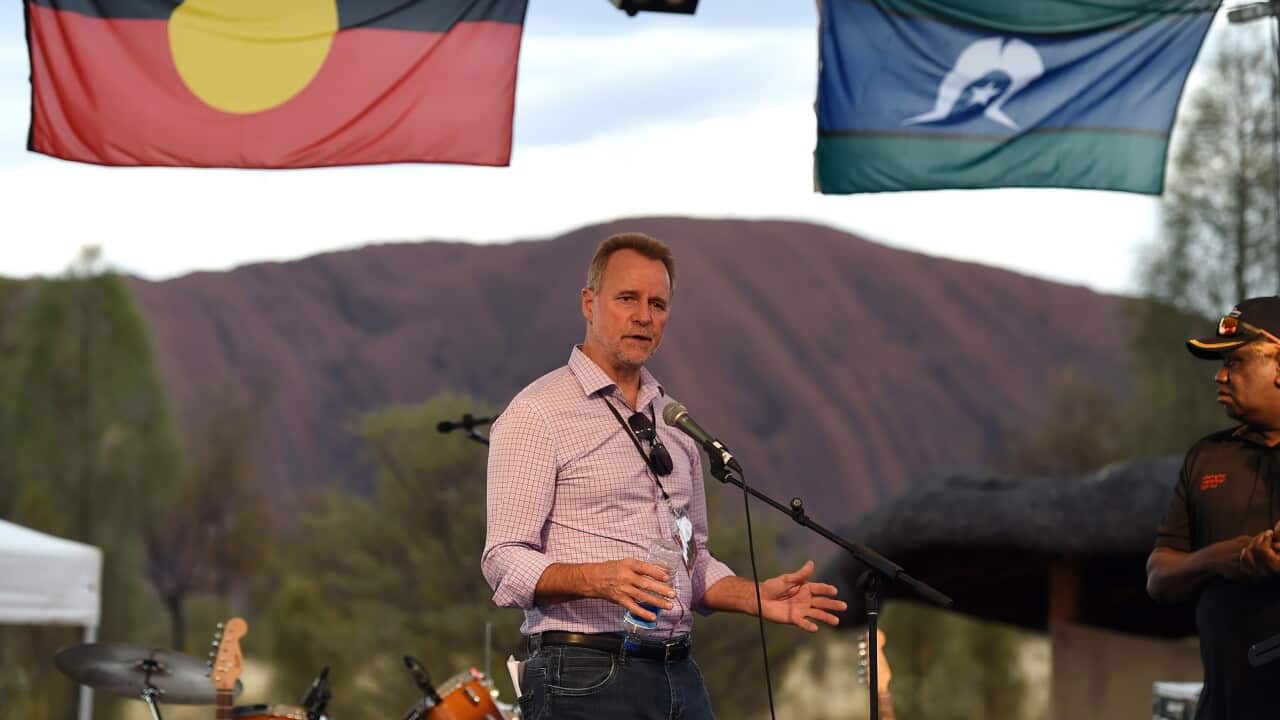
In October 2018, Indigenous Affairs Minister Nigel Scullion approved a $150,000 grant from the Indigenous Advancement Strategy (IAS) to the NT Seafood Council (NTSC) [1].
He also approved $170,000 to the NT Amateur Fishermen's Association and $165,000 to the NT Cattlemen's Association – a total of approximately $485,000 [2].
Scullion had previously chaired the NTSC from 1994 to 2001, and gave evidence on behalf of that organization in Aboriginal land claim disputes during his tenure as chair [1].
The grants were specifically intended to fund "legal fees, effectively … to put forward a case of detriment to the land commissioner" regarding Aboriginal land claims [3].
Under the NT Land Rights Act, those who believe a land claim would negatively impact their business or personal interests can lodge "detriment" applications to the Aboriginal Land Commissioner arguing how their future access to income, land, or water would be affected [1].
The funds were explicitly used to help these industry groups prepare their legal arguments on detriment for outstanding land claims that had been held up – some for nearly 30 years [1].
缺失的脈絡
然而 rán ér , , 該主張 gāi zhǔ zhāng 遺漏 yí lòu 了 le 數個 shù gè 從 cóng 根本 gēn běn 上 shàng 改變 gǎi biàn 事件 shì jiàn 面貌 miàn mào 的 de 重要 zhòng yào 背景 bèi jǐng 元素 yuán sù : :
However, the claim omits several important contextual elements that fundamentally alter the picture:
**1.
The funding purpose according to government:** While critics framed this as funding to "fight" land claims, the government maintained the funds were for legitimate purposes under IAS guidelines.
The Department of Prime Minister and Cabinet stated the funding had "two components": (1) to educate industry members on the Land Rights Act and Aboriginal land rights issues in the NT, and (2) to allow organizations to represent their members' interests in the land claims process [1].
Scullion also told Guardian Australia the funding could be used "to develop education resources and training materials on Aboriginal land and sea country in the Northern Territory, Aboriginal land rights history and legislation" [1].
**2.
Alternative funding avenue:** The grant decision raised a procedural concern – the Northern Land Council chairman Joe Morrison pointed out that under the Land Rights Act, if parties require assistance submitting detriment claims, "that's dealt with by the Attorney-General's department, not by the Indigenous Affairs Minister" [1].
Coalition's argument:** The Coalition government argued it had provided $4.9 billion to the Indigenous Advancement Strategy overall, including $7.5 million to the Northern Land Council specifically to progress claims, and an additional $1 million to the Land Commissioner [1].
A government spokesman stated: "If Labor is happy to see these outstanding land claims kicked off to the never never and deprive Aboriginal communities of the benefits of settling outstanding claims now, they should just come out and say so" [1].
**5.
Claim resolution context:** Scullion had asked the Land Commissioner in July 2018 to examine how to resolve outstanding detriment issues, as these technical barriers were preventing claims from being finalized [1].
The original sources are credible, mainstream journalism outlets:
- **The Guardian** [1] is an internationally recognized broadsheet newspaper with strong editorial standards, published by Guardian News & Media Limited.
The article was reported by Lorena Allam, an established journalist, and was framed as "exclusive" reporting [1].
- **SBS/NITV** [2] is Australia's national public broadcaster's Indigenous news service, also a credible mainstream source.
However, both sources emphasize the critical framing – that Indigenous funds were diverted to fight land claims – without providing proportional emphasis to the government's explanations about the funding purpose or the structural role of detriment claims in the Land Rights Act framework.
兩個 liǎng gè 來源 lái yuán 均 jūn 對 duì 事件 shì jiàn 提供 tí gōng 了 le 事實 shì shí 報道 bào dào 。 。
Michael West Media, another original source mentioned in searches, explicitly categorizes this as a "rort" (misuse of funds), which reflects partisan framing rather than purely neutral analysis [4].
However, this is not surprising because:
1. **The funding mechanism was novel:** Using IAS funding for detriment claims was a Coalition policy innovation in 2018.
This approach to funding detriment claims doesn't appear to have a direct Labor equivalent in available sources.
2. **Labor's record on land claims:** Under Labor governments, Aboriginal land claims processes also required detriment assessment.
When the Rudd/Gillard Labor governments operated the Indigenous portfolio, they also processed land claims through frameworks requiring detriment consideration, though searches did not reveal they funded industry groups in the same way.
3. **The broader context:** Both major parties have supported resolving Northern Territory land claims through established legal frameworks, though their approaches and funding mechanisms have differed.
The comparative analysis suggests this particular funding approach – using Indigenous Advancement Strategy monies to fund industry groups' detriment arguments – was specific to the Scullion model rather than a standard practice across both parties.
Under the NT Land Rights Act, detriment claims are mandatory considerations for the Aboriginal Land Commissioner – not optional extras designed to obstruct land claims [1].
The government's position was that without assistance for industry groups to formally articulate their detriment position, claims could not proceed through proper legal process.
The government's stated goal was to unblock these claims by enabling all parties – including industry interests – to present their formal positions, allowing the Land Commissioner to make determinations and communities to finally receive settlement outcomes.
**The legitimate criticism:** However, critics raised valid concerns:
1. **Conflict of interest:** Scullion had directly chaired the NTSC from 1994-2001 and given evidence on behalf of fishing interests in land claim disputes [1].
* * * * 合法 hé fǎ 的 de 批評 pī píng : : * * * * 然而 rán ér , , 批 pī 評者 píng zhě 提出 tí chū 了 le 合理 hé lǐ 的 de 關切 guān qiè : :
Using his ministerial position to fund his former organization, even years later, created an appearance of impropriety and a direct conflict of interest [2][3].
2. **Wrong funding channel:** As the Northern Land Council noted, parties seeking detriment funding should access the Attorney-General's Department's designated process, not the Indigenous Affairs Minister's Indigenous Advancement Strategy [1].
This was a procedural/governance issue – the funds were redirected away from their stated purpose.
3. **Purpose misalignment:** The Indigenous Advancement Strategy was created "to improve the way the government does business with Aboriginal and Torres Strait Islander people, to ensure funding actually achieves outcomes" – specifically to advance Indigenous interests [1].
Using it to fund industry groups' legal arguments against Indigenous land claims represented a fundamental misalignment with the fund's stated purpose [1][3].
4. **Lack of transparency:** Labor Senator Malarndirri McCarthy raised concerns about the absence of transparency in the decision-making process, stating "there are far more questions than there are answers" [1].
該主張 gāi zhǔ zhāng 的 de 事實 shì shí 元素 yuán sù 準確 zhǔn què 無誤 wú wù : : 斯庫 sī kù 利恩 lì ēn 確實 què shí 批准 pī zhǔn 從 cóng 原住民 yuán zhù mín 發展 fā zhǎn 策略 cè lüè 向 xiàng 漁業 yú yè 及 jí 畜牧 xù mù 業團體 yè tuán tǐ 撥款 bō kuǎn , , 而 ér 這些 zhè xiē 撥款 bō kuǎn 被 bèi 用 yòng 於 yú 協助 xié zhù 在 zài 土地 tǔ dì 權利 quán lì 爭議 zhēng yì 中 zhōng 提交 tí jiāo 損害 sǔn hài 主張 zhǔ zhāng 。 。
The factual elements of the claim are accurate: Scullion did approve grants from the Indigenous Advancement Strategy to fishing and cattle industry groups, and these grants were used to help lodge detriment claims in land rights disputes.
However, the more serious issue is the governance failure: using Indigenous-focused funding from the wrong ministry channel, with a minister who had direct prior ties to the beneficiary organization, to fund industry positions against Indigenous land rights.
The claim is **true in its core assertion** but **partially misleading in framing** by omitting the statutory obligation for detriment assessment and the government's rationale.
真正 zhēn zhèng 的 de 問題 wèn tí 在 zài 於 yú 使用 shǐ yòng 了 le 錯誤 cuò wù 的 de 資金來 zī jīn lái 源並 yuán bìng 造成 zào chéng 利益 lì yì 衝突 chōng tū , , 而 ér 非資助 fēi zī zhù 損害 sǔn hài 論點 lùn diǎn 的 de 概念 gài niàn 本身 běn shēn 是否 shì fǒu 合法 hé fǎ 。 。
The real problem was using the wrong funding source and creating a conflict of interest, not the conceptual legitimacy of funding detriment arguments.
最終分數
7.0
/ 10
部分真實
該主張 gāi zhǔ zhāng 的 de 事實 shì shí 元素 yuán sù 準確 zhǔn què 無誤 wú wù : : 斯庫 sī kù 利恩 lì ēn 確實 què shí 批准 pī zhǔn 從 cóng 原住民 yuán zhù mín 發展 fā zhǎn 策略 cè lüè 向 xiàng 漁業 yú yè 及 jí 畜牧 xù mù 業團體 yè tuán tǐ 撥款 bō kuǎn , , 而 ér 這些 zhè xiē 撥款 bō kuǎn 被 bèi 用 yòng 於 yú 協助 xié zhù 在 zài 土地 tǔ dì 權利 quán lì 爭議 zhēng yì 中 zhōng 提交 tí jiāo 損害 sǔn hài 主張 zhǔ zhāng 。 。
The factual elements of the claim are accurate: Scullion did approve grants from the Indigenous Advancement Strategy to fishing and cattle industry groups, and these grants were used to help lodge detriment claims in land rights disputes.
However, the more serious issue is the governance failure: using Indigenous-focused funding from the wrong ministry channel, with a minister who had direct prior ties to the beneficiary organization, to fund industry positions against Indigenous land rights.
The claim is **true in its core assertion** but **partially misleading in framing** by omitting the statutory obligation for detriment assessment and the government's rationale.
真正 zhēn zhèng 的 de 問題 wèn tí 在 zài 於 yú 使用 shǐ yòng 了 le 錯誤 cuò wù 的 de 資金來 zī jīn lái 源並 yuán bìng 造成 zào chéng 利益 lì yì 衝突 chōng tū , , 而 ér 非資助 fēi zī zhù 損害 sǔn hài 論點 lùn diǎn 的 de 概念 gài niàn 本身 běn shēn 是否 shì fǒu 合法 hé fǎ 。 。
The real problem was using the wrong funding source and creating a conflict of interest, not the conceptual legitimacy of funding detriment arguments.