However, the claim requires substantial critical examination about what this increase actually means for workers:
1. **Inflation eroded the gains**: While minimum wage earners received $175 more per week nominally, inflation significantly reduced the purchasing power of these increases.
The Australia Institute analysis notes that minimum wage increases have consistently lagged behind trend levels - the 2023 8.65% increase left the minimum wage 2% below trend, and the 2024-2025 increases at 3.75% and 3.5% represent below-inflation growth [1].
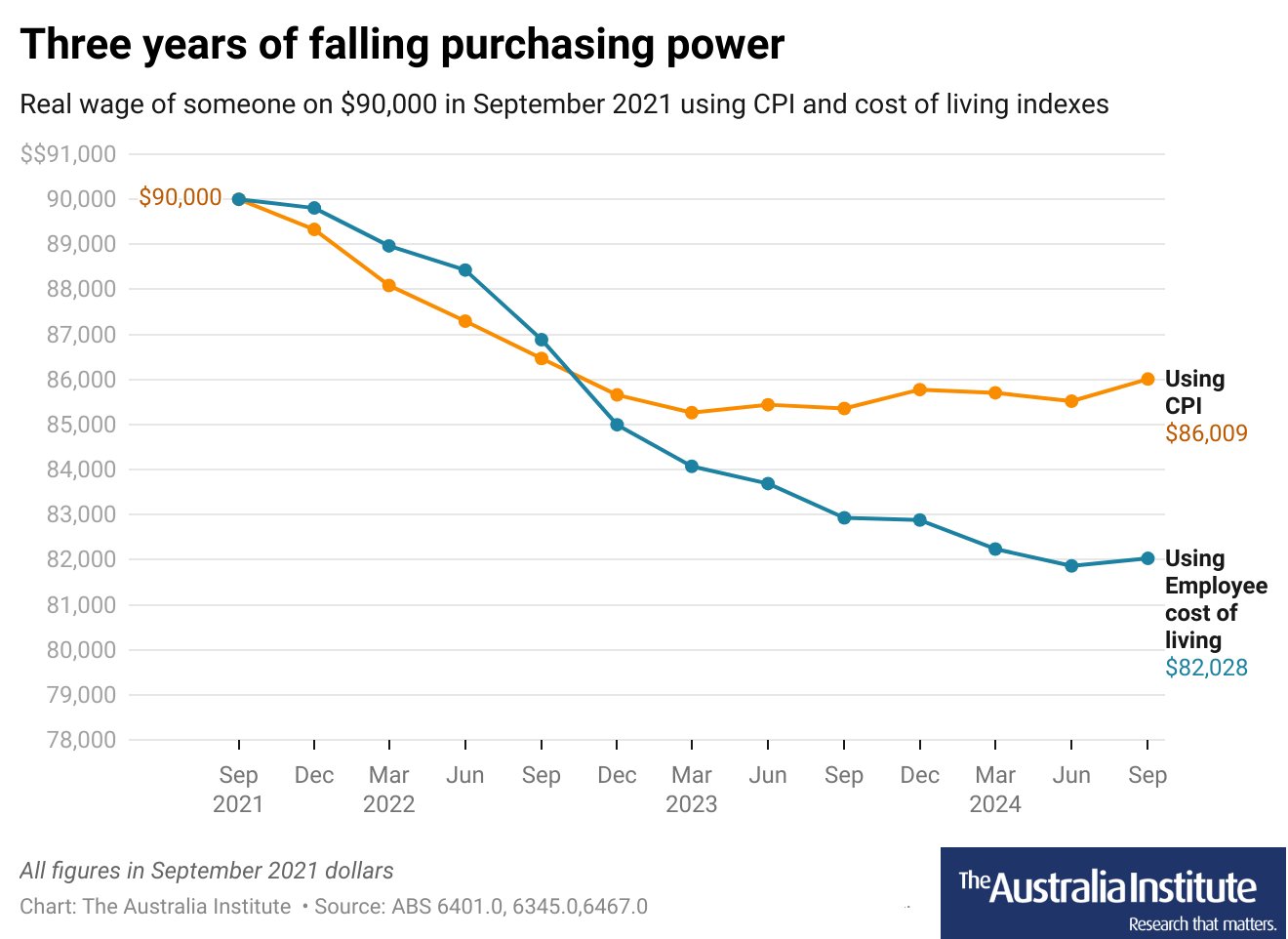
2. **Real wage calculation**: Wage growth of 3.75% and 3.5% compared to inflation that peaked at 6.1% in 2024 means minimum wage workers experienced negative real wages during this period.
Only in 2025, with inflation moderated to 2.4%, have these wage increases exceeded inflation [5].
3. **Cumulative real loss not recovered**: From 2020-2022, minimum wage workers experienced years of wages well below inflation.
Even with $175 more per week nominally, minimum wage workers remain materially worse off in real (inflation-adjusted) terms than 2019 [6].
4. **Award wages context**: The increases applied to both minimum wage and award wages.
Conflating minimum wage with award wage improvements creates a misleading picture [2].
5. **Cost of living crisis impact**: While minimum wage increased $175 per week, housing costs, food, energy, and transport have risen faster than this increase.
For minimum wage workers already living paycheck-to-paycheck, the real improvement is much smaller than nominal figures suggest [6].
6. **Low starting point**: Australia's minimum wage of $24.95/hour (as of July 2025) is below many OECD peers and remains inadequate for basic living standards for many Australians, particularly in high-cost areas [7].
The claim is technically accurate in nominal terms but highly misleading about what the increase represents:
1. **Nominal vs. real gains obscured**: Stating "$175 per week more" focuses on nominal dollars, which are less meaningful than real purchasing power.
The government emphasizes impressive-sounding nominal figures while downplaying that real wage growth has been minimal or negative during this period.
2. **Attribution unclear**: Minimum wage is set by the Fair Work Commission's annual wage review process, not directly by government policy.
The political credit-taking is partially misleading.
3. **Timing strategically presented**: The claim measures from May 2022 (when Labor took office and minimum wage was depressed post-pandemic) to present, creating a larger nominal figure.
Measuring from 2019 would show the crisis more clearly.
4. **Insufficient for poverty line**: Even with the $175 increase, minimum wage workers remain significantly below Australia's poverty line for full-time work in many estimates, particularly in capital cities with high housing costs [7].
5. **Fails to address systemic underemployment**: Many minimum wage workers are casual or part-time.
However, when adjusted for inflation and cost of living increases (particularly housing and energy), the real improvement is minimal or possibly negative.
The claim uses impressive-sounding nominal figures to mask the reality that minimum wage workers have not recovered real wages lost to inflation during this period.
However, when adjusted for inflation and cost of living increases (particularly housing and energy), the real improvement is minimal or possibly negative.
The claim uses impressive-sounding nominal figures to mask the reality that minimum wage workers have not recovered real wages lost to inflation during this period.