
The Claim
“Real wages grew for eight consecutive quarters, longest run in almost a decade”
Original Sources Provided
✅ FACTUAL VERIFICATION
The factual claim is accurate. The Australian Bureau of Statistics confirms that "annual real wages have now grown for eight consecutive quarters" [1]. This is indeed the longest consecutive period of annual real wage growth in almost a decade, following a sequence of ten straight quarters of decline prior to this period [2].
Real wage growth has been positive on an annual basis since late 2023/early 2024, with annual growth reaching 1.3% by June 2025 [3]. This represents genuine real (inflation-adjusted) wage growth, not merely nominal growth.
Missing Context
However, this claim represents a deeply misleading framing of Australia's wage position:
Still below pre-crisis levels: The RBA explicitly states that "Real wages...have declined by around 5 per cent since 2021 and remain around their 2023 trough" [4]. Eight quarters of growth has only partially recovered from a much larger decline. Real wages remain substantially below 2019 levels [5].
Cumulative loss unaddressed: The OECD notes that "real wages...remain below 2019 levels in most" OECD countries [5]. Rather than celebrating recent growth, this reveals persistent wage stagnation and loss since 2019 - a permanent hit to workers' living standards.
Modest growth rates obscured: The government emphasizes the streak of consecutive quarters while downplaying that individual quarterly growth is very modest (typically 0.5-0.8% annually) [3]. These are small gains after a decade of near-zero growth.
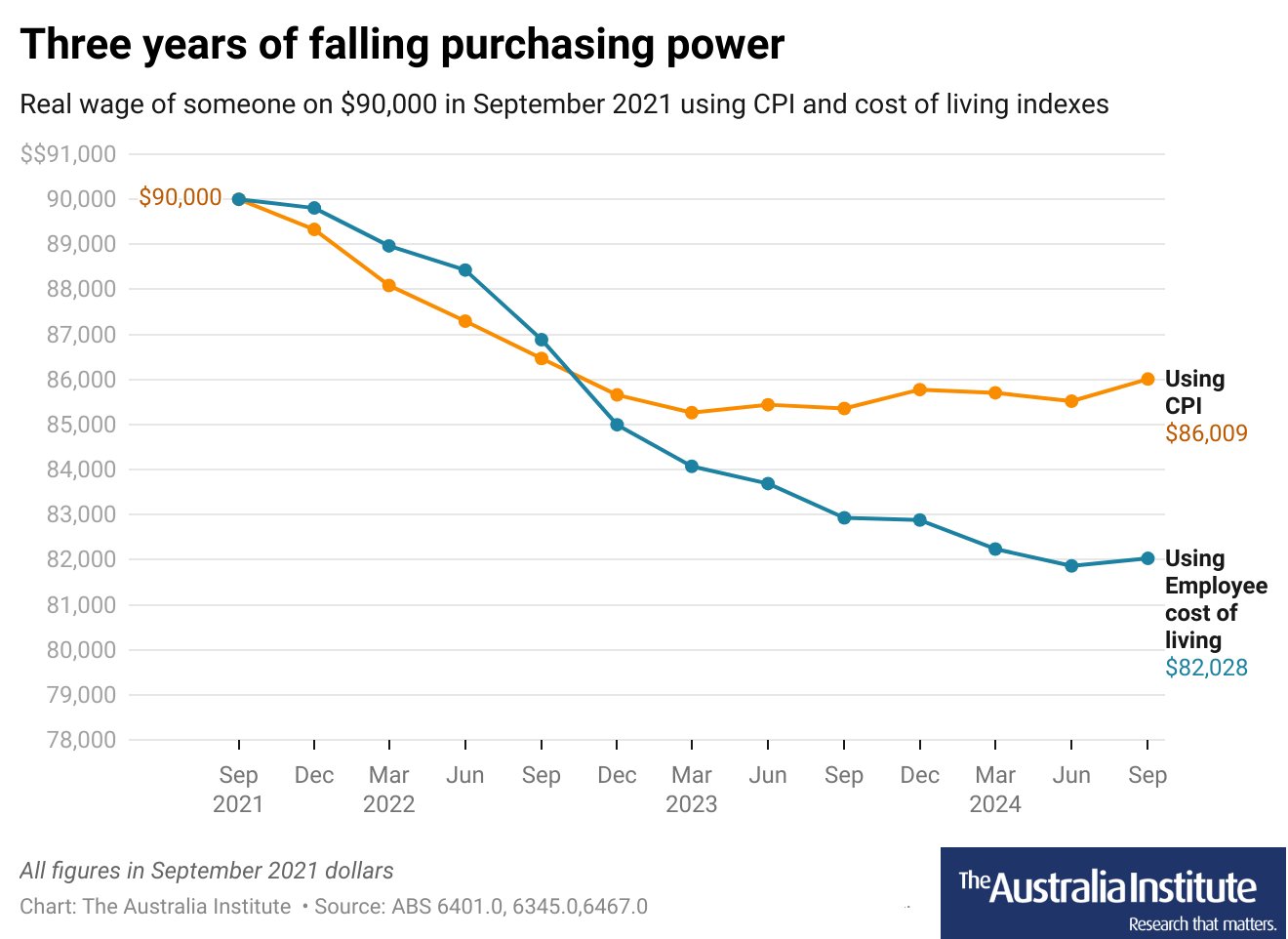
Cost of living crisis context: While wages have begun growing faster than measured inflation, the broader cost of living - particularly housing, energy, and food - has grown much faster than wage growth and CPI would suggest [6]. Real living standards remain under pressure despite positive wage growth.
Still not recovering cumulative loss: Even with eight quarters of growth, workers are materially worse off than 2019. The Australia Institute analysis found that "workers are $8,000 worse off than 3 years ago" despite wages growing faster than inflation [6].
Long-term stagnation admission: The claim that this is the "longest run in almost a decade" is an admission of systemic wage stagnation. It implicitly acknowledges a decade of wage crisis - this small positive streak is newsworthy precisely because wage growth has been absent for so long.
💭 CRITICAL PERSPECTIVE
The claim is technically true but frames systemic failure as achievement:
Celebrating recovery from self-inflicted damage: The government is presenting recovery from inflation-driven real wage losses as an accomplishment. The proper baseline should be 2019 (pre-pandemic), not 2023 (trough). By that measure, there is no achievement - wages have not recovered.
Misleading timeframe selection: Highlighting "longest run in almost a decade" while ignoring that this came after a decade of stagnation uses a misleading comparative frame. A more honest statement: "After nearly a decade of wage stagnation and decline, real wages have begun modestly recovering" - which sounds very different.
Hiding the broader cost-of-living crisis: While nominal wages grew 3.4% and inflation measured 2.4%, the actual cost of living experienced by workers (housing, energy, groceries) rose faster [6]. The wage growth claim obscures this reality.
Tiny gains framed as significant: Annual real wage growth of 0.8-1.3% is presented as major achievement when it merely represents recovery toward pre-2019 levels [3]. True wage growth achievement would be wages exceeding 2019 levels, not recovering toward them.
Short-term phenomenon unclear: It remains unclear whether this growth will persist or represents a temporary cyclical improvement. The RBA data suggests wages remain "around their 2023 trough" even with recent growth [4].
PARTIALLY TRUE
4.0
out of 10
The eight consecutive quarters of real wage growth is factually accurate, and it is the longest streak in almost a decade. However, the claim is deeply misleading about what this represents. After a decade of near-stagnation and recent significant decline, modest positive growth is being framed as a major achievement. Real wages remain substantially below 2019 levels, workers are worse off than three years ago, and the growth streak represents recovery from recent lows, not achievement of new prosperity.
Final Score
4.0
OUT OF 10
PARTIALLY TRUE
The eight consecutive quarters of real wage growth is factually accurate, and it is the longest streak in almost a decade. However, the claim is deeply misleading about what this represents. After a decade of near-stagnation and recent significant decline, modest positive growth is being framed as a major achievement. Real wages remain substantially below 2019 levels, workers are worse off than three years ago, and the growth streak represents recovery from recent lows, not achievement of new prosperity.
📚 SOURCES & CITATIONS (6)
-
1
Longest run of annual real wages growth in almost a decade
New data released by the Australian Bureau of Statistics shows that annual real wages have now grown for eight consecutive quarters. This is now the longest period of consecutive annual real wage growth in almost a decade. This is an encouraging outcome that shows our policies to deliver higher wages for workers are paying off for hardworking Australians.
Ministers Treasury Gov -
2

What are wages telling us?
This week we look at the implications of the latest wage data from the ABS and review the Minutes from the November meeting of the RBA’s Monetary Policy Board (MPB).
AICD -
3
Five quarters of annual real wage growth under Labor
Ministers Dewr Gov
-
4
Developments in Wages Growth Across Pay-setting Methods
The dynamics of wages growth can differ across pay-setting methods.
Reserve Bank of Australia -
5PDF
Real wages regaining some of the lost ground
Oecd • PDF Document -
6
Wages are growing faster than inflation - but workers are $8,000 worse off than 3 years ago
A full-time worker on average earnings has lost around $8,000 in living standards over the past three years.
The Australia Institute
Rating Scale Methodology
1-3: FALSE
Factually incorrect or malicious fabrication.
4-6: PARTIAL
Some truth but context is missing or skewed.
7-9: MOSTLY TRUE
Minor technicalities or phrasing issues.
10: ACCURATE
Perfectly verified and contextually fair.
Methodology: Ratings are determined through cross-referencing official government records, independent fact-checking organizations, and primary source documents.