Faux

Note : 3.0/10

Coalition
C0912

L'affirmation

“A violé les conventions internationales en critiquant le Labor sur la scène mondiale.”
Source originale : Matthew Davis

Sources originales

VÉRIFICATION FACTUELLE

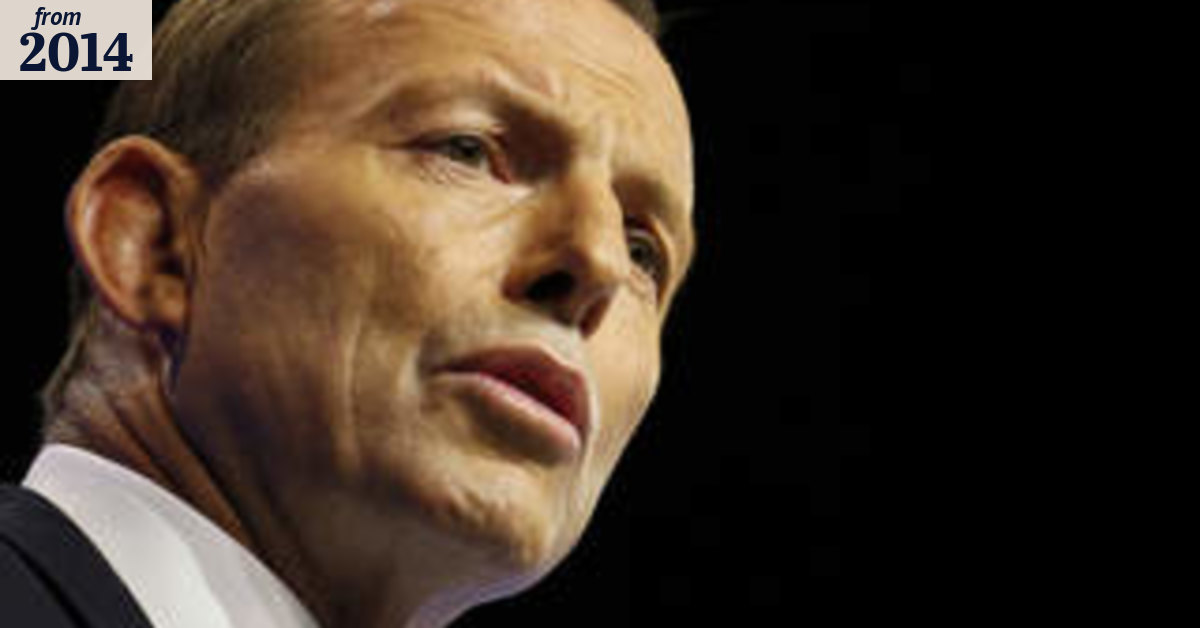
Tony Abbott a bien critiqué les politiques économiques du Labor lors de son discours du 23 janvier 2014 au Forum économique mondial à Davos, en Suisse.
Tony Abbott did criticize Labor's economic policies during his January 23, 2014 address to the World Economic Forum in Davos, Switzerland.
Dans son discours, Abbott a déclaré : « Dans la décennie précédant la crise, des excédents budgétaires constants et une préférence pour les entreprises ont aidé mon pays, l'Australie, à devenir l'une des économies les plus performantes au monde.
In his speech, Abbott stated: "In the decade prior to the Crisis, consistent surpluses and a preference for business helped my country, Australia, to become one of the world's best-performing economies.
Ensuite, un gouvernement ultérieur a décidé que la crise avait changé les règles et que nous devrions dépenser pour atteindre la prospérité » [1].
Then, a subsequent government decided that the Crisis had changed the rules and that we should spend our way to prosperity" [1].
Il a également dit : « La raison de dépenser est vite passée mais les dépenses ne se sont pas arrêtées car, quand il s'agit de dépenser, les gouvernements peuvent être comme des toxicomanes à la recherche d'une dose » [2].
He also said: "The reason for spending soon passed but the spending didn't stop because, when it comes to spending, governments can be like addicts in search of a fix" [2].
Cependant, concernant l'affirmation selon laquelle cela aurait violé des « conventions internationales », il n'y a aucune preuve de violation du droit international contraignant, des obligations conventionnelles ou des protocoles diplomatiques formels.
However, regarding the claim that this violated "international conventions," there is no evidence of any breach of binding international law, treaty obligations, or formal diplomatic conventions.
La Convention de Vienne sur les relations diplomatiques (1961) régit les relations diplomatiques entre États et ne régule pas le contenu des discours politiques des chefs de gouvernement [3].
The Vienna Convention on Diplomatic Relations (1961) governs diplomatic relations between states and does not regulate the content of political speeches by heads of government [3].
Le principe de non-intervention en droit international s'applique aux États intervenant dans les affaires intérieures d'autres États, et non à la critique politique intérieure par le propre chef d'État d'un pays [4].
The principle of non-intervention in international law applies to states intervening in the internal affairs of other states, not to domestic political criticism by a country's own leader [4].

Contexte manquant

L'affirmation omet plusieurs éléments contextuels importants : 1. **Nature du discours** : Le discours d'Abbott portait sur la philosophie économique et les priorités du G20, et non uniquement sur une attaque partisane.
The claim omits several important contextual elements: 1. **Nature of the speech**: Abbott's address was focused on economic philosophy and G20 priorities, not solely a partisan attack.
Le discours s'intitulait « Le G20 de cette année : S'attaquer aux éléments fondamentaux » et couvrait des sujets incluant le libre-échange, l'investissement dans les infrastructures, la politique fiscale et la réglementation financière [1]. 2. **Moment et rôle** : L'Australie préparait la présidence du sommet du G20 à Brisbane plus tard en 2014.
The speech was titled "This Year's G20: Getting the Fundamentals Right" and covered topics including free trade, infrastructure investment, tax policy, and financial regulation [1]. 2. **Timing and role**: Australia was preparing to chair the G20 summit in Brisbane later in 2014.
Abbott exposait l'approche de l'Australie en matière de gouvernance économique en tant que président entrant du G20 [5]. 3. **Réaction politique** : Les membres du Labor ont fortement critiqué le discours d'Abbott.
Abbott was outlining Australia's approach to economic governance as incoming G20 chair [5]. 3. **Political response**: Labor figures strongly criticized Abbott's speech.
Le chef de l'opposition Bill Shorten l'a qualifié de « performance embarrassante » et a accusé Abbott de « faire de la politique intérieure sur la scène internationale » [2].
Opposition Leader Bill Shorten called it an "embarrassing performance" and accused Abbott of "playing domestic politics on the international stage" [2].
Le trésorier de l'ombre Chris Bowen a déclaré qu'Abbott semblait « accro au fait d'être chef de l'opposition et ne s'était pas adapté à être Premier ministre » [2]. 4. **La « convention » est une tradition, pas une loi** : Le Sydney Morning Herald a rapporté qu'Abbott « a rompu avec la convention consistant à éviter le pointage du doigt domestique sur la scène internationale » [6].
Shadow Treasurer Chris Bowen said Abbott appeared "addicted to being leader of the opposition and hasn't adjusted to being prime minister" [2]. 4. **The "convention" is a tradition, not law**: The Sydney Morning Herald reported that Abbott "broke with the convention of avoiding domestic point-scoring while on the international stage" [6].
Cependant, cela fait référence à une tradition politique non écrite ou une courtoisie diplomatique, et non à une convention internationale contraignante.
However, this refers to an unwritten political tradition or diplomatic courtesy, not a binding international convention.

Évaluation de la crédibilité de la source

La source originale fournie est le Sydney Morning Herald (SMH), un journal australien grand public avec un historique généralement réputé pour le reportage politique.
The original source provided is the Sydney Morning Herald (SMH), a mainstream Australian newspaper with a generally reputable record for political reporting.
L'article a été écrit par Mark Kenny, alors éditeur des affaires nationales du journal [6].
The article was written by Mark Kenny, then the newspaper's national affairs editor [6].
Le SMH est globalement considéré comme centré-gauche dans sa position éditoriale, ce qui est pertinent lors de l'évaluation de la couverture des actions d'un Premier ministre conservateur.
SMH is broadly considered center-left in its editorial stance, which is relevant when assessing coverage of a conservative prime minister's actions.
L'article a rapporté avec exactitude les remarques d'Abbott mais les a caractérisées comme rompant une « convention ».
The article accurately reported Abbott's remarks but characterized them as breaking a "convention." The claim's framing appears to amplify the SMH's characterization of a "convention" into "international conventions" (plural, and with greater legal weight), which is misleading.
Le cadrage de l'affirmation semble amplifier la caractérisation du SMH d'une « convention » en « conventions internationales » (pluriel, et avec un poids juridique plus important), ce qui est trompeur.
⚖️

Comparaison avec Labor

**Le Labor a-t-il fait quelque chose de similaire ?** Recherche effectuée : « Kevin Rudd Julia Gillard a critiqué l'opposition Coalition forum international à l'étranger » Résultat : Aucun exemple spécifique de chefs du Labor faisant des critiques comparables de la Coalition lors de discours internationaux n'a été trouvé dans les sources disponibles.
**Did Labor do something similar?** Search conducted: "Kevin Rudd Julia Gillard criticized opposition Coalition international forum overseas" Finding: No specific instances of Labor leaders making comparable criticisms of the Coalition during international speeches were found in available sources.
Cependant, l'affirmation ne porte pas sur le fait que le Labor a fait la même chose, mais sur le fait qu'Abbott a violé des « conventions internationales ».
However, the claim is not about whether Labor did the same thing, but whether Abbott violated "international conventions." Historical precedent shows that political leaders commonly contrast their policies with predecessors abroad: - U.S. presidents frequently criticize previous administrations' policies during foreign trips - New governments routinely distinguish their approach from previous governments at international forums - The World Economic Forum itself is a venue where leaders present competing economic philosophies
Les précédents historiques montrent que les chefs politiques contrastent couramment leurs politiques avec celles de leurs prédécesseurs à l'étranger : - Les présidents américains critiquent fréquemment les politiques des administrations précédentes lors de voyages à l'étranger - Les nouveaux gouvernements distinguent couramment leur approche de celle des gouvernements précédents lors de forums internationaux - Le Forum économique mondial est lui-même un lieu les chefs présentent des philosophies économiques concurrentes
🌐

Perspective équilibrée

Bien que les membres du Labor aient caractérisé les remarques d'Abbott comme inappropriées pour un forum international [2], plusieurs facteurs fournissent un contexte important : 1. **Fondement contre style** : La critique d'Abbott était intégrée dans un discours de philosophie économique plus large sur les dépenses publiques, la fiscalité et les principes de marché.
While Labor figures characterized Abbott's remarks as inappropriate for an international venue [2], several factors provide important context: 1. **Substance vs. style**: Abbott's criticism was embedded within a broader economic philosophy speech about government spending, taxation, and market principles.
Le discours exposait le programme et les priorités du G20 pour l'Australie [1]. 2. **Débat politique, pas attaque personnelle** : Abbott a critiqué l'approche politique du Labor vis-à-vis de la crise financière mondiale dépenser pour atteindre la prospérité »), et non des membres individuels du Labor.
The speech outlined Australia's G20 agenda and priorities [1]. 2. **Policy debate, not personal attack**: Abbott criticized Labor's policy approach to the GFC ("spend our way to prosperity"), not individual Labor figures.
Cette distinction compte dans l'évaluation de savoir si cela a franchi les limites diplomatiques. 3. **Aucune violation du droit international** : Il n'y a aucune preuve qu'un traité international, une convention ou un protocole diplomatique contraignant a été violé.
This distinction matters in assessing whether this crossed diplomatic boundaries. 3. **No international law violation**: There is no evidence that any international treaty, convention, or binding diplomatic protocol was violated.
Le principe de non-intervention en droit international ne s'applique pas à un chef de gouvernement critiquant les politiques intérieures de son propre prédécesseur [4]. 4. **Tradition politique contre obligation juridique** : Bien qu'il puisse exister une tradition non écrite consistant à éviter la critique domestique ouvertement partisane lors de voyages à l'étranger, il s'agit d'une question de courtoisie diplomatique et de jugement politique, et non de conformité juridique. 5. **La propre perspective du Labor** : L'ancien trésorier Wayne Swan a reconnu que le point de vue d'Abbott « ignore l'analyse des économistes, du Trésor, du Fonds monétaire international, de la Banque mondiale et du G20 » [6], suggérant que la critique d'Abbott portait sur la politique économique, ce qui est un sujet légitime pour les forums économiques internationaux. **Contexte clé** : Ce n'était pas une violation des conventions internationales - c'était un écart par rapport à une tradition politique non écrite.
The principle of non-intervention in international law does not apply to a head of government criticizing their own predecessor's domestic policies [4]. 4. **Political tradition vs. legal obligation**: While there may be an unwritten tradition of avoiding overtly partisan domestic criticism on foreign trips, this is a matter of diplomatic courtesy and political judgment, not legal compliance. 5. **Labor's own perspective**: Former Treasurer Wayne Swan acknowledged that Abbott's view "ignores the analysis of economists, Treasury, the International Monetary Fund, the World Bank and the G20" [6], suggesting Abbott's criticism was of economic policy, which is a legitimate subject for international economic forums. **Key context:** This was not a violation of international conventions - it was a departure from an unwritten political tradition.
Le fait que cette tradition devrait être contraignante est une question de débat politique, pas de fait juridique.
Whether that tradition should be binding is a matter of political debate, not legal fact.

FAUX

3.0

sur 10

L'affirmation selon laquelle Abbott a « violé des conventions internationales » est fausse.
The claim that Abbott "violated international conventions" is false.
Bien qu'Abbott ait bien critiqué la réponse du Labor à la crise financière mondiale lors de son discours à Davos, cela ne constituait pas une violation d'aucune convention internationale contraignante, traité ou protocole diplomatique.
While Abbott did criticize Labor's GFC response during his Davos speech, this did not constitute a violation of any binding international convention, treaty, or diplomatic protocol.
La Convention de Vienne sur les relations diplomatiques ne régule pas le contenu des discours politiques des chefs de gouvernement.
The Vienna Convention on Diplomatic Relations does not regulate the content of political speeches by heads of government.
Le principe de non-intervention en droit international concerne l'intervention entre États, et non la critique politique intérieure par le propre chef d'État d'un pays.
The principle of non-intervention in international law concerns state-to-state intervention, not domestic political criticism by a country's own leader.
Le Sydney Morning Herald a décrit Abbott comme rompant une « convention » - faisant référence à une tradition politique non écrite consistant à éviter le pointage du doigt domestique à l'étranger, et non à une convention internationale formelle comme le suggère l'affirmation.
The Sydney Morning Herald described Abbott as breaking a "convention" - referring to an unwritten political tradition of avoiding domestic point-scoring abroad, not a formal international convention as the claim suggests.
L'affirmation confond une courtoisie diplomatique avec une obligation juridique internationale contraignante.
The claim conflates a diplomatic courtesy with a binding international legal obligation.

📚 SOURCES ET CITATIONS (6)

  1. 1
    pm.gov.au

    pm.gov.au

    Pm Gov

  2. 2
    abc.net.au

    abc.net.au

    Opposition Leader Bill Shorten says Tony Abbott's swipe at Labor in Switzerland last night was "embarrassing" and proves the Prime Minister is stuck in opposition mode. Mr Abbott used a keynote speech at the World Economic Forum in Davos to criticise Labor's response to the global financial crisis, saying the party had decided to "spend our way to prosperity". "The reason for spending soon passed but the spending didn't stop, because when it comes to spending governments can be like addicts in search of a fix," Mr Abbott said. Mr Shorten says Mr Abbott's speech demonstrated "in front of the whole world" that the Government is still "thinking like an opposition".

    Abc Net
  3. 3
    PDF

    9 1 1961

    Legal Un • PDF Document
  4. 4
    cambridge.org

    cambridge.org

    The Principle of Non-intervention - Volume 22 Issue 2

    Cambridge Core
  5. 5
    g20.utoronto.ca

    g20.utoronto.ca

    G20 Utoronto
  6. 6
    smh.com.au

    smh.com.au

    Prime Minister Tony Abbott has used his contribution to the World Economic Forum in Davos, Switzerland, to criticise Labor's stimulus spending during the global financial crisis while also calling on the US to tread carefully as it tapers its own stimulus measures.

    The Sydney Morning Herald
Méthodologie de l'échelle de notation

1-3: FAUX

Factuellement incorrect ou fabrication malveillante.

4-6: PARTIEL

Une part de vérité mais le contexte manque ou est biaisé.

7-9: MAJORITAIREMENT VRAI

Détails techniques mineurs ou problèmes de formulation.

10: EXACT

Parfaitement vérifié et contextuellement équitable.

Méthodologie: Les notations sont déterminées par recoupement des documents gouvernementaux officiels, des organisations indépendantes de vérification des faits et des documents sources primaires.