The claim that the Coalition Government "closed 150 remote Indigenous communities" is **misleading and conflates threatened closures with actual closures**.
**What Actually Happened:**
In September 2014, the federal Coalition government announced it would transfer responsibility for municipal services (power, water, waste) in remote Indigenous communities to state governments, effective June 30, 2015 [1].
In November 2014, Western Australian Premier Colin Barnett (Liberal Party) announced that **up to 150 of the state's 274 remote Indigenous communities might be closed** due to the withdrawal of federal funding [3].
The Oombulgurri community in the Kimberley region was closed, but this occurred in 2011 under the previous state Labor government following a coronial inquiry that found the community in a "state of crisis" with high rates of suicide, sexual abuse, and domestic violence [4][5].
* * * * 實際 shí jì 關閉 guān bì vs vs . . 威脅 wēi xié 關閉 guān bì : : * * * *
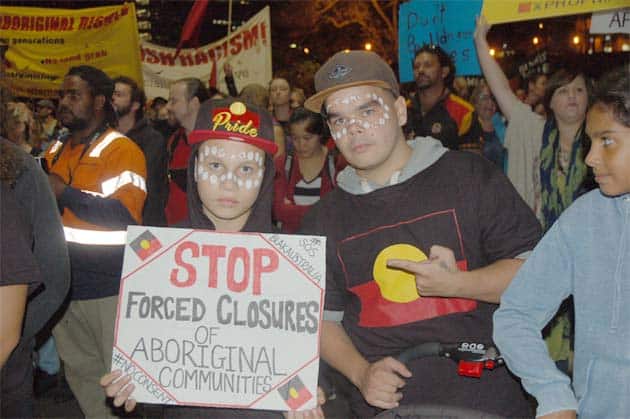
Following nationwide protests and international attention in 2015, the Barnett government was forced to backtrack on its closure plans [6].
While some small communities did lose services or were consolidated in subsequent years, the claim that 150 communities were "closed" by the Coalition Government is factually incorrect.
Federal Funding Withdrawal Triggered State Decisions**
The controversy began when the federal Coalition government withdrew funding for municipal services in remote communities.
這 zhè 迫使 pò shǐ 各州 gè zhōu 要么 yào me 吸收 xī shōu 成本 chéng běn , , 要么 yào me 關閉 guān bì 社區 shè qū 。 。
This forced states to either absorb the costs or close communities.
Tony Abbott's "Lifestyle Choice" Comment**
In March 2015, Prime Minister Tony Abbott defended the funding cuts, stating: "What we can't do is endlessly subsidise lifestyle choices" [8].
This comment was widely condemned by Indigenous leaders including Warren Mundine (Chair of the Prime Minister's Indigenous Advisory Council) and Noel Pearson, who called it "hopeless," "disrespectful," and "simplistic" [8].
However, critics argued that forced closures would create "fringe dwellers" in larger towns, increasing homelessness, social disruption, and costs to other services [4].
South Australia Rejected the Federal Offer**
South Australia's Labor government rejected the federal offer as insufficient and warned that 60 communities (home to 4,000 people) would close if forced to accept [7].
**The Guardian (Source 2):**
- **Credibility:** Generally high for factual reporting
- **Bias:** Left-center bias (acknowledged by media bias assessments)
- **Assessment:** The Guardian is a mainstream, reputable news organization.
However, readers should note The Guardian has a center-left editorial stance that may frame Coalition policies more critically than conservative outlets [10].
**VICE News (Source 1):**
- **Credibility:** Moderate - reports factual information but with loaded language
- **Bias:** Left-center bias with a focus on progressive/social justice perspectives
- **Assessment:** Media Bias/Fact Check rates VICE as left-center biased, noting they "often publish factual information that utilizes loaded words to favor liberal causes" [11].
The VICE article provides accurate information about the threatened closures but frames the issue from an advocacy perspective sympathetic to Indigenous communities.
該 gāi 文章 wén zhāng 準確 zhǔn què 報導 bào dǎo 了 le Tony Tony Abbott Abbott 備受 bèi shòu 爭議 zhēng yì 的 de 「 「 生活 shēng huó 方式 fāng shì 選擇 xuǎn zé 」 」 言論 yán lùn 及 jí 相關 xiāng guān 爭議 zhēng yì 。 。
This is not problematic for factual accuracy but readers should understand the editorial perspective.
**Did Labor do something similar?**
**Yes - The Northern Territory Intervention (2007):**
The Howard Coalition government enacted the Northern Territory National Emergency Response ("The Intervention") in August 2007, which was passed with **bipartisan support from the Labor opposition** [12].
* * * *
The Intervention involved:
- Suspension of the Racial Discrimination Act
- Compulsory acquisition of Aboriginal land
- Welfare quarantining
- Military and police deployment to remote communities
- Forced community closures and consolidations
When Kevin Rudd's Labor government was elected in November 2007, they **continued and expanded the Intervention**.
In June 2008, the Rudd government appointed a review board to assess the first 12 months of the NTER [13].
**Oombulgurri Closure (2011):**
The Oombulgurri community was closed in 2011 under the state Labor government in Western Australia [4][5].
This closure involved:
- Gradual withdrawal of services (store, school, health clinic)
- Power and water shut off
- Residents forced to leave
- Community eventually demolished
**Key Finding:** Both major parties have implemented policies affecting remote Indigenous communities.
該 gāi 干預 gàn yù 措施 cuò shī 涉及 shè jí : :
The Coalition's 2014-2015 funding withdrawal and threatened closures occurred within a broader bipartisan history of interventions in remote Indigenous communities.
- - 暫停 zàn tíng 《 《 種族 zhǒng zú 歧視法 qí shì fǎ 》 》
The Intervention began under Howard with Labor support and continued under Rudd/Gillard.
**The Coalition Government's Position:**
The federal government argued that:
- Municipal services in very small remote communities were prohibitively expensive
- Some communities had only 4-5 residents but required full infrastructure support
- Resources could be better directed to larger communities where more people could benefit
- The policy was about sustainability, not targeting Indigenous people (Tony Abbott noted: "All Australians are free to live where they choose, but inevitably there are some limits to what we can reasonably expect of the taxpayer") [8]
**Criticisms and Counter-Arguments:**
Indigenous leaders and advocates argued:
- Connection to country is fundamental to Indigenous culture and identity (not a "lifestyle choice")
- Forced displacement would repeat historical injustices and create "fringe dwellers"
- The Oombulgurri closure demonstrated that forced relocation doesn't solve social problems
- No formal evaluation was conducted of the costs or impacts before the policy was announced
- Native title rights are undermined when people are removed from their traditional lands [9]
**The Full Story:**
The 150 communities were **threatened** with closure, not actually closed.
聯 lián 邦政府 bāng zhèng fǔ 辯稱 biàn chēng : :
The policy was announced in 2014-2015 but faced massive public backlash, protests across Australia, and international criticism.
The issue highlights a genuine policy challenge: remote Indigenous communities face serious social issues (health, employment, education gaps) and require significant government support.
However, both major parties have struggled to find solutions that balance fiscal responsibility with respect for Indigenous land rights and cultural connection to country.
The policy faced massive backlash and was largely abandoned
The claim conflates threatened closures with actual closures, exaggerating what occurred.
該聲 gāi shēng 稱將 chēng jiāng 威脅 wēi xié 關閉 guān bì 與 yǔ 實際 shí jì 關閉 guān bì 混為 hùn wèi 一談 yī tán , , 誇大 kuā dà 了 le 實際 shí jì 發生 fā shēng 的 de 情況 qíng kuàng 。 。
While the Coalition government did withdraw federal funding for municipal services (triggering the state closure proposals) and Tony Abbott made widely condemned "lifestyle choice" comments, the specific claim that 150 communities were "closed" is factually inaccurate.
The policy faced massive backlash and was largely abandoned
The claim conflates threatened closures with actual closures, exaggerating what occurred.
該聲 gāi shēng 稱將 chēng jiāng 威脅 wēi xié 關閉 guān bì 與 yǔ 實際 shí jì 關閉 guān bì 混為 hùn wèi 一談 yī tán , , 誇大 kuā dà 了 le 實際 shí jì 發生 fā shēng 的 de 情況 qíng kuàng 。 。
While the Coalition government did withdraw federal funding for municipal services (triggering the state closure proposals) and Tony Abbott made widely condemned "lifestyle choice" comments, the specific claim that 150 communities were "closed" is factually inaccurate.