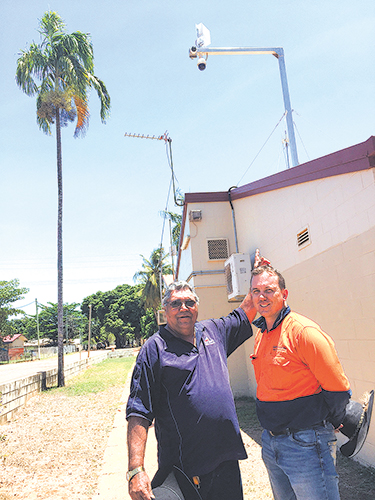
**The $1.3 million figure is substantially accurate, though understated.**
According to Aurukun Shire Council's official announcement, the CCTV system cost **$1.47 million** (later reported as over **$1.7 million** when expanded) [1].
* * * *
The installation began in May 2016 and included 65 cameras by completion [2].
**However, the claim contains significant factual errors about funding attribution:**
The project was funded by **THREE levels of government**, not solely the federal Coalition:
- Aurukun Shire Council (local government)
- Queensland Department of Aboriginal and Torres Strait Islander Partnerships (**state Labor government**)
- Department of Prime Minister and Cabinet (federal Coalition government) [1][2]
This was explicitly described as a collaborative "three levels of government" project in official statements [3].
The Queensland Minister for Indigenous Affairs at the time was Curtis Pitt from the **Queensland Labor government** [4].
**The CCTV system achieved measurable positive outcomes:**
The system won a **2017 Australian Security Industry Award for Excellence** [2].
According to Aurukun Mayor Dereck Walpo:
- "It is like living in a different town since the installation"
- "Dramatically reduced large scale unrest and ongoing community tensions"
- "Infrastructure damage and vandalism of Council property has been considerably reduced"
- "No vehicle thefts since October last year" (as of November 2017)
- "People living in Aurukun feel much safer" [2]
**Aurukun did face severe disadvantage:**
According to the "Dropping off the Edge" report cited in the original article, Aurukun ranked:
- **#1 nationally** for criminal convictions (up from 11th in 2007)
- **#5 nationally** for young adults not engaged in work or study
- **#10 nationally** for unemployment [4]
**The claim omits critical contextual information:**
1. **Tripartite funding structure:** The claim implies Coalition-only spending, when in fact the Queensland **Labor government** was an equal partner in funding this project [1][3].
2. **Severe crime crisis in Aurukun:** The community was experiencing extreme violence and crime, not just "disadvantage." The "Dropping off the Edge" report showed Aurukun had the **worst criminal conviction rate in Australia** [4].
Community safety is a prerequisite for education, health, and economic development.
3. **Positive outcomes achieved:** The claim makes no mention that the CCTV system won national awards and achieved measurable crime reduction [2].
4. **Community support:** The project had support from the Aurukun Shire Council, Queensland Police Service, and community stakeholders who had visited Palm Island to observe their successful CCTV system [1][4].
5. **Part of broader strategy:** The CCTV was part of a comprehensive community safety approach including private security guards, Community Police program, PCYC construction, and library refurbishment [1].
6. **Different budget categories:** The claim conflates capital expenditure on community safety (CCTV) with operational spending on education, health, housing, and welfare.
State/territory governments primarily fund education and health, while the federal government provides Indigenous-specific funding through various programs.
**New Matilda - LEFT BIAS / Progressive Advocacy Journalism**
According to Media Bias/Fact Check, New Matilda is rated as having **"LEFT BIAS"** - "moderately to strongly biased toward liberal causes through story selection and/or political affiliation" [5].
Key characteristics:
- **Self-described:** "Independent media outlet" focused on "investigative journalism and analysis"
- **Owned/edited by:** Chris Graham, a Walkley Award and Human Rights Award-winning journalist
- **Political orientation:** Progressive/left-wing perspective
- **Approach in this article:** Highly sarcastic and opinionated framing ("How to beat poverty... install a CCTV system")
**Assessment:** New Matilda is a **partisan advocacy publication**, not a mainstream balanced news source.
主要 zhǔ yào 特點 tè diǎn : :
The article presents selective facts, uses mocking language, and omits positive outcomes and collaborative funding structure.
**Did Labor governments fund similar community safety initiatives in Indigenous communities?**
**Queensland Labor was a co-funder of THIS project.** The Queensland Department of Aboriginal and Torres Strait Islander Partnerships contributed to the $1.47 million CCTV system [1][3].
* * * *
This demonstrates bipartisan support for community safety spending when facing severe crime crises.
**Historical context:** Community safety spending in remote Indigenous communities has been supported by governments of both parties.
The Palm Island CCTV system (referenced in the article as a model) was installed in August 2014 - during the **Abbott Coalition government** period at federal level, but also with state government involvement [4].
**No direct equivalent found** of a Labor federal government specifically funding CCTV in a comparable community, but this reflects that:
1.
The Queensland Labor government explicitly supported THIS Coalition-era project
**Key insight:** The claim falsely implies this was uniquely Coalition spending.
**The full story is more complex than the claim suggests:**
**Legitimate criticisms (acknowledged):**
- Aurukun was indeed severely disadvantaged and needed substantial investment in education, health, housing, and welfare [4]
- CCTV alone cannot address root causes of poverty and disadvantage
- $1.47+ million is significant spending that could have funded other services
**Important context and government rationale:**
- Aurukun had Australia's highest criminal conviction rate - community safety was an urgent crisis [4]
- Without safety, education and economic development cannot succeed (teachers and professionals won't work in unsafe communities)
- The project had tripartite government support including the Queensland **Labor** government [1][3]
- The Aurukun community and Council requested and supported the installation [1]
- The system achieved measurable success: national award, reduced crime, no vehicle thefts, improved community perception of safety [2]
- It was part of broader investments including security guards, community police, PCYC, and library refurbishment [1]
**Comparative analysis:**
- This is NOT unique to Coalition - Queensland Labor co-funded the same project
- Community safety spending in remote Indigenous communities has bipartisan support
- The claim's framing suggests this was wasteful or unique to Coalition, when neither is accurate
**The fundamental question:** Should governments prioritize community safety infrastructure when a community has Australia's highest crime rate, even if other needs exist?
The claim is factually true about the dollar amount spent but **deeply misleading** in three critical ways:
1. **Attribution error:** It implies Coalition-only spending when Queensland **Labor** was an equal co-funder through the Department of Aboriginal and Torres Strait Islander Partnerships [1][3].
2. **Selective framing:** It presents the CCTV as wasteful spending while ignoring (a) the severity of Aurukun's crime crisis (#1 in Australia), (b) the positive outcomes achieved (national award, reduced crime), and (c) community support for the project [2][4].
3. **False dichotomy:** It suggests CCTV spending came at the expense of education/health/housing, when these are separate budget categories at different government levels.
The claim is factually true about the dollar amount spent but **deeply misleading** in three critical ways:
1. **Attribution error:** It implies Coalition-only spending when Queensland **Labor** was an equal co-funder through the Department of Aboriginal and Torres Strait Islander Partnerships [1][3].
2. **Selective framing:** It presents the CCTV as wasteful spending while ignoring (a) the severity of Aurukun's crime crisis (#1 in Australia), (b) the positive outcomes achieved (national award, reduced crime), and (c) community support for the project [2][4].
3. **False dichotomy:** It suggests CCTV spending came at the expense of education/health/housing, when these are separate budget categories at different government levels.