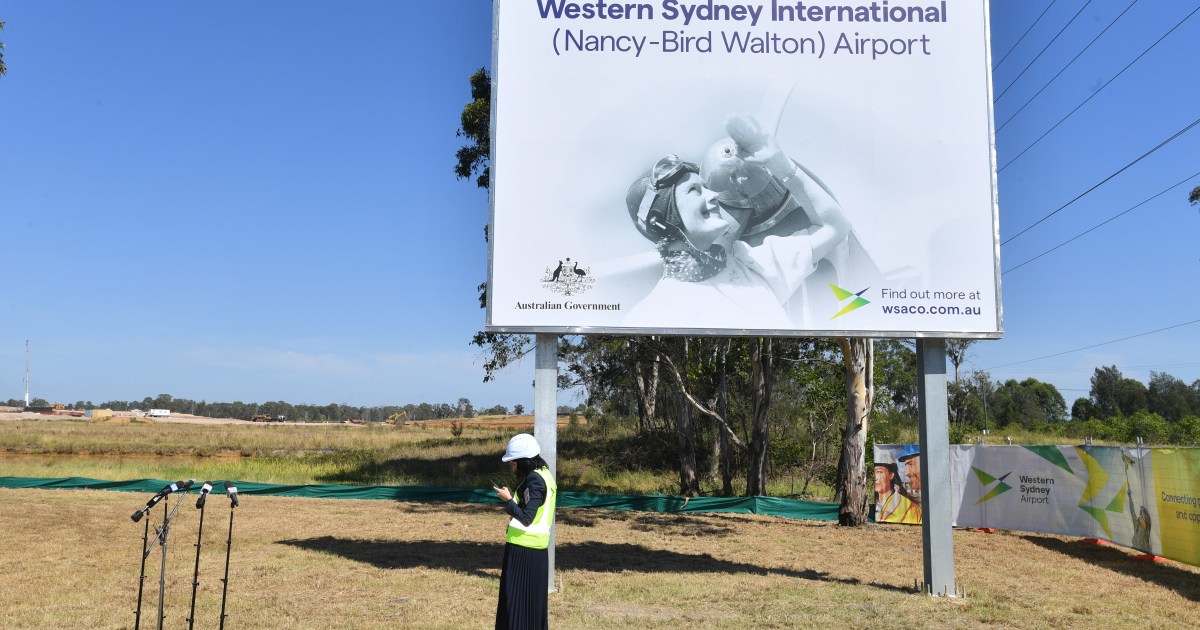
On 31 July 2018, the Australian Government purchased the "Leppington Triangle" land parcel—3.5 hectares near Western Sydney Airport—for **$29,839,026** [1].
Just eleven months later, on 30 June 2019, the Department of Infrastructure's own financial statements valued the same land at only **$3,065,000**, representing an apparent overpayment of approximately **$26.7 million** [1].
The Australian National Audit Office (ANAO) conducted an official performance audit released in September 2020 and confirmed the excessive pricing [2].
The ANAO explicitly found that the valuer was selected by the property seller (not independently chosen) and was directed to value the land "based on the best possible rezoning potential" [2].
As the ANAO concluded: "The approach inflated the value of the land, which in turn led to the Australian Government paying more than was proper in the circumstances" [2].
比較 bǐ jiào 分析 fēn xī 顯示 xiǎn shì 了 le 超付 chāo fù 的 de 規模 guī mó 。 。
Comparative analysis demonstrates the scale of overpayment.
Infrastructure Minister Paul Fletcher defended the purchase as "perfectly sensible" for early strategic acquisition of land potentially needed around 2050 for a second runway [5].
Critically, no formal cost-benefit analysis comparing early acquisition costs against future purchase costs was performed—a step that should have been mandatory for such a significant decision [2].
Decision-maker briefings deliberately presented only confirming evidence for the high price and **explicitly omitted reference to other valuations of the land** [2].
The briefings omitted the fact that the government's price exceeded all known market valuations—a material omission that undermined informed decision-making [2].
The property seller, Leppington Pastoral Company (owned by the Perich family), donated **$58,800 to the Liberal Party** in 2018-19—the same year as the land purchase [6].
Additionally, six staff members in the Department's Western Sydney Unit declared conflicts of interest with the transaction, and one employee with a declared conflict was allowed to continue on the key acquisition project [6].
An additional contradiction emerged: the same land was immediately leased back to the seller under a 10-year arrangement with 10-year renewal options (20-year total).
This suggests the government's own subsequent assessment valued the land at approximately 3% of the purchase price.
來源可信度評估
提供 tí gōng 的 de 原始 yuán shǐ 來源 lái yuán 包括 bāo kuò ABC ABC 新聞 xīn wén ( ( 具有 jù yǒu 強 qiáng 大事 dà shì 實 shí 查核 chá hé 聲譽 shēng yù 的 de 主流 zhǔ liú 廣播 guǎng bō 公司 gōng sī ) ) 和 hé The The New New Daily Daily ( ( 獨立 dú lì 進步 jìn bù 新聞 xīn wén 媒體 méi tǐ ) ) 。 。
The original sources provided include the ABC News (mainstream broadcaster with strong fact-checking reputation) and The New Daily (independent progressive news outlet).
Minister Fletcher later claimed valuations were "not disclosed even to senior officials," but Senate documents released in 2021 proved Fletcher knew about and personally endorsed the price in 2018 [7].
他後來 tā hòu lái 的 de 辯護 biàn hù 與 yǔ 他 tā 自己 zì jǐ 當時 dāng shí 的 de 書面 shū miàn 批准 pī zhǔn 相 xiāng 矛盾 máo dùn , , 表明 biǎo míng 辯護論 biàn hù lùn 點應 diǎn yīng 被 bèi 懷疑 huái yí 看待 kàn dài 。 。
His later defense was contradicted by his own contemporaneous written approval, demonstrating that defense arguments should be viewed skeptically.
**Did Labor do something similar?**
Search conducted: "Labor government controversial land acquisitions," "Labor government land valuation controversy," "Labor government airport land purchases," and "Labor government Infrastructure Department audits excessive spending"
Finding: Labor governments have faced various land acquisition controversies (e.g., the Australian Workplace Relations Centre in Canberra purchased during Labor administration), but no equivalent case involving a 10-fold valuation discrepancy has been identified in comparable audit reports [8].
* * * *
More significantly, when Labor was in power, such a transaction would likely have faced similar ANAO scrutiny—the Coalition's misadventure was only identified because the ANAO conducted a performance audit during the Coalition's watch.
搜索 sōu suǒ 進行 jìn xíng : : " " Labor Labor government government controversial controversial land land acquisitions acquisitions " " 、 、 " " Labor Labor government government land land valuation valuation controversy controversy " " 、 、 " " Labor Labor government government airport airport land land purchases purchases " " 、 、 " " Labor Labor government government Infrastructure Infrastructure Department Department audits audits excessive excessive spending spending " "
The broader context: Government agencies across both Labor and Coalition administrations have made questionable land acquisitions and received ANAO criticism.
However, the Leppington Triangle case is notable for the systematic nature of the process failures—seller-selected valuer, omitted valuations, misleading briefings—rather than isolated judgment errors [2].
While critics argue the purchase represents gross mismanagement or worse, the government stated the early acquisition had strategic merit for planning purposes around a second runway [5].
Even accepting the government's justification for early acquisition, the ANAO found that:
- Appropriate cost-benefit analysis was not performed to justify the early purchase [2]
- The valuation process was fundamentally compromised by seller influence [2]
- Briefings to decision-makers were deliberately misleading through selective information presentation [2]
- The process "fell short of ethical standards" [2]
Independent analysis from the ANAO (an agency with bipartisan support and reputation for rigor) suggests this was not merely poor judgment but systematic process failure [2].
The fact that eight of nine valuations contradicted the accepted price suggests either unusually poor valuation practices or deliberate selection of an inflated valuation [3].
This finding is important but limited in scope—it indicates no fraudulent intent or criminality, but it does **not** validate the administrative process or decision quality.
The conflict of interest context is noteworthy: the seller's subsequent $58,800 donation to the Liberal Party in the same year creates appearance of impropriety, though without evidence of quid pro quo [6].
The government did lease the land back to the seller for 20 years, suggesting the government was not entirely unhappy with the arrangement, but this does not explain the valuation methodology problems.
**Key context:** The core issue is not unique to the Coalition in terms of governmental land acquisitions, but the magnitude of the valuation discrepancy (10-fold) and the systematic nature of process failures (seller-selected valuer, omitted information, misleading briefings) are exceptionally serious and would likely draw similar criticism if perpetrated by any government.
The $29.8 million purchase price versus $3 million to $6 million fair value estimates, the seller-selected valuer using inflated assumptions, and the deliberate omission of eight contradictory valuations from decision-maker briefings are all documented by official audit [2].
The $29.8 million purchase price versus $3 million to $6 million fair value estimates, the seller-selected valuer using inflated assumptions, and the deliberate omission of eight contradictory valuations from decision-maker briefings are all documented by official audit [2].