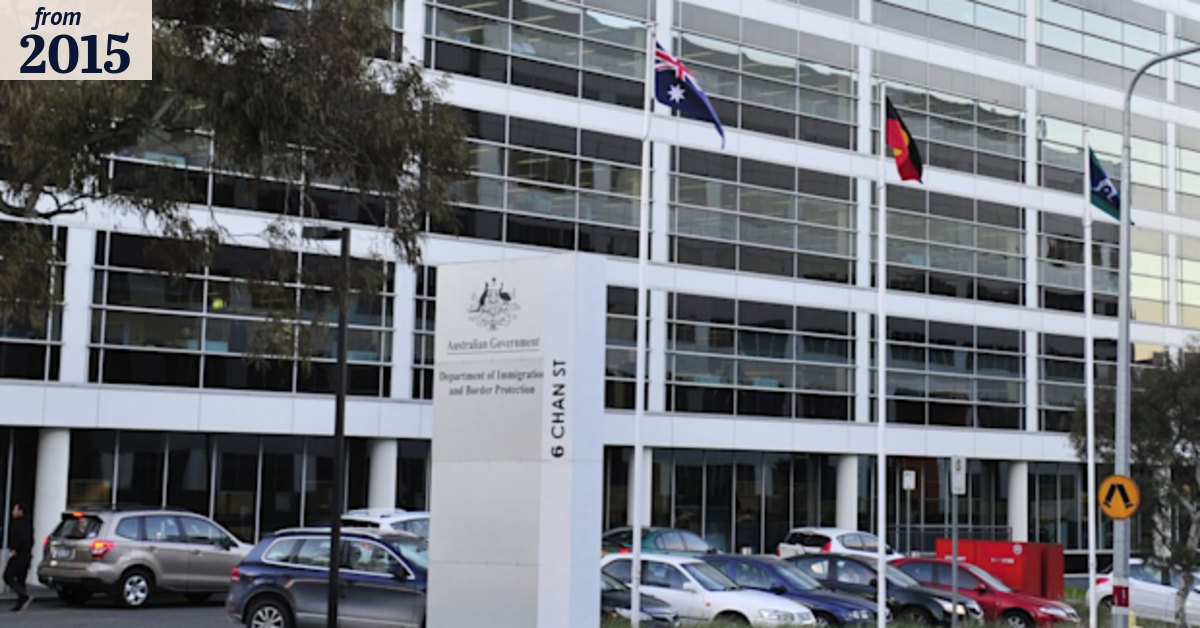
In March 2015, the Australian Border Force Bill introduced provisions that would strip more than 8,000 Immigration Department public servants of some rights to unfair dismissal appeals [1].
The bill allowed the Secretary (Michael Pezzullo) to issue a "serious misconduct declaration" after a code of conduct investigation, which would leave employees with no recourse to the Fair Work Commission for unfair dismissal claims [1][2].
The affected workers were "mostly deskbound public servants" at the Immigration Department, who were to be merged with Customs into the new Australian Border Force on July 1, 2015 [1].
However, the department noted that dismissals could still be reviewed under the Administrative Decisions (Judicial Review) Act, and that investigations were still required to be procedurally fair under the Public Service Act [1].
The claim omits several important contextual elements:
**Prior existence in Customs:** Similar provisions had already been in force in the Australian Customs Service for nearly three years prior to this extension [1].
These provisions were originally brought in to help Customs "rid itself of corrupt officers manning the nation's borders" [1].
**Corruption rationale:** The government cited documented corruption risks as justification, including "involvement in drug importation, unauthorised access and dealing in information, and the 'selling' of visas" [1].
Secretary Pezzullo stated that "well documented instances of corruption in both the department and the service" necessitated a strong "integrity framework" [1].
**Specific scope:** The changes applied only to "serious misconduct" cases under a formal declaration process, not to all dismissals.
Regular disciplinary matters still maintained existing appeal avenues including the Merit Protection Commissioner [1].
**Additional requirements:** The new regime also included mandatory drug, alcohol and psychological testing, physical fitness requirements for some positions, and background checks for criminal or radical associations [1].
**Ministerial oversight:** The legislation required reporting investigation outcomes to the Minister once a serious misconduct declaration was issued [1].
As the relevant trade union, they have a vested interest in opposing these changes, which should be considered when evaluating their characterization of the provisions as "draconian" and a "sledgehammer to the rights" [1].
**Did Labor do something similar?**
Search conducted: "Labor government public service unfair dismissal changes", "Australian Customs Service serious misconduct provisions history"
Finding: The serious misconduct provisions for Customs officers—the same provisions being extended to Immigration staff—had been in place for nearly three years prior to March 2015 [1].
This places their introduction during the Labor government period (2007-2013) or early Coalition period.
这 zhè 将 jiāng 它们 tā men 的 de 引入 yǐn rù 时间 shí jiān 定 dìng 在 zài 工党 gōng dǎng 政府 zhèng fǔ 时期 shí qī ( ( 2007 2007 - - 2013 2013 ) ) 或 huò 早期 zǎo qī 联盟党 lián méng dǎng 时期 shí qī 。 。
The SMH article notes these were "brought in to help the agency rid itself of corrupt officers" [1].
**The Australian Border Force itself** was a Coalition initiative (announced 2014, established July 2015), merging the Department of Immigration and Border Protection with the Australian Customs and Border Protection Service [3].
The Labor comparison here is that while Labor had created the original framework for border agency integrity, the Coalition extended these powers to a broader range of public servants.
However, Labor governments have historically taken different approaches to public service workplace relations, including during the 2012-2013 bargaining disputes.
While the CPSU and critics characterized these changes as an attack on workers' rights [1], the government framed them as necessary anti-corruption measures for a critical national security function.
The context of documented corruption in immigration and border functions—including drug smuggling, visa selling, and unauthorized information access—provided legitimate policy rationale for strengthened integrity frameworks [1].
The provisions were not absolute: affected employees retained access to judicial review under the Administrative Decisions (Judicial Review) Act, and investigations were still required to meet procedural fairness standards under the Public Service Act [1].
The changes represented an expansion of powers that had already existed for Customs officers for several years, suggesting this was an extension of an existing framework rather than a wholly new attack on public service protections [1].
However, the union's concerns about due process and natural justice were substantive—the removal of Fair Work Commission access for this category of dismissal removed a key avenue of industrial justice for affected workers.
CPSU CPSU 将 jiāng " " 没有 méi yǒu 独立 dú lì 仲裁员 zhòng cái yuán 确保 què bǎo 公平 gōng píng " " 的 de 描述 miáo shù 准确 zhǔn què 地 dì 反映 fǎn yìng 了 le 申诉 shēn sù 权利 quán lì 的 de 实际 shí jì 减少 jiǎn shǎo [ [ 1 1 ] ] 。 。
The CPSU's characterization that there was "no independent umpire to ensure fairness" captured a real reduction in appeal rights [1].
**Key context:** This action was specific to the Australian Border Force formation and the particular corruption risks associated with border/immigration functions.
It was not a government-wide stripping of dismissal rights across all public service departments, though it did affect 8,000+ workers in the merged department.
The core claim is factually accurate—8,000+ Immigration Department public servants were stripped of some unfair dismissal appeal rights as part of the Australian Border Force formation.
However, the claim lacks important context that these provisions already existed for Customs officers for nearly three years, and that the changes were specifically targeted at serious misconduct cases with a documented corruption rationale.
The claim presents the action without acknowledging the anti-corruption justification, the limited scope to serious misconduct cases, or the retention of judicial review rights.
The core claim is factually accurate—8,000+ Immigration Department public servants were stripped of some unfair dismissal appeal rights as part of the Australian Border Force formation.
However, the claim lacks important context that these provisions already existed for Customs officers for nearly three years, and that the changes were specifically targeted at serious misconduct cases with a documented corruption rationale.
The claim presents the action without acknowledging the anti-corruption justification, the limited scope to serious misconduct cases, or the retention of judicial review rights.