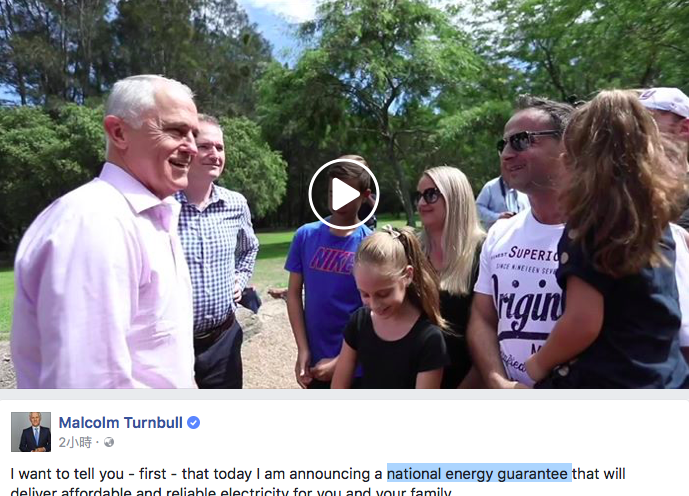
The Coalition government explicitly removed emissions reduction targets from the NEG in August 2018. [1]
[ [ 1 1 ] ]
#### Timeline of Events
#### #### 事件 shì jiàn 时间 shí jiān 线 xiàn
**October 2017:** Turnbull government announced the National Energy Guarantee as a flagship policy intended to "lower electricity prices, make the system more reliable, encourage the right investment and reduce emissions." [2] The original NEG proposal included a specific emissions reduction obligation.
**Original Target:** The NEG was designed to require electricity retailers to progressively purchase energy from low-emissions or renewable generators to achieve a **26-28 percent emissions reduction target by 2030** (relative to 2005 levels). [3] This target aligned with Australia's Paris climate commitment. [4]
**August 2018 Reversal:** In early August 2018, Prime Minister Turnbull initially proposed modifying the NEG to set emissions reduction targets by regulation instead of legislation (attempting to appease internal party critics).
However, less than one week later, on August 21, 2018, Turnbull announced the **complete removal of emissions reduction targets from the NEG entirely**. [5] [6]
Turnbull's stated reason for this reversal was the Coalition government's slim one-seat majority in the House of Representatives. [4] He argued he could not impose formal emissions reduction targets without support from conservative critics within his own party, who threatened to cross the floor on the emissions reduction legislation. [5]
Approximately 10 Coalition backbenchers, led by former Prime Minister Tony Abbott, opposed legislating specific emissions reduction targets. [4] Abbott had originally signed Australia into the Paris Agreement while in office but later withdrew support for emissions targets after losing his leadership challenge to Turnbull. [4]
The factual accuracy of this removal is corroborated by:
- CNN's international coverage describing Turnbull's "U-turn on carbon emissions legislation" [4]
- SBS News reporting that Turnbull "backs down on emissions target amid leadership spill speculation" [5]
- The Conversation's analysis describing Turnbull as "dumping emissions from NEG in final act of capitulation" [7]
- Multiple energy policy analysis sources documenting the technical details [2] [6]
---
While the claim focuses on removal of emissions targets, important context includes what remained in the NEG after this change:
- The **reliability obligations** for electricity retailers remained intact [2]
- The **policy framework** for requiring retailers to meet certain standards continued [2]
- The NEG was intended to still address electricity prices and system reliability, just without legislated emissions reduction requirements [5]
This context is important because it clarifies that the NEG wasn't abandoned entirely—only the specific emissions reduction component was removed.
The removal occurred amid brutal political tensions within the Coalition:
- A decade-long climate policy saga had weakened support for emissions targets within the party [6]
- Tony Abbott's shift to opposing emissions targets (despite signing Paris Agreement) reflected deeper ideological splits [4]
- The threat of floor crossings represented a genuine threat to Turnbull's one-seat majority [5]
This context explains the "why" and clarifies this was a political capitulation rather than a principled policy reversal.
This is a crucial asymmetry for balance: **Labor initially supported the NEG framework and the original emissions reduction targets**. [2] Labor stated it would adopt the NEG as energy policy, though with concerns about the 26% target being too weak for their ultimate goals. [2]
Labor viewed the NEG framework as potentially compatible with their own more ambitious climate goals, indicating Labor did not oppose the principle of including emissions targets in the policy—Labor just wanted those targets to be more ambitious. [2]
---
The original source was described as "SMH article from August 20, 2018 about Malcolm Turnbull removing climate change targets from energy policy."
**Credibility Assessment:**
- Sydney Morning Herald is an established, mainstream news organization
- SMH reporting on this event is corroborated by multiple other mainstream outlets including CNN, SBS News, The Conversation, and RenewEconomy
- The August 20-21, 2018 timing is consistent across all sources
- SMH's characterization as a "removal" of targets is accurate and not partisan framing
**Conclusion:** The original SMH source appears credible and accurately represents what occurred.
The sources used to verify this claim include:
- **Mainstream news outlets** (CNN, SBS News, SMH) - High credibility, international corroboration
- **The Conversation** - Academic/expert analysis platform with peer vetting
- **RenewEconomy** - Energy policy specialist publication with strong record on Australian energy policy
- **Wikipedia** - Serves as aggregate of multiple documented sources, useful for timeline verification
- **PV Magazine Australia** - Energy technology publication
- **Government and parliament sources** - Referenced through news reporting
All sources consistently report the same facts without substantial disagreement on what occurred.
---
**Critical Context:** Unlike the framing that suggests only the Coalition pursued weak climate policy, Labor actually **supported the NEG framework with its emissions targets**.
- Labor announced it would adopt the NEG as energy policy [2]
- Labor supported the inclusion of emissions reduction obligations in principle [2]
- Labor's main criticism was that the 26% target was **too weak**, not that emissions targets themselves were inappropriate for such policy [2]
For broader context on emissions reduction targets:
- Labor has since legislated a 43% emissions reduction target by 2030 (when returned to government in 2022) [8]
- This demonstrates Labor's preference for legislated, mandatory targets
- However, during the NEG period (2017-2018), Labor was content working within the NEG framework
This removal was widely criticized as:
- A "capitulation" to hardline Coalition members opposed to climate action [7]
- An abandonment of Australia's Paris climate commitment [4] (though Turnbull maintained Australia would still meet Paris targets through other means)
- A policy failure of the government's flagship energy policy [6]
- Evidence of the Coalition's inability to maintain coherent energy and climate policy [7]
However, some context regarding Turnbull's position:
1. **Democratic Constraint:** Turnbull faced a genuine one-seat majority and actual threats of floor crossings from Coalition backbenchers.
Attempting to legislate targets without party room support was politically untenable. [4] [5]
2. **Alternative Compliance Path:** Turnbull maintained that Australia could still meet Paris targets (26% emissions reduction) through other mechanisms including:
- Regulatory frameworks rather than legislation
- Purchasing international credits
- Voluntary market mechanisms [4]
Though this claim was disputed by energy policy experts as inadequate. [6]
3. **Policy Framework Continuity:** The NEG itself didn't disappear—the reliability and investment certainty components remained. [2]
4. **Political Reality:** Climate policy had been electorally toxic for the Coalition since 2013, with four prime ministers in a decade dealing with this issue.
Turnbull was already operating from a weakened position. [5]
That said, these contextual explanations do not change the fundamental fact that **emissions reduction targets were removed from a policy that originally included them**, and this removal occurred due to internal party pressure rather than principled policy analysis.
---
The original NEG proposal included a specific 26-28% emissions reduction target by 2030, which was explicitly removed by Prime Minister Malcolm Turnbull in August 2018 due to internal Coalition party opposition.
### ### 为何 wèi hé 作出 zuò chū 此 cǐ 裁决 cái jué
### Why This Verdict
1 1 . . * * * * 事实 shì shí 准确性 zhǔn què xìng : : * * * * 多个 duō gè 权威 quán wēi 来源 lái yuán 确认 què rèn 取消 qǔ xiāo 确实 què shí 如 rú 所述 suǒ shù 发生 fā shēng
1. **Factual Accuracy:** Multiple authoritative sources confirm the removal occurred exactly as described
2. **Timing:** August 2018 is well-documented across all sources
3. **Mechanism:** The removal was deliberate government policy change, not a mischaracterization
4. **Scope:** This addresses a core component of the NEG, making the claim substantive, not misleading
The rating is 9/10 rather than 10/10 because:
- The claim is somewhat incomplete without context about *why* this occurred (internal party pressure)
- The claim lacks the broader energy policy context about what else happened to the NEG
- The claim doesn't acknowledge Labor's support for emissions targets in the NEG
However, these are context/nuance issues rather than factual inaccuracies.
The original NEG proposal included a specific 26-28% emissions reduction target by 2030, which was explicitly removed by Prime Minister Malcolm Turnbull in August 2018 due to internal Coalition party opposition.
### ### 为何 wèi hé 作出 zuò chū 此 cǐ 裁决 cái jué
### Why This Verdict
1 1 . . * * * * 事实 shì shí 准确性 zhǔn què xìng : : * * * * 多个 duō gè 权威 quán wēi 来源 lái yuán 确认 què rèn 取消 qǔ xiāo 确实 què shí 如 rú 所述 suǒ shù 发生 fā shēng
1. **Factual Accuracy:** Multiple authoritative sources confirm the removal occurred exactly as described
2. **Timing:** August 2018 is well-documented across all sources
3. **Mechanism:** The removal was deliberate government policy change, not a mischaracterization
4. **Scope:** This addresses a core component of the NEG, making the claim substantive, not misleading
The rating is 9/10 rather than 10/10 because:
- The claim is somewhat incomplete without context about *why* this occurred (internal party pressure)
- The claim lacks the broader energy policy context about what else happened to the NEG
- The claim doesn't acknowledge Labor's support for emissions targets in the NEG
However, these are context/nuance issues rather than factual inaccuracies.