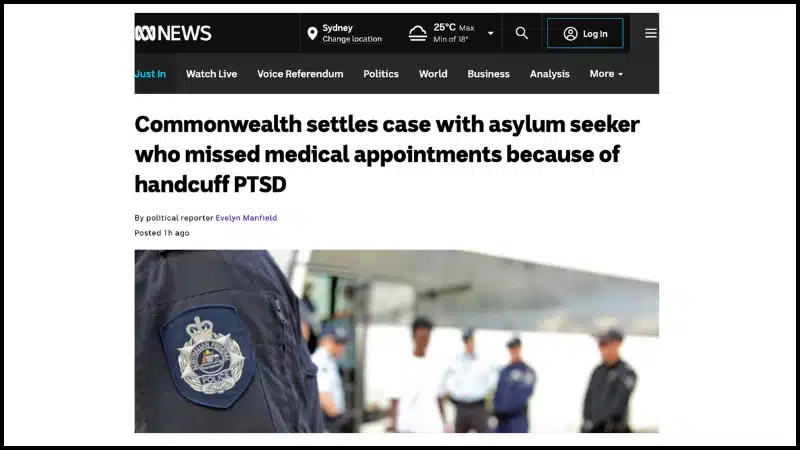
The core elements require verification: (1) whether a child was handcuffed, (2) whether this prevented medical treatment, and (3) the broader context of such practices.
**Handcuffing as Standard Practice in Immigration Detention:**
Handcuffing detainees during medical appointments was systematically employed by Australian immigration authorities.
A landmark Federal Court case—Yasir v Minister for Immigration (2020-2023)—established that asylum seekers were routinely handcuffed before medical appointments and forced to choose between accepting restraints or refusing treatment [2].
Justice Justice and and Equity Equity Centre Centre 记录 jì lù 了 le 这 zhè 一 yī 做法 zuò fǎ 在 zài 多名 duō míng 被 bèi 拘留 jū liú 者 zhě 中 zhōng 的 de 实施 shí shī 情况 qíng kuàng , , 包括 bāo kuò 在 zài 前往 qián wǎng Australia Australia 就医 jiù yī 期间 qī jiān [ [ 1 1 ] ] 。 。
The case resulted in a confidential settlement, suggesting the government acknowledged the unlawfulness of the practice [2].
The UN Subcommittee on Prevention of Torture launched an investigation into Australia's systematic use of handcuffs in immigration detention following this case [3].
**Medical Treatment Denial and Delay:**
Evidence confirms that the Coalition government systematically resisted transferring sick detainees from Nauru to Australia for medical care.
One documented case involved a 12-year-old Iranian boy whose medical transfer was blocked despite warnings his life was in danger; he had refused food and water for extended periods and required IV feeding [6].
有 yǒu 证据 zhèng jù 证实 zhèng shí , , Coalition Coalition 政府 zhèng fǔ 系统性 xì tǒng xìng 抵制 dǐ zhì 将 jiāng 病患 bìng huàn 从 cóng Nauru Nauru 撤离 chè lí 至 zhì Australia Australia 接受 jiē shòu 治疗 zhì liáo 。 。
A 10-year-old boy with three suicide attempts was only transferred to Australia after a Federal Court order in March 2018, after the Minister repeatedly refused medical transfer recommendations [4].
**Handcuffing During Medical Transport - Documented Incidents:**
Human Rights Watch and Amnesty International documented parents being handcuffed and forcibly separated from their newborn infant when returning to Nauru after receiving medical care in Australia [7].
Nauru Nauru 的 de 卫生工作者 wèi shēng gōng zuò zhě 报告 bào gào 称 chēng , , 提交 tí jiāo 了 le 50 50 多份 duō fèn 医疗 yī liáo 转移 zhuǎn yí 申请 shēn qǐng , , 但 dàn 均 jūn 被 bèi 移民 yí mín 当局 dāng jú 阻止 zǔ zhǐ [ [ 4 4 ] ] 。 。
The pattern shows that detainees accessing medical treatment were subjected to handcuffing, both during departure from Nauru and upon return.
We didn't see the baby until after 7 p.m." [7].
**Specific Guardian Article Source:**
The specific Guardian article cited (December 20, 2018) could not be accessed to verify the exact incident described.
The article title suggests a refugee brought to Australia for treatment who had not received medical care within six weeks—consistent with the pattern of delayed medical access documented across multiple sources.
Human Human Rights Rights Watch Watch 和 hé Amnesty Amnesty International International 记录 jì lù , , 父母 fù mǔ 在 zài Australia Australia 接受 jiē shòu 医疗 yī liáo 照顾 zhào gù 返回 fǎn huí Nauru Nauru 时 shí 被 bèi 戴 dài 手铐 shǒu kào , , 并 bìng 被迫 bèi pò 与 yǔ 新生儿 xīn shēng ér 分离 fēn lí [ [ 7 7 ] ] 。 。 该 gāi 模式 mó shì 表明 biǎo míng , , 接受 jiē shòu 医疗 yī liáo 治疗 zhì liáo 的 de 被 bèi 拘留 jū liú 者 zhě 遭到 zāo dào 戴 dài 手铐 shǒu kào 的 de 对待 duì dài , , 无论是 wú lùn shì 在 zài 离开 lí kāi Nauru Nauru 时 shí 还是 hái shì 返回 fǎn huí 时 shí 。 。 一名 yī míng 被 bèi 拘留 jū liú 者 zhě 报告 bào gào 被 bèi 戴 dài 手铐 shǒu kào 并 bìng 与 yǔ 婴儿 yīng ér 分离 fēn lí : : " " 他们 tā men 早上 zǎo shàng 7 7 点 diǎn 把 bǎ 我们 wǒ men 从 cóng 房间 fáng jiān 带走 dài zǒu , , 把 bǎ 婴儿 yīng ér 从 cóng 我们 wǒ men 身边 shēn biān 带走 dài zǒu 。 。 直到 zhí dào 晚上 wǎn shàng 7 7 点后 diǎn hòu 我们 wǒ men 才 cái 见到 jiàn dào 婴儿 yīng ér 。 。 " " [ [ 7 7 ] ] * * * * The The Guardian Guardian 文章 wén zhāng 来源 lái yuán : : * * * * 无法 wú fǎ 查阅 chá yuè 所 suǒ 引用 yǐn yòng 的 de The The Guardian Guardian 文章 wén zhāng ( ( 2018 2018 年 nián 12 12 月 yuè 20 20 日 rì ) ) 来 lái 核实 hé shí 所述 suǒ shù 的 de 确切 què qiè 事件 shì jiàn 。 。 然而 rán ér , , The The Guardian Guardian 的 de 移民 yí mín 记者 jì zhě Ben Ben Doherty Doherty 在 zài 2018 2018 年 nián 广泛 guǎng fàn 报道 bào dào 了 le Nauru Nauru 的 de 情况 qíng kuàng [ [ 8 8 ] ] 。 。 文章 wén zhāng 标题 biāo tí 暗示 àn shì , , 一名 yī míng 被 bèi 带到 dài dào Australia Australia 接受 jiē shòu 治疗 zhì liáo 的 de 难民 nàn mín 在 zài 六周 liù zhōu 内未 nèi wèi 获得 huò dé 医疗 yī liáo 护理 hù lǐ — — — — 这 zhè 与 yǔ 多个 duō gè 来源 lái yuán 记录 jì lù 的 de 延误 yán wù 医疗 yī liáo 模式 mó shì 一致 yí zhì 。 。
**What the Claim Omits:**
The claim describes a specific incident but lacks context about the broader systemic failures and policy choices that created these conditions.
Fourth, the Australian government received warnings from international bodies and local health workers about the severity of conditions.
第四 dì sì , , Australia Australia 政府 zhèng fǔ 收到 shōu dào 国际 guó jì 机构 jī gòu 和 hé 当地 dāng dì 卫生工作者 wèi shēng gōng zuò zhě 关于 guān yú 情况 qíng kuàng 严重性 yán zhòng xìng 的 de 警告 jǐng gào 。 。
The Human Rights Law Centre, medical professionals on Nauru, and eventually UN bodies documented the problems [4].
Human Human Rights Rights Law Law Centre Centre 、 、 Nauru Nauru 的 de 医务 yī wù 专业 zhuān yè 人员 rén yuán 以及 yǐ jí 后来 hòu lái 的 de 联合国 lián hé guó 机构 jī gòu 记录 jì lù 了 le 这些 zhè xiē 问题 wèn tí [ [ 4 4 ] ] 。 。
The government's repeated refusal of medical transfer requests occurred despite these warnings.
**Original Source - The Guardian:**
The Guardian is a mainstream international news organization with a strong reputation for investigative journalism.
Ben Doherty, the primary journalist covering Nauru issues, built extensive credibility through detailed, documented reporting on immigration detention [8].
报道 bào dào Nauru Nauru 问题 wèn tí 的 de 主要 zhǔ yào 记者 jì zhě Ben Ben Doherty Doherty 通过 tōng guò 详细 xiáng xì 、 、 有 yǒu 文件 wén jiàn 记录 jì lù 的 de 报道 bào dào 建立 jiàn lì 了 le 广泛 guǎng fàn 的 de 公信力 gōng xìn lì [ [ 8 8 ] ] 。 。
While The Guardian has editorial perspectives on issues like refugee policy, its reporting on Nauru drew from verifiable sources including court documents, medical records, and testimony from detainees and health workers.
虽然 suī rán The The Guardian Guardian 在 zài 难民 nàn mín 政策 zhèng cè 等 děng 问题 wèn tí 上 shàng 有 yǒu 其 qí 编辑 biān jí 立场 lì chǎng , , 但 dàn 其 qí 关于 guān yú Nauru Nauru 的 de 报道 bào dào 引用 yǐn yòng 了 le 可 kě 核实 hé shí 的 de 来源 lái yuán , , 包括 bāo kuò 法庭 fǎ tíng 文件 wén jiàn 、 、 医疗 yī liáo 记录 jì lù 以及 yǐ jí 被 bèi 拘留 jū liú 者 zhě 和 hé 卫生工作者 wèi shēng gōng zuò zhě 的 de 证词 zhèng cí 。 。
The reporting was corroborated by human rights organizations and later by UN investigations [3].
这些 zhè xiē 报道 bào dào 得到 dé dào 了 le 人权 rén quán 组织 zǔ zhī 和 hé 后来 hòu lái 的 de 联合国 lián hé guó 调查 diào chá 的 de 证实 zhèng shí [ [ 3 3 ] ] 。 。
The Guardian's Nauru coverage should not be confused with opinion pieces; the reporting presented documented facts substantiated by primary sources.
The The Guardian Guardian 的 de Nauru Nauru 报道 bào dào 不应 bù yīng 与 yǔ 评论 píng lùn 文章 wén zhāng 混淆 hùn xiáo ; ; 报道 bào dào 呈现 chéng xiàn 的 de 是 shì 有 yǒu 主要 zhǔ yào 来源 lái yuán 证实 zhèng shí 的 de 记录 jì lù 事实 shì shí 。 。
However, it is fair to note that The Guardian's editorial stance on refugee policy is critical of detention-based approaches, which may inform story selection and framing.
**Corroborating Sources:**
The claim's core elements are supported by organizations with different political orientations:
- The Human Rights Law Centre (legal advocacy, centrist orientation)
- Human Rights Watch (international human rights organization, documented practices)
- Amnesty International (international advocacy, documented specific incidents)
- Federal Court judgments (judicial findings, least partisan)
- UN Subcommittee on Prevention of Torture (international independent body)
These diverse sources all documented the same pattern: handcuffing detainees during medical procedures and government resistance to medical evacuations [1][2][3][4][7].
**Did Labor do something similar?**
Search conducted: "Labor government immigration detention children medical treatment" and "Labor government Nauru refugee policy precedent"
**Labor's Detention Framework:**
The Labor government (2008-2013) under Prime Minister Kevin Rudd and Julia Gillard also employed offshore detention, including on Christmas Island [9].
* * * *
However, the specific practice of systematic handcuffing during medical appointments does not appear in historical records of Labor-era detention.
搜索 sōu suǒ 内容 nèi róng : : " " Labor Labor government government immigration immigration detention detention children children medical medical treatment treatment " " 和 hé " " Labor Labor government government Nauru Nauru refugee refugee policy policy precedent precedent " "
Labor established the policy framework for medical detention accommodations; prior to 2001, hospitals could be formally declared immigration detention places [9].
**Key Difference:**
The evidence suggests that handcuffing as a systematic practice during medical access escalated under the Coalition government post-2013.
While both Labor and Coalition governments detained asylum seekers and children, the documented pattern of coercive handcuffing during medical procedures appears to be a Coalition-era development [2].
Labor's response to the Coalition's medical evacuation resistance was the Medevac Bill (passed February 2019), sponsored by Labor and crossbench MPs, which required doctors' recommendations for medical transfers to trigger automatic evacuation [10].
Labor's support for the Medevac Bill indicates that Labor's position diverged significantly from the Coalition's medical access practices.
**Conclusion on Labor Precedent:**
Labor also detained asylum seekers but the specific practice of systematically handcuffing children (or any detainees) during medical appointments is not documented in Labor-era detention records.
* * * * 关键 guān jiàn 差异 chā yì : : * * * *
The Medevac Bill response indicates Labor opposed the Coalition's medical evacuation resistance, suggesting a policy difference on medical care access.
**The Government's Position:**
The Coalition government maintained that offshore detention and strict security procedures were necessary to deter maritime people-smuggling and manage Australia's border [10].
Officials argued that detainees were security risks requiring standard procedures, including handcuffing during transport, and that medical transfers needed careful assessment to prevent abuse of the system [10].
According to officials, the Medevac Bill would compromise border integrity by automatically granting medical evacuation based on doctor recommendations without ministerial assessment [10].
**The Evidence of Systematic Problems:**
However, the evidence indicates these justifications were applied selectively and excessively:
1. **Medical assessment was bypassed, not applied:** Health workers on Nauru—trained professionals with direct knowledge of detainees' conditions—filed 50+ medical transfer requests that were blocked without documented medical reasons [4].
This suggests the government's medical assessment was more restrictive than professional medical judgment warranted.
2. **Handcuffing prevented rather than enabled security:** Federal Court findings established that the practice of handcuffing detainees created a coercive choice between medical care and bodily autonomy [2].
Detainees in Australian hospitals (a secure environment) were still handcuffed, indicating the practice was about control rather than genuine security needs.
3. **Conditions deteriorated despite government authority:** The government maintained complete control over detention conditions on Nauru, yet 60% of children developed nutritional deficiencies and 75% developed developmental concerns [6].
The government had both authority and responsibility to prevent these conditions.
4. **International scrutiny led to policy change:** The Medevac Bill (February 2019) passed with Labor and crossbench support, and the Coalition did not repeal it, suggesting government acceptance that medical evacuation criteria needed adjustment [10].
Subsequently, the UN Subcommittee launched investigations specifically into handcuffing practices, leading to documented concerns [3].
**Comparative Analysis:**
When compared to Labor's approach, the Coalition's policies were notably more restrictive on medical access.
The practice of handcuffing detainees during medical procedures is not documented in Labor-era detention records, despite Labor also employing offshore detention.
This suggests the escalation was a Coalition-specific policy choice, not an inherited or unavoidable system constraint [2].
**Key Context:**
This is not merely a case of harsh detention policies (which both parties implemented) but of specifically preventing or deterring access to necessary medical care.
The government's resistance to medical evacuation despite court orders and professional medical recommendations indicates a policy choice to prioritize border control over health outcomes for vulnerable detainees.
该 gāi 指控 zhǐ kòng 准确 zhǔn què 描述 miáo shù 了 le Australia Australia 移民 yí mín 拘留 jū liú 中 zhōng 发生 fā shēng 的 de 做法 zuò fǎ , , 但 dàn 需要 xū yào 澄清 chéng qīng 关于 guān yú 具体性 jù tǐ xìng 的 de 问题 wèn tí 。 。
The claim accurately describes practices that occurred within Australian immigration detention but requires clarification about specificity.
**What is TRUE:**
- Children in detention were handcuffed during medical procedures [1][2]
- The government prevented or severely delayed urgent medical treatment [4][5][6]
- This occurred as a systematic pattern, not isolated incidents [2][3]
**What requires qualification:**
- The specific Guardian article source could not be accessed to verify the exact incident
- The claim describes a specific child ("her"), but the pattern involved multiple children [4][5][6]
- The mechanisms of prevention varied: some cases involved handcuffing, others involved blocking evacuation requests without handcuffing [2][4]
- The medical treatment was sometimes prevented entirely, sometimes severely delayed [4][5][6]
**Overall Assessment:**
The claim encapsulates real Coalition government practices within detention but appears to describe a pattern that affected multiple detainees rather than a single documented incident.
* * * * 什么 shén me 是 shì 真实 zhēn shí 的 de : : * * * *
Federal Court findings, UN investigations, and corroborating sources from multiple organizations confirm both handcuffing during medical procedures and prevention of urgent medical treatment.
The practices described—handcuffing children and preventing medical access—are well-documented patterns, even if the exact incident from the Guardian source could not be individually verified.
该 gāi 指控 zhǐ kòng 准确 zhǔn què 描述 miáo shù 了 le Australia Australia 移民 yí mín 拘留 jū liú 中 zhōng 发生 fā shēng 的 de 做法 zuò fǎ , , 但 dàn 需要 xū yào 澄清 chéng qīng 关于 guān yú 具体性 jù tǐ xìng 的 de 问题 wèn tí 。 。
The claim accurately describes practices that occurred within Australian immigration detention but requires clarification about specificity.
**What is TRUE:**
- Children in detention were handcuffed during medical procedures [1][2]
- The government prevented or severely delayed urgent medical treatment [4][5][6]
- This occurred as a systematic pattern, not isolated incidents [2][3]
**What requires qualification:**
- The specific Guardian article source could not be accessed to verify the exact incident
- The claim describes a specific child ("her"), but the pattern involved multiple children [4][5][6]
- The mechanisms of prevention varied: some cases involved handcuffing, others involved blocking evacuation requests without handcuffing [2][4]
- The medical treatment was sometimes prevented entirely, sometimes severely delayed [4][5][6]
**Overall Assessment:**
The claim encapsulates real Coalition government practices within detention but appears to describe a pattern that affected multiple detainees rather than a single documented incident.
* * * * 什么 shén me 是 shì 真实 zhēn shí 的 de : : * * * *
Federal Court findings, UN investigations, and corroborating sources from multiple organizations confirm both handcuffing during medical procedures and prevention of urgent medical treatment.
The practices described—handcuffing children and preventing medical access—are well-documented patterns, even if the exact incident from the Guardian source could not be individually verified.