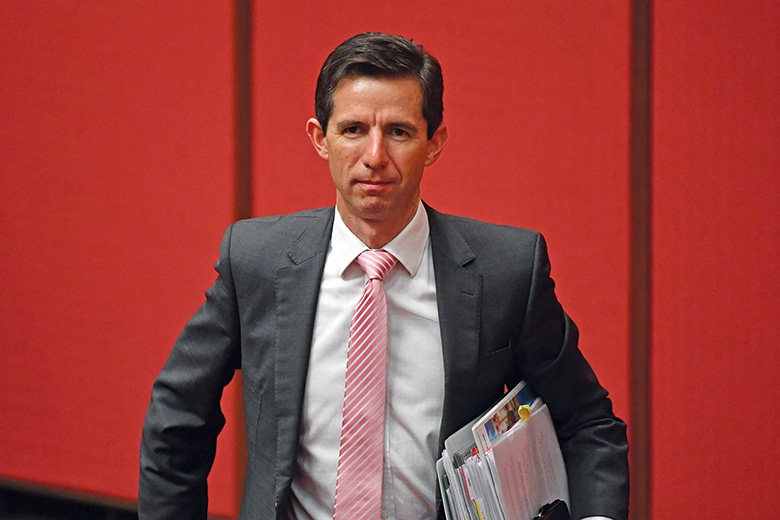
Senate estimates revealed that Birmingham had personally intervened to reject 11 humanities research grants that had been approved through the standard peer-review process [2].
The grants included projects such as:
- "Writing the struggle for Sioux and US modernity" ($926,372) [3]
- "The music of nature and the nature of music" ($764,744) [3]
- "Price, metals and materials in the global exchange" ($391,574) [3]
- A history of men's dress from 1870 to 1970 ($326,000) [1]
- Research on "beauty and ugliness as persuasive tools in changing China's gender norms" [1]
- "Post orientalist arts in the Strait of Gibraltar" [1]
The intervention was indeed secretive initially - the blocking was only revealed during Senate estimates questioning, not through any government announcement [2].
该 gāi 主张 zhǔ zhāng 准确 zhǔn què 但 dàn 忽略 hū lüè 了 le 几个 jǐ gè 重要 zhòng yào 的 de 背景 bèi jǐng 因素 yīn sù : :
The claim is accurate but omits several important contextual factors:
1. **Ministerial Power**: The intervention, while extraordinary, was technically within existing ministerial powers.
Labor's innovation spokesman Kim Carr pointed out that Labor had established a protocol in 2007 requiring ministers to provide "full, timely and public explanation" when overturning ARC decisions [1].
The protocol had existed but was not legally binding.
2. **Government Justification**: Birmingham defended the decision, stating that "more than 99.7% of recommended grants had been approved" and that the rejected projects were redirected to "other research projects" [1].
He argued that the vast majority of taxpayers would view the rejected projects as wrong priorities [1].
3. **The Specific Claims About Projects**: While universities and academics criticized the selections as arbitrary, the government's defense was that some projects seemed frivolous or of questionable value.
The claim omits this government perspective entirely.
4. **Affected Universities**: The blocking affected 11 grants across multiple universities, including seven from Group of Eight universities and three from UNSW [1].
他 tā 认为 rèn wéi , , 绝大多数 jué dà duō shù 纳税人 nà shuì rén 会 huì 认为 rèn wéi 被 bèi 拒绝 jù jué 的 de 项目 xiàng mù 是 shì 错误 cuò wù 的 de 优先 yōu xiān 事项 shì xiàng [ [ 1 1 ] ] 。 。
This suggests the impact was broader than suggested by the phrasing "research projects."
5. **ARC Processes**: The ARC's peer-review system is genuinely expert-driven, making ministerial veto of approved grants highly unusual and controversial [1].
**Did Labor do something similar?**
Search conducted for Labor government blocking ARC grants or overturning ministerial vetoes of research funding.
**Finding**: Labor's Kim Carr (then innovation and industry spokesman for Labor) responded to this incident by referencing a protocol Labor had established in 2007: "Labor established in 2007 that the minister not overturn ARC decisions 'without a full, timely and public explanation'" [1].
* * * *
This suggests Labor had recognized ministerial powers existed but attempted to constrain them through protocol.
The broader context from academic critics suggests this has been an ongoing issue with multiple Coalition ministers across the decade, not just Birmingham, indicating a pattern rather than an isolated incident [3].
**Criticisms of the decision:**
Multiple peak university bodies condemned the intervention as "reprehensible," "disgraceful," and damaging to Australia's international research reputation [1].
The Group of Eight's chief executive called the decision "base politics" and noted it "infringes on research projects that have already been accepted by this nation's highly respected ARC" [1].
Academic leaders expressed concern that political interference "undermines the peer-review system, which is designed to ensure academic integrity" [1].
**Government justification and legitimate concerns:**
The government's response was that:
1.
The funds were "recommitted to other research projects" rather than cut from research overall [1]
3.
政府 zhèng fǔ 的 de 回应 huí yìng 是 shì : :
Some of the rejected projects genuinely could be characterized as of questionable immediate utility or relevance (e.g., the historian studying men's fashion)
Education Minister Dan Tehan argued that "a good government respects hard-working taxpayers by doing due diligence about how their money is spent" [1], suggesting a genuine concern about accountability and value for money, not partisan censorship.
**Key tension:** The real issue is that there is a genuine tension between:
- **Peer-review independence**: The ARC's expert peer-review process should be free from political interference to maintain academic integrity
- **Democratic accountability**: Elected governments do have some responsibility to ensure public funding is used effectively, and ministers are accountable to parliament
The controversy lay not in whether ministers should have *any* oversight (they should), but in whether this should be done secretly and selectively, potentially chilling research into politically sensitive topics.
**Precedent and systemic issue:** The TJ Ryan Foundation's research notes that this intervention was "not unprecedented," suggesting ministerial intervention in research funding has a history, though perhaps not to this degree [3].
Sources indicate this continued to be an issue under subsequent Coalition governments, with Education Minister Stuart Robert also overturning ARC decisions [3].
The blocking was indeed initially secret (revealed only through Senate estimates), and the grants were already approved through proper government processes.
However, the claim simplifies a more complex issue about ministerial discretion, research funding priorities, and the tension between political accountability and academic independence.
While the blocking was controversial and opposed by universities, the government's position that it had authority to redirect funding for projects it deemed lower priority has some basis in existing ministerial powers (though the use of these powers in this manner was highly unusual).
最终评分
8.0
/ 10
属实
该 gāi 主张 zhǔ zhāng 在 zài 事实 shì shí 层面 céng miàn 是 shì 准确 zhǔn què 的 de 。 。
The claim is factually accurate.
Simon Simon Birmingham Birmingham 确实 què shí 阻止 zǔ zhǐ 了 le 420 420 万美元 wàn měi yuán 已 yǐ 通过 tōng guò ARC ARC 批准 pī zhǔn 的 de 人文科学 rén wén kē xué 研究 yán jiū 拨款 bō kuǎn 。 。
Simon Birmingham did block $4.2 million in humanities research grants that had been approved by the ARC.
The blocking was indeed initially secret (revealed only through Senate estimates), and the grants were already approved through proper government processes.
However, the claim simplifies a more complex issue about ministerial discretion, research funding priorities, and the tension between political accountability and academic independence.
While the blocking was controversial and opposed by universities, the government's position that it had authority to redirect funding for projects it deemed lower priority has some basis in existing ministerial powers (though the use of these powers in this manner was highly unusual).