Totoo

Rating: 7.0/10

Coalition
C0447

Ang Claim

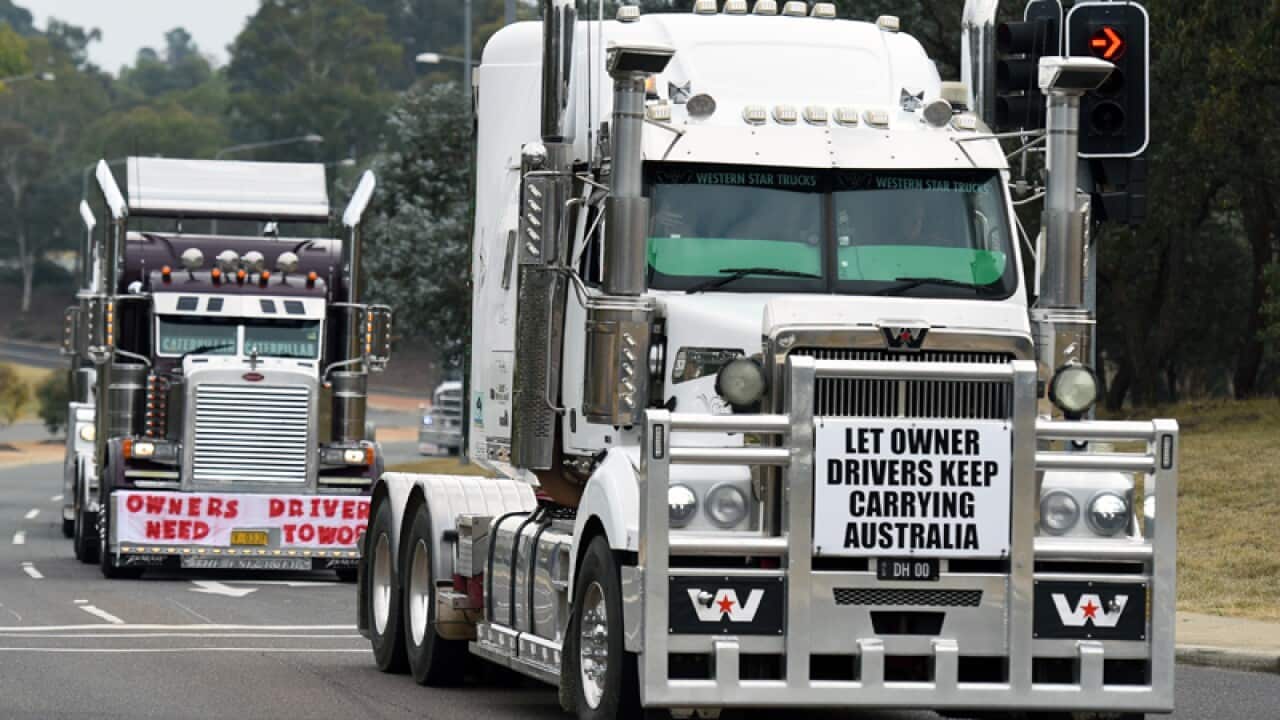
“Iminungkahi ang pagpapawalang-bisa sa independent na organisasyon na nagtatakda ng minimum wage para sa mga truck driver.”
Orihinal na Pinagmulan: Matthew Davis

Orihinal na Pinagmulan

FACTUAL NA BERIPIKASYON

Ang claim ay **factually accurate**.
The claim is **factually accurate**.
Si Prime Minister Malcolm Turnbull ay iminungkahi at sumunod na nagsabatas ng pagpapawalang-bisa sa Road Safety Remuneration Tribunal (RSRT), isang independent na body na nagtatakda ng minimum pay rates para sa truck owner-drivers [1][2].
Prime Minister Malcolm Turnbull did propose and subsequently legislate the abolition of the Road Safety Remuneration Tribunal (RSRT), an independent body that set minimum pay rates for truck owner-drivers [1][2].
Ang RSRT ay itinatag noong 2012 ng Gillard Labor government sa ilalim ng Road Safety Remuneration Act [3].
The RSRT was established in 2012 by the Gillard Labor government under the Road Safety Remuneration Act [3].
Ito ay nilikha pagkatapos ng 2008 National Transport Commission finding na nag-uugnay ng driver remuneration sa safety outcomes [3].
It was created following a 2008 National Transport Commission finding that linked driver remuneration to safety outcomes [3].
Ang tribunal ay independent mula sa Fair Work Commission at nag-regulate ng parehong employee drivers at contractor/owner-drivers [3].
The tribunal was independent from the Fair Work Commission and regulated both employee drivers and contractor/owner-drivers [3].
Noong Abril 2016, ang RSRT ay naglabas ng Contractor Driver Minimum Payments Road Safety Remuneration Order na nagtatakda ng national minimum rates at unpaid leave, na epektibo mula Abril 4, 2016 [3][4].
In April 2016, the RSRT issued a Contractor Driver Minimum Payments Road Safety Remuneration Order that established national minimum rates and unpaid leave, effective from April 4, 2016 [3][4].
Ito ang nag-trigger ng response ng Turnbull government na ipawalang-bisa ang tribunal.
This triggered the Turnbull government's response to abolish the tribunal.
Ang abolition legislation ay naipasa sa Senate noong Abril 18, 2016, sa botong 36 sa 32, kasama ang crossbench support (maliban kay Motoring Enthusiast Ricky Muir) [2].
The abolition legislation passed the Senate on April 18, 2016, by a vote of 36 to 32, with crossbench support (except Motoring Enthusiast Ricky Muir) [2].
Ang Labor at ang Greens ay tumutol sa bill [2].
Labor and the Greens opposed the bill [2].

Nawawalang Konteksto

Ang claim ay nagpapabaya ng ilang mahahalagang kontekstwal na elemento: **1.
The claim omits several important contextual elements: **1.
Ang RSRT ay nilikha ng Labor, hindi minana ng Coalition** Ang tribunal ay itinatag ng Gillard Labor government noong 2012 [3].
The RSRT was created by Labor, not inherited by Coalition** The tribunal was established by the Gillard Labor government in 2012 [3].
Ito ay hindi isang pre-existing body na pinili ng Coalition na alisin; ito ay isang aktibong pagbaligtad ng isang Labor policy initiative. **2.
This was not a pre-existing body that the Coalition decided to eliminate; it was an active reversal of a Labor policy initiative. **2.
Ang pay order ay inilapat lamang sa owner-drivers, hindi sa employed drivers** Ang kontrobersyal na 2016 minimum pay order ay sumaklaw lamang sa owner-operator truck drivers, hindi sa employed drivers sa mas malalaking transport companies [2][4].
The pay order applied only to owner-drivers, not employed drivers** The controversial 2016 minimum pay order only covered owner-operator truck drivers, not employed drivers at larger transport companies [2][4].
Ito ay lumilikha ng isang asymmetry kung saan ang mas malalaking companies na gumagamit ng employed drivers ay maaaring mag-operate sa ilalim ng ibang cost structures kaysa sa maliliit na owner-operators. **3.
This created an asymmetry where larger companies using employed drivers could operate under different cost structures than small owner-operators. **3.
Ang RSRT ay may maikli at magulong kasaysayan** Ang RSRT ay nag-operate ng halos 4 na taon lamang bago mapawalang-bisa.
The RSRT had a short and troubled history** The RSRT operated for only about 4 years before abolition.
Noong 2013, ang Abbott Coalition government ay nagkomisyon sa Jaguar Consulting para suriin ang tribunal, na nag-ulat na ang RSRT ay "achieved little of a concrete nature" sa puntong iyon [3].
In 2013, the Abbott Coalition government commissioned Jaguar Consulting to review the tribunal, which reported that the RSRT had "achieved little of a concrete nature" at that point [3].
Ang tribunal ay naglabas lamang ng dalawang order sa buong existence nito [3]. **4.
The tribunal had issued only two orders during its existence [3]. **4.
Ang gobyerno ay iminungkahi ang paglilipat ng mga function sa National Heavy Vehicle Regulator** Ang Coalition ay hindi lamang nag-alis ng oversight nang buo—iminungkahi nito ang paglilipat ng $4 million taunang funding ng RSRT at ilan sa mga safety function nito sa National Heavy Vehicle Regulator (NHVR) [1][4]. **5.
The government proposed transferring functions to the National Heavy Vehicle Regulator** The Coalition did not simply eliminate oversight entirely—it proposed shifting the RSRT's $4 million annual funding and some of its safety functions to the National Heavy Vehicle Regulator (NHVR) [1][4]. **5.
Ang mga owner-drivers ay nakaranas ng malaking economic pressure** Ayon sa academic analysis, maraming owner-drivers ay "among the most poorly remunerated in the industry and have extensive debt wrapped up in their trucks," kung saan marami ay "making a marginal living at best" [3].
Owner-drivers faced significant economic pressure** According to academic analysis, many owner-drivers were "among the most poorly remunerated in the industry and have extensive debt wrapped up in their trucks," with many "making a marginal living at best" [3].
Ang bagong pay order ay nagbanta na i-price out ang ilang owner-operators mula sa market [3].
The new pay order threatened to price some owner-operators out of the market [3].

Pagsusuri ng Kredibilidad ng Pinagmulan

Ang orihinal na source, **The Guardian Australia**, ay isang mainstream media outlet na may center-left editorial stance.
The original source, **The Guardian Australia**, is a mainstream media outlet with a center-left editorial stance.
Ito ay karaniwang itinuturing na reputable at factual sa pag-uulat nito, bagama't mayroon itong acknowledged progressive leanings [5].
It is generally considered reputable and factual in its reporting, though it does have acknowledged progressive leanings [5].
Ang pamagat ng artikulo ay gumagamit ng pariralang "protecting truck driver pay rates," na nagfa-frame sa papel ng tribunal nang positibo—ito ay accurate ngunit kumakatawan sa isang partikular na perspektiba sa policy debate.
The article title uses the phrase "protecting truck driver pay rates," which frames the tribunal's role positively—this is accurate but represents a particular perspective on the policy debate.
Ang Guardian ay hindi isang partisan advocacy organization; ito ay isang established international news outlet na may editorial standards.
The Guardian is not a partisan advocacy organization; it is an established international news outlet with editorial standards.
Gayunpaman, ang mga mambabasa ay dapat na malaman na ang The Guardian ay karaniwang sumusuporta sa mas malakas na worker protections at union involvement sa industrial relations.
However, readers should be aware that The Guardian typically supports stronger worker protections and union involvement in industrial relations.
⚖️

Paghahambing sa Labor

**Gumawa ba ng kahalintulad na bagay ang Labor?** Ang isinagawang search: "Labor government abolish independent tribunal industrial relations body" Ang natuklasan: Ang Labor ay hindi tradisyonal na nagpawalang-bisa ng independent industrial tribunals na itinatag ng conservative governments.
**Did Labor do something similar?** Search conducted: "Labor government abolish independent tribunal industrial relations body" Finding: Labor has not historically abolished independent industrial tribunals established by conservative governments.
Gayunpaman, ang Labor at Coalition governments ay parehong nagtatrabaho sa magkabilang panig sa industrial relations bodies: - **Ang Labor ay lumikha ng RSRT noong 2012** [3] - **Ang Labor ay tumutol sa pagpapawalang-bisa ng RSRT noong 2016**, kung saan sinabi ni Opposition Leader Bill Shorten na ang tribunal ay nakatuon sa safety at handang magkompromiso sa implementation timing sa halip na pagpapawalang-bisa [4] - Ang Labor ay tradisyonal na sumusuporta sa mas malakas na industrial relations oversight bodies, habang ang Coalition governments ay karaniwang pabor sa pagbabawas ng regulatory burdens sa mga negosyo **Precedent para sa pagpawalang-bisa ng industrial bodies:** Ang Coalition governments ay may pattern ng pagbuwag sa Labor-established industrial relations structures: - Ang Howard government's abolition ng Australian Industrial Relations Commission (pinalitan ng Fair Work Commission) - Ang Abbott government's 2013-2014 review ng RSRT na humantong sa pagpapawalang-bisa nito sa ilalim ni Turnbull [3] Ang Labor governments ay gayundin nagbaliktad ng Coalition industrial relations policies kapag nasa kapangyarihan, bagama't karaniwang sa pamamagitan ng legislative modification sa halip na outright abolition ng independent bodies.
However, Labor and Coalition governments have consistently taken opposing positions on industrial relations bodies: - **Labor created the RSRT in 2012** [3] - **Labor opposed the RSRT's abolition in 2016**, with Opposition Leader Bill Shorten stating the tribunal was focused on safety and willing to compromise on implementation timing rather than abolition [4] - Labor has historically supported stronger industrial relations oversight bodies, while Coalition governments have generally favored reducing regulatory burdens on businesses **Precedent for abolishing industrial bodies:** Coalition governments have a pattern of dismantling Labor-established industrial relations structures: - The Howard government's abolition of the Australian Industrial Relations Commission (replaced with the Fair Work Commission) - The Abbott government's 2013-2014 review of the RSRT leading to its abolition under Turnbull [3] Labor governments have similarly reversed Coalition industrial relations policies when in power, though typically through legislative modification rather than outright abolition of independent bodies.
🌐

Balanseng Pananaw

Ang desisyon ng Coalition na ipawalang-bisa ang RSRT ay in-frame bilang pagprotekta sa maliliit na business owner-operators mula sa tinawag ni Nationals MP Mark Coulton na "anti-competitive behaviour" [2].
The Coalition's decision to abolish the RSRT was framed as protecting small business owner-operators from what Nationals MP Mark Coulton called "anti-competitive behaviour" [2].
Ang posisyon ng gobyerno ay ang pay order ay pipilitin ang owner-drivers na either labagin ang batas o i-price ang kanilang sarili mula sa market [2].
The government's position was that the pay order would force owner-drivers to either break the law or price themselves out of the market [2].
Sinabi ni Treasurer Scott Morrison na ang delay at pagpapawalang-bisa ay "only practical" upang magbigay ng panahon para mangalap ng suporta para sa pagkawala ng tribunal [4].
Treasurer Scott Morrison stated the delay and abolition was "only practical" to allow time to gather support for the tribunal's elimination [4].
Inalegato ng Coalition na ang RSRT ay nagproduce ng "no tangible safety outcome" [2], bagama't ang assessment na ito ay ginawa bago magkaroon ng sapat na panahon upang masukat ang safety impacts.
The Coalition argued the RSRT had produced "no tangible safety outcome" [2], though this assessment was made before sufficient time had passed to measure safety impacts.
Ang mga kritiko ng oposisyon, kabilang si Labor's Stephen Conroy, ay nangalega na "Australian roads would be less safe" at tinuligsa si Turnbull ng "using truckies as a pawn in his political game" [2].
Opposition critics, including Labor's Stephen Conroy, argued that "Australian roads would be less safe" and accused Turnbull of "using truckies as a pawn in his political game" [2].
Ang academic analysis ay nagmungkahi na ang pagpawalang-bisa ng RSRT ay nangangahulugang "owner driver safety will remain a long way off" [3].
Academic analysis suggests that abolishing the RSRT meant "owner driver safety will remain a long way off" [3].
Ang pay order ay kontrobersyal kahit sa mga stakeholder.
The pay order was controversial even among stakeholders.
Ang ilang industry parties ay nagmungkahi ng mas mahabang implementation timelines, at ang Labor ay handang magkompromiso sa rollout timing [4].
Some industry parties had suggested longer implementation timelines, and Labor was willing to compromise on rollout timing [4].
Ang pundamental na tensyon ay sa pagitan ng pagprotekta sa economic viability ng maliliit na owner-operators laban sa pagtiyak ng fair pay at potensyal na pinabuting safety outcomes. **Pangunahing konteksto:** Ang aksyong ito ay kumakatawan sa mas malawak na pilosopikal na approach ng Coalition sa industrial relations—pagbabawas ng regulatory intervention sa pabor ng market mechanisms—sa halip na isang isolated o natatanging desisyon.
The fundamental tension was between protecting small owner-operators' economic viability versus ensuring fair pay and potentially improved safety outcomes. **Key context:** This action represents the Coalition's broader philosophical approach to industrial relations—reducing regulatory intervention in favor of market mechanisms—rather than an isolated or unique decision.
Ang RSRT ay isang relatibong bago at untested body (nilikha 2012, unang major pay order 2016) na may limitadong operational history upang masuri ang effectiveness nito.
The RSRT was a relatively new and untested body (created 2012, first major pay order 2016) with limited operational history to assess its effectiveness.

TOTOO

7.0

sa 10

Ang Coalition ay iminungkahi at matagumpay na nagsabatas ng pagpapawalang-bisa sa Road Safety Remuneration Tribunal, isang independent na body na nagtatakda ng minimum pay rates para sa truck owner-drivers.
The Coalition did propose and successfully legislate the abolition of the Road Safety Remuneration Tribunal, an independent body that set minimum pay rates for truck owner-drivers.
Ito ay nangyari noong Abril 2016 pagkatapos ng isang kontrobersyal na pay order na inilabas ng tribunal.
This occurred in April 2016 following a controversial pay order issued by the tribunal.
Ang claim ay tumpak na sumasalamin sa Coalition policy at mga aksyon, bagama't kulang sa konteksto tungkol sa pinagmulan ng tribunal sa Labor, ang tiyak na epekto sa owner-drivers laban sa employed drivers, at ang rasyonal ng Coalition para sa desisyon.
The claim accurately reflects Coalition policy and actions, though it lacks context about the tribunal's Labor origins, the specific impact on owner-drivers versus employed drivers, and the Coalition's rationale for the decision.

📚 MGA PINAGMULAN AT SANGGUNIAN (5)

  1. 1
    Labor willing to compromise as Coalition pushes to oppose truck driver pay increases

    Labor willing to compromise as Coalition pushes to oppose truck driver pay increases

    Labor is willing to compromise over the Federal Government's bid to oppose a pay hike for truck drivers, Opposition Leader Bill Shorten says.

    Abc Net
  2. 2
    Truckies road safety tribunal abolished

    Truckies road safety tribunal abolished

    The Turnbull government has won Senate support to scrap the Road Safety Remuneration Tribunal, which imposed minimum wage rates on owner-driver truckies.

    SBS News
  3. 3
    Controversial history of Road Safety Tribunal shows minimum pay was doomed from the start

    Controversial history of Road Safety Tribunal shows minimum pay was doomed from the start

    If the federal government abolishes the Road Safety Renumeration Tribunal, a minimum pay to improve the safety of truckers is less likely to ever be addressed.

    The Conversation
  4. 4
    Coalition pushes for immediate abolition of truck driver pay tribunal

    Coalition pushes for immediate abolition of truck driver pay tribunal

    Government to introduce legislation next week after push by senators Glenn Lazarus and Jacqui Lambie

    the Guardian
  5. 5
    crikey.com.au

    The Guardian's biases are well-known, so why the big deal over new political editor?

    Crikey Com

    Original link no longer available

Pamamaraan ng Rating Scale

1-3: MALI

Hindi tama sa katotohanan o malisyosong gawa-gawa.

4-6: BAHAGYA

May katotohanan ngunit kulang o baluktot ang konteksto.

7-9: HALOS TOTOO

Maliit na teknikal na detalye o isyu sa pagkakasulat.

10: TUMPAK

Perpektong na-verify at patas ayon sa konteksto.

Pamamaraan: Ang mga rating ay tinutukoy sa pamamagitan ng cross-referencing ng opisyal na mga rekord ng pamahalaan, independiyenteng mga organisasyong nag-fact-check, at mga primaryang dokumento.