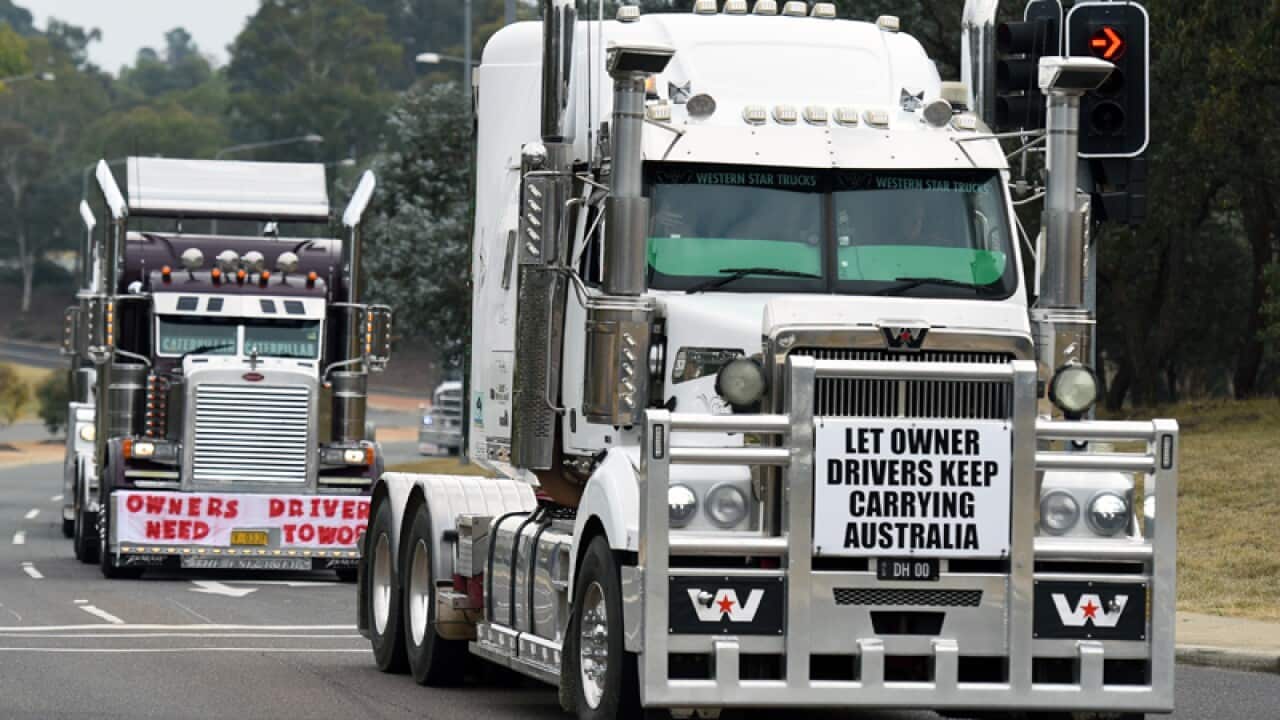
Prime Minister Malcolm Turnbull did propose and subsequently legislate the abolition of the Road Safety Remuneration Tribunal (RSRT), an independent body that set minimum pay rates for truck owner-drivers [1][2].
In April 2016, the RSRT issued a Contractor Driver Minimum Payments Road Safety Remuneration Order that established national minimum rates and unpaid leave, effective from April 4, 2016 [3][4].
The abolition legislation passed the Senate on April 18, 2016, by a vote of 36 to 32, with crossbench support (except Motoring Enthusiast Ricky Muir) [2].
The pay order applied only to owner-drivers, not employed drivers**
The controversial 2016 minimum pay order only covered owner-operator truck drivers, not employed drivers at larger transport companies [2][4].
In 2013, the Abbott Coalition government commissioned Jaguar Consulting to review the tribunal, which reported that the RSRT had "achieved little of a concrete nature" at that point [3].
The government proposed transferring functions to the National Heavy Vehicle Regulator**
The Coalition did not simply eliminate oversight entirely—it proposed shifting the RSRT's $4 million annual funding and some of its safety functions to the National Heavy Vehicle Regulator (NHVR) [1][4].
**5.
Owner-drivers faced significant economic pressure**
According to academic analysis, many owner-drivers were "among the most poorly remunerated in the industry and have extensive debt wrapped up in their trucks," with many "making a marginal living at best" [3].
The article title uses the phrase "protecting truck driver pay rates," which frames the tribunal's role positively—this is accurate but represents a particular perspective on the policy debate.
**Did Labor do something similar?**
Search conducted: "Labor government abolish independent tribunal industrial relations body"
Finding: Labor has not historically abolished independent industrial tribunals established by conservative governments.
* * * *
However, Labor and Coalition governments have consistently taken opposing positions on industrial relations bodies:
- **Labor created the RSRT in 2012** [3]
- **Labor opposed the RSRT's abolition in 2016**, with Opposition Leader Bill Shorten stating the tribunal was focused on safety and willing to compromise on implementation timing rather than abolition [4]
- Labor has historically supported stronger industrial relations oversight bodies, while Coalition governments have generally favored reducing regulatory burdens on businesses
**Precedent for abolishing industrial bodies:**
Coalition governments have a pattern of dismantling Labor-established industrial relations structures:
- The Howard government's abolition of the Australian Industrial Relations Commission (replaced with the Fair Work Commission)
- The Abbott government's 2013-2014 review of the RSRT leading to its abolition under Turnbull [3]
Labor governments have similarly reversed Coalition industrial relations policies when in power, though typically through legislative modification rather than outright abolition of independent bodies.
The Coalition's decision to abolish the RSRT was framed as protecting small business owner-operators from what Nationals MP Mark Coulton called "anti-competitive behaviour" [2].
The Coalition argued the RSRT had produced "no tangible safety outcome" [2], though this assessment was made before sufficient time had passed to measure safety impacts.
Opposition critics, including Labor's Stephen Conroy, argued that "Australian roads would be less safe" and accused Turnbull of "using truckies as a pawn in his political game" [2].
The fundamental tension was between protecting small owner-operators' economic viability versus ensuring fair pay and potentially improved safety outcomes.
**Key context:** This action represents the Coalition's broader philosophical approach to industrial relations—reducing regulatory intervention in favor of market mechanisms—rather than an isolated or unique decision.
The RSRT was a relatively new and untested body (created 2012, first major pay order 2016) with limited operational history to assess its effectiveness.
The Coalition did propose and successfully legislate the abolition of the Road Safety Remuneration Tribunal, an independent body that set minimum pay rates for truck owner-drivers.
The claim accurately reflects Coalition policy and actions, though it lacks context about the tribunal's Labor origins, the specific impact on owner-drivers versus employed drivers, and the Coalition's rationale for the decision.
The Coalition did propose and successfully legislate the abolition of the Road Safety Remuneration Tribunal, an independent body that set minimum pay rates for truck owner-drivers.
The claim accurately reflects Coalition policy and actions, though it lacks context about the tribunal's Labor origins, the specific impact on owner-drivers versus employed drivers, and the Coalition's rationale for the decision.