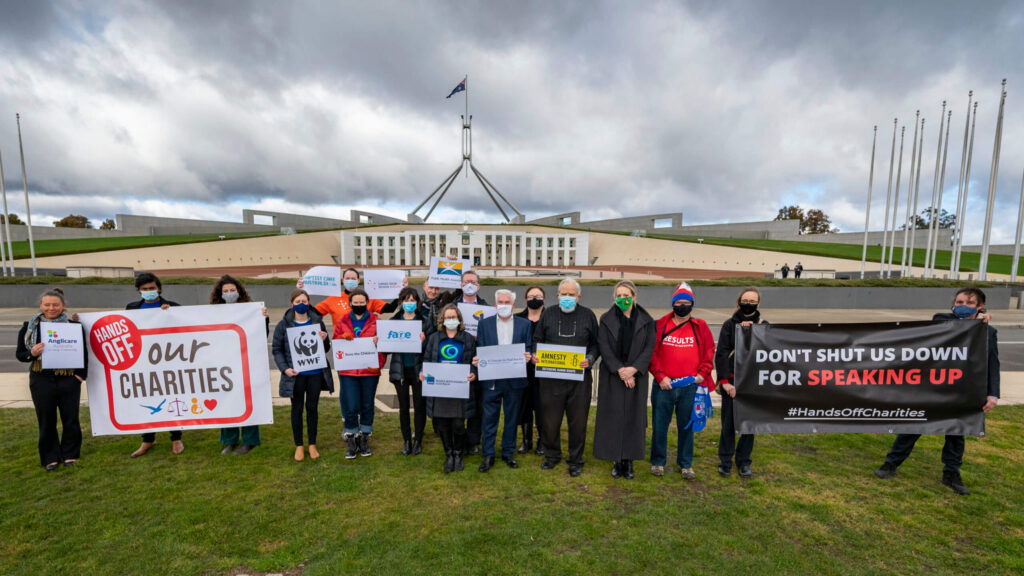
The Morrison Coalition government did table amendments to the Australian Charities and Not-for-profits Commission (ACNC) Regulations in June 2021 that would have expanded the grounds for charity deregistration [1][2].
**Specific regulatory change:** The amendments sought to extend Governance Standard 3 of the ACNC Regulations by lowering the threshold from requiring charities to avoid conduct punishable as an "indictable offence" down to conduct that could be dealt with as a "summary offence" [3].
Summary offences in the proposed regulation specifically included: (i) entering or remaining on real or personal property; (ii) destroying or damaging property; (iii) appropriating property; and (iv) causing personal injury [3].
**Practical impact:** Under these regulations, charities could theoretically be deregistered for staff members blocking a footpath at a public vigil, or for tweeting in support of a protest [1][2].
The regulations gave the Charities Commissioner "subjective belief" authority to act even if no charge had been made [1].
**What actually happened:** The regulations were **never implemented**.
On 25 November 2021, the Senate voted 24-19 in favor of Independent Senator Rex Patrick's disallowance motion, preventing the regulations from ever coming into effect [4][5].
The regulations never became law.** While the claim accurately describes what was tabled, it could mislead readers into believing these rules were implemented.
The government's stated rationale.** Assistant Treasurer Michael Sukkar defended the regulations as targeting "activist organisations masquerading as charities" and preventing charities' resources from being directed toward "unlawful activities" rather than charitable works [2].
The charities regulator (ACNC Commissioner) said the problem didn't exist.** The head of the ACNC itself confirmed that "very few charities are acting illegally" and questioned the necessity of the regulations [6].
Sukkar's office clarified the regulations were aimed at "sustained illegal activity."** In response to charity concerns, Sukkar's office clarified that the regulations were not intended to result in deregistration for a single staff member's tweet, but rather sustained illegal activity [2].
Precedent was limited.** The only recent example cited was the 2019 deregistration of Aussie Farms Inc., an animal rights group that had organized protests [2].
Amnesty is a human rights organization that operates globally and is generally regarded as reliable, though it does advocate for specific policy positions.
SBS is a public broadcaster and mainstream news source.
**Supporting sources:** The Stronger Charities Alliance (a coalition of 100+ charities) and the Human Rights Law Centre are both reputable advocacy and legal organizations [4][5].
**Did Labor do something similar?**
The Labor government under Anthony Albanese (elected May 2022) did not pursue comparable restrictions on charity advocacy.
* * * *
When the Labor government came to power, the 2021 regulations had already been defeated and were not in effect.
However, it should be noted that government regulation of charity spending and advocacy—to prevent misuse of tax concessions—is not unique to the Coalition.
**The Coalition's position:** The government argued these regulations were necessary to prevent charities from abusing tax-deductible donation status by directing resources toward unlawful activity rather than charitable purposes.
The rationale was that donors fund charities expecting their money to support charitable work, not illegal activities [2].
**However, several factors undermined this justification:**
1. **Lack of evidence of widespread problem:** The ACNC Commissioner himself stated there were very few charities engaging in illegal activity, undermining the claim that new sweeping powers were necessary [6].
2. **Scope was overly broad:** The regulations would have caught minor summary offences (like blocking a sidewalk) rather than targeting serious illegal conduct [3].
This made the measure appear punitive toward advocacy rather than genuinely addressing fraud or serious illegality.
3. **Chilling effect on legitimate advocacy:** Critics across the political spectrum (including Senator Fierravanti-Wells, a Coalition member) argued the regulations would deter charities from lawful advocacy activities that charities exist to perform [4].
Unlike most western democracies, this seemed designed to silence rather than regulate.
4. **Subjective test was problematic:** Giving the Commissioner power to act based on "subjective belief" that a minor offence "may" occur created uncertainty that would burden charities with excessive compliance costs [1][3].
**Key context:** This is not unique to the Coalition—governments globally sometimes seek to regulate charitable activity.
However, Australian charities pointed out that no parallel restrictions exist in the business sector or for political parties (making the analogy to deregistering the Liberal Party for a member jaywalking apt) [1].
The unanimous opposition from 100+ charities across the political spectrum, and the defeat by the Senate, suggests this measure fell outside mainstream Australian political consensus [4][5].
The claim accurately describes the scope of the proposed regulations (tweeting about protests, displaying logos at protests where minor offences might occur) but without noting the Senate rejected them after sustained cross-party and charity sector opposition.
The claim accurately describes the scope of the proposed regulations (tweeting about protests, displaying logos at protests where minor offences might occur) but without noting the Senate rejected them after sustained cross-party and charity sector opposition.