Vrai

Note : 8.0/10

Coalition
C0635

L'affirmation

“A nommé 2 amis libéraux au Migration Review Tribunal alors qu'ils n'avaient pas été présélectionnés par le comité de sélection.”
Source originale : Matthew Davis

Sources originales

VÉRIFICATION FACTUELLE

**VRAI.** L'allégation est factuellement exacte sur la base du témoignage devant les commissions sénatoriales et des documents probants.
**TRUE.** The claim is factually accurate based on Senate estimates testimony and documented evidence.
En octobre 2014, le gouvernement fédéral a nommé 18 nouveaux membres au Migration Review Tribunal.
In October 2014, the federal government appointed 18 new members to the Migration Review Tribunal.
Parmi ces nominations, trois personnes—Helena Claringbold, Nick McGowan et Antoinette Younes—ont été nommées malgré le fait qu'elles n'aient pas été présélectionnées par le comité de sélection conjoint qui recommande généralement des candidats au ministre de l'Immigration [1].
Of these appointments, three individuals—Helena Claringbold, Nick McGowan, and Antoinette Younes—were appointed despite not being shortlisted by the joint selection panel that typically recommends candidates to the immigration minister [1].
Deux de ces personnes nommées entretenaient des liens bien documentés avec le Parti libéral : - **Helena Claringbold** : Ancienne collaboratrice du Premier ministre Tony Abbott (a quitté son bureau en juillet 2014) et répertoriée dans les déclarations de financement électoral de la Nouvelle-Galles du Sud comme ayant donné 45 000 $ au Parti libéral de la Nouvelle-Galles du Sud en 2002 [1][2] - **Nick McGowan** : S'est présenté comme candidat libéral dans la circonscription de Jagajaga lors de l'élection fédérale de 2013 [1][3] Les nominations ont été révélées lors des audiences des commissions sénatoriales le 20 octobre 2014, lorsque le sénateur travailliste Kim Carr a soulevé des préoccupations concernant le processus.
Two of these appointees had well-documented ties to the Liberal Party: - **Helena Claringbold**: Former staffer to Prime Minister Tony Abbott (left his office in July 2014) and listed on NSW electoral funding disclosures as having donated $45,000 to the NSW Liberal Party in 2002 [1][2] - **Nick McGowan**: Ran as a Liberal candidate in the seat of Jagajaga during the 2013 federal election [1][3] The appointments were revealed during Senate estimates hearings on October 20, 2014, when Labor Senator Kim Carr raised concerns about the process.
La ministre assistante de l'Immigration, Michaelia Cash, a défendu les nominations, déclarant : « Le processus a été mené conformément aux lignes directrices de mérite et de transparence de la commission de la fonction publique australienne » et que « le gouvernement... peut nommer qui il souhaite.
Assistant Immigration Minister Michaelia Cash defended the appointments, stating: "The process was undertaken in accordance with the Australian public service commission merit and transparency guidelines" and that "the government...are able to appoint whomever they wish.
C'est une nomination du cabinet » [1].
It is a cabinet appointment" [1].

Contexte manquant

L'allégation omet plusieurs éléments contextuels importants : **1.
The claim omits several important contextual elements: **1.
Troisième personne nommée sans lien libéral** : Bien que l'allégation se concentre sur « 2 amis libéraux », il y avait en fait une troisième personne nommée (Antoinette Younes) qui n'avait pas non plus été présélectionnée par le comité de sélection mais qui n'avait aucun lien documenté avec le Parti libéral mentionné dans les reportages [1]. **2.
Third appointee without Liberal ties**: While the claim focuses on "2 Liberal mates," there was actually a third appointee (Antoinette Younes) who was also not shortlisted by the selection panel but had no documented Liberal Party connections mentioned in the reporting [1]. **2.
Pouvoir légal de nomination** : Les nominations ministérielles aux tribunaux sont finalement des décisions du cabinet.
Legal authority for appointments**: Ministerial appointments to tribunals are ultimately cabinet decisions.
Le comité de sélection fournit des recommandations, mais le gouvernement conserve l'autorité constitutionnelle de faire des nominations.
The selection panel provides recommendations, but the government retains constitutional authority to make appointments.
Comme le sénateur Cash l'a noté, les gouvernements « peuvent nommer qui ils souhaitent » [1]. **3.
As Senator Cash noted, governments "are able to appoint whomever they wish" [1]. **3.
Conformité aux lignes directrices de la fonction publique** : Le gouvernement a maintenu que le processus suivait les lignes directrices de mérite et de transparence de la commission de la fonction publique australienne, suggérant que les nominations étaient techniquement légales même si elles étaient controversées [1]. **4.
APS guidelines compliance**: The government maintained that the process followed Australian Public Service Commission merit and transparency guidelines, suggesting the appointments were technically lawful even if controversial [1]. **4.
Deuxième source sans rapport** : La deuxième source du Guardian fournie avec cette allégation (concernant la décision de l'ONU sur la détention indéfinie en 2016) n'a absolument aucun rapport avec la question des nominations au tribunal—elle traite d'une question complètement distincte concernant les évaluations de sécurité de l'ASIO et la détention des réfugiés entre 2009-2015, une période couvrant les gouvernements travailliste et de la Coalition [4].
Second source unrelated**: The second Guardian source provided with this claim (about UN ruling on indefinite detention in 2016) is entirely unrelated to the tribunal appointments issue—it addresses a completely separate matter of ASIO security assessments and refugee detention between 2009-2015, a period spanning both Labor and Coalition governments [4].

Évaluation de la crédibilité de la source

Les sources originales fournies avec cette allégation nécessitent une évaluation critique : **Source 1 : The Guardian (2014)** - The Guardian Australia est un média généraliste progressiste.
The original sources provided with this claim require critical assessment: **Source 1: The Guardian (2014)** - The Guardian Australia is a mainstream progressive-leaning news outlet.
L'article est un reportage factuel basé sur le témoignage devant les commissions sénatoriales, une procédure parlementaire publique.
The article is factual reporting based on Senate estimates testimony, a public parliamentary proceeding.
Le reportage est exact et basé sur des documents probants.
The reporting is accurate and based on documented evidence.
Cependant, The Guardian a une orientation éditoriale centriste-gauche et a été critique envers les politiques d'immigration de la Coalition [1]. **Source 2 : The Guardian (2016)** - Cet article concerne les décisions de l'ONU sur la détention des réfugiés et n'a aucune pertinence pour l'allégation concernant les nominations aux tribunaux.
However, The Guardian editorially leans center-left and has been critical of Coalition immigration policies [1]. **Source 2: The Guardian (2016)** - This article is about UN rulings on refugee detention and has no relevance to the claim about tribunal appointments.
Son inclusion semble être une erreur dans la compilation originale de l'allégation [4].
Its inclusion appears to be an error in the original claim compilation [4].
⚖️

Comparaison avec Labor

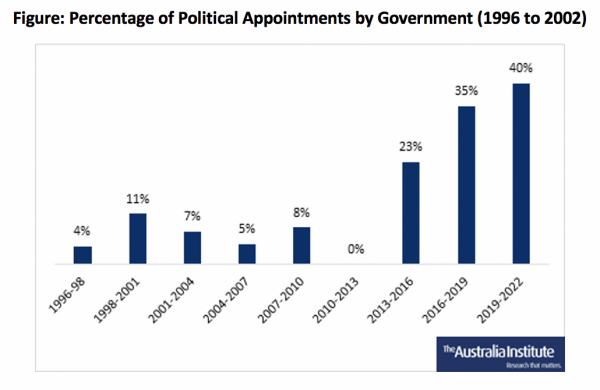
**Le Parti travailliste a-t-il fait quelque chose de similaire ?** Les recherches indiquent que si les deux grands partis font des nominations politiques, l'échelle diffère considérablement : Selon les recherches de l'Australia Institute analysant les 974 nominations au Administrative Appeals Tribunal (AAT) et à ses prédécesseurs entre 1996 et 2022 : - **Gouvernement Howard (Coalition)** : 6 % de nominations politiques - **Gouvernement Rudd/Gillard (Travailliste)** : 5 % de nominations politiques - **Gouvernement Abbott/Turnbull/Morrison (Coalition)** : 32 % de nominations politiques [5] Une autre étude a révélé que les gouvernements de la Coalition ont fait 109 nominations politiques pendant leurs 21 années au pouvoir depuis 1996, contre 10 pour le Parti travailliste pendant ses six années au pouvoir—ce qui signifie que 92 % des personnes nommées politiquement au AAT ont été nommées par des Premiers ministres libéraux [6].
**Did Labor do something similar?** Research indicates that while both major parties make political appointments, the scale differs dramatically: According to Australia Institute research analyzing all 974 appointments to the Administrative Appeals Tribunal (AAT) and its precursors between 1996 and 2022: - **Howard Government (Coalition)**: 6% political appointments - **Rudd/Gillard Government (Labor)**: 5% political appointments - **Abbott/Turnbull/Morrison Government (Coalition)**: 32% political appointments [5] Another study found that Coalition governments made 109 political appointments in their 21 years in office since 1996, compared to Labor's 10 in its six years in power—meaning 92% of political appointees to the AAT were made by Liberal prime ministers [6].
La recherche a également révélé que la Coalition a nommé 22 membres seniors politiquement connectés au AAT (sur 61 au total) depuis 2013, dont sept sans qualifications juridiques [5].
The research also found that the Coalition appointed 22 politically connected Senior Members to the AAT (out of 61 total) since 2013, including seven without legal qualifications [5].
Cependant, les gouvernements travaillistes ont également fait des nominations politiques, et les deux partis ont été critiqués pour une culture de « jobs pour les copains ».
However, Labor governments also made political appointments, and both parties have been criticized for a "jobs for mates" culture.
Un examen parlementaire de 2025 a révélé que les nominations gouvernementales par les deux grands partis sont « entachées de népotisme » et de patronage [7].
A 2025 parliamentary review found government appointments by both major parties are "clouded by nepotism" and patronage [7].
🌐

Perspective équilibrée

**Contexte sur les nominations aux tribunaux :** Bien que l'allégation décrive avec exactitude les nominations de 2014, le contexte plus large montre : 1. **Échelle du problème** : Les nominations politiques aux tribunaux ont considérablement augmenté sous la Coalition par rapport aux gouvernements précédents—environ 6 à 7 fois le taux du gouvernement travailliste Rudd/Gillard [5][6]. 2. **Justification défensive** : Le gouvernement a défendu les nominations comme suivant les lignes directrices appropriées et exerçant l'autorité légitime du cabinet.
**Context on tribunal appointments:** While the claim accurately describes the 2014 appointments, the broader context shows: 1. **Scale of issue**: Political appointments to tribunals increased significantly under the Coalition compared to previous governments—approximately 6-7 times the rate of the Rudd/Gillard Labor government [5][6]. 2. **Defensive justification**: The government defended the appointments as following proper guidelines and exercising legitimate cabinet authority.
Les critiques ont soutenu que cela sapait la sélection fondée sur le mérite [1]. 3. **Schéma bipartite** : Bien que le taux de la Coalition ait été nettement plus élevé, les deux partis se livrent à des nominations politiques.
Critics argued this undermined merit-based selection [1]. 3. **Bipartisan pattern**: While the Coalition's rate was significantly higher, both parties engage in political appointments.
La Coalition a nommé 32 % de personnes politiquement nommées contre 5 % pour le Parti travailliste pendant leurs mandats respectifs récents [5]. 4. **Préoccupation systémique** : Plusieurs analyses indépendantes et examens parlementaires ont identifié une culture de « jobs pour les copains » affectant les deux partis, le gouvernement Albanese ayant par la suite établi un Strengthening Democracy Taskforce en 2023 pour traiter de l'intégrité des nominations [5][7][8]. **Analyse comparative** : Cet incident spécifique de 2014 faisait partie d'un schéma plus large d'augmentation des nominations politiques sous le gouvernement Abbott/Turnbull/Morrison par rapport au gouvernement Rudd/Gillard, bien que le Parti travailliste ait également fait certaines nominations politiques pendant son mandat (2007-2013).
The Coalition appointed 32% political appointees versus Labor's 5% during their respective recent terms [5]. 4. **Systemic concern**: Multiple independent analyses and parliamentary reviews have identified a "jobs for mates" culture affecting both parties, with the Albanese government subsequently establishing a Strengthening Democracy Taskforce in 2023 to address appointment integrity [5][7][8]. **Comparative analysis**: This specific 2014 incident was part of a broader pattern of increased political appointments under the Abbott/Turnbull/Morrison government compared to the Rudd/Gillard government, though Labor also made some political appointments during its term (2007-2013).

VRAI

8.0

sur 10

L'allégation est factuellement exacte.
The claim is factually accurate.
En 2014, le gouvernement de la Coalition a nommé au moins deux personnes ayant des liens documentés avec le Parti libéral (Helena Claringbold et Nick McGowan) au Migration Review Tribunal alors qu'elles n'avaient pas été présélectionnées par le comité de sélection.
In 2014, the Coalition government appointed at least two individuals with documented Liberal Party ties (Helena Claringbold and Nick McGowan) to the Migration Review Tribunal despite them not being shortlisted by the selection panel.
Cela a été confirmé dans le témoignage public devant les commissions sénatoriales [1].
This was confirmed in public Senate estimates testimony [1].
Le gouvernement a défendu les nominations comme suivant les lignes directrices appropriées et exerçant l'autorité légitime du cabinet, mais l'allégation factuelle—selon laquelle des candidats non présélectionnés ayant des liens avec le parti ont été nommés—est correcte.
The appointments were defended by the government as following proper guidelines and exercising legitimate cabinet authority, but the factual allegation—that non-shortlisted candidates with party connections were appointed—is correct.

📚 SOURCES ET CITATIONS (8)

  1. 1
    New members of Migration Review Tribunal bypassed selection panel

    New members of Migration Review Tribunal bypassed selection panel

    Two members have Liberal party ties and were not shortlisted by a selection panel, Senate committee told

    the Guardian
  2. 2
    afr.com

    Tony Abbott staffer Helena Claringbold

    Afr

    Original link unavailable — view archived version
  3. 3
    mypolitician.com.au

    Nick McGowan candidate profile

    Mypolitician Com

  4. 4
    Australia's indefinite detention of refugees illegal, UN rules

    Australia's indefinite detention of refugees illegal, UN rules

    Government told it should compensate five people who were incarcerated without charge on secret security grounds

    the Guardian
  5. 5
    Government Agency Political Appointments as High as One in Three

    Government Agency Political Appointments as High as One in Three

    A new report from the Australia Institute’s Democracy & Accountability Program represents the largest and most comprehensive domestic study of the

    The Australia Institute
  6. 6
    AAT appointments 'have become increasingly political'

    AAT appointments 'have become increasingly political'

    Just days out from the federal election, a new study from the Australia Institute reveals how political appointments to the Administrative Appeals Tribunal has “skyrocketed”, as well as how few

    Lawyersweekly Com
  7. 7
    Scathing 'jobs for mates' review finds government appointments too often political

    Scathing 'jobs for mates' review finds government appointments too often political

    A report into government appointments to boards savages the system, which it says too often allows governments to award friends or pick candidates for political purposes, eroding trust with the public.

    Abc Net
  8. 8
    Labor and merit-based appointments

    Labor and merit-based appointments

    As the new Administrative Review Tribunal prepares to begin operating on October 14, an analysis of 364 appointments shows Labor has been sincere in reforming the stacked body it replaces.

    The Saturday Paper

Méthodologie de l'échelle de notation

1-3: FAUX

Factuellement incorrect ou fabrication malveillante.

4-6: PARTIEL

Une part de vérité mais le contexte manque ou est biaisé.

7-9: MAJORITAIREMENT VRAI

Détails techniques mineurs ou problèmes de formulation.

10: EXACT

Parfaitement vérifié et contextuellement équitable.

Méthodologie: Les notations sont déterminées par recoupement des documents gouvernementaux officiels, des organisations indépendantes de vérification des faits et des documents sources primaires.