
The Claim
“Denied any link between droughts and climate change.”
Original Sources Provided
✅ FACTUAL VERIFICATION
The claim references Tony Abbott's statements during a drought tour of New South Wales and Queensland in February 2014. According to The Guardian's reporting, when asked about the effects of climate change on the drought, Abbott stated: "If you look at the records of Australian agriculture going back 150 years, there have always been good times and bad times... There have always been tough times and lush times and farmers ought to be able to deal with the sorts of things that are expected every few years" [1]. When asked if some farming land may become unviable due to changing conditions, Abbott replied that drought was "not a new thing in Australia" and that "from the very beginning of settlement there have always been arguments about what is the appropriate limit to farming" [1].
The scientific context in 2014 was complex. The Millennium Drought (2001-2009), considered one of the worst droughts in Australia's recorded history, had recently ended [4]. Research into connections between specific drought events and climate change was ongoing, with CSIRO and other scientific institutions studying attribution [5]. While climate change science indicated that rainfall patterns were changing, attributing specific drought events to climate change remained scientifically complex and contested among researchers at the time [4].
The claim that Abbott "denied any link" is a stronger characterization than what the record shows. Abbott's statements contextualized drought within Australia's historical climate patterns while discussing short-term disaster relief eligibility, rather than explicitly denying a scientific connection between climate change and drought patterns [1][2].
Missing Context
The claim omits several important contextual elements. Abbott made these comments during a tour announcing a $320 million drought assistance package for farmers [1]. His remarks were specifically about the threshold for declaring a "natural disaster" and providing federal assistance, not a comprehensive statement on climate science. Abbott emphasized that "where the ordinary preparations that prudent farmers could be expected to make for the ordinary weather patterns that you'd expect [are made], when those weather patterns become particularly extreme... that's when it becomes a natural disaster and [that's] when the government ought to be there to lend a hand" [1].
The timing is also significant. Abbott was touring drought-affected regions with Agriculture Minister Barnaby Joyce in February 2014, preparing emergency relief legislation [1]. The broader context included his government's decision to abolish the independent Climate Commission and appoint climate skeptic Dick Warburton to review the Renewable Energy Target [2], indicating a broader pattern of climate policy skepticism, though this was not reflected in the specific drought relief context.
Source Credibility Assessment
The original source, The Guardian, is rated as having a "Left" media bias by AllSides and Media Bias/Fact Check [6][7]. It is generally considered a reputable mainstream news organization but with a center-left political orientation. The Guardian's Australia edition launched in 2013 and has been known for critical coverage of conservative governments [6]. The article in question was published as an opinion/analysis piece rather than straight news reporting, which is relevant to how the statements were framed [2]. The Guardian has openly described itself as "centre-left" and its columnists have argued that "transparent bias is preferable to faux-neutrality" [7].
Labor Comparison
Did Labor do something similar?
Search conducted: "Labor government drought assistance policy Australia history"
Finding: Labor governments historically maintained similar drought assistance frameworks. The National Farmers' Federation drought package that Abbott was considering was actually supported by the Labor party [1]. Shadow Agriculture Minister Joel Fitzgibbon criticized Abbott for delay but did not fundamentally disagree on the approach to drought assistance, instead stating Labor was "disappointed the first parliamentary sitting week passed without the government introducing a farm household support bill" [1].
Drought policy has historically been treated as a bipartisan issue of humanitarian assistance to farming communities. The 2014 drought affected Queensland and New South Wales following rainfall deficiencies recorded by the Bureau of Meteorology between April 2012 and January 2014 [3]. Both major parties have historically provided emergency assistance during severe droughts, though the debate over whether to incorporate climate change projections into long-term agricultural policy has been more contentious.
The Howard government (1996-2007) also dealt with severe drought during the Millennium Drought, with cabinet papers from 2004 showing drought was a significant policy concern affecting water policy in the Murray-Darling Basin [8]. Climate change was emerging as a policy issue during this period, but drought assistance remained primarily framed as disaster relief rather than climate adaptation.
Balanced Perspective
Abbott's statements can be interpreted in two ways. Critics argued that by characterizing drought as a normal historical pattern, Abbott was ignoring climate science suggesting that climate change was affecting rainfall patterns and increasing the frequency and severity of extreme weather events [2]. The Sydney Morning Herald editorialized that Abbott's "attempts to deny the facts of global warming are an insult to voters and an international embarrassment" [2]. Climate advocates noted that the recently-abolished Climate Commission had warned that "changing rainfall patterns, the increasing risk of extreme heat and bushfire weather present challenges for Australian agriculture" [2].
However, Abbott's defenders would note that he was making a specific policy argument about disaster assistance thresholds rather than a comprehensive scientific statement. His argument was that farmers should plan for periodic droughts as a normal part of Australian agriculture, and only seek government assistance when conditions exceeded historical norms - effectively a "1 in 20, 50, or 100-year events" standard [2]. This is consistent with traditional drought policy approaches that distinguish between normal business risks (which farmers should self-insure against) and exceptional circumstances warranting government intervention.
Key context: Drought assistance policy has been largely consistent across Australian governments of both parties, treated primarily as emergency humanitarian aid rather than climate adaptation policy. The question of whether and how to incorporate climate change projections into agricultural policy remains a point of partisan difference, but the provision of emergency relief during severe droughts has been bipartisan.
PARTIALLY TRUE
5.0
out of 10
The claim that Abbott "denied any link between droughts and climate change" is an oversimplification of his statements. What Abbott actually did was contextualize the 2014 drought within Australia's 150-year agricultural history while discussing disaster assistance eligibility thresholds [1]. He did not explicitly deny that climate change could affect drought patterns; rather, he characterized drought as a recurring historical phenomenon that farmers should plan for. The characterization of this as "denying any link" reflects partisan framing by the original source [2]. However, Abbott's statements did reflect a broader pattern of his government's skepticism toward climate change policy, including abolishing the Climate Commission and appointing known climate skeptics to review renewable energy policies [2]. The claim is therefore not false, but lacks important context about what was actually said and the specific policy context in which it was said.
Final Score
5.0
OUT OF 10
PARTIALLY TRUE
The claim that Abbott "denied any link between droughts and climate change" is an oversimplification of his statements. What Abbott actually did was contextualize the 2014 drought within Australia's 150-year agricultural history while discussing disaster assistance eligibility thresholds [1]. He did not explicitly deny that climate change could affect drought patterns; rather, he characterized drought as a recurring historical phenomenon that farmers should plan for. The characterization of this as "denying any link" reflects partisan framing by the original source [2]. However, Abbott's statements did reflect a broader pattern of his government's skepticism toward climate change policy, including abolishing the Climate Commission and appointing known climate skeptics to review renewable energy policies [2]. The claim is therefore not false, but lacks important context about what was actually said and the specific policy context in which it was said.
📚 SOURCES & CITATIONS (8)
-
1

Tony Abbott dismisses link between drought and climate change
‘There have always been tough times and lush times,’ says prime minister on second day of tour of drought-affected areas
the Guardian -
2
Abbott's ignorance of climate facts insults and embarrasses
Tony Abbott is up to his old trick of putting conflicting arguments all at once, this time in relation to drought assistance and climate change (''Drought is unrelated to climate change: Abbott'', February 18).
The Sydney Morning Herald -
3
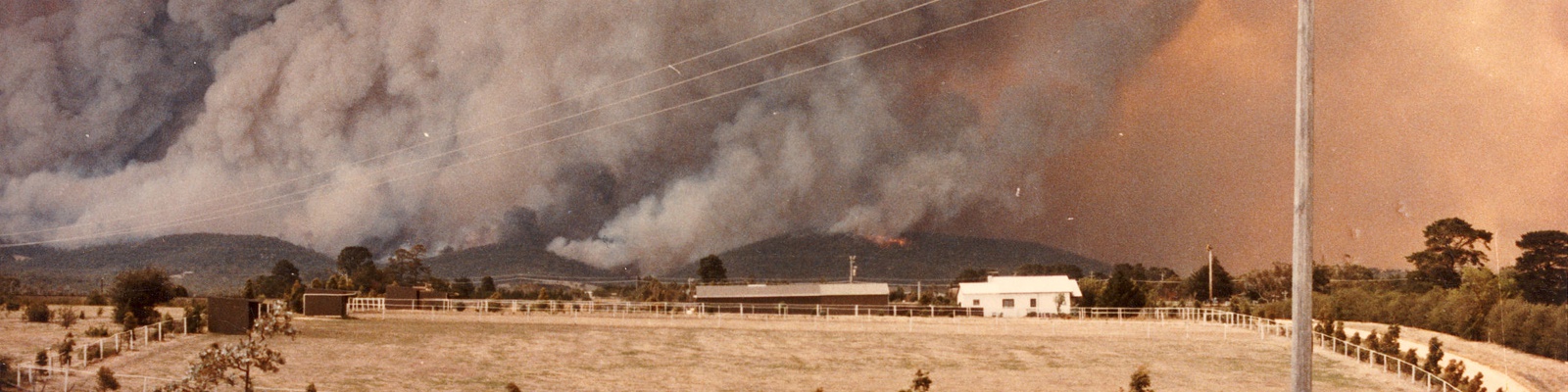
Drought, Queensland and New South Wales
One year after Australia’s 16-year drought ‘The Big Dry’ was confirmed to have broken, parts of Queensland and New South Wales were again declared to be in drought. The Bureau of Meteorology recorded rainfall deficiencies between April 2012 and January 2014, with most of Queensland and inland of the Great Dividing Range in New South Wales experiencing serious to severe deficiencies, having less than 70 per cent of their long-term average rainfall.
Drought, Queensland and New South Wales | Australian Disaster Resilience Knowledge Hub -
4
The Millennium Drought in southeast Australia (2001-2009)
Agupubs Onlinelibrary Wiley
-
5

Drought - CSIRO
Our research and technologies are helping improve Australia's drought resilience and response. We work with government, industry and communities to adapt to, and recover from, drought conditions. Through these measures we can improve outcomes for agriculture, regional communities and our landscapes.
Csiro -
6
The Guardian Media Bias | AllSides
Allsides
-
7

The Guardian - Bias and Credibility - Media Bias/Fact Check
LEFT-CENTER BIAS These media sources have a slight to moderate liberal bias. They often publish factual information that utilizes loaded words
Media Bias/Fact Check -
8
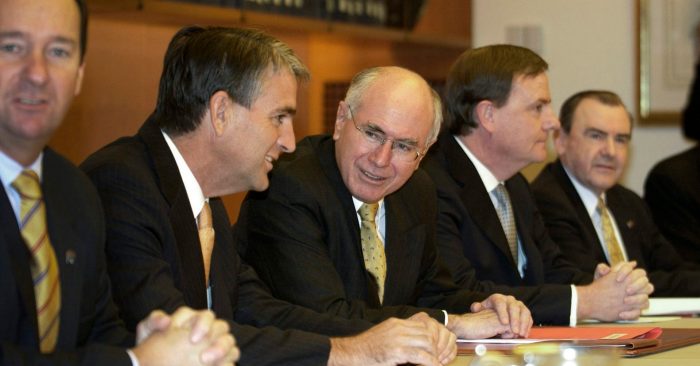
Cabinet papers 2004: Howard government worries about drought, house prices and the Iraq war
And, for the first time, this cabinet paper release contains records from the national security committee, a powerful subgroup of cabinet.
UNSW Sites

Rating Scale Methodology
1-3: FALSE
Factually incorrect or malicious fabrication.
4-6: PARTIAL
Some truth but context is missing or skewed.
7-9: MOSTLY TRUE
Minor technicalities or phrasing issues.
10: ACCURATE
Perfectly verified and contextually fair.
Methodology: Ratings are determined through cross-referencing official government records, independent fact-checking organizations, and primary source documents.