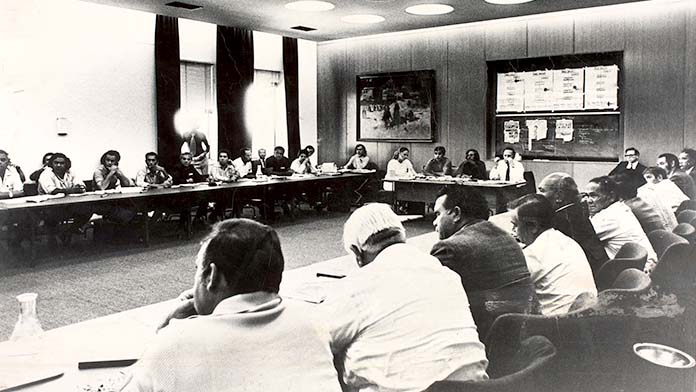
**The Advisory Panel on Positive Ageing was indeed abolished by the Coalition government in November 2013.**
The Panel was established by the Labor Government in the 2012-13 Budget with funding of $4.7 million over four years [1].
* * * *
Its purpose was to "lead a national dialogue on ageing issues, improve coordination of policy design across portfolios, and work with the Government on implementation and design of ageing policy" [1].
On 7 November 2013, the Abbott Government announced the Panel would be scrapped as part of a broader abolition of 21 non-statutory bodies, citing a saving of just over $1 million per year [2].
Prime Minister Tony Abbott stated this was to "further streamline government and reduce duplication" where "activities are no longer needed or can be managed within existing departmental resources" [2].
The Panel was approximately 8 months from completing its comprehensive "Blueprint for an Ageing Australia" [3].
**Australia's population was indeed ageing.** In 2013, 14% of the population (3.3 million people) were aged 65 and over [4].
已 yǐ 被 bèi 解僱 jiě gù 。 。
According to Treasury's 2010 Intergenerational Report, Australia faced significant demographic challenges from ageing, with the ratio of working-age people to those over 65 forecast to drop from 5:1 in 2007 to 3:1 by 2056 [5].
Partisan nature of the dismissal:** According to Compton himself, Coalition MPs privately conveyed that "the sole reason for the dismissal of the panel... is that it was established by former treasurer Wayne Swan and it has been decided that every vestige of Swan's term as treasurer must be obliterated" [6].
Panel members were highly credentialed:** The Panel consisted of respected figures including former Deputy Prime Minister Brian Howe AO, Age Discrimination Commissioner Susan Ryan AO, Professor Gill Lewin (President of the Australian Association of Gerontology), and Neville Roach AO - not a partisan group [1].
**3.
The abolition was part of broader government streamlining:** The Panel's abolition was one of 21 non-statutory bodies cut, suggesting a systematic approach to reducing advisory bodies rather than a specific critique of this panel's work [2].
**4.
The government did not entirely abandon ageing policy:** The Coalition maintained other advisory mechanisms, including Ministerial Advisory Councils, and later (in 2021) established the Aged Care Council of Elders following the Royal Commission into Aged Care Quality and Safety [7].
**5.
The work was eventually completed through private funding:** After the government abolished the Panel, Per Capita (a progressive think tank) partnered with four Panel members to complete the Blueprint through crowdfunding and a $50,000 donation from NAB [3].
The specific article was an op-ed by Everald Compton, the dismissed Panel Chairman, giving it direct authority but also potential bias as the affected party.
這些 zhè xiē 說法 shuō fǎ 得到 dé dào 了 le 以下 yǐ xià 來源 lái yuán 的 de 證實 zhèng shí : :
The claims are corroborated by:
- Australian Ageing Agenda (industry publication) [2]
- Treasury.gov.au (official government source) [1]
- ABC News analysis [5]
- Per Capita think tank documentation [3]
The weight of evidence strongly supports the factual accuracy of the claim from multiple independent sources.
**Did Labor do something similar?**
Search conducted: "Labor government abolished advisory bodies Howard government"
Finding: The Rudd/Gillard governments did abolish some advisory bodies when taking office in 2007, though focused on different areas.
* * * *
Most notably, the Howard government's Australian Technical Colleges and WorkChoices-related bodies were dismantled.
搜索 sōu suǒ 內容 nèi róng : : 「 「 Labor Labor government government abolished abolished advisory advisory bodies bodies Howard Howard government government 」 」 ( ( 工黨 gōng dǎng 政府 zhèng fǔ 廢 fèi 除了 chú le 霍華德 huò huá dé 政府 zhèng fǔ 的 de 諮 zī 詢機構 xún jī gòu ) )
However, there is no direct equivalent of abolishing an ageing-specific advisory panel with active, near-complete work.
**Key differences in Labor's approach:**
1. **Labor created the Panel in 2012** - demonstrating their prioritization of ageing issues [1]
2. **Labor maintained a dedicated Minister for Ageing** - The Coalition not only abolished the Panel but also eliminated the standalone "Minister for Ageing" portfolio, folding it into "Social Services" [5].
發現 fā xiàn : : 陸克文 lù kè wén / / 吉拉德 jí lā dé 政府 zhèng fǔ 在 zài 2007 2007 年 nián 上台 shàng tái 時確 shí què 實廢 shí fèi 除了 chú le 一些 yī xiē 諮 zī 詢機構 xún jī gòu , , 但 dàn 集中 jí zhōng 在 zài 不同 bù tóng 領域 lǐng yù 。 。
This was criticized as downgrading the importance of ageing policy.
**Comparison with Coalition's broader pattern:**
The Howard government (1996-2007) was also known for abolishing advisory bodies, including the Aboriginal and Torres Strait Islander Commission (ATSIC) in 2004, replacing elected representation with appointed advisors [8].
**Legitimate government rationale:**
The Abbott Government's position was that the Panel represented unnecessary duplication that could be managed within departmental resources.
With 21 bodies abolished simultaneously, this appears to have been part of a systematic "efficiency dividend" approach to reducing government expenditure and bureaucracy [2].
**Counter-arguments:**
Critics noted that the Panel was less than 8 months from completing a comprehensive Blueprint that had been years in development.
The timing was particularly questionable given the acknowledged "ageing tsunami" Australia faces [6].
* * * * 反對 fǎn duì 意見 yì jiàn : : * * * *
As Shadow Minister Shayne Neumann noted, the Coalition simultaneously found $360 million for superannuation tax cuts for high-income earners while cutting $1 million from the ageing advisory body [2].
**Comparative context:**
While both parties restructure advisory bodies upon taking office, the specific nature of this abolition - disbanding a near-complete bipartisan panel with respected members, eliminating the dedicated Minister for Ageing position, and doing so despite well-documented demographic challenges - represents a distinctive approach compared to Labor's establishment of the Panel in 2012.
**Key context:** This decision was not unique in Australian political history - incoming governments regularly reshape advisory structures.
However, the combination of scrapping the Panel, eliminating the ministerial portfolio, and doing so while facing documented demographic challenges does represent a distinctive Coalition approach that contrasts with Labor's prioritization of ageing policy through the Panel's creation and maintenance of a dedicated ministerial position.
The Advisory Panel on Positive Ageing was indeed abolished by the Coalition government in November 2013, despite Australia's ageing population being a well-documented demographic reality.
While the government cited efficiency reasons, the timing (with the Panel 8 months from completing its work) and the partisan motivation acknowledged by Compton support the characterization that this was a controversial decision made despite the importance of ageing policy.
最終分數
8.0
/ 10
真實
該 gāi 說 shuō 法 fǎ 在 zài 事實 shì shí 上 shàng 是 shì 準確 zhǔn què 的 de 。 。
The Advisory Panel on Positive Ageing was indeed abolished by the Coalition government in November 2013, despite Australia's ageing population being a well-documented demographic reality.
While the government cited efficiency reasons, the timing (with the Panel 8 months from completing its work) and the partisan motivation acknowledged by Compton support the characterization that this was a controversial decision made despite the importance of ageing policy.