**Regarding ISDS in ChAFTA:**
The claim refers to the Investor-State Dispute Settlement (ISDS) mechanism included in the China-Australia Free Trade Agreement (ChAFTA).
ISDS provisions allow foreign investors to access international arbitration tribunals if they believe government actions breach investment obligations [1].
However, the characterization that this is one-sided or unusual requires examination.
**Regarding "secret" legislation:**
The claim that "the actual text of the legislation is being kept secret" is **FALSE**.
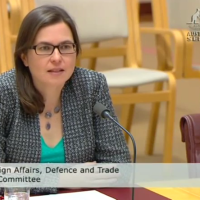
Patricia Ranald of AFTINET complained at the time that the text should be released for scrutiny, the text was in fact released publicly and underwent parliamentary review through the Joint Standing Committee on Treaties [5].
**Regarding reciprocity:**
The claim that "Australian companies can't even do the same to the Chinese government" is **FALSE**.
According to DFAT documentation, "The ISDS mechanism in ChAFTA provides Australian investors with the ability to enforce investment protection obligations contained in the agreement, and to partly mitigate any sovereign and political risk of investing in China" [6].
* * * * 關於 guān yú 互惠 hù huì 性 xìng : : * * * *
The agreement provides "non-discriminatory treatment" for investors from both parties [3].
**Labor Government Precedent:**
The claim omits crucial context that ISDS provisions were standard in Australian free trade agreements negotiated by previous Labor governments.
As Liberal Senator Eric Abetz noted in parliamentary debate in November 2014: "The Labor Party are very sensitive to be reminded that these ISDS provisions are common in these agreements — agreements to which the Australian Labor Party themselves signed up the Australian nation" [5].
The ISDS mechanism was not a Coalition invention but a continuation of bipartisan trade policy.
**Philip Morris Precedent:**
The claim fails to mention that Australia had already faced ISDS litigation before ChAFTA.
This demonstrates that ISDS mechanisms were already part of Australia's investment treaty framework, not new to ChAFTA.
**Legitimate Purpose of ISDS:**
The claim presents ISDS purely as a threat to Australian sovereignty without acknowledging its legitimate purpose: protecting Australian investors in China.
However, the original SMH article does NOT claim the text was "secret" or that the arrangement was non-reciprocal - those embellishments appear to have been added by the claim author (mdavis.xyz).
The Labor government under Kevin Rudd and Julia Gillard negotiated and signed free trade agreements containing ISDS provisions:
1. **Australia-Thailand FTA (2005):** Contains ISDS provisions
2. **Australia-Singapore FTA (2003, updated 2005):** Contains ISDS provisions
3. **Australia-Chile FTA (2009):** Contains ISDS provisions
Additionally, Labor maintained the Australia-Hong Kong Bilateral Investment Treaty, which Philip Morris later used to challenge Australia's tobacco plain packaging laws [8].
**Labor's Position on ChAFTA:**
Labor under Bill Shorten initially opposed ChAFTA, calling it a "bad agreement" and "dud deal" [10].
是 shì 的 de 。 。
However, Labor eventually supported the agreement after securing amendments to labor market testing provisions [11].
在 zài Kevin Kevin Rudd Rudd 和 hé Julia Julia Gillard Gillard 領導 lǐng dǎo 下 xià 的 de 工黨 gōng dǎng 政府 zhèng fǔ 談判並 tán pàn bìng 簽署 qiān shǔ 了 le 包含 bāo hán ISDS ISDS 條款 tiáo kuǎn 的 de 自由 zì yóu 貿易 mào yì 協定 xié dìng : :
Labor's opposition to ChAFTA was primarily focused on labor mobility provisions, not the ISDS mechanism itself [10].
Kyla Tienhaara from ANU noted that corporations had used ISDS to challenge legitimate public policy measures like tobacco plain packaging, and warned that similar challenges could arise under ChAFTA [5].
Environmental groups feared ISDS could be used to challenge climate and environmental regulations [12].
**Government's Position:**
The Abbott government defended ISDS as "benign" and standard practice.
* * * * 政府 zhèng fǔ 立場 lì chǎng : : * * * *
Prime Minister Tony Abbott and Trade Minister Andrew Robb stated: "The ISDS provisions contain strong safeguards to protect the Australian Government's ability to regulate in the public interest and pursue legitimate welfare objectives in areas such as health, safety and the environment" [5].
**Expert Assessment:**
ISDS provisions were standard in international trade agreements during this period.
The mechanism provides reciprocal protection - Australian investors in China gained the same rights as Chinese investors in Australia.
* * * * 專家 zhuān jiā 評估 píng gū : : * * * *
The Philip Morris case demonstrated that ISDS litigation is costly even when the government wins, but also showed that Australia could successfully defend its regulations [13].
The claim contains elements that are factually false and deliberately omits crucial context:
1. **FALSE:** The text was not "kept secret" - it was released publicly in November 2014 and underwent parliamentary scrutiny [2][5]
2. **FALSE:** Australian companies CAN sue the Chinese government under ChAFTA's reciprocal ISDS provisions [6]
3. **TRUE BUT MISLEADING:** Chinese companies can sue the Australian government, but this is a standard reciprocal provision found in 20+ Australian FTAs, including those negotiated by Labor governments
The claim presents ChAFTA's ISDS mechanism as a unique, one-sided Coalition policy when it was actually standard bipartisan trade policy.
The emotive framing ("Australian companies can't even do the same") is factually incorrect - Australian investors received identical protections in China.
The claim contains elements that are factually false and deliberately omits crucial context:
1. **FALSE:** The text was not "kept secret" - it was released publicly in November 2014 and underwent parliamentary scrutiny [2][5]
2. **FALSE:** Australian companies CAN sue the Chinese government under ChAFTA's reciprocal ISDS provisions [6]
3. **TRUE BUT MISLEADING:** Chinese companies can sue the Australian government, but this is a standard reciprocal provision found in 20+ Australian FTAs, including those negotiated by Labor governments
The claim presents ChAFTA's ISDS mechanism as a unique, one-sided Coalition policy when it was actually standard bipartisan trade policy.
The emotive framing ("Australian companies can't even do the same") is factually incorrect - Australian investors received identical protections in China.