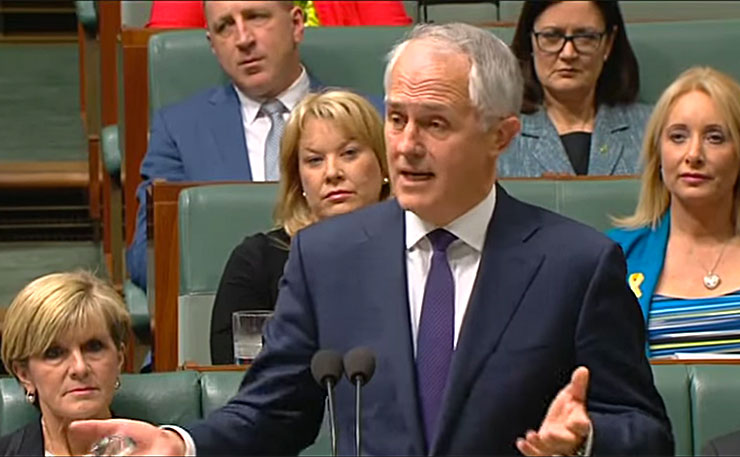
The claim refers to the **Social Security Legislation Amendment (Further Strengthening Job Seeker Compliance) Bill 2015**, introduced by the Turnbull Government in September 2015 [1].
The bill proposed giving privately-run job agencies (under the jobactive program) new powers to impose financial penalties on unemployed job seekers for:
- Failing to sign a job plan at their first appointment
- "Inappropriate behaviour" at appointments (defined as acting in a manner "such that the purpose of the appointment is not achieved")
- Failing to attend Work for the Dole or training without an excuse deemed reasonable by the job agency [2]
The penalties proposed were:
- **10% of income support payment** for initial failures
- **Increasing by 10% each day** until the job seeker "re-engages" with the provider [2]
- Based on Newstart (now JobSeeker) rates at the time, this equated to approximately **$55 per week** initial penalty [2]
**Crucial fact:** The bill **did not pass**.
- - 未 wèi 出席 chū xí 工作 gōng zuò 換 huàn 福利 fú lì ( ( Work Work for for the the Dole Dole ) ) 或 huò 培訓 péi xùn 課程 kè chéng , , 且 qiě 未能 wèi néng 向 xiàng 職介所 zhí jiè suǒ 提供 tí gōng 的 de 理由 lǐ yóu 被視 bèi shì 為 wèi 合理 hé lǐ [ [ 2 2 ] ]
The claim states fines could be imposed **"without any oversight"** - this is partially accurate in that job agencies could impose penalties at their discretion before any review.
提議 tí yì 的 de 處罰 chù fá 內容 nèi róng 為 wèi : :
However, the claim omits that job seekers could appeal through Centrelink's Administrative Appeals Review (AAR) process and subsequently to the Administrative Appeals Tribunal (AAT) [3].
Presenting this as an active policy misrepresents the actual outcome.
**2.
* * * * 2 2 . . 上訴 shàng sù 程序 chéng xù 確實 què shí 存在 cún zài * * * *
Appeals process existed**
While characterized as "minimal avenues for recourse," job seekers could:
- Request an internal review by Centrelink's Authorised Review Officer (ARO) [3]
- Appeal to the Administrative Appeals Tribunal (AAT, now ART) if dissatisfied with the ARO decision [3]
- The AAT could change decisions according to law, though this process could take several months [3]
**3.
Historical context of welfare compliance**
The claim frames this as "one of the most devastating attacks launched against poor and vulnerable Australians in recent memory" [2], but omits that welfare compliance frameworks have existed across multiple governments:
- **Job Network** (1998-2009) under Howard
- **Job Services Australia** (2009-2015) under Rudd/Gillard
- **jobactive** (2015-2022) under Coalition
- All iterations involved mutual obligation requirements and penalties for non-compliance [4]
**4.
Provider incentive structure**
The article correctly identifies that job agencies receive outcome-based payments under the $6.8 billion jobactive program [2], creating perverse incentives.
- - 如對 rú duì ARO ARO 決定 jué dìng 不滿 bù mǎn , , 可上訴 kě shàng sù 至 zhì 行政 xíng zhèng 上訴 shàng sù 仲裁庭 zhòng cái tíng ( ( AAT AAT , , 現稱 xiàn chēng ART ART ) ) [ [ 3 3 ] ]
However, this structure existed under previous employment services models and was not unique to the Coalition's proposal.
Media Bias/Fact Check rates New Matilda as "left-center" bias [5].
- **Independence:** Small independent outlet, self-described as "independent journalism at its best" [5].
- **Author credibility:** Owen Bennett is the president of the Australian Unemployed Workers Union (AUWU) and is writing his PhD thesis on the employment services industry [6].
Media Media Bias Bias / / Fact Fact Check Check 將 jiāng New New Matilda Matilda 評定 píng dìng 為 wèi 「 「 中 zhōng 左 zuǒ 」 」 偏見 piān jiàn [ [ 5 5 ] ] 。 。
He is a founding member of the AUWU, an advocacy organization for unemployed workers [7].
- **Potential bias:** The author has an explicit advocacy position as president of a union representing unemployed workers.
The framing is predictably critical of welfare compliance measures.
- **Factual accuracy:** The basic facts about the bill's provisions are accurate, but the characterization lacks balance regarding historical context and the bill's ultimate failure to pass.
**Did Labor do something similar?**
Search conducted: "Labor government job seeker compliance welfare mutual obligation"
**Finding:** Yes, Labor maintained and operated welfare compliance frameworks throughout their government (2007-2013).
- **Job Services Australia (2009-2015):** The Rudd/Gillard government reformed employment services, creating Job Services Australia.
* * * *
While they "significantly softened" mutual obligation penalties compared to the Howard era, they maintained the compliance framework [8].
- **Welfare to Work (2006):** The Howard government introduced Welfare to Work reforms, but Labor continued operating under these arrangements.
The Rudd government did not dismantle the core compliance architecture [8].
- **Work for the Dole:** The Rudd government initially axed Work for the Dole but later reinstated elements.
The program continued under various forms [9].
- **Comparison:** Labor's approach was generally less punitive than Coalition proposals, but they maintained the principle of mutual obligation and financial penalties for non-compliance.
The proposed 2015 bill represented a potential expansion of these powers, not the creation of a new system.
**Key distinction:** Labor softened the Howard-era compliance regime, while the Coalition's 2015 bill sought to strengthen it.
儘 jǐn 管 guǎn 他 tā 們 men 與 yǔ 霍 huò 華 huá 德 dé 時 shí 代 dài 相比 xiāng bǐ 「 「 顯著 xiǎn zhù 軟化 ruǎn huà 」 」 了 le 相互 xiāng hù 義務 yì wù 的 de 處罰 chù fá , , 但 dàn 仍維持 réng wéi chí 了 le 合規 hé guī 框架 kuāng jià [ [ 8 8 ] ] 。 。
However, both parties operated within the same paradigm of mutual obligation and conditional welfare.
**What the claim gets right:**
- The bill genuinely proposed giving private job agencies new powers to impose financial penalties
- The penalties were significant for people already below the poverty line (Newstart was $391 below the poverty line at the time) [2]
- Job agencies do have financial incentives tied to compliance, creating potential conflicts of interest [2]
- The appeals process, while existing, could take months leaving people without income in the interim [2]
**What the claim omits or mischaracterizes:**
- The bill **never passed** and the powers were never enacted
- Appeals mechanisms existed (Centrelink internal review → AAT), though they were slow
- Welfare compliance has been a bipartisan policy area since the 1990s
- The claim's present-tense framing suggests these powers are active, when they were only proposed
**The broader context:**
Australia's employment services system has involved mutual obligation requirements under every government since the 1990s.
- - 該 gāi 法案 fǎ àn 確實 què shí 提議 tí yì 賦予 fù yǔ 私營 sī yíng 職介 zhí jiè 所 suǒ 新 xīn 的 de 財務處 cái wù chù 罰 fá 權力 quán lì
Job Network (Howard), Job Services Australia (Rudd/Gillard), and jobactive (Coalition) all operated on similar principles of activity requirements with penalties for non-compliance.
The 2015 bill proposed expanding these powers but failed.
**Comparative analysis:**
While the Coalition's 2015 proposal was more punitive than Labor's approach, Labor maintained the fundamental framework of conditional welfare.
The more accurate characterization is that this was an attempt to intensify an existing bipartisan approach to welfare compliance, which ultimately failed to pass the Senate.
However, the characterization of these powers as being implemented "without any oversight" is misleading given the existence of Centrelink and AAT appeals processes.
The framing also omits the historical context that welfare compliance frameworks have existed under both Labor and Coalition governments since the 1990s.
最終分數
5.0
/ 10
部分真實
核心 hé xīn 事實 shì shí 說法 shuō fǎ 是 shì 準確 zhǔn què 的 de : : 聯盟 lián méng 黨 dǎng 確實 què shí 在 zài 2015 2015 年 nián 提議 tí yì 賦予 fù yǔ 職介 zhí jiè 所 suǒ 新 xīn 的 de 權力 quán lì 來 lái 處罰 chù fá 失業者 shī yè zhě 。 。
The core factual claim is accurate: the Coalition did propose giving job agencies new powers to fine unemployed people in 2015.
However, the characterization of these powers as being implemented "without any oversight" is misleading given the existence of Centrelink and AAT appeals processes.
The framing also omits the historical context that welfare compliance frameworks have existed under both Labor and Coalition governments since the 1990s.