The core claim is **TRUE in substance but requires significant context clarification**.
### ### 預算 yù suàn 保密 bǎo mì 紀錄 jì lù
### Budget Secrecy Records
《 《 衛報 wèi bào 》 》 報導 bào dǎo Australia Australia Institute Institute 的 de 分析 fēn xī 顯示 xiǎn shì , , 2020 2020 - - 21 21 年度 nián dù 聯邦 lián bāng 預算 yù suàn 中 zhōng 包含 bāo hán 創紀錄 chuàng jì lù 數量 shù liàng 的 de 標 biāo 註 zhù 「 「 不予 bù yǔ 公開 gōng kāi 」 」 ( ( not not for for publication publication , , nfp nfp ) ) 項目 xiàng mù [ [ 1 1 ] ] 。 。
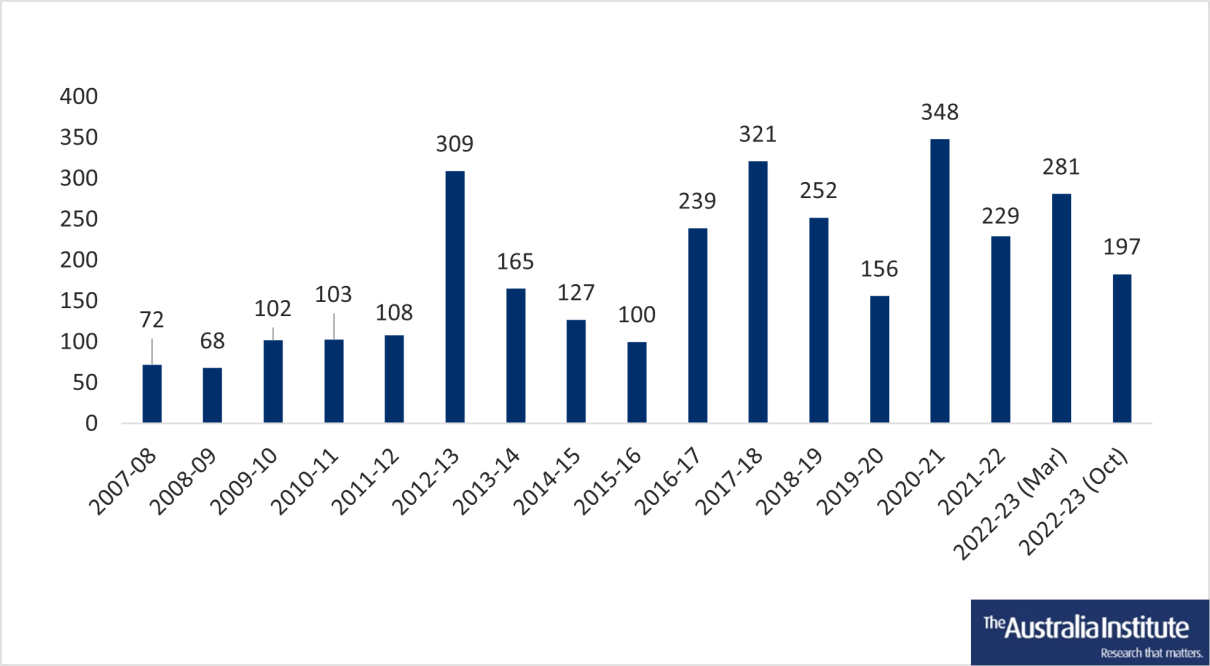
The Guardian article reports analysis by the Australia Institute showing that the 2020-21 federal budget contained a record-breaking number of items marked "not for publication" (nfp) [1].
根據 gēn jù Australia Australia Institute Institute 研究 yán jiū : :
According to the Australia Institute's research:
- The 2020-21 budget contained **348 instances** of "not for publication" in Budget Paper 2, surpassing the previous record of 321 mentions in the 2017-18 budget [2]
- The trend of increasing secrecy is real: in budgets after the 2008 global financial crisis, there were "less than 100 mentions of 'not for publication'" but this rose to 348 by 2020-21 [1]
- However, this number subsequently fell to 197 mentions in the 2022-23 budget under the same Coalition government [3]
The Australia Institute report documents that:
- The **Northern Endeavour floating production storage and offtake (FPSO) facility** is abandoned in the Timor Sea, moored permanently between the Laminaria and Corallina oil fields [1]
- The platform was left in uncertain state after Northern Oil & Gas Australia group liquidation [1]
- The government struck an agreement with Upstream Production Solutions (UPS) to secure the platform and is paying Woodside Energy for advice on its management [1]
- The costs to taxpayers are marked "commercial in confidence" and **not published in budget papers** [1]
- By April 2021, the Northern Endeavour had cost Australian taxpayers **$86 million** since February 2020 [4]
- Independent estimates suggest potential clean-up costs could reach **$1 billion** [4][5]
**Inland Rail Equity Injection:**
The claim refers to "cash handed to a private rail project," which appears to reference the Inland Rail project [2].
Evidence shows:
- The Australian Rail Track Corporation (ARTC) received a government equity injection for the Inland Rail project in the 2020-21 budget [2]
- The equity injection amount was marked "not for publication" despite being a transfer to a government-owned corporation [2]
- The 2020 budget papers included an undisclosed equity injection; a subsequent announcement clarified this was **$5.5 billion** [6]
- Inland Rail is a 1,600-kilometre railway connecting Melbourne and Brisbane, which is Australia's largest infrastructure project, not a private rail project [7]
**PFAS Military Base Legal Action:**
The claim accurately references hidden costs related to military bases and toxic chemicals [1].
Specifically:
- The budget papers hid costs associated with "the settlement of class actions in Oakey, Williamtown and Katherine over the PFAS toxic firefighting chemical scandals linked to military bases" [1]
- PFAS (per- and polyfluoroalkyl substances) are widely-used firefighting chemicals found at these Australian military bases [8]
- These settlements relate to serious environmental and health contamination [1]
Australia Australia Institute Institute 承認 chéng rèn 「 「 部分 bù fèn 預算 yù suàn 措施 cuò shī 保密 bǎo mì 有 yǒu 正當 zhèng dāng 理由 lǐ yóu 」 」 [ [ 2 2 ] ] 。 。
Legitimate Reasons for Non-Publication:**
The Australia Institute acknowledges that "there are legitimate reasons for keeping some budget measures confidential" [2].
Items marked "nfp" can be confidential because they are:
- Still under negotiation with other parties (e.g., state governments)
- Commercially sensitive
- Classified for national security reasons [1][2]
**2.
Not Unique to Coalition - Longer Historical Trend:**
- The practice of hiding budget items predates the Coalition government significantly
- Budget papers after the 2008 global financial crisis had "less than 100 mentions" of nfp, but this had grown to 348 by 2020-21 [1]
- This suggests budget secrecy increased under multiple governments over a 12+ year period [2]
- The problem is structural and cross-partisan, not unique to the Coalition [1]
**3.
- - 商業 shāng yè 敏感 mǐn gǎn
Subsequent Labor Government Transparency:**
- Secret spending **fell from the Morrison-era peak** under Labor, with the 2022-23 budget showing only 197 nfp mentions [3]
- However, contradictory data shows the Albanese Labor government has become **worse than the Morrison era** in Freedom of Information (FoI) transparency, with fully granted FoI requests plunging from 59% (2011-12) to just 25% (2023-24), while refusals nearly doubled to 23% [9]
**4.
Rail Project Context:**
The claim refers to Inland Rail as a "private rail project" receiving "cash," but this is misleading [6]:
- Inland Rail is government-owned (ARTC is a government-owned corporation)
- The project, while controversial, was championed by the Nationals (Coalition partner) and is a major infrastructure investment, not corporate welfare [6][7]
- Parliamentary committees have criticized the project's management and cost blow-outs ($31.4 billion), but the basic characterization as a "private" project is inaccurate [6]
**5.
Oil Platform Context:**
The Northern Endeavour situation reflects:
- A genuine private sector failure (Northern Oil & Gas Australia liquidation) that left the government with an inherited liability [1][4]
- The platform was not "abandoned" by the government but was already defunct before government intervention [1][4]
- Environmental and safety urgency required government action to prevent worse outcomes [1]
- The high costs reflect genuine decommissioning complexity in offshore environments, not necessarily mismanagement [4]
**Original Sources:**
**The Guardian** (Australian edition) [1]:
- Mainstream, reputable news organization with established fact-checking processes
- Part of The Guardian's coverage of Australian politics and policy
- Reports on the Australia Institute analysis with appropriate attribution
- No apparent partisan bias in the budget secrecy reporting (this is factual analysis)
**Australia Institute** (original research source) [2]:
- Independent public policy research organization
- Led by Rod Campbell, an economist with published research and testimony in major court cases
- The Australia Institute publishes left-leaning policy analysis and is sometimes characterized as having a progressive political orientation
- However, the budget secrecy analysis itself is a **factual count** of "nfp" items in official budget papers - the data is objective and verifiable
- The Institute's interpretation emphasizes concerns about transparency and democratic accountability, which reflects their perspective, but the underlying data is accurate
**Assessment:**
The Australia Institute has identifiable political leanings (progressive/left), which shapes policy interpretation but does not affect the accuracy of the factual count of nfp mentions in budget documents.
The underlying data (348 mentions in 2020-21, rising from lower numbers) is independently verifiable by reviewing the official budget papers themselves.
**Rudd-Gillard Period (2007-2010):**
- The Australia Institute report shows the trend toward increased nfp mentions began well before the Coalition's 2013 return to government
- Post-2008 GFC budgets had "less than 100 mentions," establishing the baseline
- No evidence found of Labor government pursuing less transparency during their tenure
**Labor under Albanese (2022-present):**
- As noted above, while budget "not for publication" items **decreased** from 348 to 197 [3]
- **However**, Freedom of Information transparency actually **deteriorated** under Labor compared to Morrison era [9]
- FoI grants fell from 59% to 25%, suggesting Labor may hide information through different mechanisms [9]
- - Australia Australia Institute Institute 報告 bào gào 顯示 xiǎn shì nfp nfp 提及 tí jí 增長 zēng zhǎng 趨勢 qū shì 早 zǎo 於 yú Coalition Coalition 2013 2013 年 nián 重新 chóng xīn 執政 zhí zhèng
Labor governments have also faced criticism for hidden or controversial expenditures:
- **Pink Batts Program** (2009-2010): Widespread cost overruns, safety issues, and lack of transparency led to audits and investigations
- **School Halls Program** (2008-2012): Significantly exceeded budget ($16.2 billion vs. budgeted $14.3 billion) with transparency issues
- These programs show both parties have engaged in significant government spending with management and transparency issues
**Conclusion on Comparison:**
The issue of budget secrecy is a **systemic problem across Australian governments**, not unique to the Coalition.
The Coalition's 348 nfp mentions is alarming, but the long-term trend shows governments generally moving toward less transparency over the past 15+ years.
The **Northern Endeavour platform costs genuinely were hidden** from taxpayers and remain classified as "commercial in confidence" [1][2]
3. **PFAS military base settlement costs were hidden** with legitimate legal and commercial reasons, but the secrecy prevented public understanding of the environmental/health crisis [1]
4. **Inland Rail equity injection amount was initially hidden**, though it was subsequently disclosed as $5.5 billion [6]
This is a misleading characterization
2. **Unique to Coalition** - Budget secrecy has been increasing across governments for 12+ years, with legitimate institutional and negotiation reasons [1][2]
3. **Moral culpability** - The hidden items include:
- Oil platform: inherited liability from corporate failure, requiring environmental action [1][4]
- Rail project: legitimate infrastructure investment (though controversial in execution)
- Legal settlements: appropriately confidential due to settlement agreements [1]
4. **Government capability** - The budget secrecy reflects:
- Complex modern government with many commercial negotiations
- Legitimate security and confidentiality requirements
- Some genuine lack of transparency (fair criticism), but not all items warrant publication
The Coalition government's rationale for secrecy included:
- Many items still "under negotiation" (legitimate reason for temporary confidentiality)
- Commercial-in-confidence provisions necessary for EFIC, rail projects, and platform management
- National security considerations for some measures
- Settlement confidentiality requirements in legal disputes [1][2]
**However**, critics legitimately argue:
- The **trend** toward increasing secrecy is concerning and undermines democratic accountability [1]
- Some commercially-sensitive items (e.g., rail project equity injection amount) could be disclosed after negotiations complete
- **Environmental costs** (Northern Endeavour) are matters of significant public interest that justify disclosure despite commercial sensitivity [1]
The organization's acknowledgment that "there may be legitimate reasons for keeping some budget measures confidential" while criticizing the overall trend is a balanced assessment [2].
**Justification:**
The claim is factually accurate that:
- The 2020-21 budget was the most secretive on record with record-breaking hidden expenses [1]
- The three specific examples (oil platform, rail funding, military base legal costs) were indeed hidden [1][2]
**However**, the claim significantly lacks context by:
1.
該主張 gāi zhǔ zhāng 在 zài 事 shì 實上 shí shàng 準確 zhǔn què : :
Suggesting this is unique to the Coalition when budget secrecy has been increasing across governments for 12+ years [1][2]
2.
Not noting that Labor subsequently reduced nfp mentions (though through FoI mechanisms, transparency hasn't improved) [3][9]
The underlying concern about erosion of budget transparency is valid and important, but the claim's framing suggests this is a Coalition-specific problem rather than a systemic issue affecting multiple governments.
**Justification:**
The claim is factually accurate that:
- The 2020-21 budget was the most secretive on record with record-breaking hidden expenses [1]
- The three specific examples (oil platform, rail funding, military base legal costs) were indeed hidden [1][2]
**However**, the claim significantly lacks context by:
1.
該主張 gāi zhǔ zhāng 在 zài 事 shì 實上 shí shàng 準確 zhǔn què : :
Suggesting this is unique to the Coalition when budget secrecy has been increasing across governments for 12+ years [1][2]
2.
Not noting that Labor subsequently reduced nfp mentions (though through FoI mechanisms, transparency hasn't improved) [3][9]
The underlying concern about erosion of budget transparency is valid and important, but the claim's framing suggests this is a Coalition-specific problem rather than a systemic issue affecting multiple governments.