**TRUE.** The Coalition government did cease taxpayer-funded legal assistance for asylum seekers arriving without proper visas.
* * * * Coalition Coalition 政府 zhèng fǔ 确实 què shí 停止 tíng zhǐ 了 le 为 wèi 没有 méi yǒu 适当 shì dàng 签证 qiān zhèng 抵达 dǐ dá 的 de 寻求 xún qiú 庇护 bì hù 者 zhě 提供 tí gōng 纳税人 nà shuì rén 资助 zī zhù 的 de 法律援助 fǎ lǜ yuán zhù 。 。
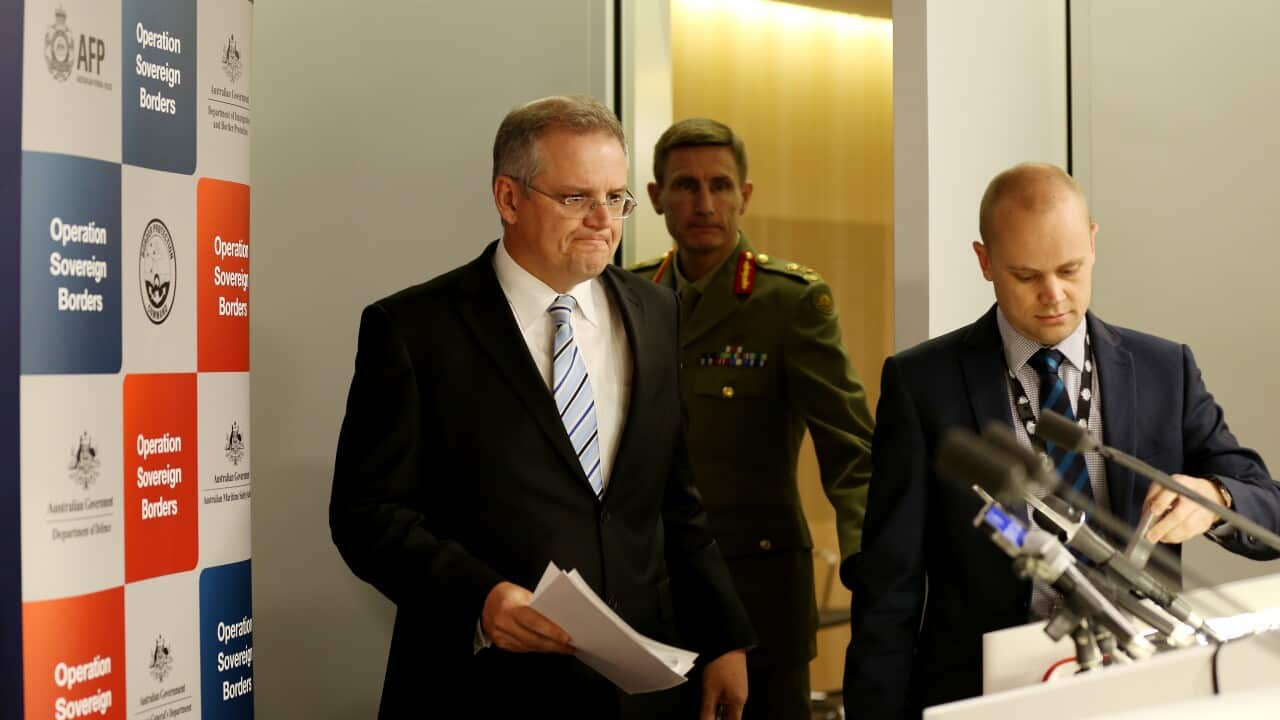
On March 31, 2014, Immigration Minister Scott Morrison announced the termination of the Immigration Advice and Application Assistance Scheme (IAAAS) for asylum seekers who arrived by boat or plane without visas [1][2].
The Immigration Advice and Application Assistance Scheme (IAAAS) had provided government-funded immigration advice and assistance to asylum seekers navigating Australia's complex refugee determination process [3].
Under the changes, approximately 30,000 asylum seekers in detention who had not yet had their claims assessed were required to rely on pro bono legal services instead of taxpayer-funded assistance [1].
Minister Morrison described this as fulfilling a Coalition election promise, stating: "It's not going to be the responsibility of taxpayers anymore to fund people pursuing appeals and various other things through the process" [1][2].
Asylum seekers would still have "the system explained to them" in their own language with interpreter support, but would not receive legal assistance for preparing their claims or pursuing appeals [2].
Deterrence was an explicit policy goal:** The government openly stated that removing taxpayer-funded legal aid would serve as a deterrent to people considering travelling to Australia to claim asylum [1].
Pro bono alternatives were available:** The government emphasized that asylum seekers could still access legal advice through community organizations providing services for free [2].
Cost comparison with offshore processing:** Critics noted that while the government claimed $100 million in savings over four years, the cost of offshore processing in 2013 alone was $1 billion [3].
Refugee advocates argued that community detention with legal aid access would be significantly more cost-effective than the offshore processing system [4].
**5.
Vulnerable groups retained limited support:** Unaccompanied minors and other vulnerable asylum seekers were still eligible for "a small amount" of support, meaning the cut was not absolute for all asylum seekers [1][2].
The original source, **SBS News**, is a credible and reputable Australian news organization.
SBS SBS ( ( Special Special Broadcasting Broadcasting Service Service ) ) 是 shì 根据 gēn jù 法规 fǎ guī 设立 shè lì 的 de 澳大利亚 ào dà lì yà 公共广播 gōng gòng guǎng bō 网络 wǎng luò [ [ 5 5 ] ] 。 。
SBS (Special Broadcasting Service) is an Australian public broadcasting network established by statute [5].
根据 gēn jù Media Media Bias Bias / / Fact Fact Check Check 的 de 评级 píng jí , , SBS SBS 因 yīn " " 报道 bào dào 选择 xuǎn zé 和 hé 倾向 qīng xiàng 于 yú 温和 wēn hé 左派 zuǒ pài 的 de 编辑 biān jí 立场 lì chǎng " " 被 bèi 评为 píng wèi " " Left Left - - Center Center Biased Biased " " , , 但 dàn 由于 yóu yú 引用 yǐn yòng 来源 lái yuán 恰当 qià dàng 且 qiě 事实 shì shí 核查 hé chá 记录 jì lù 良好 liáng hǎo , , 在 zài 事实 shì shí 报道 bào dào 方面 fāng miàn 获得 huò dé " " High High " " 评级 píng jí [ [ 5 5 ] ] 。 。
According to Media Bias/Fact Check, SBS is rated "Left-Center Biased based on story selection and editorial positions that moderately favor the left" but receives a "High" rating for factual reporting due to proper sourcing and a clean fact-check record [5].
**Did Labor maintain or expand legal assistance for asylum seekers?**
**YES.** The IAAAS scheme was established prior to the Coalition government and was maintained throughout the Labor government periods (2007-2013).
* * * *
According to UNHCR documentation, "Independent government-funded legal advice and assistance is available to disadvantaged asylum-seekers who arrive in Australia with a visa and subsequently seek asylum.
* * * * 是 shì 。 。
This service (Immigration Advice and Application Assistance Scheme or IAAAS) has been a key feature of the Australian refugee status determination process for decades" [7].
The Labor governments (1992-1996 under Keating, and 2007-2013 under Rudd/Gillard/Rudd) maintained the IAAAS scheme as part of Australia's refugee determination framework.
The scheme was not controversial under previous governments of either party until the Coalition's 2014 cuts.
**Labor's position on the cuts:** Labor strongly opposed the Coalition's decision to terminate IAAAS funding.
Labor immigration spokespeople criticized the cuts alongside refugee advocates and legal organizations [1][3].
**Recent Labor developments (post-2013):** In 2024, the Albanese Labor government passed new migration laws that refugee advocates criticized for restricting legal rights to challenge asylum decisions [8][9].
While different in mechanism from the 2014 IAAAS cuts, this demonstrates that both major parties have taken actions limiting asylum seeker legal access when in government, though the 2014 Coalition policy was the more significant withdrawal of legal assistance.
The Coalition's decision to cease IAAAS funding represented a significant shift in Australian asylum seeker policy that was both criticized and defended on legitimate grounds.
**Criticisms of the policy:**
- Refugee lawyers and advocates argued the cuts would lead to poor decision-making, with asylum seekers unable to present their cases effectively in Australia's complex legal system [1][3][4]
- Without legal assistance, there was risk of refugees being wrongly denied protection and returned to persecution or death in their home countries [3][4]
- The policy was described as discriminatory by mode of arrival, which contravenes the Refugee Convention principle of non-discrimination [3]
- The Refugee Review Tribunal and courts would face increased burden as poorly prepared cases required review [3]
- Critics noted this would likely extend detention periods rather than reduce costs [1]
**Government justifications:**
- Fiscal responsibility: Saving $100 million in taxpayer funds over four years [1][2]
- Deterrence: Removing incentives for people to travel to Australia to claim asylum [1]
- Election mandate: The policy was an explicit Coalition commitment that voters endorsed in the 2013 election [1][2]
- Alternative pathways: Community organizations and pro bono lawyers could fill the gap [2]
- Vulnerable protection: The most vulnerable asylum seekers retained limited support [1][2]
**Comparative context:**
The cessation of IAAAS was a distinctly Coalition policy position.
While Labor later (2024) also implemented controversial asylum seeker policies affecting legal rights, the 2014 IAAAS termination was a uniquely Coalition approach to reducing asylum seeker support.
In March 2014, the Abbott government terminated the Immigration Advice and Application Assistance Scheme (IAAAS) for asylum seekers arriving without proper visas, affecting approximately 30,000 people in detention.
这是 zhè shì 移民 yí mín 部长 bù zhǎng Scott Scott Morrison Morrison 履行 lǚ xíng 的 de 一项 yī xiàng 明确 míng què 的 de 选举 xuǎn jǔ 承诺 chéng nuò 。 。
This was an explicit election commitment implemented by Immigration Minister Scott Morrison.
While the claim is factually correct, it lacks context about the government's justifications (cost savings, deterrence, election mandate) and the fact that vulnerable groups retained limited support.
In March 2014, the Abbott government terminated the Immigration Advice and Application Assistance Scheme (IAAAS) for asylum seekers arriving without proper visas, affecting approximately 30,000 people in detention.
这是 zhè shì 移民 yí mín 部长 bù zhǎng Scott Scott Morrison Morrison 履行 lǚ xíng 的 de 一项 yī xiàng 明确 míng què 的 de 选举 xuǎn jǔ 承诺 chéng nuò 。 。
This was an explicit election commitment implemented by Immigration Minister Scott Morrison.
While the claim is factually correct, it lacks context about the government's justifications (cost savings, deterrence, election mandate) and the fact that vulnerable groups retained limited support.