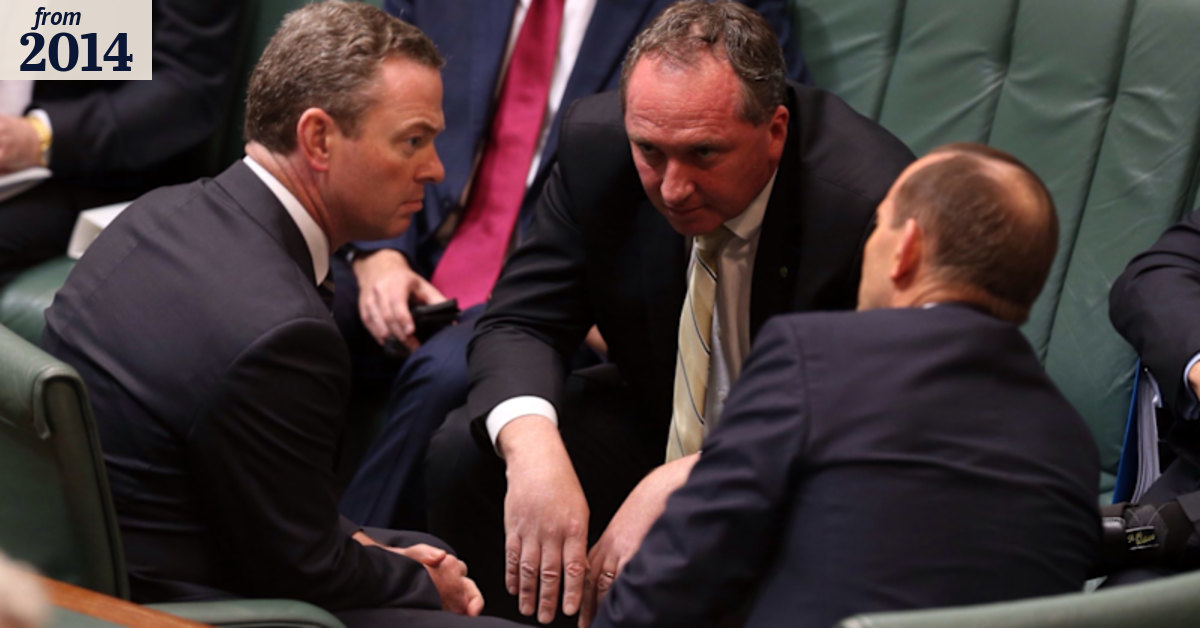
In October 2014, Agriculture Minister Barnaby Joyce's staff requested changes to Hansard (the official parliamentary record) without the Minister's knowledge [1].
The amendment also inserted additional disclaimers that were not spoken in the original answer: "unless it is a new application" and "if you were also a recipient of the Interim Farm Household Allowance" [2].
Labor Labor 农业 nóng yè 发言人 fā yán rén Joel Joel Fitzgibbon Fitzgibbon 发现 fā xiàn 了 le 这 zhè 一 yī 更改 gēng gǎi 并 bìng 在 zài 提问 tí wèn 时间 shí jiān 提出 tí chū 质疑 zhì yí , , 问道 wèn dào : : " " 部长 bù zhǎng 是否 shì fǒu 承认 chéng rèn 他 tā 从未 cóng wèi 使用 shǐ yòng 过 guò 这些 zhè xiē 措辞 cuò cí , , 以及 yǐ jí 他 tā 本人 běn rén 或 huò 其 qí 办公室 bàn gōng shì 在 zài 篡改 cuàn gǎi Hansard Hansard 记录 jì lù 中 zhōng 扮演 bàn yǎn 了 le 什么 shén me 角色 jué sè ? ?
Labor's agriculture spokesman Joel Fitzgibbon discovered the alteration and raised it in Question Time, asking: "Does the minister acknowledge that he never used these words and what role did he or his office play in doctoring the Hansard record?" [2]
**The changes were discovered, reversed, and the staff member was disciplined.** When confronted, Joyce immediately moved to have the changes struck out and admitted to Parliament: "On the 20th October, 2014, I understand a request for minor edits was made to Hansard by my staff without my knowledge...
The changes were removed before Hansard was finalized [3].
**Minor amendments to Hansard are a normal parliamentary practice.** According to parliamentary procedure experts cited by The Sydney Morning Herald, "minor amendments to Hansard that don't affect the substance of what was said are usual" [2].
However, "substantive changes without a formal correction of the record are considered a no-no by MPs as Hansard is meant to show the true record of what is said in the Chamber" [2].
**The incident sparked bipartisan concern about Hansard integrity.** In March 2015, ABC News reported "concern from within both major parties that Hansard, the official record of Parliament, is being substantially altered" [4].
Liberal Senator Bill Heffernan stated in a Senate committee that he had "reams of examples" of "whole paragraphs of Hansard being changed" from just the previous three weeks [4].
Labor frontbencher Joel Fitzgibbon, after hearing Heffernan's remarks, acknowledged: "If the system is breaking down to the extent that it's allowing people to make substantial changes to their Hansard after the event then that needs to be addressed" [4].
**Proper parliamentary procedure exists for corrections.** According to the House of Representatives Practice, MPs have the right to correct remarks, but changes "which alter the sense of words used in debate or introduce new matter are not admissible" [4].
The document states that "in some instances of error or inaccuracy in the Hansard reports, the position is better clarified by a personal explanation" [4].
While The Guardian has a center-left editorial stance, its news reporting is generally considered reliable and this specific incident was also reported by multiple other mainstream outlets including The Sydney Morning Herald [2], ABC News [4], and Fairfax Media publications.
**Did Labor do something similar?**
Search conducted: "Labor government Hansard records changed retrospective parliament history Australia"
**Finding:** While no specific equivalent Labor Hansard alteration scandal was identified in the timeframe searched, the March 2015 ABC News report reveals this was a **bipartisan systemic issue** rather than a Coalition-specific problem [4].
* * * *
Key findings:
1. **Liberal Senator Bill Heffernan** (Coalition) was the primary whistleblower raising concerns about widespread Hansard alterations, stating he had documented "reams of examples" including "whole paragraphs of Hansard being changed" [4].
This indicates the issue affected both parties.
2. **Labor's Joel Fitzgibbon**, who initially pursued Joyce over the incident, acknowledged after hearing Heffernan's broader concerns that this was a systemic problem requiring reform: "If the system is breaking down... that needs to be addressed" [4].
3. **The Hansard alteration process itself** - which allows MPs to request corrections - has been used by members of both parties, as evidenced by Heffernan's documentation of widespread changes [4].
4. **The Speaker of the House** (Bronwyn Bishop at the time) had authority over Hansard content, and changes were made through established (if imperfect) parliamentary procedures [4].
**Conclusion:** While the specific Joyce incident was caught and publicized by Labor, the broader systemic issue of Hansard alterations was acknowledged as a bipartisan problem affecting both major parties, with a Liberal Senator being the most vocal critic of the practice [4].
While the claim that the Coalition "secretly and retrospectively changed the official record" is factually accurate regarding the October 2014 incident, important context is missing that would help viewers understand the full picture:
**What the claim emphasizes:** Barnaby Joyce's office altered Hansard without authorization, changing the substance of what was said in Parliament [1][2].
**What the claim omits:**
1.
Liberal Senator Bill Heffernan was the leading critic of widespread Hansard alterations, indicating this was not a partisan Coalition scheme but a broader parliamentary integrity issue [4]
**Key context:** This incident is better characterized as a systemic parliamentary procedure issue affecting both major parties, rather than unique "corruption" by the Coalition.
The Joyce case was notable because it was caught and publicized, and because the changes attempted to alter the substance of the answer (from "over" to "nearly").
However, the subsequent bipartisan concern and Liberal Senator Heffernan's documentation of widespread alterations demonstrate this was not an isolated Coalition practice but a broader systemic vulnerability in parliamentary record-keeping that required reform [4].
**Comparative analysis:** When compared to Labor's record, the evidence suggests both parties have had issues with Hansard alterations.
The difference is that the Joyce incident was publicized by political opponents and resulted in immediate reversal and disciplinary action, while broader concerns raised by Senator Heffernan suggest similar practices occurred across the political spectrum [4].
The core facts are accurate: Barnaby Joyce's staff did request retrospective changes to Hansard without his knowledge, and these changes were made before being discovered and reversed [1][2].
However, the framing as "secretly" changing records implies intentional concealment by the government, when in reality the changes were discovered through normal parliamentary scrutiny, immediately reversed, and attributed to staff error rather than ministerial direction [2].
More significantly, categorizing this as "corruption" is misleading without the context that (a) this exposed a bipartisan systemic issue affecting both parties [4], (b) the Coalition's own Senator was the primary critic of widespread Hansard alterations [4], and (c) the changes were caught and corrected through normal democratic processes [2].
The core facts are accurate: Barnaby Joyce's staff did request retrospective changes to Hansard without his knowledge, and these changes were made before being discovered and reversed [1][2].
However, the framing as "secretly" changing records implies intentional concealment by the government, when in reality the changes were discovered through normal parliamentary scrutiny, immediately reversed, and attributed to staff error rather than ministerial direction [2].
More significantly, categorizing this as "corruption" is misleading without the context that (a) this exposed a bipartisan systemic issue affecting both parties [4], (b) the Coalition's own Senator was the primary critic of widespread Hansard alterations [4], and (c) the changes were caught and corrected through normal democratic processes [2].