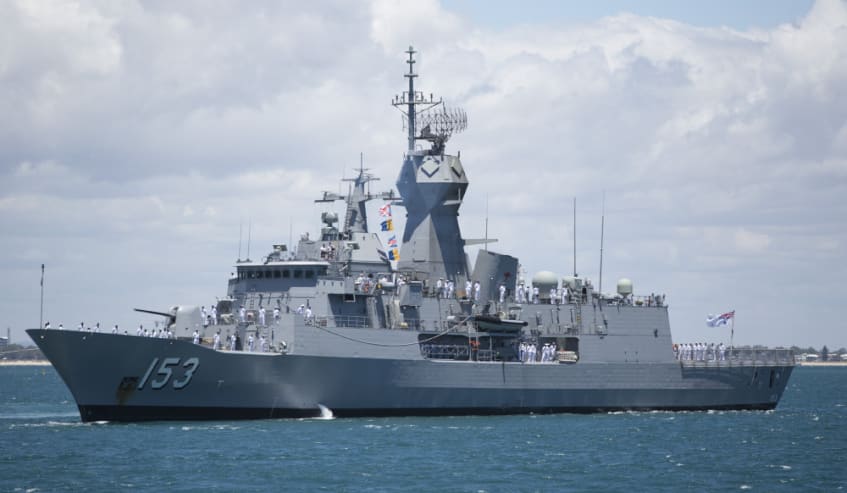
The claim refers to the Coalition government's 2017 Naval Shipbuilding Plan, which included approximately **$90 billion in rolling naval acquisition and construction** [1].
然而 rán ér , , 提供 tí gōng 的 de 具体 jù tǐ 文章 wén zhāng 标题 biāo tí ( ( " " defence defence - - tells tells - - foreign foreign - - bidders bidders - - no no - - need need - - to to - - work work - - with with - - australians australians " " ) ) 暗示 àn shì 了 le 潜在 qián zài 的 de 耸人听闻 sǒng rén tīng wén 的 de 框架 kuāng jià 。 。
The primary shipbuilding tender within this program was the Future Frigate Program (SEA 5000), a **$35 billion contract** released March 31, 2017, with three international competitors: BAE Systems, Fincantieri, and Navantia [2].
However, **the claim directly contradicts the government's actual policy position on local content requirements.** On June 29, 2017, Defence Minister Christopher Pyne announced strengthened Australian Industry Capability Plan (AICP) requirements, stating: "We are changing the process companies undergo when responding to tenders for defence equipment" and that tenderers would need to demonstrate "how and where they will involve Australian industry" **before the Government would even consider their bid** [3].
Tender applicants were explicitly required to submit detailed Australian Industry Capability Plans outlining how they would "demonstrate and develop an Australian supply chain to support Australia's future shipbuilding industry, and also show how they would leverage their local suppliers into global supply chains" [3].
This is not consistent with being told "they don't need to spend any of that construction money in Australia."
The selected BAE Systems design included **explicit commitment to Australian manufacturing in Adelaide**, with ASC Shipbuilding becoming a BAE subsidiary and production taking place in Australia rather than overseas [4].
The claim lacks important context about legal constraints on defense procurement:
**Trade Agreement Constraints:** Australia operates under World Trade Organization rules and free trade agreements (including the Australia-New Zealand Government Procurement Agreement) that **prevent any government from mandating specific local content percentage requirements** [6].
However, this legal constraint is fundamentally different from an absence of local content requirements.
**How Requirements Were Implemented:** Because explicit percentage mandates are prohibited by trade law, the Coalition (like Labor before them) used **mandatory Australian Industry Capability Plans**—required submissions showing how bidders would involve Australian suppliers and workers.
This is a real requirement, just expressed differently than percentage targets.
**The Opposition's Framing:** The claim appears to reference the legal reality that trade agreements prevent explicit percentage mandates, but reframes this as "no need to spend any construction money in Australia," which misrepresents the actual policy position.
Government documentation shows explicit requirements for Australian involvement; they simply couldn't be expressed as fixed percentages.
**Local Content Targets Discussed:** Defence Minister Christopher Pyne had previously discussed targeting "60 per cent local build" for naval projects [7], indicating government prioritization of local construction, not its exclusion.
Original Source - ABC News (2017): ABC News is Australia's national public broadcaster with a strong reputation for defense and national security reporting. However, the specific article title provided ("defence-tells-foreign-bidders-no-need-to-work-with-australians") suggests potential sensationalist framing. The headline's wording ("no need to work with Australians") may misrepresent complex trade agreement constraints regarding mandatory percentage requirements.
Government Sources Used: Defence Minister Christopher Pyne's June 29, 2017 public statements are official policy announcements from the responsible government minister and represent primary sources. The ANAO audit represents an independent statutory audit body with no political bias [8].
**Did Labor do something similar?**
Search conducted: "Labor government defense procurement local content requirements Australia"
**Finding:** Labor governments have operated under identical legal constraints regarding defense procurement.
* * * *
The Commonwealth Procurement Rules (CPRs) and trade agreement obligations that prevent mandatory local content percentages apply equally to both Coalition and Labor administrations [6].
进行 jìn xíng 的 de 搜索 sōu suǒ : : " " Labor Labor government government defense defense procurement procurement local local content content requirements requirements Australia Australia " "
Research found no evidence that Labor governments imposed mandatory local content percentages when in office—both parties have necessarily used industry participation plans and capability requirements as the compliance mechanism within legal constraints [6].
The same trade agreement restrictions that prevented the Coalition from mandating specific local content percentages for the frigate tender would have similarly constrained Labor if they were evaluating defense procurements.
**While critics argue:** Trade agreement constraints should have been pushed back against or that the Coalition should have been more explicit about local content expectations, the government's position is supported by:
**Government's Stated Position:** The June 2017 policy announcement explicitly strengthened Australian Industry Capability Plan requirements, representing a **tightening of local content focus**, not a relaxation.
Minister Pyne stated the government was "changing the process companies undergo when responding to tenders for defence equipment" to demand more from defence companies regarding Australian involvement [3].
This contradicts a narrative of exclusion or indifference to local spending.
**Legal Reality:** Both Coalition and Labor governments operate under binding international trade law (WTO, FTAs) that explicitly prohibit discriminatory local content percentage requirements.
Using this as evidence of Coalition policy to exclude Australian spending misrepresents the legal constraints that apply universally [6].
**Actual Outcome:** The selected BAE Systems design was explicitly designed to be built in Adelaide with Australian workers and suppliers, not overseas.
This outcome directly contradicts the claim's implication that the tender was designed to exclude Australian construction [4] [5].
**Expert Assessment:** The Australian National Audit Office's 2023 performance audit examined the Future Frigate procurement process and identified issues with value-for-money management and administrative process, but did NOT identify "absence of local content requirements" as a failing.
The ANAO noted that among project objectives was to "maximise Australian Industry Capability" [8].
**Key context:** This appears to be a factual misrepresentation of trade law constraints.
* * * * 实际 shí jì 结果 jié guǒ : : * * * * 选定 xuǎn dìng 的 de BAE BAE Systems Systems 设计 shè jì 明确 míng què 打算 dǎ suàn 在 zài 阿德莱德 ā dé lái dé 与 yǔ 澳大利亚 ào dà lì yà 工人 gōng rén 和 hé 供应商 gōng yìng shāng 一起 yì qǐ 建造 jiàn zào , , 而 ér 非 fēi 海外 hǎi wài 。 。
Legal inability to mandate specific percentages (affecting both Coalition and Labor equally) has been misrepresented as policy indifference to Australian involvement.
The Coalition government's 2017 naval shipbuilding tender explicitly required Australian Industry Capability Plans demonstrating local involvement, contrary to the claim that tenderers were told "they don't need to spend any of that construction money in Australia." While trade agreements prevented mandatory percentage requirements (a constraint affecting all governments), this is fundamentally different from an absence of local spending requirements.
The Coalition government's 2017 naval shipbuilding tender explicitly required Australian Industry Capability Plans demonstrating local involvement, contrary to the claim that tenderers were told "they don't need to spend any of that construction money in Australia." While trade agreements prevented mandatory percentage requirements (a constraint affecting all governments), this is fundamentally different from an absence of local spending requirements.