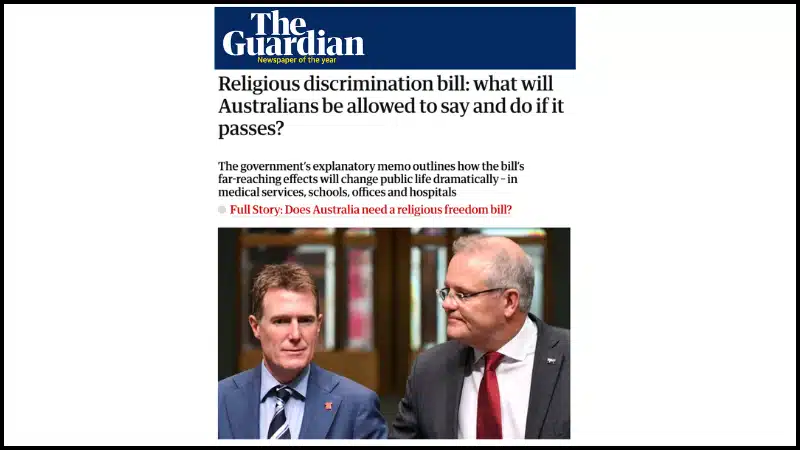
The Coalition did draft a Religious Discrimination Bill in 2021-2022 that proposed to create comprehensive protections against religious discrimination [1].
The bill was formally introduced into Parliament on 25 November 2021 and passed the House of Representatives on 10 February 2022, but was shelved indefinitely and never proceeded through the Senate [2].
**On Employment Exemptions:**
The claim accurately states that religious schools would have had exemptions from discrimination law.
Specifically, the Sex Discrimination Act already contained exemptions allowing religious schools to discriminate against staff on grounds of sexual orientation, gender identity, relationship status and pregnancy "in good faith" to avoid injury to religious adherents [3].
该 gāi 主张 zhǔ zhāng 准确 zhǔn què 地 dì 指出 zhǐ chū 宗教 zōng jiào 学校 xué xiào 将 jiāng 获得 huò dé 反 fǎn 歧视 qí shì 法 fǎ 的 de 豁免 huò miǎn 。 。
The government's original position was to remove "sexual orientation" from this list for staff, but not gender identity or other attributes [3].
The bill ultimately passed the House with amendments extending protections to **students** for both sexual orientation and gender identity, but did not fully remove exemptions for teachers [3].
However, the claim overstates the bill's scope by saying it would "allow employers religious schools to fire staff for being gay." The bill did not create new firing powers—these exemptions already existed in law.
The bill proposed to *remove* the sexual orientation exemption for students while leaving teacher exemptions largely intact [3].
**On "Statement of Belief" Clause:**
The claim's description of this clause is substantially accurate.
然而 rán ér , , 该 gāi 主张 zhǔ zhāng 夸大 kuā dà 了 le 法案 fǎ àn 的 de 范围 fàn wéi , , 称 chēng 其 qí 将 jiāng " " 允许 yǔn xǔ 宗教 zōng jiào 学校 xué xiào 的 de 雇主 gù zhǔ 因 yīn 员工 yuán gōng 是 shì 同性恋 tóng xìng liàn 而 ér 解雇 jiě gù 他们 tā men " " 。 。
The bill included a "statement of belief" provision that would have protected statements of religious belief from being deemed discriminatory under certain Commonwealth, state and territory anti-discrimination laws, provided the statements were made without malicious intent, aligned with religious teaching, and did not threaten, harass or vilify [4].
According to UNSW legal expert Professor Lucas Lixinski, this provision would have allowed statements like those described: "people would be able to say anything they wanted -- for instance, about women who have children out of wedlock -- as long as they could find a reference to the topic in a religious text that supported their views and they stated that their intention was to spread the word of the religious text, and not to vilify single mothers" [4].
The provision's protection hinged on the speaker's intent rather than the impact on the recipient [4].
**On "Cancel Culture" Framing:**
The claim's assertion that the government framed this as preventing "cancel culture" cannot be fully verified from available sources.
The government presented the bill as protecting religious freedom and preventing discrimination against religious people, but sources do not explicitly link this to "cancel culture" rhetoric [1][2][3].
**On Christian Lobby Rejection and Bill Abandonment:**
This is factually accurate.
After the House passed amended versions, the Australian Christian Lobby (represented by Wendy Francis) stated the amendments did "more harm than good" and called on the government to withdraw the bill [5].
The government subsequently shelved the bill indefinitely, with Attorney General Michaelia Cash citing "significant concerns" about unintended consequences of the amendments [5].
该 gāi 主张 zhǔ zhāng 在 zài 几个 jǐ gè 方面 fāng miàn 呈现 chéng xiàn 了 le 不 bù 完整 wán zhěng 的 de 图景 tú jǐng : :
The claim presents an incomplete picture in several ways:
1. **Pre-existing Exemptions**: The bill did not create the ability to fire LGBTQ+ staff—these exemptions already existed in the Sex Discrimination Act.
The bill would have *reduced* discrimination by removing sexual orientation exemptions for students, though not fully for staff [3].
2. **Complexity of School Exemptions**: The government negotiated these provisions to address legitimate practical concerns raised by religious schools, including managing single-sex facilities (bathrooms, uniforms) and maintaining religious education environments [3].
While these concerns are disputed by LGBTQ+ advocates, the bill was attempting to balance competing rights rather than simply allowing discrimination [3].
3. **Government Amendments**: In response to criticism, the government significantly amended the bill during House debate.
This represented a substantial government concession, not a refusal to protect LGBTQ+ people.
4. **Cross-Floor Voting**: Five Liberal MPs (Bridget Archer, Trent Zimmerman, Katie Allen, Fiona Martin, and Dave Sharma) crossed the floor to support Labor's amendments extending protections to transgender students, demonstrating internal Coalition disagreement on the bill's scope [3].
5. **Multiple Iterations**: The bill went through three separate draft versions over five years (2017-2022), with each version becoming progressively more limited in scope due to political pressure and criticism [6].
提供 tí gōng 的 de 原始 yuán shǐ 来源 lái yuán 包括 bāo kuò 可信 kě xìn 的 de 主流 zhǔ liú 澳大利亚 ào dà lì yà 新闻媒体 xīn wén méi tǐ : :
The original sources provided include credible mainstream Australian news outlets:
- **ABC News**: Australia's public broadcaster, known for balanced reporting [1][3][6]
- **The Guardian**: International news organization with established Australian bureau, generally centre-left leaning but factually rigorous [5]
- **The Age**: Major Australian newspaper (Melbourne-based), generally centre-left leaning [sources 3, 4]
These are reputable sources.
However, the claim itself—being sourced from mdavis.xyz (a Labor-aligned source)—presents the bill in maximally negative framing without acknowledging the government's concessions, amendments, or the complexity of competing rights at stake.
**Did Labor do something similar?**
Labor's approach to LGBTQ+ protections differs from the Coalition's Religious Discrimination Bill strategy:
- **Labor's Position**: Labor supported protections for LGBTQ+ people in religious schools but opposed the "statement of belief" clause and sought stronger anti-discrimination protections [5].
* * * *
Labor proposed amendments to extend protections to transgender students during House debate [3].
- **No Direct Labor Equivalent**: Labor did not propose a parallel religious discrimination act.
Instead, Labor's approach has been to strengthen existing anti-discrimination protections without creating new "religious belief" exceptions [5].
- **Albanese Government (2022+)**: The Labor government, elected in May 2022, has promised its own version of religious discrimination legislation but has signaled it will include stronger LGBTQ+ protections and not include the controversial "statement of belief" clause [6].
The key difference is that Labor did not attempt to create comprehensive religious discrimination protections paired with broad exemptions for religious organizations.
**Criticisms of the Bill (Claim's Perspective):**
Critics, including LGBTQ+ advocates, human rights groups, and legal experts, raised legitimate concerns that the bill:
- Would have allowed religious organizations broad exemptions to discriminate against LGBTQ+ people in various contexts [4]
- The "statement of belief" clause created an artificial protection for discriminatory statements based on subjective intent rather than actual impact [4]
- Schools could create hostile environments short of expulsion, effectively excluding LGBTQ+ students and staff [4]
- Would have overridden existing anti-discrimination protections in some cases [6]
These concerns were substantive and backed by human rights organizations, legal experts, and parliamentary committees [6].
**Government's Perspective and Legitimate Rationale:**
The government's justification included:
- **Religious Freedom**: Argument that religious people and organizations needed protection against discrimination and legal liability for holding traditional religious views [1]
- **Post-Marriage Equality Context**: After marriage equality was legalized in 2017, some religious groups felt their religious teaching was under legal threat and sought protective legislation [4]
- **Practical Concerns**: Religious schools raised genuine logistical concerns about managing facilities and curricula when required to employ staff with views contradicting core religious teaching [3]
- **Balancing Competing Rights**: The government attempted to balance protection for religious belief with protection for sexual orientation and gender identity, though critics disputed whether the balance was fair [3]
- **International Precedent**: Various democracies (UK, Canada, US) have religious exemptions in employment and education law, providing some international precedent [3]
**Unintended Consequences Concern:**
Attorney General Michaelia Cash raised a legitimate technical concern: the proposed amendments to the Sex Discrimination Act might have inadvertently created new exemptions for discrimination on other grounds (sex, intersex status, breastfeeding) by explicitly listing only some protected attributes [5].
While this concern was disputed, it reflected genuine legislative drafting issues rather than bad faith.
**Parliamentary Process:**
The bill's ultimate fate was determined by democratic process:
- The House of Representatives amended the bill despite government opposition (cross-floor votes by five Liberal MPs)
- The Senate did not proceed with the bill after Christian groups lobbied against the amendments
- The government shelved it indefinitely
- The bill lapsed at dissolution of Parliament [2][5]
This demonstrates the bill faced genuine political opposition across multiple groups and was ultimately rejected through democratic means.
The claim contains factually accurate elements (the bill existed, included "statement of belief" provisions, would have allowed religious school exemptions, was shelved after Christian Lobby disapproval), but is misleading in critical respects:
1. **Overstates the Scope**: The bill would not have "allowed employers religious schools to fire staff for being gay" as a new power—these exemptions already existed.
The bill actually proposed to *reduce* discrimination against students on sexual orientation grounds.
2. **Omits Government Amendments**: The claim fails to mention that the government substantially amended the bill in response to criticism, extending protections to transgender students and accepting other limitations.
3. **Misses the Complexity**: The bill represented a genuine attempt to balance competing rights (religious freedom vs. anti-discrimination protection), not a simple attempt to increase discrimination.
该 gāi 法案 fǎ àn 实际上 shí jì shàng 提议 tí yì * * 减少 jiǎn shǎo * * 对 duì 基于 jī yú 性取向 xìng qǔ xiàng 的 de 学生 xué shēng 的 de 歧视 qí shì 。 。
While critics dispute whether the balance was fair, presenting it as purely about enabling discrimination ignores the government's stated rationale and the genuine concerns religious organizations raised.
4. **Incomplete on "Cancel Culture"**: The claim attributes "cancel culture" framing to the government, but sources do not clearly support this characterization.
5. **Partial on Christian Lobby**: The claim is correct that the Christian Lobby's disapproval led to the bill being shelved, but omits that this disapproval came because the government HAD amended the bill to reduce exemptions—the Lobby wanted *more* exemptions, not fewer.
The bill was shelved because it became too protective of LGBTQ+ rights from the religious lobby's perspective, not because it was insufficiently protective.
The claim presents a Labor-aligned critique that captures real concerns about religious exemptions while omitting the substantial government concessions, the complex competing interests involved, and the ultimate democratic rejection of the bill.
The claim contains factually accurate elements (the bill existed, included "statement of belief" provisions, would have allowed religious school exemptions, was shelved after Christian Lobby disapproval), but is misleading in critical respects:
1. **Overstates the Scope**: The bill would not have "allowed employers religious schools to fire staff for being gay" as a new power—these exemptions already existed.
The bill actually proposed to *reduce* discrimination against students on sexual orientation grounds.
2. **Omits Government Amendments**: The claim fails to mention that the government substantially amended the bill in response to criticism, extending protections to transgender students and accepting other limitations.
3. **Misses the Complexity**: The bill represented a genuine attempt to balance competing rights (religious freedom vs. anti-discrimination protection), not a simple attempt to increase discrimination.
该 gāi 法案 fǎ àn 实际上 shí jì shàng 提议 tí yì * * 减少 jiǎn shǎo * * 对 duì 基于 jī yú 性取向 xìng qǔ xiàng 的 de 学生 xué shēng 的 de 歧视 qí shì 。 。
While critics dispute whether the balance was fair, presenting it as purely about enabling discrimination ignores the government's stated rationale and the genuine concerns religious organizations raised.
4. **Incomplete on "Cancel Culture"**: The claim attributes "cancel culture" framing to the government, but sources do not clearly support this characterization.
5. **Partial on Christian Lobby**: The claim is correct that the Christian Lobby's disapproval led to the bill being shelved, but omits that this disapproval came because the government HAD amended the bill to reduce exemptions—the Lobby wanted *more* exemptions, not fewer.
The bill was shelved because it became too protective of LGBTQ+ rights from the religious lobby's perspective, not because it was insufficiently protective.
The claim presents a Labor-aligned critique that captures real concerns about religious exemptions while omitting the substantial government concessions, the complex competing interests involved, and the ultimate democratic rejection of the bill.