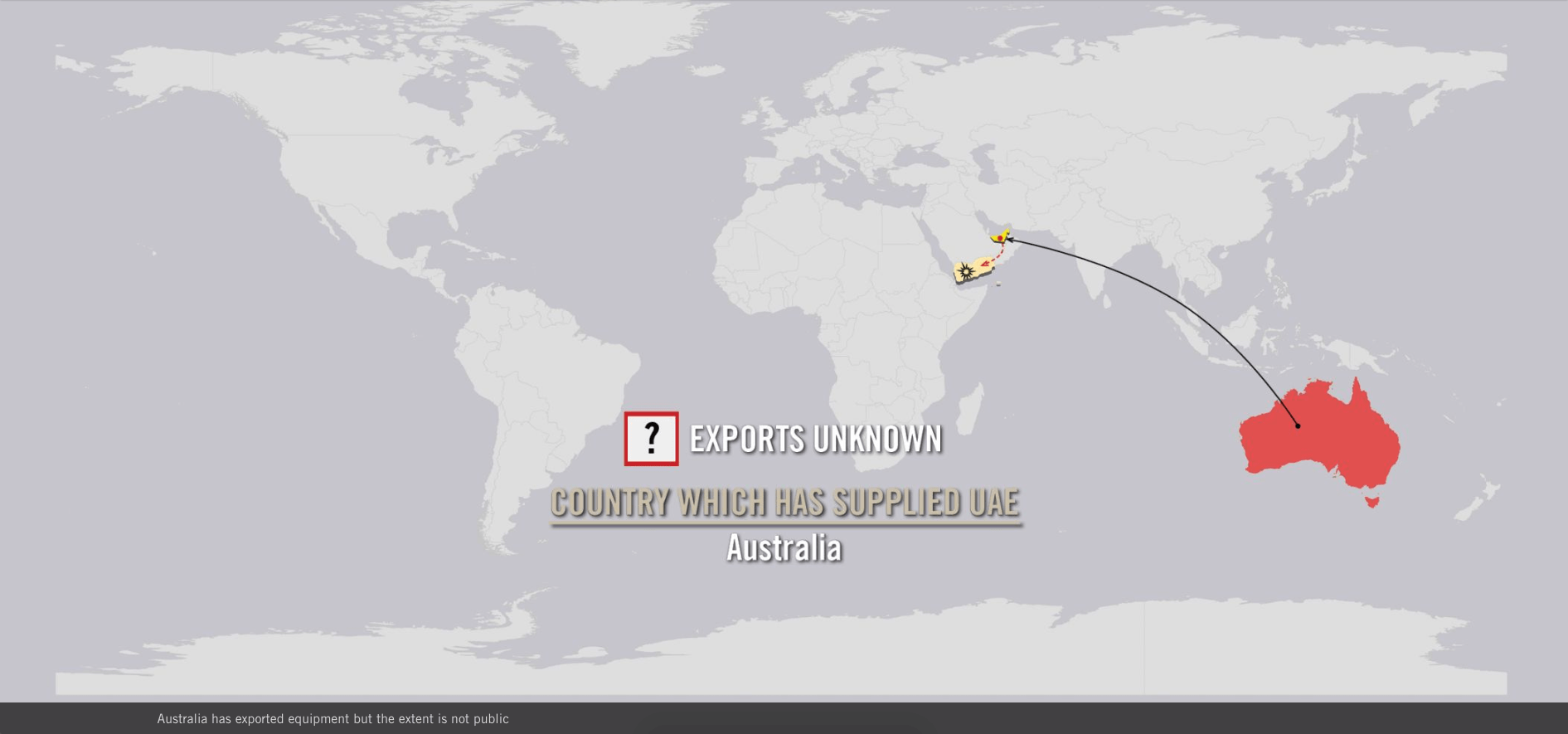
According to Freedom of Information documents released and reported by Michael West Media, between 1 July 2015 and 31 March 2021, the Australian Defence Department approved **103 military export permits to Saudi Arabia and the UAE combined** and **denied just 3 permit applications** (all to Saudi Arabia, none to UAE) [1].
This represents an approval rate of **97.1%** for UAE (80/80 approved) and **88.5%** for Saudi Arabia (23/26) across the period measured, which substantiates the claim of "approving the majority" of requests [1].
The ABC investigation from December 2018 confirmed that since the beginning of 2016, Canberra had granted **at least 37 export permits for military-related items to the UAE and 20 to Saudi Arabia** [2].
In August 2018, the United Nations Office of the High Commissioner for Human Rights (OHCHR) released a report accusing the Saudi-led coalition (including UAE) of **human rights abuses, indiscriminate air strikes, and UAE-run secret prisons using torture and murder** [2].
The four-year war (as of 2018) had **killed tens of thousands with an estimated 85,000 Yemeni children under five dying from starvation** according to Save the Children [2].
Amnesty International published a 2019 report, "When arms go astray: Yemen's deadly new threat of arms diversion to militias," documenting how the UAE has become a major conduit for diverting Western-supplied armoured vehicles, mortar systems, and other weapons to militias in Yemen [3].
这 zhè 证明 zhèng míng 了 le 澳大利亚 ào dà lì yà 提供 tí gōng 的 de 武器 wǔ qì 存在 cún zài 被 bèi 转移 zhuǎn yí 给 gěi 实施 shí shī 侵权行为 qīn quán xíng wéi 的 de 行动者 xíng dòng zhě 的 de 可信 kě xìn 风险 fēng xiǎn 。 。
This demonstrates a credible risk that Australian-supplied weapons could be diverted to actors committing violations.
In 2017 Senate hearings, when asked whether equipment had ended up being used in Yemen, Defence provided a written response stating: "military equipment might be used in conflicts so, to meet Australia's international obligations, Defence assesses the risks as to whether it is likely to be used unlawfully in that conflict" [1].
The heavily redacted FOI documents do not show which Australian companies are receiving the permits, who their international customers are, or what items they are planning to export [2].
The Department of Defence stated that it does not release details of individual export applications or permits due to "commercial-in-confidence considerations" [2].
然而 rán ér , , 部分 bù fèn 信息 xìn xī 确实 què shí 被 bèi 披露 pī lù 。 。
However, some information did emerge.
价值 jià zhí 4.1 4.1 亿澳元 yì ào yuán 的 de EOS EOS ( ( Electro Electro Optic Optic Systems Systems ) ) 交易 jiāo yì 最终 zuì zhōng 被 bèi 披露 pī lù 目的地 mù dì dì 为 wèi 阿联酋 ā lián qiú , , 尽管 jǐn guǎn 政府 zhèng fǔ 起初 qǐ chū 拒绝 jù jué 证实 zhèng shí 这 zhè 一点 yì diǎn , , EOS EOS 表示 biǎo shì 无法 wú fǎ " " 确认 què rèn 或 huò 否认 fǒu rèn " " 最终用户 zuì zhōng yòng hù [ [ 2 2 ] ] 。 。
The $410 million EOS (Electro Optic Systems) deal was eventually revealed to be bound for the UAE, though the government initially refused to confirm this, with EOS stating it could not "confirm or deny" the end-user [2].
The UAE itself later publicly announced the purchase with no apparent concern about "national security," suggesting the secrecy was primarily commercial rather than security-related [1].
Historical Policy Continuity**
While the claim focuses on Coalition approval rates, it omits important context about pre-Coalition weapons export patterns.
The strategic emphasis on weapons exports as a growth industry emerged particularly under the 2018 Defence Export Strategy launched by Malcolm Turnbull's government, but baseline export controls and commercial relationships existed previously.
**2.
* * * * 2 2 . . 政策 zhèng cè 理由 lǐ yóu * * * *
Policy Rationale**
The Coalition government's rationale for approving these exports was based on strategic alliance considerations.
Christopher Pyne, Defence Industry Minister, visited both UAE (October 2016, February 2017) and Saudi Arabia (December 2016, October 2017) to promote defence exports and frame Australia as a "reliable defence partner" [2].
The Middle East was explicitly earmarked as a "priority market" in the 2018 Defence Export Strategy aimed at making Australia the 10th-largest arms exporter globally [2].
**3.
The Export Finance and Insurance Corporation (EFIC) provided EOS with more than $33 million in performance bonds connected to the weapons systems deal [2].
Coalition Coalition 政府 zhèng fǔ 提供 tí gōng 了 le 除 chú 简单 jiǎn dān 批准 pī zhǔn 之外 zhī wài 的 de 实质性 shí zhì xìng 财政 cái zhèng 支持 zhī chí 。 。
A $3.8 billion Defence Export Facility was established in 2018 to finance defence companies' overseas sales, with $20 million annually allocated to implement the strategy [2].
**4.
International Context**
The claim does not mention that Saudi Arabia and UAE are regional allies of Australia's primary security partner, the United States.
The US has been the largest weapons supplier to both countries, and Australian policy aligned with broader Western strategic interests in the Middle East, particularly regarding counterterrorism and regional security against Iranian influence.
* * * * 4 4 . . 国际背景 guó jì bèi jǐng * * * *
This does not justify arms sales to rights-abusing regimes, but explains the strategic context.
**5.
Arms Trade Treaty Compliance**
The Coalition government asserted that all approvals were made "in accordance with export control provisions...including the Arms Trade Treaty" and that each case involved "assessment against the legislative criteria of international obligations, human rights, national security, regional security and foreign policy" [2].
The government stated it assessed "whether there is an overriding risk that the exported items could be used to commit or facilitate a serious violation of international humanitarian law or human rights law" [2].
However, the high approval rate combined with documented UN warnings and Amnesty International evidence of diversion raises questions about how rigorously this assessment was applied.
**6.
The investigation relied on official FOI documents and interviews with human rights activists and former MPs [2].
**Michael West Media**: Independent publication founded by Michael West, a former financial journalist.
* * * * Michael Michael West West Media Media * * * * : : 由前 yóu qián 财经 cái jīng 记者 jì zhě Michael Michael West West 创立 chuàng lì 的 de 独立 dú lì 出版物 chū bǎn wù 。 。
Michael West Media operates as a left-leaning advocacy outlet with a stated focus on corruption, lobbying influence, and corporate accountability.
Michael Michael West West Media Media 作为 zuò wéi 一家 yī jiā 左翼 zuǒ yì 倡导 chàng dǎo outlet outlet 运营 yùn yíng , , 明确 míng què 关注 guān zhù 腐败 fǔ bài 、 、 游说 yóu shuì 影响 yǐng xiǎng 和 hé 企业 qǐ yè 问责 wèn zé 。 。
The publication is explicitly critical of Coalition economic and defence policies.
The May 2021 article by Michelle Fahy includes detailed FOI data and Amnesty International research but is framed within a critical narrative questioning Coalition integrity [1].
**OHCHR (UN Office of High Commissioner for Human Rights)**: Authoritative UN body producing official reports on human rights violations.
Highly credible primary source, though its conclusions about war crimes are contested by Saudi Arabia and UAE [2].
**The Guardian**: Mainstream international news organization with strong human rights and investigative focus.
The factual claims about approval rates and secrecy are well-documented through FOI releases.
### ### 可信度 kě xìn dù 结论 jié lùn
The characterization of Saudi Arabia/UAE actions as "war crimes" is based on UN findings, though this remains contested by the accused governments.
原始 yuán shǐ 来源 lái yuán 结合 jié hé 了 le 权威 quán wēi ( ( OHCHR OHCHR 、 、 ABC ABC ) ) 和 hé 倡导 chàng dǎo 导向 dǎo xiàng ( ( Michael Michael West West ) ) 的 de outlet outlet 。 。
The framing of the Coalition government's position as hypocritical (claiming "strict controls" while approving most exports) is supported by the data, though context about strategic rationale and policy-making process is minimal in these sources.
* * * * 搜索 sōu suǒ 内容 nèi róng * * * * : : " " Labor Labor government government weapons weapons export export Saudi Saudi Arabia Arabia policy policy " "
**Search conducted**: "Labor government weapons export Saudi Arabia policy"
Labor under Kevin Rudd and Julia Gillard (2007-2013) also maintained defence export relationships with Middle Eastern countries, including Saudi Arabia.
However, the scale and strategic emphasis differ significantly:
1. **Scale Difference**: The Coalition's explicit 2018 Defence Export Strategy marked a deliberate escalation aimed at making Australia a top-10 arms exporter.
Labor's approach was less strategically coordinated, lacking the institutional infrastructure of the Australian Defence Export Office (ADEO) and dedicated $3.8 billion financing facility [1].
2. **Yemen War Context**: The Yemen war began in 2015, after Labor left office.
The claim's focus on Yemen-era approvals is inherently about Coalition-period decisions.
3. **Transparency**: Both governments restricted information about weapons sales, citing commercial and security confidentiality.
The comparison is limited because: (a) Yemen war occurred during Coalition government; (b) Labor's pre-2013 export volumes were lower and less strategically pushed; (c) both parties maintain commercial secrecy around exports.
The clearest difference is the Coalition's deliberate policy escalation and institutional commitment to expanding weapons sales as a strategic industry, rather than the principle of exporting to authoritarian regimes.
The claim that "strict controls" prevent exports to authoritarian regimes is contradicted by approving virtually all requests from authoritarian states [1].
2. **Documented War Crimes and Diversion Risk**: The UN's detailed findings of UAE-facilitated torture, secret prisons, and indiscriminate airstrikes are well-documented [2].
Amnesty International's evidence of weapons diversion from UAE to unaccountable militias in Yemen demonstrates a material risk that Australian weapons could be used in violations [3].
3. **Inadequate Risk Assessment**: Defence's statement that it "assesses whether [weapons] are likely to be used unlawfully" while simultaneously approving 80 consecutive exports to a country with documented unlawful conduct suggests either inadequate assessment or acceptance of known risks [1].
4. **Genuine Secrecy Concerns**: The government's refusal to disclose end-users, customers, and weapons types is harder to justify when the UAE itself publicly disclosed the major EOS deal, showing the secrecy was commercial rather than security-driven [2].
The US, UK, France, and Germany all supply weapons to both countries.
### ### 合理 hé lǐ 的 de 政府 zhèng fǔ 解释 jiě shì ( ( 主张 zhǔ zhāng 中未 zhōng wèi 提及 tí jí ) )
Unilateral Australian restrictions would have limited impact on their military capability while damaging relationships with important allies [2].
2. **Arms Trade Treaty Framework**: The Coalition asserted all approvals met ATT standards of assessing risks of serious humanitarian law violations.
The government's interpretation was that the assessment bar is "overriding risk" of unlawful use—a high threshold, not an absolute prohibition on sales to rights-abusing states.
3. **Dual-Use and Defense Items**: Not all approved exports are weapons.
The figures include "defence assets" which can include body armour, helmets, and military vehicles—some of which have legitimate defensive uses and don't directly constitute weapons systems [1].
4. **Commercial Competition**: If Australia refused exports that other Western allies continue supplying, Australian companies would lose contracts without reducing the weapons flowing to these countries.
The claim is strongest on the point that Australia's stated commitment to "strict controls" and "only like-minded countries with strong human rights records" is not supported by the evidence of approving nearly all exports to documented rights abusers.
However, the claim is somewhat weakened by not acknowledging:
- Why these exports were approved (strategic alliance logic)
- That the same issue affects all Western arms exporters
- That Defense Department claims to have assessed these cases against ATT standards (however contestable that assessment may be)
**Key context**: This is not unique to the Coalition—weapons exports to authoritarian regimes is normal practice across Western governments.
The factual claims are accurate: the Coalition did approve the vast majority (97%+) of weapons export permits to Saudi Arabia and UAE; these countries are credibly accused of war crimes in Yemen; the government was indeed "unable to rule out" that weapons could be used in violations; and weapons export information is heavily classified [1][2][3].
However, the claim presents these facts without acknowledging: (a) the strategic rationale and alliance context that motivated the approvals; (b) that such exports are normal practice across Western governments, not unique to the Coalition; (c) the Defence Department's stated assessment process and compliance framework (even if that framework proves inadequate); (d) the distinction between policy statements about "strict controls" and the assessment methodology actually applied.
The claim is most accurate when characterizing the gap between government rhetoric ("strict controls," "like-minded countries") and actual practice (approving 97%+ of requests to documented human rights abusers).
它 tā 在 zài 暗示 àn shì 这 zhè 代表 dài biǎo 了 le 不 bù 寻常 xún cháng 的 de 政府 zhèng fǔ 渎职 dú zhí 而 ér 非西方 fēi xī fāng 武器 wǔ qì 出口国 chū kǒu guó 的 de 常规 cháng guī 做法 zuò fǎ , , 以及 yǐ jí 在 zài 遗漏 yí lòu 决策 jué cè 的 de 战略 zhàn lüè 背景 bèi jǐng 时 shí 最弱 zuì ruò 。 。
It is weakest when implying this represents unusual government malfeasance rather than common practice across Western arms exporters, and when omitting strategic context for the decisions.
The factual claims are accurate: the Coalition did approve the vast majority (97%+) of weapons export permits to Saudi Arabia and UAE; these countries are credibly accused of war crimes in Yemen; the government was indeed "unable to rule out" that weapons could be used in violations; and weapons export information is heavily classified [1][2][3].
However, the claim presents these facts without acknowledging: (a) the strategic rationale and alliance context that motivated the approvals; (b) that such exports are normal practice across Western governments, not unique to the Coalition; (c) the Defence Department's stated assessment process and compliance framework (even if that framework proves inadequate); (d) the distinction between policy statements about "strict controls" and the assessment methodology actually applied.
The claim is most accurate when characterizing the gap between government rhetoric ("strict controls," "like-minded countries") and actual practice (approving 97%+ of requests to documented human rights abusers).
它 tā 在 zài 暗示 àn shì 这 zhè 代表 dài biǎo 了 le 不 bù 寻常 xún cháng 的 de 政府 zhèng fǔ 渎职 dú zhí 而 ér 非西方 fēi xī fāng 武器 wǔ qì 出口国 chū kǒu guó 的 de 常规 cháng guī 做法 zuò fǎ , , 以及 yǐ jí 在 zài 遗漏 yí lòu 决策 jué cè 的 de 战略 zhàn lüè 背景 bèi jǐng 时 shí 最弱 zuì ruò 。 。
It is weakest when implying this represents unusual government malfeasance rather than common practice across Western arms exporters, and when omitting strategic context for the decisions.