“Iniwan ang pangunahing layunin ng surplus ng pamahalaan matapos na paulit-ulit na hindi magawa ito sa loob ng 6 na taon, sa huli ay nag-print ng ilang daang bilyong dolyar noong pandemya (sa pamamagitan ng pagbebenta ng bond), at paglipat sa patakarang mas naka-align sa Modern Monetary Theory (MMT).”
### Layunin ng Budget Surplus - Kasaysayan ng Coalition
### Budget Surplus Goal - Coalition History
Ang pamahalaang Coalition (2013-2022) ay talagang nagbigay-prioridad sa pagbabalik sa budget surplus bilang pangunahing layunin sa patakaran.
The Coalition government (2013-2022) did indeed prioritize returning to budget surplus as a key policy goal.
Ang unang budget ni Treasurer Joe Hockey noong 2014 ay eksplisitong ini-frame bilang pagtugon sa "debt and deficit disaster" at kasama ang mga hakbang sa austerity na dinisenyo para sa mabilis na pagbabalik sa surplus [1].
Treasurer Joe Hockey's first budget in 2014 was explicitly framed as addressing the "debt and deficit disaster" and included austerity measures designed to fast-track a return to surplus [1].
Gayunpaman, ang Coalition ay paulit-ulit na nabigo na makamit ang layuning ito.
However, the Coalition failed repeatedly to achieve this goal.
Ang datos mula sa Parliamentary Budget Office ay nagpapakita na ang cash balance ng Australian Government ay nanatili sa deficit sa buong panahon ng Coalition mula 2013-2022 [2].
The Parliamentary Budget Office data shows the Australian Government cash balance remained in deficit for the entire Coalition period from 2013-2022 [2].
Ang pamahalaan ay hindi nakamit ang budget surplus sa anumang financial year sa loob ng siyam na taon nila sa pamamahala, bagama't pinakamalapit sila noong 2019-20 nang ang mga deficit ay nagsimulang lumit [3].
The government did not achieve a budget surplus in any financial year during its nine-year tenure, though it came closest in 2019-20 when deficits began to narrow [3].
Ang pag-angkin na nabigo sila sa "6 na taon nang magkakasunod" ay teknikal na tama ngunit kulang sa paglalarawan—nabigo silang makamit ang surplus sa lahat ng siyam na taon ng kanilang pamamahala.
The claim that they failed "6 years in a row" is technically accurate but understates the issue—they failed to achieve surplus in all nine years of their governance.
### "Pag-print ng Ilang Daang Bilyong Dolyar"
### "Printing Several Hundred Billion Dollars"
Ang pariralang ito ay nangangailangan ng paliwanag.
This phrase requires clarification.
Ang pamahalaan ay hindi literal na "nag-print ng pera" sa tradisyonal na kahulugan.
The government did not literally "print money" in the traditional sense.
Ang nangyari ay: 1. **Pagsasabatas ng Government Bond**: Ang Australian Office of Financial Management (AOFM) ay nag-issue ng makabuluhang nadagdagan na halaga ng Australian Government Securities (bonds) para pondohan ang gastos sa tulong pandemya.
What occurred was:
1. **Government Bond Issuance**: The Australian Office of Financial Management (AOFM) issued significantly increased amounts of Australian Government Securities (bonds) to fund pandemic relief spending.
Tumaas ang Gross Government debt mula $534.4 bilyon noong Marso 2019 hanggang $885.5 bilyon noong Abril 2022 [4]. 2. **Pagbili ng Reserve Bank ng Bonds (QE)**: Ang Reserve Bank of Australia (RBA) ay nagpatupad ng quantitative easing sa pamamagitan ng pagbili ng Australian Government Securities sa secondary market bilang bahagi ng kanilang COVID-19 monetary policy response.
Gross Government debt increased from $534.4 billion in March 2019 to $885.5 billion in April 2022 [4].
2. **Reserve Bank Bond Purchases (QE)**: The Reserve Bank of Australia (RBA) implemented quantitative easing by purchasing Australian Government Securities on the secondary market as part of its COVID-19 monetary policy response.
Itinigil ng RBA ang pagbili ng AGS noong Pebrero 2022 [4].
The RBA ceased purchasing AGS in February 2022 [4].
Bagama't ito ay kolokyal na tinutukoy bilang "pag-print ng pera," mas tumpak na ilarawan ito bilang pagbili ng central bank ng assets na ginamit para pamahalaan ang yields at liquidity.
While this is colloquially referred to as "printing money," it is more accurately described as central bank asset purchases used to manage yields and liquidity.
Ang kabuuang halaga ay kasalukuyan sa "ilang daang bilyong dolyar"—ang pagtaas ng Commonwealth Government debt na humigit-kumulang $351 bilyon sa pagitan ng Marso 2019 at Abril 2022 ang kumakatawan sa pangunahing pagtaas noong pandemya [4].
The total amount is consistent with "several hundred billion dollars"—the increase in Commonwealth Government debt of approximately $351 billion between March 2019 and April 2022 represents the primary increase during the pandemic [4].
### Pag-align sa Modern Monetary Theory (MMT)
### Modern Monetary Theory (MMT) Alignment
Ang pag-angkin na ang Coalition ay "nag-convert sa patakarang mas naka-align sa Modern Monetary Theory" ay mas controversial.
The claim that the Coalition "converted to policy that aligns more with Modern Monetary Theory" is more contentious.
Ang Modern Monetary Theory ay isang economic framework na binuo pangunahin ni Australian economist Bill Mitchell at iba pa, na hamon sa mga tradisyonal na pananaw sa government deficits at sovereign currency issuance [5].
Modern Monetary Theory is an economic framework developed primarily by Australian economist Bill Mitchell and others, which challenges traditional views on government deficits and sovereign currency issuance [5].
Gayunpaman, ang pamahalaang Coalition ay hindi eksplisitong pinatupad o sinuportahan ang mga prinsipyo ng MMT.
However, the Coalition government did not explicitly adopt or endorse MMT principles.
Sa halip, ang pamahalaan ay nakibahagi sa nadagdagang deficit spending at bond issuance mula sa praktikal na pangangailangan noong pandemya, sumusunod sa mga approach na ginamit ng karamihan sa mga developed economies.
Rather, the government engaged in increased deficit spending and bond issuance out of practical necessity during the pandemic, following approaches used by most developed economies.
Ito ay kumakatawan sa praktikal na fiscal policy response sa krisis sa halip na ideolohikal na pagpapatibay ng MMT [2].
This represents pragmatic fiscal policy response to crisis rather than ideological adoption of MMT [2].
Ang paglipat ay mula sa pagtugon ng budget surplus "whatever it takes" hanggang sa pagtanggap ng mas malalaking deficit bilang kinakailangan noong pandemya emergency—isang pagbabago sa diin sa halip na eksplisitong pagpapatibay ng MMT.
The shift was from pursuing budget surplus "whatever it takes" to accepting larger deficits as necessary during pandemic emergency—a change in emphasis rather than explicit MMT adoption.
Nawawalang Konteksto
### Ang Deficit Performance ng Coalition Ay Bahagi ng Mas Malawak na Trend
### Coalition's Deficit Performance Was Part of Broader Trend
Ang pagkabigo ng Coalition na makamit ang budget surplus ay dapat maunawaan sa mas malawak na konteksto ng mga panggigipit sa gastos ng pamahalaan: 1. **Global Financial Crisis Legacy**: Mula 2008-09, ang Australian Government debt bilang ratio sa GDP ay unti-unting tumataas habang ang mga pamahalaan sa lahat ng developed countries ay nakibahagi sa crisis response spending [4].
The Coalition's failure to achieve budget surplus should be understood within the broader context of government spending pressures:
1. **Global Financial Crisis Legacy**: From 2008-09 onward, Australian Government debt as a ratio to GDP steadily increased as governments across all developed countries engaged in crisis response spending [4].
Ang Coalition ay minana ang isang kapaligiran sa ekonomiya na nangangailangan ng maingat na pamamahala. 2. **Structural Revenue Challenges**: Ang mga pagbabago sa ekonomiya kabilang ang mas mabagal na wage growth at mining sector cyclicality ay nangahulugan na kahit na may spending restraint, ang pagkamit ng surplus ay napatunayang mahirap [1]. 3. **Population at Aging Pressures**: Ang pagtanda ng populasyon ng Australia ay naglagay ng tumataas na mga demand sa healthcare at aged care spending, na nagpapahirap sa pagbabalik sa surplus [2].
The Coalition inherited an economic environment requiring careful management.
2. **Structural Revenue Challenges**: Economic changes including slower wage growth and mining sector cyclicality meant that even with spending restraint, achieving surplus proved difficult [1].
3. **Population and Aging Pressures**: Australia's aging population placed increasing demands on healthcare and aged care spending, making return to surplus progressively more difficult [2].
### Katulad na Rekord ng Labor
### Labor's Similar Record
Ang claim ay hindi binabanggit na ang mga pamahalaang Labor ay may mas masamang historical record sa budget surplus.
The claim does not mention that Labor governments have an even worse historical record on budget surplus.
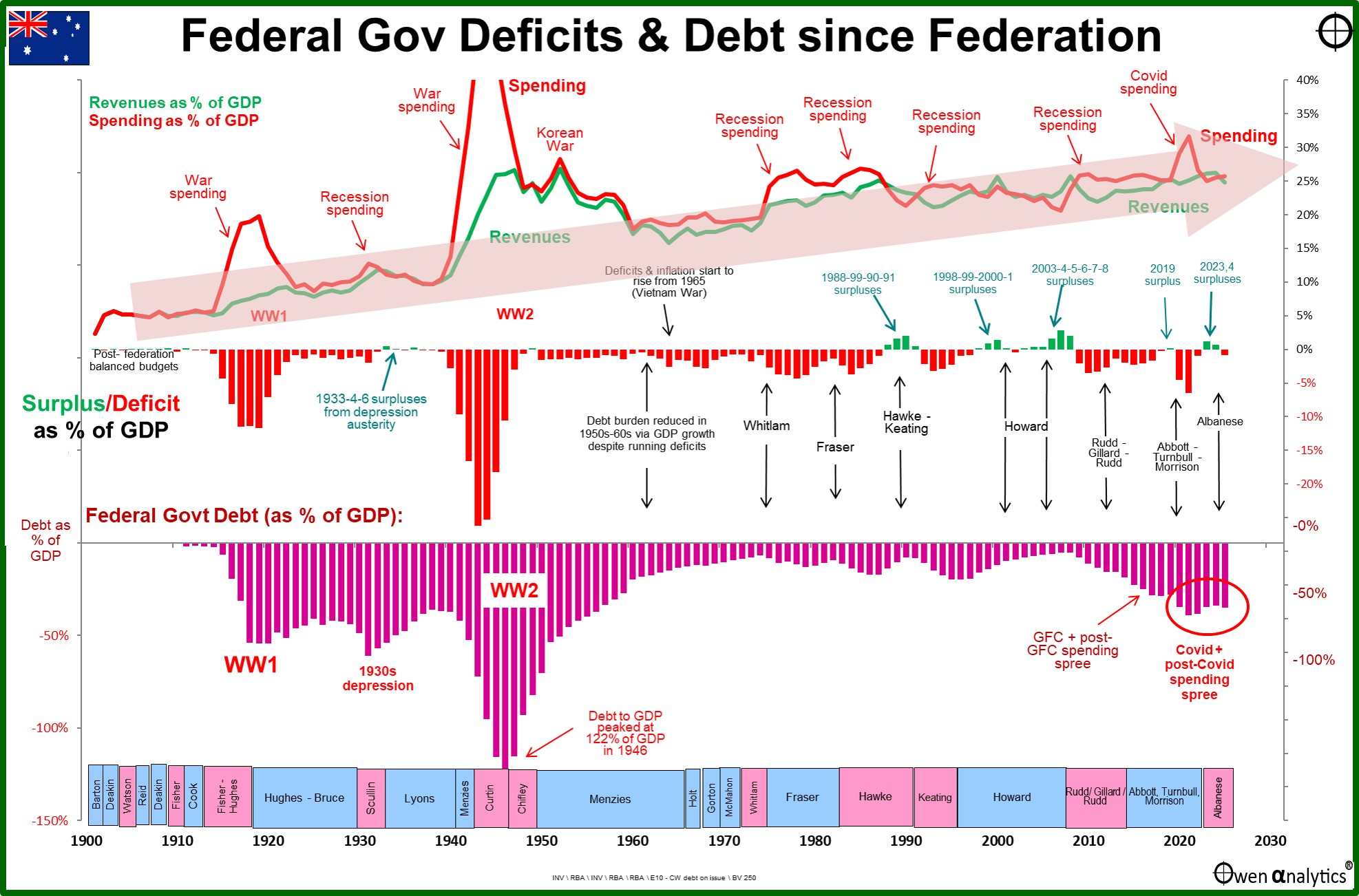
Ang pananaliksik ng Owen Analytics ay nagpapakita na "ang Labor ay nasa kapangyarihan noong dalawang pangunahing panahon ng war-time deficits at debts," at sa kabuuan, "ang mga pamahalaang Left ay may mas mahinang record kaysa sa mga pamahalaang Right sa deficits at debts" [6].
Owen Analytics research shows "Labor happened to be in power during the two main periods of war-time deficits and debts," and overall, "Left governments have a poorer record than Right governments overall on deficits and debts" [6].
Gayunpaman, ang deficit spending ng Labor noong 2007-2013 ay rin malaki, at sa kamakailang panahon ng Labor (2008-2013), hindi rin sila nakamit ng budget surplus [2].
However, Labor's 2007-2013 deficit spending was also substantial, and during Labor's recent period (2008-2013), they did not achieve budget surplus either [2].
### Ang Pagbebenta ng Bond Ay Karaniwang Fiscal Tool
### Bond Sales Are Standard Fiscal Tool
Ang paglalarawan ng "pag-print ng ilang daang bilyong dolyar" sa pamamagitan ng pagbebenta ng bond ay maaaring mapanlinlang.
The characterization of "printing several hundred billion dollars" through bond sales can mislead.
Ang government bond issuance ay isang karaniwang, lehitimong fiscal tool na ginamit sa buong mundo.
Government bond issuance is a standard, legitimate fiscal tool used globally.
Ang nadagdagang bond issuance noong pandemya ay karaniwang praktika sa buong OECD countries, hindi unique sa Coalition [4].
Increased bond issuance during pandemic was standard practice across OECD countries, not unique to the Coalition [4].
Pagsusuri ng Kredibilidad ng Pinagmulan
### The Saturday Paper
### The Saturday Paper
Ang The Saturday Paper ay kilala bilang may LEFT-CENTER BIAS ng Media Bias/Fact Check at kadalasang "nagpapalathala ng factual information na gumagamit ng loaded words (wording na sumusubok na impluwensyahan ang audience sa pamamagitan ng mga apela sa emosyon o stereotypes) para paboran ang mga liberal na dahilan" [7].
The Saturday Paper is identified as having LEFT-CENTER BIAS by Media Bias/Fact Check and often "publishes factual information that utilizes loaded words (wording that attempts to influence an audience by appeals to emotion or stereotypes) to favor liberal causes" [7].
Ang publikasyon ay kumikiling sa mga perspektibang Labor-aligned, na nangangahulugan na ang mga artikulo na kumikritika sa fiscal policy ng Coalition ay maaaring magdiin ng negatibong framing habang binabawasan ang konteksto.
The publication leans toward Labor-aligned perspectives, meaning articles criticizing Coalition fiscal policy may emphasize negative framing while minimizing context.
### Sydney Morning Herald (SMH)
### Sydney Morning Herald (SMH)
Ang SMH ay isang established mainstream Australian newspaper na pag-aari ng Nine Entertainment.
The SMH is an established mainstream Australian newspaper owned by Nine Entertainment.
Bagama't pinapanatili nito ang mga pamantayan sa editorial at proseso ng fact-checking, mayroon itong bahagyang left-of-center na editorial stance historically.
While it maintains editorial standards and fact-checking processes, it does have a slightly left-of-center editorial stance historically.
Gayunpaman, ito ay mas credible at mainstream kaysa sa The Saturday Paper [2].
However, it is far more credible and mainstream than The Saturday Paper [2].
Ang mga partikular na artikulo na binanggit (budget reporting) ay kumakatawan sa factual reporting sa mga economic outcomes sa halip na opinion pieces.
The specific articles cited (budget reporting) represent factual reporting on economic outcomes rather than opinion pieces.
### Pangkalahatang Pagtatasa
### Overall Assessment
Ang mga orihinal na sources ay kasama ang isang advocacy-leaning na publikasyon (Saturday Paper) at established news reporting (SMH).
The original sources include one advocacy-leaning publication (Saturday Paper) and established news reporting (SMH).
Ang mga factual claims tungkol sa deficit at debt ay maaaring i-verify sa pamamagitan ng opisyal na government statistics, ngunit ang interpretasyon at framing ay dapat isaalang-alang bilang potensyal na Labor-favorable.
The factual claims about deficit and debt can be verified through official government statistics, but the interpretation and framing should be considered potentially Labor-favorable.
⚖️
Paghahambing sa Labor
**Ginawa ba ni Labor ang katulad na bagay?** Nagsagawa ng paghahanap: "Labor government budget deficit spending history Australia" Pagkatuklas: Oo, ang mga pamahalaang Labor ay nakibahagi sa katulad na deficit spending, partikular noong Global Financial Crisis (2008-2013).
**Did Labor do something similar?**
Search conducted: "Labor government budget deficit spending history Australia"
Finding: Yes, Labor governments have engaged in similar deficit spending, particularly during the Global Financial Crisis (2008-2013).
Sa ilalim ni Prime Minister Kevin Rudd at Julia Gillard, ang Labor ay nagpatupad ng malaking stimulus spending bilang tugon sa GFC, na nagresulta sa sustained budget deficits [2][6].
Under Prime Minister Kevin Rudd and Julia Gillard, Labor implemented massive stimulus spending responding to the GFC, resulting in sustained budget deficits [2][6].
Ang Labor ay hindi nakamit ng budget surplus sa anumang taon mula 2008-2013 habang nasa pamahalaan, at ang mga cumulative deficits ay malaki [6].
Labor did not achieve a budget surplus in any year from 2008-2013 while in government, and cumulative deficits were substantial [6].
Gayunpaman, ang panahon ng pandemya 2020-2022 ang unang pagkakataon na ang Coalition ay nakibahagi sa ganitong scale ng deficit spending at bond issuance.
However, the 2020-2022 pandemic period was the first time the Coalition engaged in this scale of deficit spending and bond issuance.
Ang pagkakaiba ay: - **Coalition pre-2020**: Naghangad ng surplus sa pamamagitan ng spending restraint at nag-angkin na may fiscal discipline - **Coalition 2020-2022**: Iniwan ang layunin ng surplus noong pandemya emergency - **Labor 2008-2013**: Naghangad ng deficit spending mula sa simula bilang sinadyang stimulus policy [2][6] Ang pangunahing pagkakaiba ay ang ideological positioning at consistency, hindi ang mismong fiscal outcomes.
The distinction is:
- **Coalition pre-2020**: Pursued surplus through spending restraint and claimed to have fiscal discipline
- **Coalition 2020-2022**: Abandoned surplus target during pandemic emergency
- **Labor 2008-2013**: Pursued deficit spending from the outset as deliberate stimulus policy [2][6]
The key difference is ideological positioning and consistency, not the fiscal outcomes themselves.
Ang pag-iwan ng Coalition sa kanilang pangunahing layunin ng surplus ay kumakatawan sa mas malaking policy reversal kaysa sa Labor (na laging mas tumatanggap ng deficits bilang mga tool sa patakaran).
The Coalition's abandonment of its core surplus goal represents a more significant policy reversal than Labor's (which had always been more accepting of deficits as policy tools).
🌐
Balanseng Pananaw
### Mga Pagkritika (Mga Valid na Punto)
### Criticisms (Valid Points)
1. **Political Hypocrisy**: Ang Coalition ay gumastos sa kanilang 2013 election campaign sa pag-atake sa mga deficit ng Labor bilang isang "debt and deficit disaster" at nangako na magbabalik sa surplus.
1. **Political Hypocrisy**: The Coalition spent its 2013 election campaign attacking Labor's deficits as a "debt and deficit disaster" and promising to return to surplus.
Ang pagkabigo na makamit ang surplus sa siyam na magkakasunod na taon, pagkatapos ay lubos na iniwan ang layunin, ay kumakatawan sa isang broken commitment [1][3]. 2. **Nawalang Pagkakataon (2019-20)**: Ang pamahalaan ay pinakamalapit sa pagkamit ng surplus noong 2019-20, bago ang pandemya.
Failing to achieve surplus in nine consecutive years, then abandoning the goal entirely, represents a broken commitment [1][3].
2. **Missed Opportunity (2019-20)**: The government was closest to achieving surplus in 2019-20, before the pandemic.
Ang ilang mga ekonomista ay nagtatalo na ang mas malakas na fiscal consolidation noong una ay maaaring magbigay ng mas maraming fiscal flexibility [2]. 3. **Pagtaas ng Debt**: Tumaas ang gross government debt ng humigit-kumulang $351 bilyon noong panahon ng Coalition sa pandemya (Marso 2019 hanggang Abril 2022), na kumakatawan sa makabuluhang pagtaas sa sovereign debt [4].
Some economists argue that stronger fiscal consolidation earlier could have provided more fiscal flexibility [2].
3. **Debt Increase**: Gross government debt increased approximately $351 billion during the Coalition's pandemic period (March 2019 to April 2022), representing a significant increase in sovereign debt [4].
### Mga Lehitimong Paliwanag (Kontekstong Kadalasang Nawawala)
### Legitimate Explanations (Context Often Missing)
1. **Ang Pandemya Ay Hindi Pangkaraniwan**: Ang COVID-19 pandemya ay pilit na nagtulak sa lahat ng developed nations sa deficit spending para sa suporta sa ekonomiya.
1. **Pandemic Was Extraordinary**: The COVID-19 pandemic forced all developed nations into deficit spending for economic support.
Ang mga pagbili ng bond ng RBA at stimulus ng pamahalaan ay angkop na macroeconomic policy responses [4][5].
The RBA's bond purchases and government stimulus were appropriate macroeconomic policy responses [4][5].
Ang pagpapanatili ng surplus noong pandemya ay sana ay mapaminsala sa ekonomiya. 2. **Ang Deficit Ay Reversible**: Ang Parliamentary Budget Office at Treasury ay inasahan na ang mga deficit ay liliit habang ang mga epekto ng pandemya ay humuhupa at ang economic growth ay nagpapatuloy [2][4].
Maintaining a surplus during pandemic would have been economically damaging.
2. **Deficit Was Reversible**: The Parliamentary Budget Office and Treasury expected deficits to narrow as pandemic impacts receded and economic growth resumed [2][4].
Ang nadagdagang debt ay iniharap bilang pansamantalang crisis response, hindi structural. 3. **Ang Interest Costs ay Nananatiling Mababa**: Sa kabila ng nadagdagang debt, ang mga interes na pagbabayad ay nanatili sa historically low levels (humigit-kumulang 1% ng GDP) dahil sa mababang interest rates, na ginagawang manageable ang burden ng debt servicing [4]. 4. **International Context**: Ang deficit spending at pagbili ng bond ay naka-align sa mga aksyon na ginawa ng halos lahat ng OECD countries.
The increased debt was presented as temporary crisis response, not structural.
3. **Interest Costs Remain Low**: Despite increased debt, interest payments remained at historically low levels (approximately 1% of GDP) due to low interest rates, making the debt servicing burden manageable [4].
4. **International Context**: The deficit spending and bond purchases were aligned with actions taken by nearly all OECD countries.
Ang debt to GDP ratio ng Australia ay nananatiling malayo sa ibaba ng United States, Japan, at karamihan sa G7 nations (humigit-kumulang 60% kumpara sa US 120%+, Japan 250%+) [4]. 5. **Pragmatism Higit sa Ideology**: Bagama't ang Coalition ay hindi eksplisitong pinatupad ang MMT, ito ay naging mas praktikal tungkol sa pagtanggap ng deficits kapag kinakailangan ng mga kalagayan.
Australia's debt to GDP ratio remains well below the United States, Japan, and most G7 nations (approximately 60% vs.
Ito ay kumakatawan sa economic common sense sa halip na ideological failure [2][5].
US 120%+, Japan 250%+) [4].
5. **Pragmatism Over Ideology**: While the Coalition did not explicitly adopt MMT, it did become more pragmatic about accepting deficits when circumstances demanded.
BAHAGYANG TOTOO
5.0
sa 10
Ang mga pangunahing factual claims ay tumpak: ang Coalition ay talagang iniwan ang kanilang layunin ng surplus pagkatapos na hindi ito makamit taon-taon, at nakibahagi sa malaking deficit spending at bond issuance (humigit-kumulang $351 bilyon na karagdagang debt) noong 2020-2022.
The core factual claims are accurate: the Coalition did abandon its surplus goal after failing to achieve it annually, and did engage in substantial deficit spending and bond issuance (approximately $351 billion additional debt) during 2020-2022.
Gayunpaman, ang framing at konteksto ng claim ay problema: 1. **Wika ng "pag-print ng pera"** ay maling naglalarawan ng normal na government bond issuance at central bank asset purchases bilang isang bagay na hindi pangkaraniwan o ilehitimo [4]. 2. **"Ilang daang bilyon"** ay tumpak ngunit ang konteksto na ito ay nangyari sa panahon ng global pandemya na nangangailangan ng fiscal support sa lahat ng developed nations ay binabanggit [4][5]. 3. **"Pag-convert sa patakarang MMT"** ay mali.
However, the claim's framing and context are problematic:
1. **"Printing money" language** mischaracterizes normal government bond issuance and central bank asset purchases as something unusual or illegitimate [4].
2. **"Several hundred billion"** is accurate but the context that this occurred during a global pandemic requiring fiscal support across all developed nations is omitted [4][5].
3. **"Converting to MMT policy"** is false.
Ang pamahalaan ay nakibahagi sa praktikal na crisis spending nang hindi tinatanggap ang MMT bilang isang framework.
The government engaged in pragmatic crisis spending without adopting MMT as a framework.
Walang ebidensya na ang pamahalaang Coalition ay nag-aral o sinuportahan ang Modern Monetary Theory [5]. 4. **Binabawasan ang paghahambing sa Labor**: Ang mga pamahalaang Labor ay rin nagpatakbo ng sustained deficits (2008-2013) nang walang kritisisyon mula sa parehong source, na nagmumungkahing partisan framing sa halip na prinsipyadong fiscal analysis [2][6].
There is no evidence the Coalition government studied or endorsed Modern Monetary Theory [5].
4. **Omits Labor comparison**: Labor governments also ran sustained deficits (2008-2013) without criticism from the same source, suggesting partisan framing rather than principled fiscal analysis [2][6].
Ang claim ay talagang totoo sa kanyang pinaka-literal na interpretasyon ngunit lubos na mapanlinlang sa kanyang framing, mga pagpili sa wika, at mga pagbabawas sa konteksto.
The claim is essentially true in its most literal interpretation but highly misleading in its framing, language choices, and context omissions.
Huling Iskor
5.0
SA 10
BAHAGYANG TOTOO
Ang mga pangunahing factual claims ay tumpak: ang Coalition ay talagang iniwan ang kanilang layunin ng surplus pagkatapos na hindi ito makamit taon-taon, at nakibahagi sa malaking deficit spending at bond issuance (humigit-kumulang $351 bilyon na karagdagang debt) noong 2020-2022.
The core factual claims are accurate: the Coalition did abandon its surplus goal after failing to achieve it annually, and did engage in substantial deficit spending and bond issuance (approximately $351 billion additional debt) during 2020-2022.
Gayunpaman, ang framing at konteksto ng claim ay problema: 1. **Wika ng "pag-print ng pera"** ay maling naglalarawan ng normal na government bond issuance at central bank asset purchases bilang isang bagay na hindi pangkaraniwan o ilehitimo [4]. 2. **"Ilang daang bilyon"** ay tumpak ngunit ang konteksto na ito ay nangyari sa panahon ng global pandemya na nangangailangan ng fiscal support sa lahat ng developed nations ay binabanggit [4][5]. 3. **"Pag-convert sa patakarang MMT"** ay mali.
However, the claim's framing and context are problematic:
1. **"Printing money" language** mischaracterizes normal government bond issuance and central bank asset purchases as something unusual or illegitimate [4].
2. **"Several hundred billion"** is accurate but the context that this occurred during a global pandemic requiring fiscal support across all developed nations is omitted [4][5].
3. **"Converting to MMT policy"** is false.
Ang pamahalaan ay nakibahagi sa praktikal na crisis spending nang hindi tinatanggap ang MMT bilang isang framework.
The government engaged in pragmatic crisis spending without adopting MMT as a framework.
Walang ebidensya na ang pamahalaang Coalition ay nag-aral o sinuportahan ang Modern Monetary Theory [5]. 4. **Binabawasan ang paghahambing sa Labor**: Ang mga pamahalaang Labor ay rin nagpatakbo ng sustained deficits (2008-2013) nang walang kritisisyon mula sa parehong source, na nagmumungkahing partisan framing sa halip na prinsipyadong fiscal analysis [2][6].
There is no evidence the Coalition government studied or endorsed Modern Monetary Theory [5].
4. **Omits Labor comparison**: Labor governments also ran sustained deficits (2008-2013) without criticism from the same source, suggesting partisan framing rather than principled fiscal analysis [2][6].
Ang claim ay talagang totoo sa kanyang pinaka-literal na interpretasyon ngunit lubos na mapanlinlang sa kanyang framing, mga pagpili sa wika, at mga pagbabawas sa konteksto.
The claim is essentially true in its most literal interpretation but highly misleading in its framing, language choices, and context omissions.
Hindi tama sa katotohanan o malisyosong gawa-gawa.
4-6: BAHAGYA
May katotohanan ngunit kulang o baluktot ang konteksto.
7-9: HALOS TOTOO
Maliit na teknikal na detalye o isyu sa pagkakasulat.
10: TUMPAK
Perpektong na-verify at patas ayon sa konteksto.
Pamamaraan: Ang mga rating ay tinutukoy sa pamamagitan ng cross-referencing ng opisyal na mga rekord ng pamahalaan, independiyenteng mga organisasyong nag-fact-check, at mga primaryang dokumento.