Nakakalito

Rating: 3.0/10

Labor
1.7

Ang Claim

“4.3% ang unemployment (Nobyembre 2025), isa sa pinakamababang rate sa loob ng 50 taon”
Orihinal na Pinagmulan: Albosteezy

Orihinal na Pinagmulan

FACTUAL NA BERIPIKASYON

Tama ang unemployment rate na 4.3% noong Nobyembre 2025 ayon sa Australian Bureau of Statistics [1].
The November 2025 unemployment rate of 4.3% is accurate according to the Australian Bureau of Statistics [1].
Gayunpaman, ang paghahambing sa claim ay misleading.
However, the claim's framing is misleading.
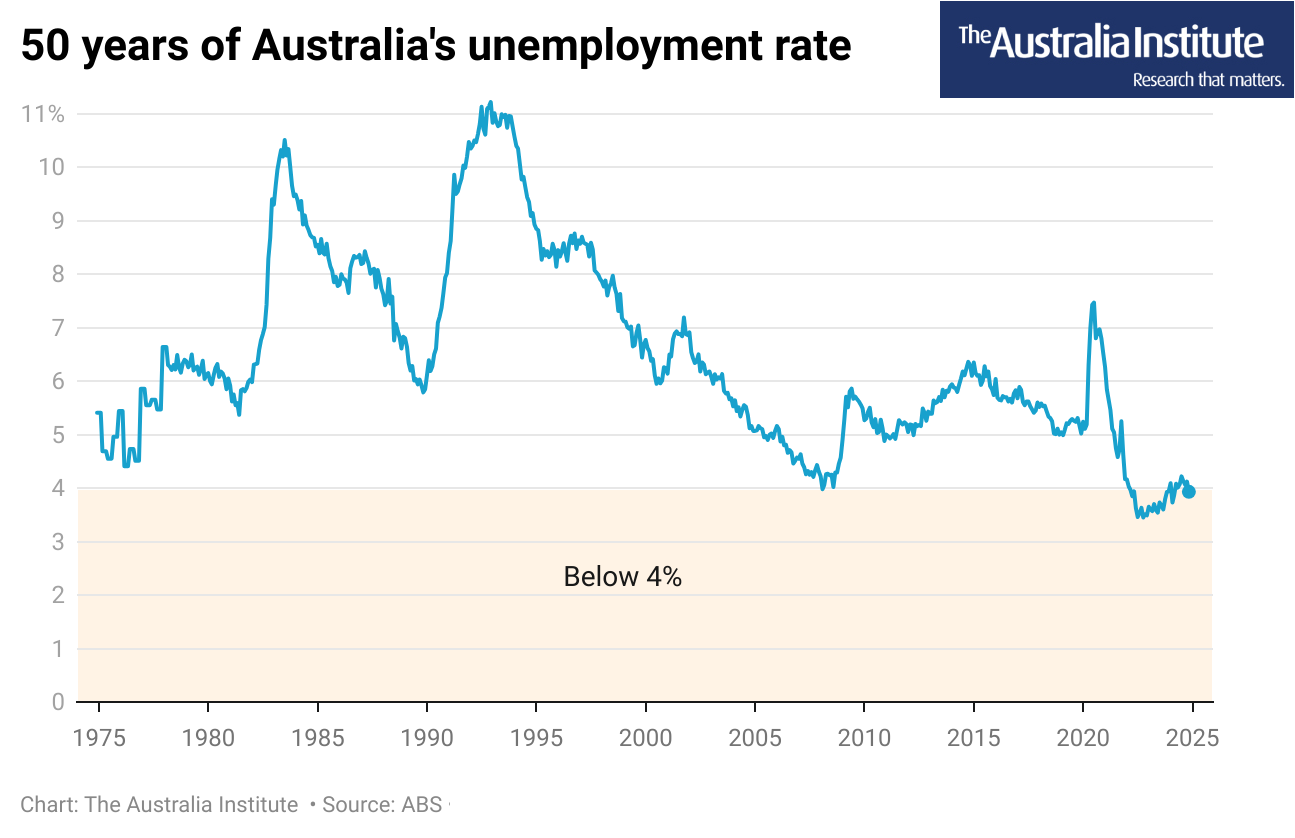
Ang pinakamababang unemployment na naabot ng Australia sa nakaraang 50 taon ay 3.5% noong Hunyo 2022 [2]—ilang linggo lamang bago umupo ang Labor noong Mayo 2022.
The lowest point Australia has reached in the past 50 years was 3.5% in June 2022 [2]—just before Labor took office in May 2022.
Mas tumpak, 3.5% ang unemployment nang minana ng Labor ang puwesto (Setyembre 2022) at tumaas na ito sa 4.3% [3][4].
More precisely, unemployment was 3.5% when Labor inherited office (September 2022) and has since risen to 4.3% [3][4].
Tama naman sa teknikal na kahulugan na "isa sa pinakamababang rate sa loob ng 50 taon" ang 4.3%—mas mababa ito kaysa sa unemployment bago ang 2022 sa karamihan ng panahong iyon, at bihira ang rate na mas mababa sa 4% sa kasaysayan [5].
The claim that 4.3% is "one of lowest rates in 50 years" is technically true—it is lower than pre-2022 unemployment for much of the period, with rates below 4% being rare historically [5].
Gayunpaman, ang paghahambing ay nagkukubli sa kritikal na katotohanan na *bumaba* ang employment sa ilalim ng pamumuno ng Labor.
However, the framing obscures the critical fact that unemployment has *worsened* under Labor's tenure.

Nawawalang Konteksto

**1.
**1.
Tumaas ang Unemployment sa Ilalim ng Labor** Ang pinakamahalagang nawawalang konteksto ay nang umupo ang Labor noong Mayo 2022, 3.5% ang unemployment (50-year low).
Unemployment Rose Under Labor** The most important missing context is that when Labor took office in May 2022, unemployment was at a 50-year low of 3.5%.
Noong Nobyembre 2025, tumaas ito sa 4.3%—pagtaas ng 0.8 percentage point [2][3].
By November 2025, it had risen to 4.3%—an increase of 0.8 percentage points [2][3].
Ito ay kabaligtaran ng tagumpay; paghina mula sa exceptional na simula.
This is the opposite of an achievement; it represents deterioration from already low unemployment.
Ang claim ay nagpapakita ng kasalukuyang rate nang hindi binabanggit ang pagtaas na ito. **2.
The claim presents the current rate without mentioning this increase. **2.
Minana ng Labor ang Malakas na Job Market** Ang 3.5% unemployment rate noong mid-2022 ay bunga ng mga patakaran ng nakaraang Coalition government at ng post-COVID labor market tightness.
Labor Inherited the Strong Job Market** The 3.5% unemployment rate in mid-2022 was the result of the previous Coalition government's policies and the post-COVID labor market tightness.
Minana ng Labor ang exceptionally tight labor market—hindi nila ito naabot.
Labor inherited an exceptionally tight labor market—not achieved it.
Ang kasalukuyang 4.3% ay nagpapakita ng pagluluwag ng minanang lakas na ito. **3.
The current 4.3% represents a loosening of this inherited strength. **3.
Underemployment sa 12-Month Highs** Samantalang nanatiling 4.3% ang headline unemployment noong Nobyembre 2025, ang underemployment ay tumaas sa pinakamataas sa loob ng 12 buwan ayon sa ulat ng ABC News [6].
Underemployment at 12-Month Highs** While headline unemployment remained at 4.3% in November 2025, underemployment rose to 12-month highs according to ABC News reporting [6].
Ang underemployment ay sumusukat sa mga manggagawang nais ng mas maraming oras (lalo na ang mga part-time worker na naghahanap ng full-time work).
Underemployment measures workers wanting more hours (particularly part-time workers seeking full-time work).
Ipinapakita nito ang kahinaan ng labor market na nakukubli ng headline unemployment figure. **4.
This indicates labor market weakness masked by the headline unemployment figure. **4.
Part-Time Work Dominance** Ang job creation ng Labor (tinatalakay sa punto 1.3) ay malaking bahagi ay part-time roles.
Part-Time Work Dominance** Labor's job creation (discussed in point 1.3) heavily skewed toward part-time roles.
Ayon sa ABS, halos kalahati ng underemployed part-time workers ang gustong magtrabaho ng full-time hours [7].
According to the ABS, nearly half of underemployed part-time workers preferred to work full-time hours [7].
Ang komposisyon ng employment—pag-shift patunong part-time at casual work—ay hindi nakikita sa headline unemployment rate. **5.
The composition of employment—shifting toward part-time and casual work—is not reflected in the headline unemployment rate. **5.
Labor Force Participation Context** Ang labor force participation ay tumaas mula 65.3% hanggang 67.0% sa pagitan ng 2022-2025 [8].
Labor Force Participation Context** Labor force participation increased from 65.3% to 67.0% between 2022-2025 [8].
Bagama't tila positibo ito, malaking bahagi nito ay dahil sa mga babaeng pumasok sa workforce (pagtaas ng 3.1 percentage point para sa mga kababaihang edad 25-54) [9].
While this appears positive, much of this was driven by women entering the workforce (participation rising 3.1 percentage points for women age 25-54) [9].
Ang pagtaas na ito sa labor supply na nakikipagkumpetensya sa trabaho, kasabay ng paglago ng populasyon mula sa mataas na migration, ang malamang na dahilan kung bakit tumaas ang unemployment sa kabila ng "1.2 million jobs created"—ang mga trabaho ay bahagya lamang nakasabay sa mga bagong entrants sa labor force. **6.
This increase in labor supply competing for jobs, combined with population growth from high migration, likely explains why unemployment rose despite "1.2 million jobs created"—the jobs barely kept pace with new entrants to the labor force. **6.
Population Growth Masking Real Labor Demand** Ang pagtaas ng unemployment sa Australia ay dapat unawain sa konteksto ng pinakamataas na net migration sa kasaysayan ng bansa sa ilalim ng termino ng Labor.
Population Growth Masking Real Labor Demand** Australia's unemployment rise must be understood in context of the highest net migration in the country's history during Labor's term.
Ang populasyon ay lumago nang mas mabilis kaysa sa employment, kaya't tumaas ang unemployment sa kabila ng mga figure ng job creation na tila malakas.
Population grew faster than employment, which is why unemployment rose despite job creation figures appearing strong.
Katulad ito ng kritika sa punto 1.3.
This is similar to point 1.3's critique.

💭 KRITIKAL NA PANANAW

Ang claim na "unemployment sa 4.3%, isa sa pinakamababang rate sa loob ng 50 taon" ay gumagamit ng tamang data ngunit deceptive framing.
The claim "unemployment at 4.3%, one of the lowest rates in 50 years" uses accurate data but deceptive framing.
Narito ang buong kuwento: 1. **Minana vs Naabot**: Ang Australia ay minana ang 3.5% unemployment (50-year low) mula sa Coalition government.
Here's the fuller story: 1. **Inherited vs Achieved**: Australia inherited 3.5% unemployment (50-year low) from the Coalition government.
Sa termino ng Labor, *tumaas* ang unemployment sa 4.3%.
Labor's term saw unemployment *rise* to 4.3%.
Hindi ito tagumpay—paghina mula sa exceptional na simula. 2. **Headline vs Reality**: Ang 4.3% headline unemployment rate ay nagkukubli ng tumataas na underemployment sa 12-month highs [6].
This is not an achievement—it's deterioration from an already exceptional starting position. 2. **Headline vs Reality**: The 4.3% headline unemployment rate masks rising underemployment at 12-month highs [6].
Ang mga manggagawa ay nais ng mas maraming oras kaysa sa kanilang natatanggap.
Workers want more hours than they're getting.
Ang labor market ay talagang mas mahina kaysa sa sinasabi ng unemployment figure. 3. **Job Quality Decline**: Ang karamihan ng mga bagong trabaho ay part-time.
The labor market is actually weaker than the unemployment figure suggests. 3. **Job Quality Decline**: Most new jobs were part-time.
Ang full-time employment growth ay nahuli sa paglago ng populasyon.
Full-time employment growth lagged population growth.
Ang mga manggagawa ay nakakakuha ng *mas kaunting* oras, hindi mas marami—ang underemployment ang nagsasabi ng kuwentong ito. 4. **Supply vs Demand**: Ang paglago ng populasyon at record migration ay nangahulugang ang labor market ay kailangang lumikha ng mga trabaho upang mapigilang tumaas pa ang unemployment.
Workers are getting *less* hours, not more—underemployment tells this story. 4. **Supply vs Demand**: Population growth and record migration meant the labor market had to create jobs just to keep unemployment from rising *further*.
Ang 1.2 million jobs created ay dapat unawain bilang bahagyang pagtugma sa paglago ng supply. 5. **Dishonest Historical Comparison**: Ang pagsabing "isa sa pinakamababa sa loob ng 50 taon" kapag ang unemployment ay *tumaas* sa ilalim ng iyong termino mula sa aktwal na 50-year low ay misleading.
The 1.2 million jobs created must be understood as barely matching supply growth. 5. **Historical Comparison Dishonesty**: Saying "one of the lowest in 50 years" when unemployment *rose* during your term from the actual 50-year low is misleading.
Tama sa teknikal na kahulugan ngunit idinisenyo upang ikubli ang relative deterioration.
It's technically true but designed to obscure the relative deterioration.
Hindi na-maintain ng Labor ang malakas na labor market na minana nila—pinayagan nilang tumaas ang unemployment habang lumobo ang populasyon.
Labor didn't maintain the strong labor market it inherited—it allowed unemployment to rise while population surged.
Ito ay kabaligtaran ng isang positibong claim.
This is the opposite of a positive claim.

NAKAKALITO

3.0

sa 10

Tama ang unemployment figure (4.3%), at teknikal na mababa ito sa pamantayan ng 50 taon.
The unemployment figure (4.3%) is accurate, and it technically is low by 50-year standards.
Gayunpaman, ang claim ay idinisenyo na magmislead sa pamamagitan ng: 1.
However, the claim is designed to mislead by: 1.
Hindi pagbunyag na *tumaas* ang unemployment mula 3.5% (ang totoong 50-year low) patungo sa 4.3% sa ilalim ng Labor 2.
Not disclosing that unemployment *rose* from 3.5% (the actual 50-year low) to 4.3% under Labor 2.
Hindi pagbanggit ng tumataas na underemployment sa 12-month highs 3.
Not mentioning rising underemployment at 12-month highs 3.
Hindi pagpapaliwanag na ang job creation ay bahagyang nakasabay lamang sa paglago ng populasyon mula sa migration 4.
Not explaining that job creation barely kept pace with population growth from migration 4.
Pagpapakita ng minanang lakas na parang na-maintain o napabuti Ang claim ay naghahambing sa isang deteriorating labor market bilang isang tagumpay.
Presenting inherited strength as if it were maintained or improved The claim frames a deteriorating labor market as an achievement.

📚 MGA PINAGMULAN AT SANGGUNIAN (9)

  1. 1
    Unemployment rate remains at 4.3%

    Unemployment rate remains at 4.3%

    Australian Bureau of Statistics
  2. 2
    Australia's jobless rate at 50-year low of 3.5%

    Australia's jobless rate at 50-year low of 3.5%

    Fall in unemployment rate from 3.9% to 3.5% is higher than forecast and may add to pressure on the Reserve Bank to continue raising interest rates

    the Guardian
  3. 3
    Unemployment rate remains at 3.5%

    Unemployment rate remains at 3.5%

    Australian Bureau of Statistics
  4. 4
    3.5% unemployment: Australia's jobless rate at its lowest since 1974

    3.5% unemployment: Australia's jobless rate at its lowest since 1974

    Australia has its lowest unemployment rates in almost 50 years – helped along by high numbers of employees off work sick.

    The Conversation
  5. 5
    Let's celebrate the new normal of unemployment below 4%

    Let's celebrate the new normal of unemployment below 4%

    Those arguing that Australia cannot sustain unemployment below 4.5% without rising prices and wages have been found to be completely wrong. And it is time they admitted it.

    The Australia Institute
  6. 6
    Australia's unemployment rate remains at 4.3 per cent, but the underemployment rate jumps to 12-month high

    Australia's unemployment rate remains at 4.3 per cent, but the underemployment rate jumps to 12-month high

    Australia's unemployment rate holds steady at 4.3 per cent in November, but the underemployment rate jumps to 12-month high.

    Abc Net
  7. 7
    Underemployed workers, February 2025

    Underemployed workers, February 2025

    Employed people who want to work more hours or worked reduced hours, including preferred hours and usual hours not worked, and underemployment ratios.

    Australian Bureau of Statistics
  8. 8
    Labour Force, Australia, October 2025

    Labour Force, Australia, October 2025

    Headline estimates of employment, unemployment, underemployment, participation and hours worked from the monthly Labour Force Survey

    Australian Bureau of Statistics
  9. 9
    Changes in participation rates for men and women in Australia

    Changes in participation rates for men and women in Australia

    Long term trends in the participation rate

    Australian Bureau of Statistics

Pamamaraan ng Rating Scale

1-3: MALI

Hindi tama sa katotohanan o malisyosong gawa-gawa.

4-6: BAHAGYA

May katotohanan ngunit kulang o baluktot ang konteksto.

7-9: HALOS TOTOO

Maliit na teknikal na detalye o isyu sa pagkakasulat.

10: TUMPAK

Perpektong na-verify at patas ayon sa konteksto.

Pamamaraan: Ang mga rating ay tinutukoy sa pamamagitan ng cross-referencing ng opisyal na mga rekord ng pamahalaan, independiyenteng mga organisasyong nag-fact-check, at mga primaryang dokumento.