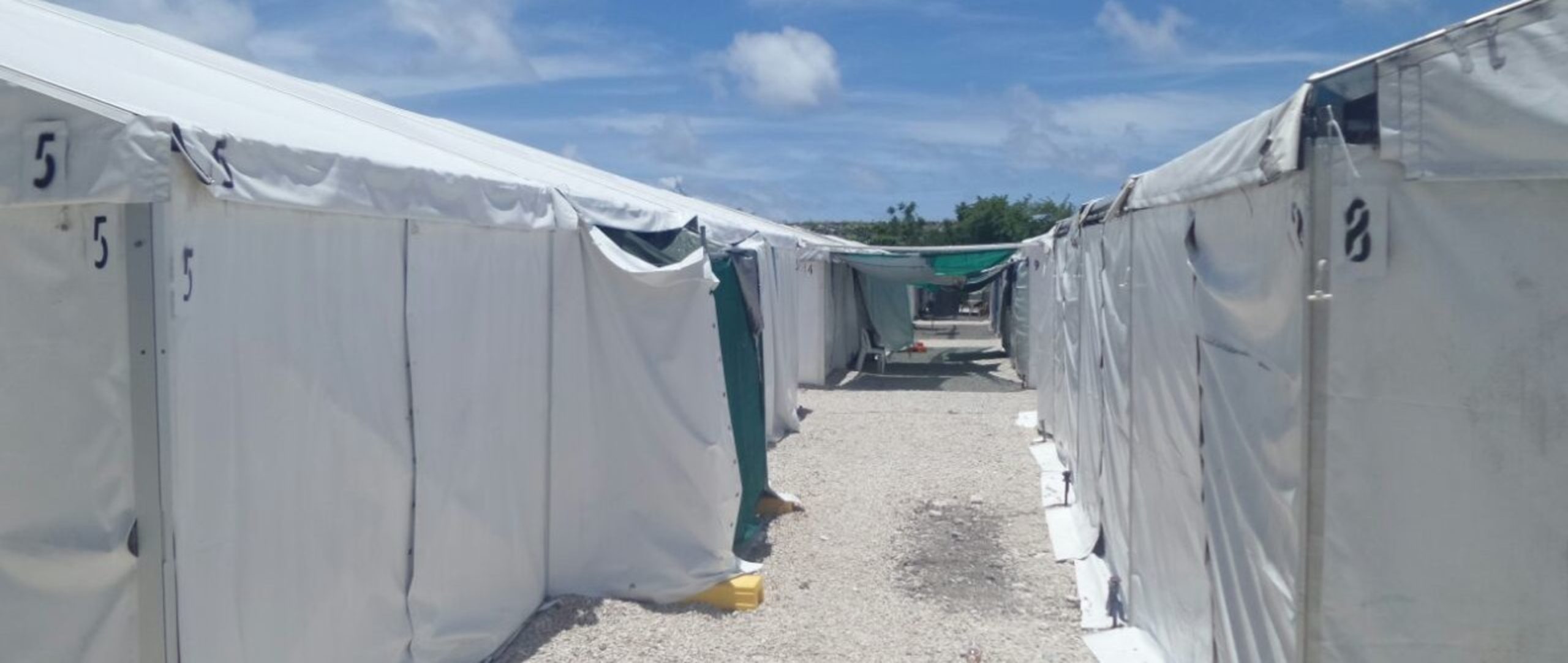
The Coalition government did incur substantial legal costs defending court cases brought by asylum seekers and advocacy organizations seeking emergency medical transfers from offshore detention facilities [1].
The Guardian's September 2018 reporting documented that Australia had spent approximately **$275,000** (not $320,000) fighting requests for urgent medical transfers of asylum seekers from Nauru and Manus Island [1].
This spending was directly related to legal costs incurred in the Federal Court defending government decisions to deny or delay medical evacuations [2].
The context for these legal costs is crucial: under the Coalition government's offshore detention policy, asylum seekers on Nauru and Manus Island had to seek court orders to obtain emergency medical transfers [3].
Between 2016 and 2019, before the Medevac Bill passed in February 2019, the legal system became the primary mechanism through which medical transfers were secured [4].
Documented cases include: emergency heart surgery, emergency brain surgery, complex abortion care, emergency psychiatric intervention, and treatment for cancers and other terminal conditions [3][4].
Government's Stated Rationale**
The Coalition government argued that adequate medical facilities existed on Nauru and Manus Island, making transfers unnecessary in most cases [5].
Peter Dutton, Home Affairs Minister, maintained that the previous system had enabled over 900 asylum seekers to reach Australia for medical treatment under the offshore processing regime [5].
Coroner's Findings Contradicted This**
However, a coroner's inquest into the death of Hamid Khazaei—an Iranian asylum seeker on Manus Island—found his death was "preventable" and resulted from significant delays in medical transfer [6].
Courts Consistently Overturned Government Decisions**
The legal costs were incurred precisely because courts repeatedly ruled against the government's decisions to deny transfers [2].
According to the Refugee Council of Australia and asylum sector analysts, the government "time and time again" had its decisions overturned by the Federal Court [3].
Medevac Bill Response**
The Medevac Bill, passed in February 2019 with cross-party support, was introduced specifically because the existing system was manifestly inadequate [4].
Parliament determined that government officials alone could not be trusted to make medical transfer decisions, requiring instead that doctors' recommendations be given substantial weight [4].
What the Legal Spending Actually Represented**
The $275,000-$320,000 represented legal defense costs for the *government's position*, not costs for "denying" transfers in the sense of implementing a coherent policy.
**The Guardian (Original Source)**
The Guardian is a major international news organization with a strong reputation for investigative journalism and fact-based reporting [7].
However, it should be noted that The Guardian has an editorial position on refugee policy that is generally critical of offshore detention, so the framing emphasizes the human suffering dimension rather than exploring government policy rationale [1][8].
The reporting is factually accurate but reflects a particular perspective on the issue.
**Figure Discrepancy**
The exact figure varies slightly between reports: some sources reference $275,000, others $320,000 [1].
**Did Labor Have Similar Medical Transfer Policies?**
Labor's position on medevac was more progressive than the Coalition's.
* * * *
Labor supported the Medevac Bill when it was introduced in February 2019 and advocated for giving doctors stronger authority in transfer decisions [9].
The Albanese Labor government has not materially changed the detention framework that created the need for legal medical transfer cases in the first place [10].
During Labor's 2007-2013 government under Kevin Rudd and Julia Gillard, mandatory detention of asylum seekers was also in place, though Labor moved toward onshore processing [11].
No direct equivalent to the Coalition's legal spending on fighting medical transfers occurred under Labor, as Labor's onshore focus reduced the need for medical evacuation from remote islands [11].
**Finding:** Labor opposed the Coalition's approach and advocated for reform, but has maintained the broader detention infrastructure when in power.
Labor did not face equivalent legal challenges because their detention model (primarily onshore) did not create the same medical evacuation necessity [11].
Strong border control was necessary to prevent drownings at sea and smuggling [5]
These were not inherently unreasonable policy positions—border protection and cost management are legitimate government concerns [5].
**Why This Failed**
However, the coroner's findings and court outcomes suggest the government's claims about medical facilities were factually incorrect [6].
Parliament's overwhelming passage of the Medevac Bill (with cross-party support) suggests even Coalition-leaning parliamentarians believed the system was inadequate [4].
**The Broader Context**
This legal spending must be understood as symptomatic of a structural policy failure: the government had created a detention system on remote islands with inadequate medical facilities, then had to spend significant resources in court defending its reluctance to evacuate people with life-threatening conditions [2][3][4].
The fact that courts consistently overturned these decisions suggests the government was not exercising sound judgment [2][3].
**Key Context:** The legal spending was not a feature of a successful policy, but rather a cost of defending a policy that the courts, coroners, and eventually Parliament determined was inadequate [2][3][4][6].
(with factual clarification needed)
The claim is substantially accurate in its core factual content: the Coalition government did spend approximately $275,000-$320,000 on legal costs defending court cases brought to challenge its denial of medical transfers for asylum seekers with life-threatening conditions [1][2].
However, two clarifications are warranted:
1. **Exact figure:** The $320,000 figure is slightly inaccurate; reports reference approximately $275,000 with some variation depending on cost definitions [1]
2. **"Denying" framing:** While technically accurate (the government was defending denial decisions), the phrasing could be misleading.
The government wasn't strategically "spending money to deny" transfers; rather, it incurred costs defending decisions that courts found inadequate [2][3].
The claim's substance is accurate: significant taxpayer money was spent on legal costs related to the government's restrictive approach to medical transfers, and this occurred before the Medevac Bill created a better system [1][2][4].
(with factual clarification needed)
The claim is substantially accurate in its core factual content: the Coalition government did spend approximately $275,000-$320,000 on legal costs defending court cases brought to challenge its denial of medical transfers for asylum seekers with life-threatening conditions [1][2].
However, two clarifications are warranted:
1. **Exact figure:** The $320,000 figure is slightly inaccurate; reports reference approximately $275,000 with some variation depending on cost definitions [1]
2. **"Denying" framing:** While technically accurate (the government was defending denial decisions), the phrasing could be misleading.
The government wasn't strategically "spending money to deny" transfers; rather, it incurred costs defending decisions that courts found inadequate [2][3].
The claim's substance is accurate: significant taxpayer money was spent on legal costs related to the government's restrictive approach to medical transfers, and this occurred before the Medevac Bill created a better system [1][2][4].