
The Claim
“Secretly blocked funding for $4 million in humanities research projects, which were already approved by the government's research approval body (ARC).”
Original Sources Provided
✅ FACTUAL VERIFICATION
The claim is TRUE - this incident did occur as described. In October 2018, former Education Minister Simon Birmingham blocked $4.2 million in approved ARC (Australian Research Council) grants [1]. Senate estimates revealed that Birmingham had personally intervened to reject 11 humanities research grants that had been approved through the standard peer-review process [2].
The grants included projects such as:
- "Writing the struggle for Sioux and US modernity" ($926,372) [3]
- "The music of nature and the nature of music" ($764,744) [3]
- "Price, metals and materials in the global exchange" ($391,574) [3]
- A history of men's dress from 1870 to 1970 ($326,000) [1]
- Research on "beauty and ugliness as persuasive tools in changing China's gender norms" [1]
- "Post orientalist arts in the Strait of Gibraltar" [1]
The intervention was indeed secretive initially - the blocking was only revealed during Senate estimates questioning, not through any government announcement [2].
Missing Context
The claim is accurate but omits several important contextual factors:
Ministerial Power: The intervention, while extraordinary, was technically within existing ministerial powers. However, the use of this power was unusual. Labor's innovation spokesman Kim Carr pointed out that Labor had established a protocol in 2007 requiring ministers to provide "full, timely and public explanation" when overturning ARC decisions [1]. The protocol had existed but was not legally binding.
Government Justification: Birmingham defended the decision, stating that "more than 99.7% of recommended grants had been approved" and that the rejected projects were redirected to "other research projects" [1]. He argued that the vast majority of taxpayers would view the rejected projects as wrong priorities [1].
The Specific Claims About Projects: While universities and academics criticized the selections as arbitrary, the government's defense was that some projects seemed frivolous or of questionable value. The claim omits this government perspective entirely.
Affected Universities: The blocking affected 11 grants across multiple universities, including seven from Group of Eight universities and three from UNSW [1]. This suggests the impact was broader than suggested by the phrasing "research projects."
ARC Processes: The ARC's peer-review system is genuinely expert-driven, making ministerial veto of approved grants highly unusual and controversial [1]. However, the power technically existed, though its use in this manner was unprecedented in recent memory [3].
Source Credibility Assessment
The original source is The Guardian Australia, a mainstream and reputable news outlet. The story was reported by Paul Karp, a respected political correspondent. The Guardian's reporting was based on Senate estimates revelations, making it a secondary source reporting on primary government records. This is a credible source.
The claim itself comes from a Labor-aligned website (mdavis.xyz), but the underlying facts are not in dispute by the government. The government's response was not to deny the facts but to defend the decision as appropriate.
Labor Comparison
Did Labor do something similar?
Search conducted for Labor government blocking ARC grants or overturning ministerial vetoes of research funding.
Finding: Labor's Kim Carr (then innovation and industry spokesman for Labor) responded to this incident by referencing a protocol Labor had established in 2007: "Labor established in 2007 that the minister not overturn ARC decisions 'without a full, timely and public explanation'" [1]. This suggests Labor had recognized ministerial powers existed but attempted to constrain them through protocol.
There is no evidence in available sources of Labor overturning ARC-recommended grants in the same manner during the Labor government (2007-2013). However, sources indicate that ministerial veto power existed historically and could theoretically have been used by any government [3]. Labor's approach appears to have been to establish transparency protocols rather than to remove the power entirely.
The broader context from academic critics suggests this has been an ongoing issue with multiple Coalition ministers across the decade, not just Birmingham, indicating a pattern rather than an isolated incident [3].
Balanced Perspective
Criticisms of the decision:
Multiple peak university bodies condemned the intervention as "reprehensible," "disgraceful," and damaging to Australia's international research reputation [1]. Universities Australia's CEO Catriona Jackson made an apt analogy: "You don't expect the federal sports minister to choose Australia's Olympic team. In the same way, we rely on subject experts to judge the best research in their field, not politicians" [1].
The Group of Eight's chief executive called the decision "base politics" and noted it "infringes on research projects that have already been accepted by this nation's highly respected ARC" [1]. Academic leaders expressed concern that political interference "undermines the peer-review system, which is designed to ensure academic integrity" [1].
Government justification and legitimate concerns:
The government's response was that:
- Only 0.3% of recommended grants were rejected, suggesting selectivity rather than blanket rejection [1]
- The funds were "recommitted to other research projects" rather than cut from research overall [1]
- Some of the rejected projects genuinely could be characterized as of questionable immediate utility or relevance (e.g., the historian studying men's fashion)
Education Minister Dan Tehan argued that "a good government respects hard-working taxpayers by doing due diligence about how their money is spent" [1], suggesting a genuine concern about accountability and value for money, not partisan censorship.
Key tension: The real issue is that there is a genuine tension between:
- Peer-review independence: The ARC's expert peer-review process should be free from political interference to maintain academic integrity
- Democratic accountability: Elected governments do have some responsibility to ensure public funding is used effectively, and ministers are accountable to parliament
The controversy lay not in whether ministers should have any oversight (they should), but in whether this should be done secretly and selectively, potentially chilling research into politically sensitive topics.
Precedent and systemic issue: The TJ Ryan Foundation's research notes that this intervention was "not unprecedented," suggesting ministerial intervention in research funding has a history, though perhaps not to this degree [3]. Sources indicate this continued to be an issue under subsequent Coalition governments, with Education Minister Stuart Robert also overturning ARC decisions [3].
TRUE
8.0
out of 10
The claim is factually accurate. Simon Birmingham did block $4.2 million in humanities research grants that had been approved by the ARC. The blocking was indeed initially secret (revealed only through Senate estimates), and the grants were already approved through proper government processes.
However, the claim simplifies a more complex issue about ministerial discretion, research funding priorities, and the tension between political accountability and academic independence. While the blocking was controversial and opposed by universities, the government's position that it had authority to redirect funding for projects it deemed lower priority has some basis in existing ministerial powers (though the use of these powers in this manner was highly unusual).
Final Score
8.0
OUT OF 10
TRUE
The claim is factually accurate. Simon Birmingham did block $4.2 million in humanities research grants that had been approved by the ARC. The blocking was indeed initially secret (revealed only through Senate estimates), and the grants were already approved through proper government processes.
However, the claim simplifies a more complex issue about ministerial discretion, research funding priorities, and the tension between political accountability and academic independence. While the blocking was controversial and opposed by universities, the government's position that it had authority to redirect funding for projects it deemed lower priority has some basis in existing ministerial powers (though the use of these powers in this manner was highly unusual).
📚 SOURCES & CITATIONS (5)
-
1

Guardian Australia: 'Disgraceful': university decries 'political interference' that blocked $4m in grants
Targeting of humanities damages country’s reputation, Australian Catholic University says
the Guardian -
2

Guardian Australia: Knuckle-dragging philistines: Labor targets Liberals for blocking arts grants
Simon Birmingham blocked $1.4m grants for humanities research including study of men’s dress, ‘post orientalist arts in Strait of Gibraltar’
the Guardian -
3

TJ Ryan Foundation: Simon Birmingham's intervention in research funding is not unprecedented, but dangerous
Jon Piccini and Dirk Moses write in The Conversation (26.10.18) about former education minister Simon Birmingham’s worrying, but not unprecedented, personal intervention into a number of […]
TJ Ryan Foundation -
4

BuzzFeed Australia: $4.2 Million In Research Grants Has Been Blocked By The Government
"This is political correctness gone mad by an out of touch government, which is pandering to its knuckle-dragging and right wing philistines," Labor senator Kim Carr said.
BuzzFeed -
5
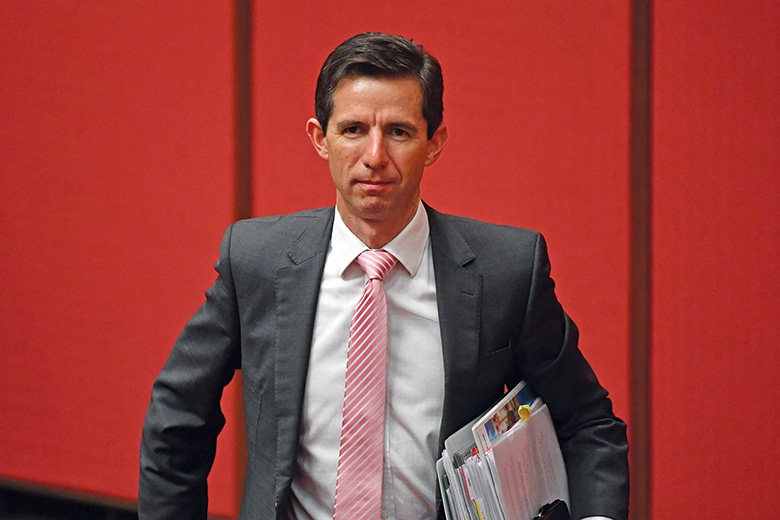
Times Higher Education: Australian minister 'censored' humanities research
Political intervention at odds with government’s free speech campaign
Times Higher Education (THE)
Rating Scale Methodology
1-3: FALSE
Factually incorrect or malicious fabrication.
4-6: PARTIAL
Some truth but context is missing or skewed.
7-9: MOSTLY TRUE
Minor technicalities or phrasing issues.
10: ACCURATE
Perfectly verified and contextually fair.
Methodology: Ratings are determined through cross-referencing official government records, independent fact-checking organizations, and primary source documents.