
Trompeur

Note : 3.0/10

Coalition
C0926

L'affirmation

“A assimilé notre programme d'immigration humanitaire à la guerre.”
Source originale : Matthew Davis
Analysé : 3 Feb 2026

Sources originales

VÉRIFICATION FACTUELLE

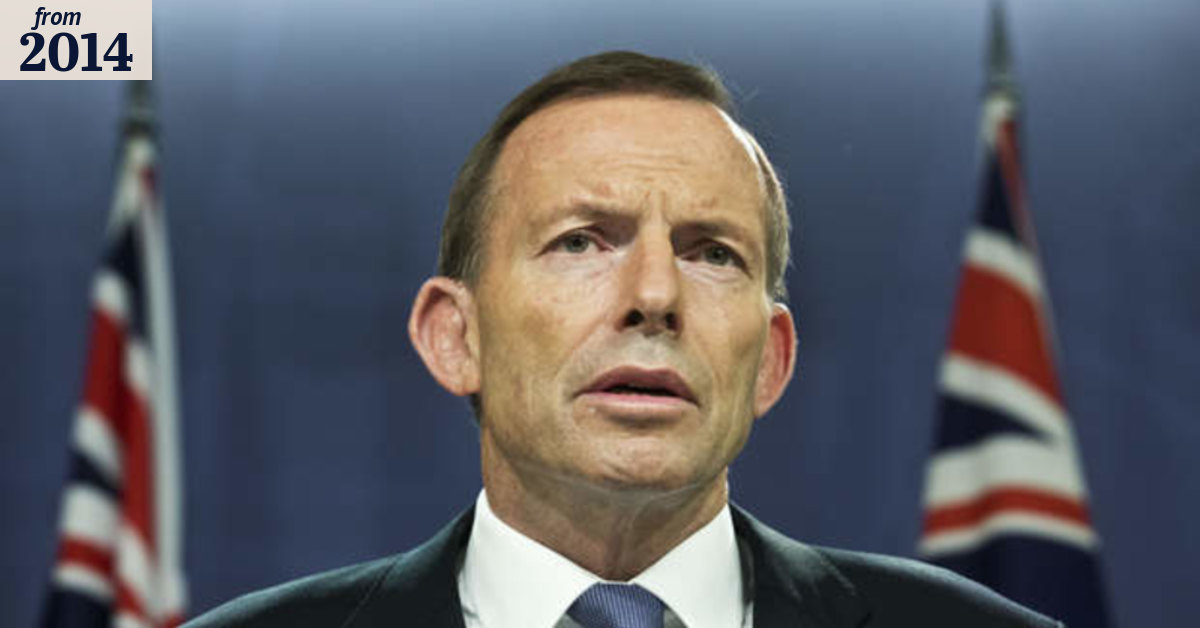
**La déclaration déforme ce que Tony Abbott a réellement dit.** Le 10 janvier 2014, le Premier ministre Tony Abbott a défendu le secret de son gouvernement concernant les opérations de protection des frontières en utilisant une analogie avec le secret de guerre.
**The claim misrepresents what Tony Abbott actually said.** On January 10, 2014, Prime Minister Tony Abbott defended his government's secrecy regarding border protection operations by using a wartime secrecy analogy.
Sa déclaration exacte était : > « Si empêcher les bateaux signifie être critiqué parce que je ne donne pas d'informations qui seraient utiles aux passeurs, qu'il en soit ainsi...
His exact statement was: > "If stopping the boats means being criticised because I'm not giving information that would be of use to people smugglers, so be it...
Si nous étions en guerre, nous ne divulguerions pas d'informations utiles à l'ennemi juste parce que nous pourrions avoir une curiosité oisive à ce sujet. » [1] Le contexte était qu'Abbott défendait l'approche « livre fermé » de son gouvernement sur l'Opération Souveraineté des Frontières, dans un contexte de controverse concernant des rapports selon lesquels des membres de la marine avaient renvoyé des bateaux de demandeurs d'asile vers l'Indonésie [1].
If we were at war we wouldn't be giving out information that is of use to the enemy just because we might have an idle curiosity about it ourselves." [1] The context was Abbott defending the government's "closed book" approach to Operation Sovereign Borders amid controversy over reports that navy personnel had turned back asylum seeker boats to Indonesia [1].
L'« ennemi » auquel Abbott faisait référence était explicitement les **passeurs**, et non les demandeurs d'asile ou le programme humanitaire lui-même [2].
The "enemy" Abbott referred to was explicitly **people smugglers**, not asylum seekers or the humanitarian program itself [2].
La déclaration inverse le sens réel de l'affirmation d'Abbott.
The claim inverts the actual meaning of Abbott's statement.
Il ne comparait pas le programme d'immigration humanitaire à la guerre il comparait le **secret autour des activités opérationnelles de protection des frontières** au secret opérationnel en temps de guerre [3].
He was not comparing the humanitarian immigration program to war - he was comparing the **secrecy around operational border protection activities** to wartime operational secrecy [3].

Contexte manquant

La déclaration omet plusieurs éléments contextuels critiques : 1. **Ce qu'Abbott comparait réellement à la guerre** : C'était le secret opérationnel, pas le programme humanitaire.
The claim omits several critical pieces of context: 1. **What Abbott actually likened to war**: It was operational secrecy, not the humanitarian program.
Abbott a déclaré : « Je ne donnerais pas d'informations qui aideraient un ennemi en guerre » dans le contexte de la défense du refus de son gouvernement de divulguer des détails sur des opérations navales qui pourraient aider les passeurs [1]. 2. **L'« ennemi » était les passeurs** : La citation d'Abbott identifiait explicitement les « passeurs » comme la cible de la campagne opérationnelle, et non les demandeurs d'asile eux-mêmes [1].
Abbott stated: "I would not give information that would help a war enemy" in the context of defending the government's refusal to disclose details of navy operations that could assist people smugglers [1]. 2. **The "enemy" was people smugglers**: Abbott's quote explicitly identified "people smugglers" as the target of the operational campaign, not asylum seekers themselves [1].
La déclaration passe sous silence cette distinction cruciale. 3. **Le contexte politique** : La Coalition avait mis en place « l'Opération Souveraineté des Frontières » en septembre 2013, une opération dirigée par les militaires impliquant la Force de Défense Australienne pour empêcher les arrivées de bateaux de demandeurs d'asile.
The claim leaves this crucial distinction unstated. 3. **The policy context**: The Coalition had implemented "Operation Sovereign Borders" in September 2013, a military-led operation involving the Australian Defence Force to prevent asylum seeker boat arrivals.
La controverse sur le secret a émergé au début de 2014 lorsque des rapports ont indiqué que des membres de la marine avaient renvoyé des bateaux [1]. 4. **Le programme humanitaire est distinct de la protection des frontières** : Le Programme des Réfugiés et de l'Aide Humanitaire de l'Australie fonctionne par des canaux officiels incluant la réinstallation en mer et les visas de protection sur le territoire [4].
The secrecy controversy emerged in early 2014 when reports emerged that navy personnel had turned back boats [1]. 4. **The humanitarian program is separate from border protection**: Australia's Refugee and Humanitarian Program operates through official channels including offshore resettlement and onshore protection visas [4].
Les commentaires d'Abbott concernaient spécifiquement les opérations de protection des frontières ciblant le passeur, pas l'accueil humanitaire lui-même.
Abbott's comments related specifically to border protection operations targeting people smuggling, not the humanitarian intake itself.

Évaluation de la crédibilité de la source

La source originale est le Herald Sun, une publication de News Corp Australia.
The original source is the Herald Sun, a News Corp Australia publication.
Les publications de News Corp ont fait l'objet de critiques pour des titres sensationnalistes et une couverture partisane, bien que le Herald Sun soit un journal métropolitain grand public [5].
News Corp publications have faced criticism for sensationalist headlines and partisan coverage, though the Herald Sun is a mainstream metropolitan newspaper [5].
Le titre du Herald Sun « Tony Abbott compare l'arrêt des bateaux de demandeurs d'asile à la guerre » est techniquement exact quant au sens superficiel mais omet le contexte crucial qu'Abbott faisait référence au secret opérationnel, et non au programme humanitaire lui-même [1].
The Herald Sun's headline "Tony Abbott compares stopping asylum-seeker boats to war" is technically accurate regarding the surface meaning but omits the crucial context that Abbott was referring to operational secrecy, not the humanitarian program itself [1].
Le titre présente une interprétation plus alarmiste que la citation réelle ne le justifie.
The headline presents a more inflammatory interpretation than the actual quote warrants.
D'autres sources grand public comme le Sydney Morning Herald et ABC News ont rapporté le même événement avec des titres plus nuancés mettant l'accent sur la comparaison avec le secret plutôt que de suggérer qu'Abbott assimilait l'ensemble du programme humanitaire à la guerre [1, 3].
Other mainstream sources like the Sydney Morning Herald and ABC News reported the same event with more nuanced headlines emphasizing the secrecy comparison rather than suggesting Abbott likened the entire humanitarian program to war [1, 3].
⚖️

Comparaison avec Labor

**Le Parti Travailliste a-t-il fait quelque chose de similaire ?** Recherche effectuée : « Labor government asylum seeker boat policy Pacific Solution » Résultat : Le Parti Travailliste a soutenu et maintenu des politiques de fermeté envers les demandeurs d'asile tout au long de différentes périodes : 1. **La Solution Pacifique (2001-2007)** : La politique du gouvernement Howard de traitement des demandes à l'étranger à Nauru et sur l'Île de Manus a eu le **soutien bipartite** de l'opposition travailliste à l'époque [6].
**Did Labor do something similar?** Search conducted: "Labor government asylum seeker boat policy Pacific Solution" Finding: The Labor Party supported and maintained hardline asylum seeker policies throughout different periods: 1. **The Pacific Solution (2001-2007)**: The Howard Government's policy of offshore processing on Nauru and Manus Island had **bipartisan support** from the Labor opposition at the time [6].
Cette politique impliquait la même approche de base consistant à empêcher les arrivées de bateaux par la détention à l'étranger. 2. **La Solution PNG de Kevin Rudd (2013)** : En juillet 2013, le Premier ministre travailliste Kevin Rudd a annoncé que tous les demandeurs d'asile arrivant par bateau seraient envoyés en Papouasie-Nouvelle-Guinée pour traitement et résidence, déclarant : « Les demandeurs d'asile qui viennent ici en bateau sans visa ne seront jamais installés en Australie » [7].
This policy involved the same basic approach of preventing boat arrivals through offshore detention. 2. **Kevin Rudd's PNG Solution (2013)**: In July 2013, Labor Prime Minister Kevin Rudd announced that all asylum seekers arriving by boat would be sent to Papua New Guinea for processing and settlement, declaring "Asylum seekers who come here by boat without a visa will never be settled in Australia" [7].
Cette politique était probablement plus restrictive que l'approche d'Abbott car elle interdisait définitivement la résidence aux arrivants par bateau. 3. **Le Parti Travailliste a maintenu les refoulements de bateaux** : Bien que les gouvernements Rudd/Gillard aient initialement abandonné les refoulements, d'ici 2013 le Parti Travailliste avait réintroduit des mesures similaires [8].
This policy was arguably more restrictive than Abbott's approach as it permanently barred boat arrivals from settlement. 3. **Labor maintained boat turnbacks**: While the Rudd/Gillard governments initially abandoned turnbacks, by 2013 Labor had reintroduced similar measures [8].
La différence clé est que les gouvernements travaillistes utilisaient un secret opérationnel similaire autour de leurs activités de protection des frontières sans la rhétorique explicite de « guerre » [1, 7].
The key difference is that Labor governments used similar operational secrecy around their border protection activities without the explicit "war" rhetoric [1, 7].
Cependant, les approches politiques de base empêcher les arrivées de bateaux, le traitement à l'étranger et le secret opérationnel étaient cohérentes entre les deux partis.
However, the core policy approaches - preventing boat arrivals, offshore processing, and operational secrecy - were consistent across both parties.
🌐

Perspective équilibrée

La déclaration présente une version déformée des remarques d'Abbott qui confond deux aspects distincts du système d'immigration australien : le **programme humanitaire** (la réinstallation officielle des réfugiés) et les **opérations de protection des frontières** (l'empêchement des arrivées de bateaux non autorisés). **Ce qu'Abbott a réellement dit :** Abbott défendait le refus du gouvernement de fournir des détails sur les opérations navales qui pourraient aider les passeurs à contourner les mesures de protection des frontières.
The claim presents a distorted version of Abbott's remarks that conflates two distinct aspects of Australia's immigration system: the **humanitarian program** (official refugee resettlement) and **border protection operations** (preventing unauthorized boat arrivals). **What Abbott actually said:** Abbott was defending the government's refusal to provide details about navy operations that could help people smugglers circumvent border protection measures.
Son analogie de « guerre » concernait spécifiquement le secret opérationnel : « Si nous étions en guerre, nous ne divulguerions pas d'informations utiles à l'ennemi » [1].
His "war" analogy was specifically about operational secrecy: "If we were at war we wouldn't be giving out information that is of use to the enemy" [1].
L'ennemi était identifié comme les passeurs, et non les réfugiés ou les demandeurs d'asile. **Le contexte politique :** L'Opération Souveraineté des Frontières de la Coalition, lancée en septembre 2013, était en effet une approche militariste de la protection des frontières impliquant la Force de Défense Australienne [1].
The enemy was identified as people smugglers, not refugees or asylum seekers. **The policy context:** The Coalition's Operation Sovereign Borders, launched in September 2013, was indeed a militarized approach to border protection involving the Australian Defence Force [1].
Bien que controversée, cette approche a réussi à réduire considérablement les arrivées de bateaux [9]. **Contexte comparatif :** La Solution PNG du Parti Travailliste (2013) et son soutien antérieur à la Solution Pacifique démontrent que les politiques de fermeté envers les demandeurs d'asile n'étaient pas uniques à la Coalition [6, 7].
While controversial, this approach succeeded in dramatically reducing boat arrivals [9]. **Comparative context:** Labor's PNG Solution (2013) and earlier Pacific Solution support demonstrate that hardline asylum seeker policies were not unique to the Coalition [6, 7].
Les deux partis ont employé le traitement à l'étranger, les refoulements et le secret opérationnel lorsqu'ils étaient au gouvernement. **Contexte clé :** La déclaration déforme l'affirmation d'Abbott en suggérant qu'il a assimilé le programme de réinstallation humanitaire de l'Australie à la guerre.
Both parties have employed offshore processing, turnbacks, and operational secrecy when in government. **Key context:** The claim misrepresents Abbott's statement by suggesting he likened Australia's humanitarian resettlement program to war.
En réalité, il faisait référence au secret opérationnel autour des activités de protection des frontières ciblant les passeurs.
In fact, he was referring to the operational secrecy around border protection activities targeting people smugglers.
Il s'agit d'un **cadrage trompeur** de la citation originale.
This is **misleading framing** of the original quote.

TROMPEUR

3.0

sur 10

L'affirmation selon laquelle Abbott a « assimilé notre programme d'immigration humanitaire à la guerre » est une déformation.
The claim that Abbott "likened our humanitarian immigration program to war" is a misrepresentation.
La déclaration réelle d'Abbott, faite le 10 janvier 2014, comparait le secret du gouvernement autour des opérations de protection des frontières au secret opérationnel en temps de guerre, utilisant l'analogie : « Si nous étions en guerre, nous ne divulguerions pas d'informations utiles à l'ennemi » [1].
Abbott's actual statement, made on January 10, 2014, compared the government's secrecy around border protection operations to wartime operational secrecy, using the analogy: "If we were at war we wouldn't be giving out information that is of use to the enemy" [1].
L'« ennemi » dans ce contexte était explicitement identifié comme les passeurs, et non les demandeurs d'asile ou le programme humanitaire [1].
The "enemy" in this context was explicitly identified as people smugglers, not asylum seekers or the humanitarian program [1].
La déclaration confond deux domaines politiques distincts : (1) le programme humanitaire (la réinstallation des réfugiés par des canaux officiels), et (2) les opérations de protection des frontières (l'empêchement des arrivées de bateaux non autorisés).
The claim conflates two distinct policy areas: (1) the humanitarian program (refugee resettlement through official channels), and (2) border protection operations (preventing unauthorized boat arrivals).
Les remarques d'Abbott ne concernaient que le second [1, 4].
Abbott's remarks addressed only the latter [1, 4].
De plus, les deux principaux partis politiques australiens ont mis en place des politiques similaires de fermeté envers les demandeurs d'asile, la Solution PNG du Parti Travailliste (2013) étant probablement plus restrictive en interdisant définitivement la résidence aux arrivants par bateau [6, 7].
Furthermore, both major Australian political parties have implemented similar hardline asylum seeker policies, with Labor's PNG Solution (2013) being arguably more restrictive in permanently barring boat arrivals from settlement [6, 7].

📚 SOURCES ET CITATIONS (9)

  1. 1
    smh.com.au

    smh.com.au

    Tony Abbott has defended his government's secrecy over its treatment of asylum seekers, saying he would not give information that would help a war enemy.

    The Sydney Morning Herald
  2. 2
    abc.net.au

    abc.net.au

    Prime Minister Tony Abbott has likened the Government's border protection approach to being at "war" with people smugglers. The Government has come under fire for refusing to release details of attempts to turn asylum seeker boats back to Indonesia. And yesterday the Chief of the Defence Force was forced to defend the actions of defence personnel, after a number of asylum seekers claimed they were mistreated by Australian authorities. This morning Mr Abbott told Channel Ten that releasing information would help people smugglers, and put asylum seekers' lives at risk. "We are in a fierce contest with these people smugglers," he said. "And if we were at war, we wouldn't be giving out information that is of use to the enemy just because we might have an idle curiosity about it ourselves."

    Abc Net
  3. 3
    news.com.au

    news.com.au

    News Com

  4. 4
    immi.homeaffairs.gov.au

    immi.homeaffairs.gov.au

    Find out about Australian visas, immigration and citizenship.

    Immigration and citizenship Website
  5. 5
    economist.com

    economist.com

    Economist

  6. 6
    en.wikipedia.org

    en.wikipedia.org

    Wikipedia
  7. 7
    abc.net.au

    abc.net.au

    Four years ago, then-PM Kevin Rudd vowed to ban asylum seekers arriving by boat from ever settling in Australia. Now he says that wasn't the case.

    Abc Net
  8. 8
    theguardian.com

    theguardian.com

    'The point is to stop the boats,' says prime minister, after reports that navy is towing vessels back to Indonesia

    the Guardian
  9. 9
    tonyabbott.com.au

    tonyabbott.com.au

    Originally published in The Telegraph With more than 16,000 arrivals by small boat across the Channel so far this year, and 100,000 in the past five years, it’s no wonder that the Prime Minister has made stopping the boats one of the Government’s five priorities. While Britain’s predicament differs somewhat, I suspect there might be...

    Tony Abbott
Méthodologie de l'échelle de notation

1-3: FAUX

Factuellement incorrect ou fabrication malveillante.

4-6: PARTIEL

Une part de vérité mais le contexte manque ou est biaisé.

7-9: MAJORITAIREMENT VRAI

Détails techniques mineurs ou problèmes de formulation.

10: EXACT

Parfaitement vérifié et contextuellement équitable.

Méthodologie: Les notations sont déterminées par recoupement des documents gouvernementaux officiels, des organisations indépendantes de vérification des faits et des documents sources primaires.