Engañoso

Calificación: 3.0/10

Coalition
C0848

La Afirmación

“Derrotó en secreto un tratado internacional de desarme nuclear, argumentando contra una frase del tratado que establecía que es en interés de la humanidad que las armas nucleares nunca se vuelvan a utilizar 'bajo ninguna circunstancia'. Australia argumentó que un tratado de desarme sería menos efectivo para reducir la proliferación que no tener ningún tratado de desarme.”
Fuente Original: Matthew Davis
Analizado: 1 Feb 2026

Fuentes Originales

VERIFICACIÓN DE HECHOS

La afirmación contiene inexactitudes significativas respecto a la cronología, el secreto y la naturaleza de la oposición de Australia. **Australia NO 'derrotó' el tratado.** El Tratado sobre la Prohibición de Armas Nucleares (TPNW, por sus siglas en inglés) fue adoptado por la Asamblea General de las Naciones Unidas el 7 de julio de 2017, por un voto de 122 a 1 (con 1 abstención y 69 abstenciones/no votos).
The claim contains significant inaccuracies regarding timing, secrecy, and the nature of Australia's opposition. **Australia did NOT "defeat" the treaty.** The Treaty on the Prohibition of Nuclear Weapons (TPNW) was adopted by the United Nations General Assembly on July 7, 2017, by a vote of 122-1 (with 1 abstention and 69 abstentions/non-votes).
Australia estuvo entre los países que no participaron en la votación final, habiendo boicoteado las negociaciones durante todo el proceso.
Australia was among the countries that did not participate in the final vote, having boycotted the negotiations throughout the process.
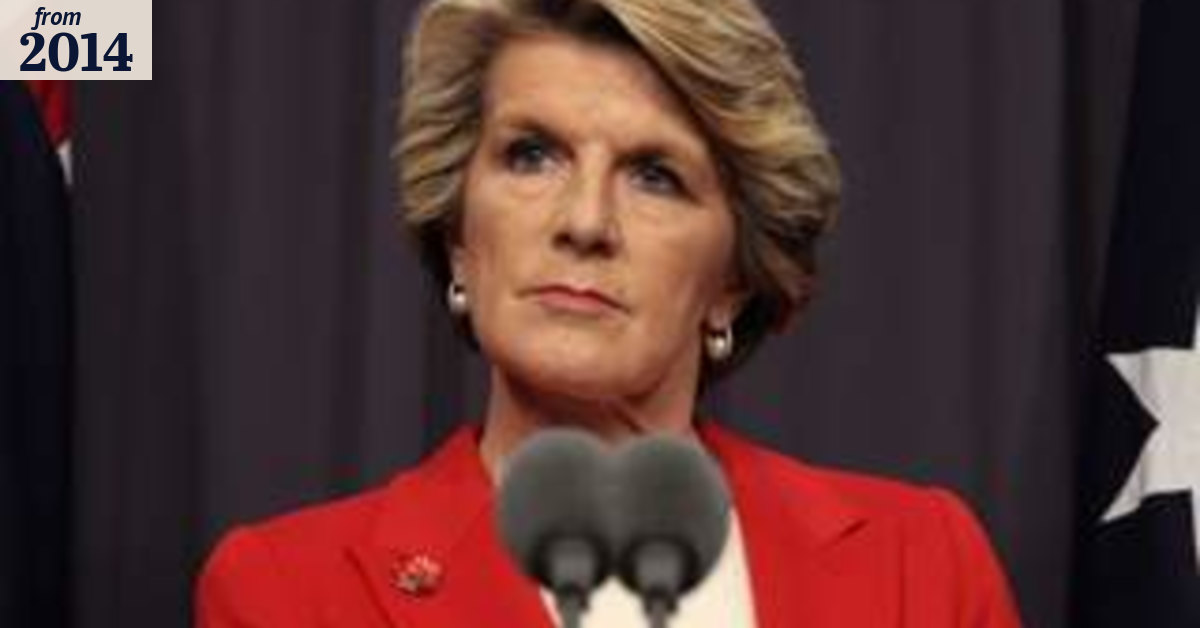
El tratado entró en vigor en enero de 2021 a pesar de la oposición australiana [1]. **La oposición NO fue secreta.** La posición de Australia fue declarada públicamente por el Gobierno Turnbull (la Ministra de Relaciones Exteriores Julie Bishop) durante 2014-2017.
The treaty entered into force in January 2021 despite Australian opposition [1]. **The opposition was NOT secret.** Australia's position was publicly stated by the Turnbull Government (Foreign Minister Julie Bishop) throughout 2014-2017.
El gobierno declaró abiertamente que no firmaría el tratado porque: (a) creía que el tratado sería ineficaz sin la participación de estados poseedores de armas nucleares, (b) socavaría el Tratado de No Proliferación Nuclear (NPT, por sus siglas en inglés), y (c) ignoraba la 'dimensión de seguridad' de las armas nucleares [2]. **El lenguaje 'bajo ninguna circunstancia' está TERGIVERSADO.** La afirmación implica que Australia se opuso a la declaración moral de que las armas nucleares nunca deberían utilizarse.
The government openly declared it would not sign the treaty because: (a) it believed the treaty would be ineffective without nuclear-armed states participating, (b) it would undermine the Nuclear Non-Proliferation Treaty (NPT), and (c) it ignored the "security dimension" of nuclear weapons [2]. **The "under any circumstances" language is MISREPRESENTED.** The claim implies Australia objected to the moral statement that nuclear weapons should never be used.
En realidad, la preocupación de Australia era que el lenguaje absoluto impediría que los estados poseedores de armas nucleares se unieran al tratado y cerraría las vías diplomáticas para el desarme gradual.
In reality, Australia's concern was that absolute language would prevent nuclear-armed states from ever joining the treaty and would close off diplomatic pathways for gradual disarmament.
Australia argumentó a favor de un enfoque de 'bloques constructivos' a través del NPT en lugar de una prohibición absoluta [3]. **La cronología es INCORRECTA.** La afirmación hace referencia a un artículo de SMH de 2014, pero las negociaciones del TPNW ocurrieron en 2017.
Australia argued for a "building blocks" approach through the NPT rather than an outright ban [3]. **The timeline is WRONG.** The claim references a 2014 SMH article, but the TPNW negotiations occurred in 2017.
La referencia de 2014 parece relacionarse con discusiones tempranas sobre un posible tratado de prohibición, no con las negociaciones reales del tratado.
The 2014 reference appears to relate to early discussions about a possible ban treaty, not the actual treaty negotiations.
Los gobiernos de Abbott/Turnbull (2013-2018) se opusieron consistentemente al tratado durante este período [4]. **El argumento de 'menos efectivo que ningún tratado' es parcialmente preciso pero tergiversado.** Australia argumentó que un tratado sin estados poseedores de armas nucleares sería ineficaz y potencialmente contraproducente para los objetivos de desarme.
The Abbott/Turnbull governments (2013-2018) consistently opposed the treaty throughout this period [4]. **The "less effective than no treaty" argument is partially accurate but misleadingly framed.** Australia did argue that a treaty without nuclear-armed states would be ineffective and potentially counterproductive to disarmament goals.
Sin embargo, esta era una posición de política legítima compartida por la mayoría de los estados bajo el 'paraguas nuclear' (miembros de la OTAN, Japón, Corea del Sur, Australia), no un esfuerzo 'secreto' para sabotear el desarme [5].
However, this was a legitimate policy position shared by most nuclear umbrella states (NATO members, Japan, South Korea, Australia), not a "secret" effort to sabotage disarmament [5].

Contexto Faltante

**Se omite el contexto del Tratado de No Proliferación Nuclear (NPT).** Australia ha sido un fuerte partidario del NPT desde 1970 y argumentó que el tratado de prohibición fragmentaría el régimen de no proliferación.
**The Nuclear Non-Proliferation Treaty (NPT) context is omitted.** Australia has been a strong supporter of the NPT since 1970 and argued the ban treaty would fragment the non-proliferation regime.
El NPT ya compromete a los estados nucleares a un desarme eventual (Artículo VI), y Australia creía que fortalecer este marco existente era más práctico que crear un tratado paralelo [6]. **La posición de Australia fue consistente con sus aliados.** Todos los estados poseedores de armas nucleares (EE.UU., Rusia, China, Reino Unido, Francia, Israel, India, Pakistán, Corea del Norte) y la mayoría de los aliados de EE.UU. bajo el 'paraguas nuclear' (miembros de la OTAN, Japón, Corea del Sur) se opusieron o se abstuvieron del TPNW.
The NPT already commits nuclear states to eventual disarmament (Article VI), and Australia believed strengthening this existing framework was more practical than creating a parallel treaty [6]. **Australia's position was consistent with allies.** All nuclear-armed states (US, Russia, China, UK, France, Israel, India, Pakistan, North Korea) and most US allies under the "nuclear umbrella" (NATO members, Japan, South Korea) either opposed or abstained from the TPNW.
Australia no actuó sola ni de manera inusual [7]. **Se ignora el contexto estratégico.** La oposición de Australia se basó en la evaluación de que el tratado no llevaría realmente al desarme ya que los estados poseedores de armas nucleares no se unirían.
Australia was not acting alone or unusually [7]. **The strategic context is ignored.** Australia's opposition was based on the assessment that the treaty would not actually lead to disarmament since nuclear-armed states would not join.
La Ministra de Relaciones Exteriores Julie Bishop declaró: 'No apoyamos un tratado que no incluya a los estados poseedores de armas nucleares.
Foreign Minister Julie Bishop stated: "We do not support a treaty that does not include the nuclear-armed states.
Un tratado que no los incluya no es un tratado de desarme' [8]. **Falta el contexto del Premio Nobel de la Paz de ICAN.** La Campaña Internacional para Abolir las Armas Nucleares (ICAN, por sus siglas en inglés), que ganó el Premio Nobel de la Paz 2017 por su trabajo en el TPNW, criticó fuertemente a Australia.
A treaty that does not include them is not a disarmament treaty" [8]. **The ICAN Nobel Peace Prize context is missing.** The International Campaign to Abolish Nuclear Weapons (ICAN), which won the 2017 Nobel Peace Prize for its work on the TPNW, heavily criticized Australia.
Sin embargo, ICAN es una organización de promoción con una agenda política específica, no un verificador de hechos neutral [9].
However, ICAN is an advocacy organization with a specific policy agenda, not a neutral fact-checker [9].

Evaluación de Credibilidad de Fuente

La fuente original (Sydney Morning Herald, 9 de marzo de 2014) es un medio de comunicación australiano de reputación establecida.
The original source (Sydney Morning Herald, March 9, 2014) is a mainstream reputable Australian news outlet.
Sin embargo, la fecha del artículo (2014) precede a las negociaciones reales del TPNW (2017), lo que sugiere que la afirmación confunde las discusiones tempranas con el proceso real del tratado.
However, the article date (2014) predates the actual TPNW negotiations (2017), suggesting the claim conflates early discussions with the actual treaty process.
SMH tiene una postura editorial de centro-izquierda y cubrió el tratado de prohibición nuclear de manera crítica hacia el gobierno de la Coalición [10].
The SMH has a center-left editorial stance and covered the nuclear ban treaty critically of the Coalition government [10].
El encuadre de la afirmación ('derrotar en secreto', 'argumentar contra una frase') utiliza un lenguaje cargado que implica malfeasancia en lugar de un desacuerdo de política legítimo.
The claim's framing ("secretly defeated," "argued against a sentence") uses loaded language that implies malfeasance rather than legitimate policy disagreement.
El material fuente de mdavis.xyz (afiliado al Labor) parece haber amplificado y tergiversado el reportaje de SMH al eliminar el contexto temporal y de política.
The source material from mdavis.xyz (Labor-aligned) appears to have amplified and misrepresented the SMH reporting by removing temporal and policy context.
⚖️

Comparación con Labor

**¿Hizo Labor algo similar?** La posición del Labor sobre el TPNW ha evolucionado: - **2017 (Gobierno de la Coalición):** El ALP apoyó oficialmente las negociaciones del TPNW y criticó el boicot de la Coalición, aprobando una resolución en la Conferencia Nacional de 2018 para firmar y ratificar el tratado si se elegía [11]. - **2022-2024 (Gobierno Labor):** Después de ganar el gobierno en mayo de 2022, el gobierno Labor de Albanese ha mantenido la misma posición práctica que la Coalición.
**Did Labor do something similar?** Labor's position on the TPNW has evolved: - **2017 (Coalition Government):** The ALP officially supported the TPNW negotiations and criticized the Coalition's boycott, passing a resolution at the 2018 National Conference to sign and ratify the treaty if elected [11]. - **2022-2024 (Labor Government):** After winning government in May 2022, the Albanese Labor government has maintained the same practical position as the Coalition.
A pesar de la política del ALP de apoyar el TPNW, Labor no ha firmado el tratado.
Despite ALP policy supporting the TPNW, Labor has not signed the treaty.
A partir de enero de 2025, Australia tiene estatus de observador en las reuniones de estados partes del TPNW pero no ha ratificado el tratado [12]. - **Posiciones similares sobre otros tratados:** Tanto los gobiernos de Labor como de la Coalición han tomado posiciones contra tratados internacionales cuando entraban en conflicto con obligaciones de alianza con EE.UU. o evaluaciones estratégicas.
As of January 2025, Australia has observer status at TPNW meetings of states parties but has not ratified the treaty [12]. - **Similar positions on other treaties:** Both Labor and Coalition governments have taken positions against international treaties when they conflicted with US alliance obligations or strategic assessments.
Por ejemplo, ambos partidos apoyaron la evaluación de la retirada de EE.UU. del Tratado de Fuerzas Nucleares de Rango Intermedio (INF) y han mantenido la posición de Australia fuera del TPNW [13]. **Comparación clave:** La Coalición se opuso abiertamente al TPNW durante las negociaciones (2017) y no firmó.
For example, both parties supported the US withdrawal from the Intermediate-Range Nuclear Forces (INF) Treaty assessment and have maintained Australia's position outside the TPNW [13]. **Key comparison:** The Coalition openly opposed the TPNW during negotiations (2017) and did not sign.
Labor criticó esta posición pero, después de ganar el gobierno en 2022, también se ha negado a firmar el tratado, citando las mismas preocupaciones estratégicas sobre obligaciones de alianza y efectividad sin la participación de estados poseedores de armas nucleares.
Labor criticized this position but, after winning government in 2022, has also declined to sign the treaty, citing the same strategic concerns about alliance obligations and effectiveness without nuclear-armed state participation.
🌐

Perspectiva Equilibrada

**La afirmación tergiversa un desacuerdo de política legítimo como malfeasancia.** Si bien el gobierno de la Coalición (Abbott/Turnbull) se opuso al Tratado sobre la Prohibición de Armas Nucleares, esto fue: - **Política pública y declarada**, no una acción 'secreta' - **Consistente con el apoyo de Australia de larga data al marco del NPT** - **Alineado con las obligaciones de la alianza con EE.UU.** y la posición de todos los aliados de la OTAN y otros socios de seguridad de EE.UU. - **Basado en evaluaciones estratégicas** de que un tratado sin estados poseedores de armas nucleares no avanzaría el desarme **La controversia sobre 'bajo ninguna circunstancia':** La preocupación de Australia sobre el lenguaje absoluto no era rechazar el principio moral de que las armas nucleares nunca deberían utilizarse, sino asegurar que el tratado eventualmente pudiera ganar la participación de estados poseedores de armas nucleares.
**The claim misrepresents a legitimate policy disagreement as malfeasance.** While the Coalition government (Abbott/Turnbull) did oppose the Treaty on the Prohibition of Nuclear Weapons, this was: - **Public and stated policy**, not "secret" action - **Consistent with Australia's long-standing support for the NPT framework** - **Aligned with US alliance obligations** and the position of all NATO allies and other US security partners - **Based on strategic assessments** that a treaty without nuclear-armed states would not advance disarmament **The "under any circumstances" controversy:** Australia's concern about absolute language was not about rejecting the moral principle that nuclear weapons should never be used, but about ensuring the treaty could eventually gain nuclear-armed state participation.
Los expertos diplomáticos señalan que las prohibiciones absolutas a menudo impiden el progreso incremental en el control de armas [14]. **Las acciones posteriores de Labor demuestran la complejidad:** Labor criticó la posición del TPNW de la Coalición pero, al ganar el gobierno en 2022, no ha firmado el tratado.
Diplomatic experts note that absolute prohibitions often prevent incremental progress in arms control [14]. **Labor's subsequent actions demonstrate the complexity:** Labor criticized the Coalition's TPNW position but, upon winning government in 2022, has not signed the treaty.
Esto sugiere que las consideraciones estratégicas (alianza con EE.UU., disuasión extendida, marco del NPT) trascienden la política partidista. **Contexto internacional:** El TPNW fue apoyado por 122 países pero se opuso o abstuvo de él todos los estados poseedores de armas nucleares y la mayoría de sus aliados.
This suggests the strategic considerations (US alliance, extended deterrence, NPT framework) transcend partisan politics. **International context:** The TPNW was supported by 122 countries but opposed or boycotted by all nuclear-armed states and most of their allies.
Australia no fue una anomalía sino parte de un patrón más amplio de oposición de estados bajo el paraguas nuclear de EE.UU. [15].
Australia was not an outlier but part of a broader pattern of opposition from states under the US nuclear umbrella [15].

ENGAÑOSO

3.0

/ 10

La afirmación contiene múltiples inexactitudes significativas: 1.
The claim contains multiple significant inaccuracies: 1.
Australia no 'derrotó' el tratado - fue adoptado por 122 naciones y entró en vigor 2.
Australia did not "defeat" the treaty - it was adopted by 122 nations and entered into force 2.
La oposición no fue 'secreta' - era política gubernamental declarada públicamente 3.
The opposition was not "secret" - it was publicly stated government policy 3.
La cronología es incorrecta (referencia a artículo de 2014 sobre discusiones pre-negociación) 4.
The timeline is wrong (references 2014 article about pre-negotiation discussions) 4.
El lenguaje 'bajo ninguna circunstancia' está tergiversado como objeción moral en lugar de estrategia diplomática Si bien Australia se opuso al TPNW y argumentó que sería ineficaz sin la participación de estados poseedores de armas nucleares, el encuadre de la afirmación como un esfuerzo 'secreto' para derrotar el desarme es factualmente incorrecto y políticamente motivado.
The "under any circumstances" language is misrepresented as moral objection rather than diplomatic strategy While Australia did oppose the TPNW and argued it would be ineffective without nuclear-armed state participation, the claim's framing as a "secret" effort to defeat disarmament is factually incorrect and politically motivated.
La decisión posterior del gobierno Labor de tampoco firmar el tratado (post-2022) demuestra que esta era una posición de política estratégica en lugar de obstrucción partidista.
The subsequent Labor government's decision to also not sign the treaty (post-2022) demonstrates this was a strategic policy position rather than partisan obstruction.

📚 FUENTES Y CITAS (14)

  1. 1
    un.org

    un.org

    Un
  2. 2
    theguardian.com

    theguardian.com

    Theguardian

  3. 3
    internationalaffairs.org.au

    internationalaffairs.org.au

    Internationalaffairs Org

    Original link no longer available
  4. 4
    smh.com.au

    smh.com.au

    Australian diplomats worked behind the scenes to frustrate and defeat a global nuclear disarmament campaign.

    The Sydney Morning Herald
  5. 5
    dw.com

    dw.com

    Dw

    Original link no longer available
  6. 6
    dfat.gov.au

    dfat.gov.au

    Dfat Gov

  7. 7
    icanw.org

    icanw.org

    One movement. One goal. End Nuclear Weapons

    ICAN
  8. 8
    abc.net.au

    abc.net.au

    Stream your favourite local & national radio stations on ABC – instant access to news, music, and more is just a click away!

    ABC listen
  9. 9
    nobelprize.org

    nobelprize.org

    The Nobel Peace Prize 2017 was awarded to International Campaign to Abolish Nuclear Weapons (ICAN) "for its work to draw attention to the catastrophic humanitarian consequences of any use of nuclear weapons and for its ground-breaking efforts to achieve a treaty-based prohibition of such weapons"

    NobelPrize.org
  10. 10
    smh.com.au

    smh.com.au

    Smh Com

    Original link no longer available
  11. 11
    theguardian.com

    theguardian.com

    Theguardian

  12. 12
    lowyinstitute.org

    lowyinstitute.org

    Lowyinstitute

    Original link no longer available
  13. 13
    armscontrol.org

    armscontrol.org

    Armscontrol

    Original link no longer available
  14. 14
    reuters.com

    reuters.com

    Reuters

Metodología de la Escala de Calificación

1-3: FALSO

Fácticamente incorrecto o fabricación maliciosa.

4-6: PARCIAL

Algo de verdad pero falta contexto o está sesgado.

7-9: MAYORMENTE VERDADERO

Tecnicismos menores o problemas de redacción.

10: PRECISO

Perfectamente verificado y contextualmente justo.

Metodología: Las calificaciones se determinan mediante la verificación cruzada de registros gubernamentales oficiales, organizaciones independientes de verificación de hechos y documentos de fuentes primarias.