Falso

Calificación: 3.0/10

Coalition
C0600

La Afirmación

“Utilizó poderes de veto para bloquear una resolución de la ONU que exigía el fin de la ocupación de Palestina por parte de Israel.”
Fuente Original: Matthew Davis
Analizado: 30 Jan 2026

Fuentes Originales

VERIFICACIÓN DE HECHOS

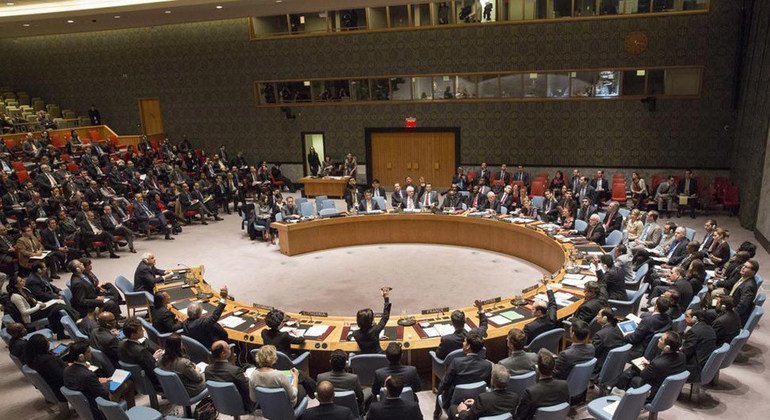
**Verificación de hechos central:** El 30 de diciembre de 2014, Australia votó "no" (en contra) de un proyecto de resolución del Consejo de Seguridad de la ONU que exigía a Israel poner fin a la ocupación de los territorios palestinos en un plazo de dos años [1][2].
**Core Fact Check:** On December 30, 2014, Australia did vote "no" (against) a UN Security Council draft resolution demanding Israel end its occupation of Palestinian territories within two years [1][2].
Sin embargo, la afirmación contiene un error factual fundamental respecto a los poderes de Australia en la ONU. **Australia NO tiene poderes de veto:** Australia estaba sirviendo como **miembro temporal y no permanente** del Consejo de Seguridad de la ONU durante 2013-2014 [3].
However, the claim contains a fundamental factual error regarding Australia's powers at the UN. **Australia Does NOT Have Veto Powers:** Australia was serving as a **temporary, non-permanent member** of the UN Security Council during 2013-2014 [3].
Solo los cinco miembros permanentes (P5) del Consejo de Seguridad de la ONU China, Francia, Rusia, el Reino Unido y los Estados Unidos poseen poderes de veto [4].
Only the five permanent members (P5) of the UN Security Council - China, France, Russia, the United Kingdom, and the United States - possess veto powers [4].
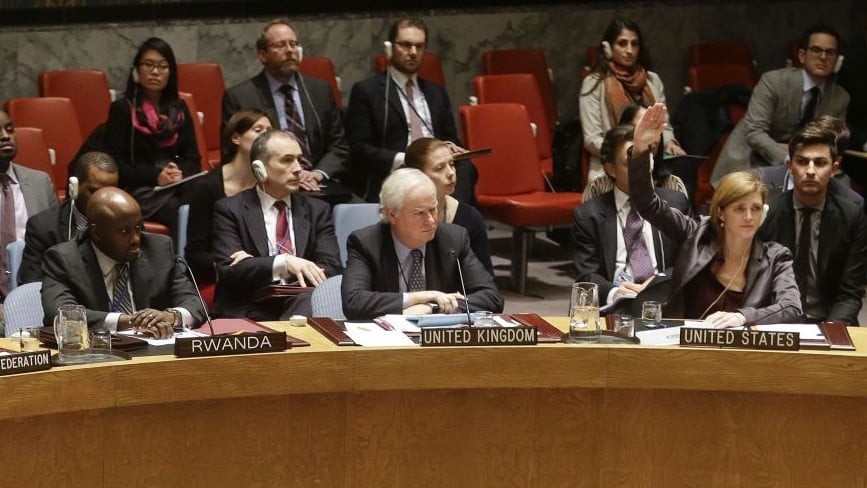
Los miembros no permanentes como Australia tienen derecho a voto pero absolutamente ninguna autoridad de veto. **Lo que realmente ocurrió:** La votación del Consejo de Seguridad de la ONU el 30 de diciembre de 2014 no adoptó la resolución sobre la soberanía palestina porque: - Solo 8 de 15 miembros votaron a favor (se requerían 9 votos para la adopción) [1][5] - Australia y los Estados Unidos votaron en contra [1][2] - Cinco países se abstuvieron (incluyendo el Reino Unido y Ruanda) [1][6] - Estados Unidos habría vetado la resolución si hubiera alcanzado 9 votos, pero no fue necesario un veto dado que la resolución no logró el apoyo mayoritario [1] **El contenido de la resolución:** La resolución patrocinada por Jordania (presentada en nombre de las naciones árabes) habría: - Establecido un plazo de 2017 para que Israel se retirara de Cisjordania y Gaza [3] - Exigido fronteras basadas en las líneas de 1967 con intercambios de tierra negociados [3] - Afirmado que Jerusalén Este es la capital de un estado palestino [5]
Non-permanent members like Australia have voting rights but absolutely no veto authority. **What Actually Happened:** The UN Security Council vote on December 30, 2014, failed to adopt the Palestinian statehood resolution because: - Only 8 of 15 members voted in favor (9 votes were required for adoption) [1][5] - Australia and the United States voted against [1][2] - Five countries abstained (including the United Kingdom and Rwanda) [1][6] - The US would have vetoed the resolution if it had achieved 9 votes, but a veto was unnecessary since the resolution failed to gain majority support [1] **The Resolution's Content:** The Jordanian-sponsored resolution (presented on behalf of Arab nations) would have: - Set a 2017 deadline for Israel to withdraw from the West Bank and Gaza [3] - Called for borders based on 1967 lines with negotiated land swaps [3] - Affirmed East Jerusalem as the capital of a Palestinian state [5]

Contexto Faltante

**Primer voto "No" de Australia:** Esta fue la **primera vez** que Australia votó en contra de un proyecto de resolución durante su mandato de dos años en el Consejo de Seguridad [3].
**Australia's First-Ever "No" Vote:** This was the **first time** Australia had voted against a proposed resolution during its two-year term on the Security Council [3].
Australia anteriormente se había abstenido en temas conflictivos en lugar de votar "no". **Explicación oficial de Australia:** El Representante Permanente de Australia ante la ONU, Gary Quinlan, explicó el voto afirmando que la resolución "carece de equilibrio y busca imponer una solución presentada por una sola parte" y que "los temas de estatus final solo pueden resolverse entre las dos partes" [2][3].
Australia had previously abstained on contentious issues rather than voting "no." **Australia's Official Explanation:** Australia's Permanent Representative to the UN, Gary Quinlan, explained the vote by stating the resolution "lacks balance and seeks to impose a solution put forward by one party alone" and that "final status issues can only be resolved between the two sides" [2][3].
Reiteró el compromiso de Australia con una solución de dos estados pero argumentó que la resolución no avanzaría el proceso de paz [3]. **El voto ya estaba condenado:** Incluso sin el voto "no" de Australia, la resolución habría fracasado debido a insuficiente apoyo (solo 8 votos en lugar de los 9 requeridos).
He reiterated Australia's commitment to a two-state solution but argued the resolution would not advance the peace process [3]. **The Vote Was Already Doomed:** Even without Australia's "no" vote, the resolution would have failed due to insufficient support (only 8 votes instead of the required 9).
El voto de Australia fue simbólico más que decisivo [1][6]. **Contexto de temporalidad:** La votación ocurrió justo antes de que Australia y Ruanda completaran sus mandatos temporales en el Consejo en diciembre de 2014.
Australia's vote was symbolic rather than decisive [1][6]. **Timing Context:** The vote occurred just before Australia and Rwanda were to complete their temporary Council terms in December 2014.
Se creía que los nuevos miembros Nueva Zelanda, Malasia y Venezuela serían más simpatizantes con la posición palestina [3]. **Reacción del mundo árabe:** El representante palestino en Australia, Izzat Abdulhadi, expresó decepción, afirmando que el voto "afectaría las relaciones con Palestina y el mundo árabe" y que esperaba que Australia "al menos" se abstuviera [2].
Incoming members New Zealand, Malaysia, and Venezuela were believed to be more sympathetic to the Palestinian position [3]. **Arab World Reaction:** The Palestinian representative in Australia, Izzat Abdulhadi, expressed disappointment, stating the vote would "affect relations with Palestine and the Arab world" and that he expected Australia to "at least" abstain [2].

Evaluación de Credibilidad de Fuente

**Fuente original: RT (Russia Today)** La fuente original proporcionada con la afirmación es RT (Russia Today), un medio de comunicación financiado por el estado ruso [7][8][9]. - **Media Bias/Fact Check** califica a RT como "Cuestionable" basándose en "promover propaganda pro-rusa, teorías conspirativas, numerosas verificaciones de hechos fallidas y falta de transparencia de autor" [7] - **AllSides** señala que RT "ha sido acusado frecuentemente de difundir desinformación" y es financiado por el gobierno ruso [8] - Investigaciones académicas identifican a RT como "una parte importante de la política exterior rusa y fuente clave global de desinformación" [9] El reportaje de RT sobre este tema parece haber sido engañoso al sugerir o permitir que los lectores inferan que Australia tenía poderes de veto, lo cual es factualmente incorrecto.
**Original Source: RT (Russia Today)** The original source provided with the claim is RT (Russia Today), a Russian state-funded media outlet [7][8][9]. - **Media Bias/Fact Check** rates RT as "Questionable" based on "promoting pro-Russian propaganda, conspiracy theories, numerous failed fact checks, and a lack of author transparency" [7] - **AllSides** notes RT "has been accused frequently for spreading misinformation" and is funded by the Russian government [8] - Academic research identifies RT as "an important part of Russian foreign policy and key global sources of disinformation" [9] RT's reporting on this issue appears to have been misleading by suggesting or allowing readers to infer that Australia had veto powers, which is factually incorrect.
⚖️

Comparación con Labor

**¿Hizo algo similar el Labor?** Los gobiernos del Labor (Rudd 2007-2010, Gillard 2010-2013) tomaron posiciones notablemente diferentes en temas de Israel-Palestina: **Votos en la Asamblea General de la ONU:** Bajo el Labor, Australia cambió su patrón de votos en varias resoluciones recurrentes de la Asamblea General de la ONU sobre Palestina [10]: - **Noviembre de 2008:** Cambió el voto de "abstención" a "a favor" en la resolución que afirma que la Convención de Ginebra aplica al Territorio Palestino Ocupado - **Noviembre de 2008:** Cambió el voto de "en contra" a "a favor" en la resolución que establece que los asentamientos israelíes son "ilegales y un obstáculo para la paz" - **Diciembre de 2009:** Cambió el voto de "abstención" a "a favor" en la resolución que afirma el derecho del pueblo palestino a la autodeterminación **Voto de estatus de Palestina en la ONUGA 2012:** El 29 de noviembre de 2012, la Asamblea General de la ONU votó para otorgar a Palestina el estatus de "estado observador no miembro".
**Did Labor do something similar?** The Labor Governments (Rudd 2007-2010, Gillard 2010-2013) took notably different positions on Israel-Palestine issues: **UN General Assembly Votes:** Under Labor, Australia changed its voting pattern on several recurring UN General Assembly resolutions concerning Palestine [10]: - **November 2008:** Changed vote from "abstain" to "in favour" on resolution affirming the Geneva Convention applies to Occupied Palestinian Territory - **November 2008:** Changed vote from "against" to "in favour" on resolution stating Israeli settlements are "illegal and an obstacle to peace" - **December 2009:** Changed vote from "abstain" to "in favour" on resolution affirming Palestinian right to self-determination **2012 UNGA Palestine Status Vote:** On November 29, 2012, the UN General Assembly voted to accord Palestine "non-member observer state" status.
El gobierno del Labor **se abstuvo** en esta votación tras un debate interno en el Gabinete [10].
The Labor government **abstained** on this vote after internal Cabinet debate [10].
Cabe destacar que la Ministra de Relaciones Exteriores en la sombra, Julie Bishop, afirmó que la Coalición habría votado "no" [10], demostrando una clara división partidista en este tema. **Lenguaje sobre asentamientos israelíes:** Funcionarios del gobierno del Labor, incluyendo al Embajador de Australia ante la ONU Gary Quinlan, se refirieron explícitamente a los asentamientos israelíes como "ilegales" bajo el derecho internacional [10].
Notably, Shadow Foreign Minister Julie Bishop stated the Coalition would have voted "no" [10], demonstrating a clear partisan divide on this issue. **Language on Israeli Settlements:** Labor government officials, including Australia's UN Ambassador Gary Quinlan, explicitly referred to Israeli settlements as "illegal" under international law [10].
Esta fue la primera vez que se usó tal lenguaje por parte de un gobierno australiano desde mediados de la década de 1990. **Diferencia clave:** El gobierno del Labor nunca enfrentó una votación similar en el Consejo de Seguridad de la ONU sobre la soberanía palestina durante su mandato (2007-2013), por lo que no es posible una comparación directa sobre la acción específica.
This marked the first time such language had been used by an Australian government since the mid-1990s. **Key Difference:** The Labor government never faced a similar UN Security Council vote on Palestinian statehood during its term (2007-2013), so a direct comparison on the specific action is not possible.
Sin embargo, el enfoque general del Labor fue más simpatizante con las posiciones palestinas en foros de la ONU en comparación tanto con el gobierno Howard anterior como con el posterior gobierno Abbott [10].
However, Labor's overall approach was more sympathetic to Palestinian positions in UN forums compared to both the preceding Howard government and the subsequent Abbott government [10].
🌐

Perspectiva Equilibrada

**Entendiendo la posición de Australia:** Australia históricamente ha sido uno de los partidarios más fuertes de Israel a nivel internacional.
**Understanding Australia's Position:** Australia has historically been one of Israel's strongest supporters internationally.
El voto del gobierno de la Coalición se alineó con la posición tradicional de política exterior de Australia y su alianza con los Estados Unidos, que también votó "no" [2][3]. **Justificación legítima de política:** El gobierno australiano argumentó que: 1.
The Coalition government's vote aligned with Australia's traditional foreign policy position and its alliance with the United States, which also voted "no" [2][3]. **Legitimate Policy Rationale:** The Australian government argued that: 1.
La resolución fue "unilateral" y carecía de equilibrio [3] 2.
The resolution was "one-sided" and lacked balance [3] 2.
La paz solo podría lograrse a través de negociaciones directas entre las partes, no mediante soluciones impuestas [2][3] 3.
Peace could only be achieved through direct negotiations between parties, not through imposed solutions [2][3] 3.
La resolución ignoraba preocupaciones legítimas de seguridad israelí [3] 4.
The resolution ignored legitimate Israeli security concerns [3] 4.
Australia permanecía comprometida con una solución de dos estados lograda mediante negociación [3] **Alineación con la posición de EE.UU.:** La Embajadora de EE.UU. ante la ONU, Samantha Power, calificó la resolución como "profundamente desequilibrada" y afirmó que establecía "plazos poco constructivos" [5].
Australia remained committed to a two-state solution achieved through negotiation [3] **US Position Alignment:** The US Ambassador to the UN, Samantha Power, called the resolution "deeply imbalanced" and stated it established "unconstructive deadlines" [5].
El voto de Australia se alineó con esta posición, aunque ambos países proporcionaron justificaciones separadas para sus votos "no" [3]. **Esto NO fue exclusivo de la Coalición:** Aunque la votación específica del Consejo de Seguridad ocurrió bajo el gobierno de la Coalición de Abbott, el patrón de votos pro-Israel de Australia en la ONU ha sido consistente a través de gobiernos de la Coalición y del Labor históricamente, aunque el Labor se movió hacia posiciones más equilibradas durante 2007-2013 [10].
Australia's vote aligned with this position, though both countries provided separate justifications for their "no" votes [3]. **This Was NOT Unique to Coalition:** While the specific Security Council vote occurred under the Abbott Coalition government, Australia's pro-Israel voting pattern at the UN has been consistent across both Coalition and Labor governments historically, though Labor shifted toward more balanced positions during 2007-2013 [10].
El gobierno de la Coalición retornó a los enfoques de la era Howard en estos temas [10]. **La tergiversación del veto:** La afirmación de que Australia "utilizó poderes de veto" es factualmente incorrecta.
The Coalition government returned to Howard-era approaches on these issues [10]. **The Veto Mischaracterization:** The claim's assertion that Australia "used veto powers" is factually incorrect.
Australia nunca ha poseído poder de veto en el Consejo de Seguridad de la ONU.
Australia has never possessed veto power at the UN Security Council.
La confusión puede provenir de: 1.
The confusion may stem from: 1.
Un malentendido de la diferencia entre miembros permanentes y no permanentes del Consejo 2.
Misunderstanding the difference between permanent and non-permanent Council members 2.
El hecho de que tanto Australia como EE.UU. votaron "no" 3.
The fact that both Australia and the US voted "no" 3.
Fuentes partidistas (RT) potencialmente enmarcando la narrativa para maximizar la crítica
Partisan sources (RT) potentially framing the narrative to maximize criticism

FALSO

3.0

/ 10

Esta afirmación es factualmente incorrecta en su aseveración central.
This claim is factually incorrect on its central assertion.
Australia no posee y nunca ha poseído poderes de veto en el Consejo de Seguridad de la ONU.
Australia does not possess and has never possessed veto powers at the UN Security Council.
Solo los cinco miembros permanentes (EE.UU., Reino Unido, Francia, Rusia, China) tienen autoridad de veto [4].
Only the five permanent members (US, UK, France, Russia, China) have veto authority [4].
Aunque Australia votó "no" contra la resolución de soberanía palestina el 30 de diciembre de 2014, este fue un voto estándar, no un veto [1][2][3].
While Australia did vote "no" against the Palestinian statehood resolution on December 30, 2014, this was a standard vote, not a veto [1][2][3].
La resolución fracasó porque recibió solo 8 votos a favor (necesitaba 9), no debido a ninguna acción de Australia [1][5].
The resolution failed because it received only 8 votes in favor (needing 9), not because of any Australian action [1][5].
La afirmación también tergiversa la naturaleza del voto de Australia al usar el término inflamatorio e inexacto "poderes de veto".
The claim also misrepresents the nature of Australia's vote by using the inflammatory and inaccurate term "veto powers." The original source (RT) is a questionable source known for propaganda and misinformation [7][8][9], which may explain the factual distortion.
La fuente original (RT) es una fuente cuestionable conocida por propaganda y desinformación [7][8][9], lo que puede explicar la distorsión factual.

📚 FUENTES Y CITAS (10)

  1. 1
    UN Security Council action on Palestinian statehood blocked

    UN Security Council action on Palestinian statehood blocked

    Falling short of the required number of positive votes and faced with a veto from one of its permanent members, the United Nations Security Council today failed to adopt a draft resolution that would have affirmed the “urgent need” to reach within 12 months a peaceful solution to the situation in the Middle East and would have paved the way to a Palestinian state with East Jerusalem as its capital.

    UN News
  2. 2
    Australia Votes 'No' On Palestinian Draft Resolution at UNSC

    Australia Votes 'No' On Palestinian Draft Resolution at UNSC

    Australia joined the United States in voting “no” on a UN Security Council draft resolution on Palestine.

    Thediplomat
  3. 3
    Australia votes against Palestinian UN resolution on Israel

    Australia votes against Palestinian UN resolution on Israel

    Australia has voted against a proposal in the United Nations Security Council demanding Israel end the occupation of Palestinian territories within two years.

    The Sydney Morning Herald
  4. 4
    un.org

    UN Security Council - Veto Power

    Un

    Original link unavailable — view archived version
  5. 5
    Security Council rejects Palestinian statehood

    Security Council rejects Palestinian statehood

    The U.N. Security Council, in a close 8-2 vote with five abstentions, on Tuesday voted down a Palestinian statehood resolution.

    CNN
  6. 6
    Palestinian statehood resolution fails at UN Security Council

    Palestinian statehood resolution fails at UN Security Council

    US veto not needed as motion falls one vote short, with last-minute Nigerian change of heart. France among 8 votes in favor; US, Australia against, five abstain

    Timesofisrael
  7. 7
    RT News Bias and Credibility - Media Bias/Fact Check

    RT News Bias and Credibility - Media Bias/Fact Check

    QUESTIONABLE SOURCE A questionable source exhibits one or more of the following: extreme bias, consistent promotion of propaganda/conspiracies, poor or no

    Media Bias/Fact Check
  8. 8
    allsides.com

    RT Media Bias - AllSides

    Allsides

  9. 9
    journals.sagepub.com

    Does Russian Propaganda Lead or Follow?

    Journals Sagepub

  10. 10
    PDF

    Australia and the Middle East conflict: the Rudd and Gillard Governments (2007-13)

    Core Ac • PDF Document
    Original link unavailable — view archived version

Metodología de la Escala de Calificación

1-3: FALSO

Fácticamente incorrecto o fabricación maliciosa.

4-6: PARCIAL

Algo de verdad pero falta contexto o está sesgado.

7-9: MAYORMENTE VERDADERO

Tecnicismos menores o problemas de redacción.

10: PRECISO

Perfectamente verificado y contextualmente justo.

Metodología: Las calificaciones se determinan mediante la verificación cruzada de registros gubernamentales oficiales, organizaciones independientes de verificación de hechos y documentos de fuentes primarias.