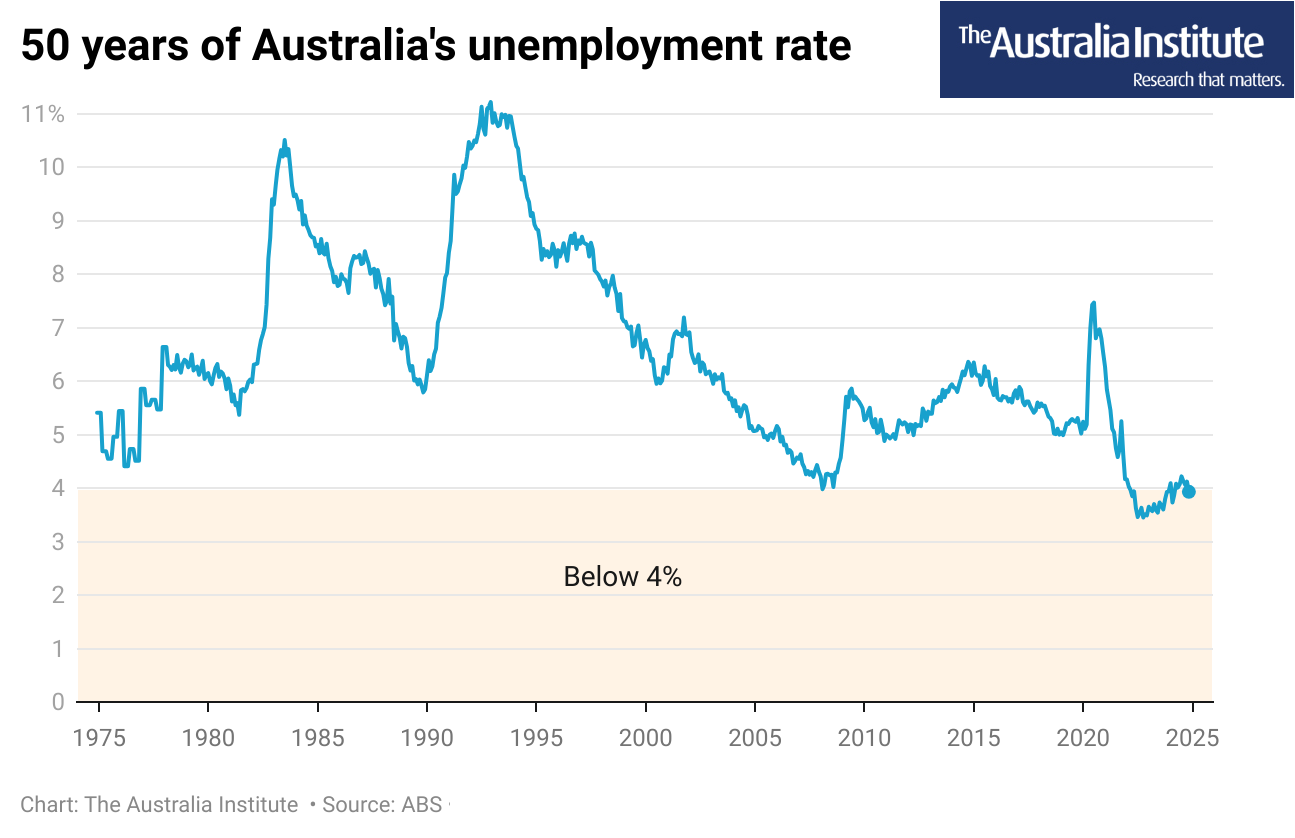
La tasa de desempleo de noviembre de 2025 del 4,3% es precisa según la Oficina Australiana de Estadísticas [1].
The November 2025 unemployment rate of 4.3% is accurate according to the Australian Bureau of Statistics [1].
Sin embargo, el enfoque de la afirmación es engañoso.
However, the claim's framing is misleading.
El punto más bajo que Australia ha alcanzado en los últimos 50 años fue del 3,5% en junio de 2022 [2], justo antes de que el Labor asumiera el cargo en mayo de 2022.
The lowest point Australia has reached in the past 50 years was 3.5% in June 2022 [2]—just before Labor took office in May 2022.
Más precisamente, el desempleo era del 3,5% cuando el Labor heredó el gobierno (septiembre de 2022) y desde entonces ha subido al 4,3% [3][4].
More precisely, unemployment was 3.5% when Labor inherited office (September 2022) and has since risen to 4.3% [3][4].
La afirmación de que el 4,3% es «una de las tasas más bajas en 50 años» es técnicamente cierta—es menor que el desempleo previo a 2022 durante gran parte del período, con tasas por debajo del 4% siendo históricamente raras [5].
The claim that 4.3% is "one of lowest rates in 50 years" is technically true—it is lower than pre-2022 unemployment for much of the period, with rates below 4% being rare historically [5].
Sin embargo, el enfoque oscurece el hecho crítico de que el desempleo ha *empeorado* durante el mandato del Labor.
However, the framing obscures the critical fact that unemployment has *worsened* under Labor's tenure.
Contexto Faltante
**1.
**1.
El Desempleo Aumentó Bajo el Labor** El contexto más importante que falta es que cuando el Labor asumió el cargo en mayo de 2022, el desempleo estaba en un mínimo de 50 años del 3,5%.
Unemployment Rose Under Labor**
The most important missing context is that when Labor took office in May 2022, unemployment was at a 50-year low of 3.5%.
Para noviembre de 2025, había subido al 4,3%, un aumento de 0,8 puntos porcentuales [2][3].
By November 2025, it had risen to 4.3%—an increase of 0.8 percentage points [2][3].
Esto es lo opuesto a un logro; representa un deterioro desde una posición ya excepcional.
This is the opposite of an achievement; it represents deterioration from already low unemployment.
La afirmación presenta la tasa actual sin mencionar este aumento. **2.
The claim presents the current rate without mentioning this increase.
**2.
El Labor Heredó un Mercado Laboral Fuerte** La tasa de desempleo del 3,5% a mediados de 2022 fue el resultado de las políticas del gobierno anterior de la Coalición y del ajustado mercado laboral post-COVID.
Labor Inherited the Strong Job Market**
The 3.5% unemployment rate in mid-2022 was the result of the previous Coalition government's policies and the post-COVID labor market tightness.
El Labor heredó un mercado laboral excepcionalmente ajustado, no lo logró.
Labor inherited an exceptionally tight labor market—not achieved it.
El 4,3% actual representa una relajación de esta fortaleza heredada. **3.
The current 4.3% represents a loosening of this inherited strength.
**3.
Subempleo en Máximos de 12 Meses** Mientras el desempleo general se mantuvo en el 4,3% en noviembre de 2025, el subempleo subió a máximos de 12 meses según reportes de ABC News [6].
Underemployment at 12-Month Highs**
While headline unemployment remained at 4.3% in November 2025, underemployment rose to 12-month highs according to ABC News reporting [6].
El subempleo mide a los trabajadores que desean más horas (particularmente trabajadores de medio tiempo que buscan trabajo de tiempo completo).
Esto indica debilidad en el mercado laboral enmascarada por la cifra general de desempleo. **4.
This indicates labor market weakness masked by the headline unemployment figure.
**4.
Dominancia del Trabajo de Medio Tiempo** La creación de empleos del Labor (discutida en el punto 1.3) estuvo fuertemente sesgada hacia roles de medio tiempo.
Part-Time Work Dominance**
Labor's job creation (discussed in point 1.3) heavily skewed toward part-time roles.
Según la Oficina de Estadísticas, casi la mitad de los trabajadores de medio tiempo subempleados preferían trabajar horas de tiempo completo [7].
According to the ABS, nearly half of underemployed part-time workers preferred to work full-time hours [7].
La composición del empleo, con desplazamiento hacia trabajo de medio tiempo y casual, no se refleja en la tasa general de desempleo. **5.
The composition of employment—shifting toward part-time and casual work—is not reflected in the headline unemployment rate.
**5.
Contexto de Participación en la Fuerza Laboral** La participación en la fuerza laboral aumentó del 65,3% al 67,0% entre 2022-2025 [8].
Labor Force Participation Context**
Labor force participation increased from 65.3% to 67.0% between 2022-2025 [8].
Aunque esto parece positivo, gran parte fue impulsado por mujeres que ingresaban a la fuerza laboral (participación subiendo 3,1 puntos porcentuales para mujeres de 25-54 años) [9].
While this appears positive, much of this was driven by women entering the workforce (participation rising 3.1 percentage points for women age 25-54) [9].
Este aumento en la oferta de mano de obra compitiendo por empleos, combinado con el crecimiento poblacional por la alta migración, probablemente explica por qué el desempleo subió a pesar de los «1,2 millones de empleos creados»—los empleos apenas mantuvieron el paso con los nuevos ingresantes a la fuerza laboral. **6.
This increase in labor supply competing for jobs, combined with population growth from high migration, likely explains why unemployment rose despite "1.2 million jobs created"—the jobs barely kept pace with new entrants to the labor force.
**6.
Crecimiento Poblacional Enmascarando la Demanda Real de Mano de Obra** El aumento del desempleo de Australia debe entenderse en el contexto de la migración neta más alta en la historia del país durante el mandato del Labor.
Population Growth Masking Real Labor Demand**
Australia's unemployment rise must be understood in context of the highest net migration in the country's history during Labor's term.
La población creció más rápido que el empleo, razón por la cual el desempleo subió a pesar de que las cifras de creación de empleos parecían sólidas.
Population grew faster than employment, which is why unemployment rose despite job creation figures appearing strong.
Esto es similar a la crítica del punto 1.3.
This is similar to point 1.3's critique.
💭 PERSPECTIVA CRÍTICA
La afirmación «desempleo al 4,3%, una de las tasas más bajas en 50 años» usa datos precisos pero un enfoque engañoso.
The claim "unemployment at 4.3%, one of the lowest rates in 50 years" uses accurate data but deceptive framing.
Aquí está la historia completa: 1. **Heredado vs Logrado**: Australia heredó un desempleo del 3,5% (mínimo de 50 años) del gobierno de la Coalición.
Here's the fuller story:
1. **Inherited vs Achieved**: Australia inherited 3.5% unemployment (50-year low) from the Coalition government.
El mandato del Labor vio el desempleo *subir* al 4,3%.
Labor's term saw unemployment *rise* to 4.3%.
Esto no es un logro—es un deterioro desde una posición inicial excepcional. 2. **Titular vs Realidad**: La tasa de desempleo del 4,3% enmascara el creciente subempleo en máximos de 12 meses [6].
This is not an achievement—it's deterioration from an already exceptional starting position.
2. **Headline vs Reality**: The 4.3% headline unemployment rate masks rising underemployment at 12-month highs [6].
Los trabajadores quieren más horas de las que están recibiendo.
Workers want more hours than they're getting.
El mercado laboral es realmente más débil de lo que sugiere la cifra de desempleo. 3. **Declive en la Calidad del Empleo**: La mayoría de los nuevos empleos fueron de medio tiempo.
The labor market is actually weaker than the unemployment figure suggests.
3. **Job Quality Decline**: Most new jobs were part-time.
El crecimiento del empleo de tiempo completo rezagó el crecimiento poblacional.
Full-time employment growth lagged population growth.
Los trabajadores están recibiendo *menos* horas, no más—el subempleo cuenta esta historia. 4. **Oferta vs Demanda**: El crecimiento poblacional y la migración récord significaron que el mercado laboral tenía que crear empleos solo para evitar que el desempleo subiera *más*.
Workers are getting *less* hours, not more—underemployment tells this story.
4. **Supply vs Demand**: Population growth and record migration meant the labor market had to create jobs just to keep unemployment from rising *further*.
Los 1,2 millones de empleos creados deben entenderse como apenas igualando el crecimiento de la oferta. 5. **Deshonestidad en la Comparación Histórica**: Decir «una de las más bajas en 50 años» cuando el desempleo *subió* durante su mandato desde el mínimo real de 50 años es engañoso.
The 1.2 million jobs created must be understood as barely matching supply growth.
5. **Historical Comparison Dishonesty**: Saying "one of the lowest in 50 years" when unemployment *rose* during your term from the actual 50-year low is misleading.
Es técnicamente cierto pero diseñado para oscurecer el deterioro relativo.
It's technically true but designed to obscure the relative deterioration.
El Labor no mantuvo el fuerte mercado laboral que heredó—permitió que el desempleo subiera mientras la población crecía.
Labor didn't maintain the strong labor market it inherited—it allowed unemployment to rise while population surged.
Esto es lo opuesto a una afirmación positiva.
This is the opposite of a positive claim.
ENGAÑOSO
3.0
/ 10
La cifra de desempleo (4,3%) es precisa, y técnicamente es baja por estándares de 50 años.
The unemployment figure (4.3%) is accurate, and it technically is low by 50-year standards.
Sin embargo, la afirmación está diseñada para engañar al: 1.
However, the claim is designed to mislead by:
1.
No revelar que el desempleo *subió* del 3,5% (el mínimo real de 50 años) al 4,3% bajo el Labor 2.
Not disclosing that unemployment *rose* from 3.5% (the actual 50-year low) to 4.3% under Labor
2.
No mencionar el creciente subempleo en máximos de 12 meses 3.
Not mentioning rising underemployment at 12-month highs
3.
No explicar que la creación de empleos apenas mantuvo el paso con el crecimiento poblacional por la migración 4.
Not explaining that job creation barely kept pace with population growth from migration
4.
Presentar fortaleza heredada como si se hubiera mantenido o mejorado La afirmación enmarca un mercado laboral deteriorado como un logro.
Presenting inherited strength as if it were maintained or improved
The claim frames a deteriorating labor market as an achievement.
Puntuación Final
3.0
/ 10
ENGAÑOSO
La cifra de desempleo (4,3%) es precisa, y técnicamente es baja por estándares de 50 años.
The unemployment figure (4.3%) is accurate, and it technically is low by 50-year standards.
Sin embargo, la afirmación está diseñada para engañar al: 1.
However, the claim is designed to mislead by:
1.
No revelar que el desempleo *subió* del 3,5% (el mínimo real de 50 años) al 4,3% bajo el Labor 2.
Not disclosing that unemployment *rose* from 3.5% (the actual 50-year low) to 4.3% under Labor
2.
No mencionar el creciente subempleo en máximos de 12 meses 3.
Not mentioning rising underemployment at 12-month highs
3.
No explicar que la creación de empleos apenas mantuvo el paso con el crecimiento poblacional por la migración 4.
Not explaining that job creation barely kept pace with population growth from migration
4.
Presentar fortaleza heredada como si se hubiera mantenido o mejorado La afirmación enmarca un mercado laboral deteriorado como un logro.
Presenting inherited strength as if it were maintained or improved
The claim frames a deteriorating labor market as an achievement.
Algo de verdad pero falta contexto o está sesgado.
7-9: MAYORMENTE VERDADERO
Tecnicismos menores o problemas de redacción.
10: PRECISO
Perfectamente verificado y contextualmente justo.
Metodología: Las calificaciones se determinan mediante la verificación cruzada de registros gubernamentales oficiales, organizaciones independientes de verificación de hechos y documentos de fuentes primarias.