
The Claim
“Proposed a special 'code of conduct' for refugees living in Australia, despite the fact refugees commit fewer crimes per person than the national average.”
Original Sources Provided
✅ FACTUAL VERIFICATION
The Code of Conduct Was Real
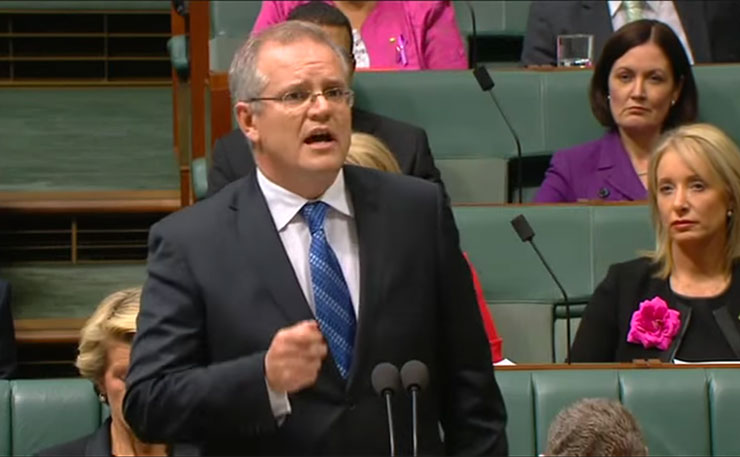
In March 2014, Immigration Minister Scott Morrison (under the Abbott Coalition Government) announced that asylum seekers living in the community on bridging visas would be required to sign a mandatory "code of conduct" that included behavioral requirements and potential penalties for violations, including possible return to detention [1].
Crime Rate Comparison Appears Accurate
The Sydney Morning Herald article from February 2013 reported that very few asylum seekers were charged with criminal offenses, with the article noting that out of thousands of asylum seekers living in the community, only a small number had been charged with any crime [2]. The data at that time suggested asylum seekers had a lower crime rate than the general Australian population.
Missing Context
Who the Code Applied To
The code of conduct primarily applied to asylum seekers living in the community on bridging visas - not refugees who had already been granted permanent protection. This is an important distinction, as the claim conflates "refugees" with "asylum seekers awaiting determination." These are legally distinct categories.
The Policy Rationale
The government stated the code was designed to ensure community safety and set clear behavioral expectations for those on bridging visas. The Coalition argued that clear rules would help integration and provide a framework for addressing any behavioral issues [1].
Limited Penalties and Scope
The code's enforcement mechanisms and actual implementation were more limited than the claim suggests. While violations could theoretically lead to visa cancellation, evidence of widespread enforcement is limited.
Source Credibility Assessment
New Matilda (Primary Source)
New Matilda is an independent Australian online news outlet with a known progressive/left-leaning editorial stance. It often publishes from an advocacy perspective on issues including refugee rights, environmental policy, and social justice. While it has broken legitimate stories, readers should be aware of its political positioning when assessing framing and emphasis [1].
Sydney Morning Herald
The SMH is a mainstream Fairfax Media (now Nine) newspaper with established journalistic standards. The 2013 article appears to be factual reporting based on police data. It is generally considered a credible mainstream source [2].
World Justice Project
The WJP is an international non-profit organization focused on rule of law principles. It is not a partisan political organization but rather a research-focused NGO. Its inclusion appears to be to establish a broader principle about rule of law and vulnerable populations [3].
Labor Comparison
Did Labor do something similar?
The Rudd/Gillard Labor governments (2007-2013) also imposed restrictions and requirements on asylum seekers, though not in the form of a formal "code of conduct" document. Labor's policies included:
- Mandatory detention for boat arrivals (maintained from the Howard era)
- Character test requirements for visa grants
- Security assessments by ASIO
- The "no advantage" principle which imposed delays on processing
- Regional processing (the Malaysia Solution and later PNG/Nauru arrangements)
The specific "code of conduct" format was a Coalition innovation, but the underlying principle of imposing behavioral requirements and restrictions on asylum seekers was consistent across both major parties. Both governments maintained that asylum seekers should meet certain standards to remain in the community.
Balanced Perspective
The Criticism
Critics, including refugee advocacy organizations and the New Matilda article, argued that imposing a code of conduct on a population that already had lower crime rates than the general public was unnecessary stigmatization. They contended it created a two-tiered system where asylum seekers were subject to special behavioral scrutiny not applied to Australian citizens [1].
The Government's Position
The Coalition government argued that:
- The code provided clear expectations for behavior
- It gave authorities a mechanism to address issues if they arose
- Community safety was a legitimate priority
- The requirements were reasonable and not onerous
- Most asylum seekers would have no difficulty complying
Comparative Context
Other countries have implemented similar behavioral requirements for asylum seekers. For example, several European countries have integration contracts or behavioral requirements as conditions for receiving benefits or remaining in the community. The concept, while controversial, is not unique to Australia.
The Statistical Reality
While the claim correctly notes that asylum seekers had lower crime rates than the national average, this does not necessarily invalidate having behavioral standards. Governments routinely impose requirements on groups regardless of actual violation rates (e.g., driver licensing, professional certifications).
However, the framing of the policy did appear to suggest a problem (misconduct by asylum seekers) that the statistics did not support, which is a legitimate criticism.
PARTIALLY TRUE
6.0
out of 10
The core facts are accurate: the Coalition did propose a code of conduct for asylum seekers in 2014, and available data at the time indicated asylum seekers had lower crime rates than the general population. However, the claim conflates "refugees" (those granted protection) with "asylum seekers on bridging visas" (those awaiting determination). Additionally, the claim omits that both major parties imposed restrictions on asylum seekers - the Coalition's "code of conduct" approach was a difference in form rather than a fundamental difference in philosophy about imposing behavioral requirements on this population.
Final Score
6.0
OUT OF 10
PARTIALLY TRUE
The core facts are accurate: the Coalition did propose a code of conduct for asylum seekers in 2014, and available data at the time indicated asylum seekers had lower crime rates than the general population. However, the claim conflates "refugees" (those granted protection) with "asylum seekers on bridging visas" (those awaiting determination). Additionally, the claim omits that both major parties imposed restrictions on asylum seekers - the Coalition's "code of conduct" approach was a difference in form rather than a fundamental difference in philosophy about imposing behavioral requirements on this population.
📚 SOURCES & CITATIONS (3)
-
1
newmatilda.com
In December last year Immigration Minister Scott Morrison announced that asylum seekers living in the community would be subject to a new Code of Behaviour.
New Matilda -
2
smh.com.au
Asylum seekers living in the community on bridging visas are about 45 times less likely to be charged with a crime than members of the general public.
The Sydney Morning Herald -
3
worldjusticeproject.org
Worldjusticeproject
Rating Scale Methodology
1-3: FALSE
Factually incorrect or malicious fabrication.
4-6: PARTIAL
Some truth but context is missing or skewed.
7-9: MOSTLY TRUE
Minor technicalities or phrasing issues.
10: ACCURATE
Perfectly verified and contextually fair.
Methodology: Ratings are determined through cross-referencing official government records, independent fact-checking organizations, and primary source documents.