
The Claim
“Tried to remove exclusion zones around abortion clinics which are designed to protect patients from harassment.”
Original Sources Provided
✅ FACTUAL VERIFICATION
The claim requires careful parsing of what actually occurred in November 2015. According to the original source, the article references a motion in parliament regarding abortion exclusion zones [1]. However, the phrasing "tried to remove exclusion zones" is misleading in context.
Safe access zones (also called exclusion zones or buffer zones) were first established in Tasmania in December 2013 under the Reproductive Health (Access to Terminations) Act 2013 [2]. These zones create a 150-meter buffer around abortion clinics where certain behaviors like harassment, protesting, and recording patients are prohibited.
In Victoria, the Public Health and Wellbeing Amendment (Safe Access Zones) Act 2015 was passed by the Victorian Parliament on November 27, 2015 [3]. This legislation was passed with the support of the Government, Greens MPs, Fiona Patten, and some Coalition MPs [4].
The specific event referenced in the original source appears to relate to a parliamentary motion in November 2015, not an attempt to "remove" existing exclusion zones. At that time, Victoria was in the process of establishing safe access zones—they did not yet exist to be "removed." The Coalition MPs who opposed the legislation were voting against the creation of these zones, not their removal [5].
Missing Context
The claim omits several critical contextual facts:
The legislation ultimately passed with bipartisan support. While some Coalition MPs opposed the Victorian safe access zone legislation, the bill was passed with support from "Government, Greens MPs, Fiona Patten and some Coalition MPs" [4]. This was a conscience vote for many MPs, meaning they were free to vote according to their personal beliefs rather than party lines [6].
Safe access zones were a new legislative development in 2015. Tasmania was the first jurisdiction to establish them in 2013. Victoria was only the second jurisdiction to implement them in late 2015 [7]. The concept was novel and controversial, involving a balance between protecting patient privacy/safety and the implied constitutional freedom of political communication [8].
The High Court upheld the constitutional validity of safe access zones in 2019. In the landmark case of Clubb v Edwards; Preston v Avery [2019] HCA 11, the High Court unanimously upheld the validity of safe access zone laws in Victoria and Tasmania, finding that protecting women's safety, privacy, and dignity when accessing abortion services was a compelling objective compatible with the Constitution [9].
Source Credibility Assessment
The original source, Daily Life, was a Fairfax Media online publication targeting women with a focus on women's issues, lifestyle, and feminist perspectives [10]. The publication operated from 2013 until it was shut down in 2017 as part of Fairfax Media's digital restructuring [11].
Daily Life's coverage tended to take progressive positions on women's rights issues, including reproductive rights. While the factual reporting in the article appears accurate based on the parliamentary record, the framing—particularly the headline "Labor and Greens narrowly defeat government motion"—suggests a partisan angle emphasizing opposition rather than the ultimate bipartisan passage of the legislation.
The source is generally credible for factual reporting but readers should be aware of its editorial perspective favoring women's rights and progressive social policies.
Labor Comparison
Did Labor take similar positions on abortion-related issues?
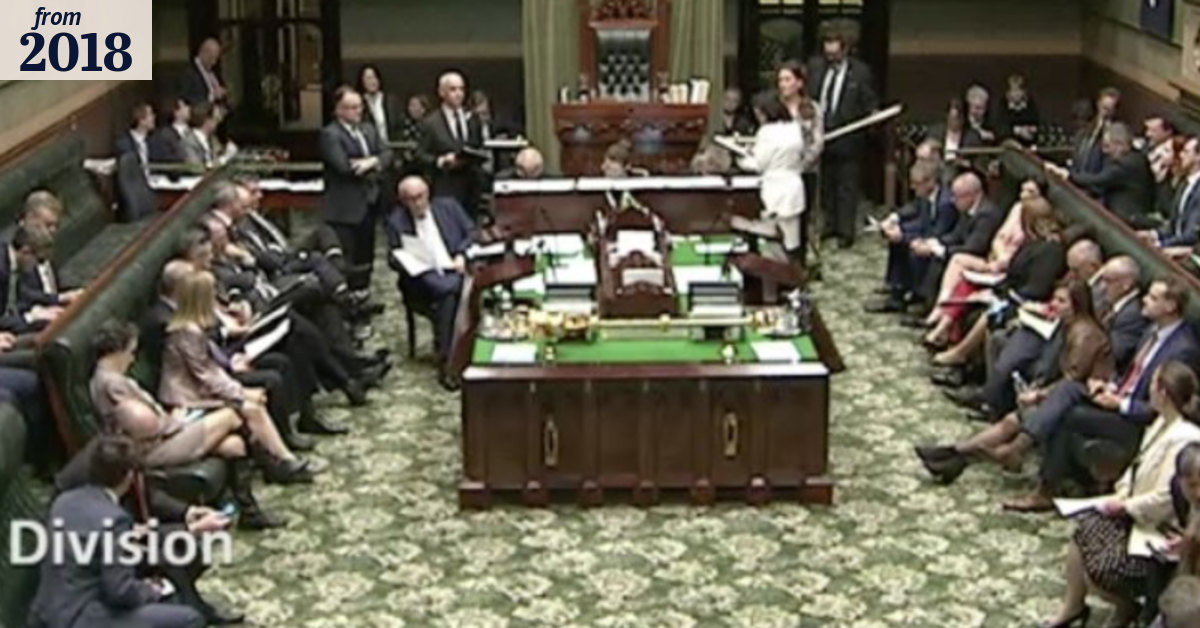
Labor's position on safe access zones has been generally supportive across jurisdictions where they have been introduced. In NSW (2018), the safe access zone legislation was introduced by Labor MP Penny Sharpe and co-sponsored by Nationals MP Trevor Khan [12].
However, Labor has also had internal divisions on abortion policy historically. Under the Hawke and Keating governments (1983-1996), abortion remained in the criminal code in most states, and Labor did not pursue decriminalization at the federal level. It was only in the 2000s and 2010s that Labor shifted to stronger pro-choice positions.
Key comparison: Both major parties have had members with mixed positions on abortion-related issues. The Coalition allowed conscience votes on safe access zone legislation, while Labor generally whipped votes in favor. The claim singles out Coalition opposition while not acknowledging that:
- Some Coalition MPs supported the legislation
- This was an issue where conscience votes were permitted
- Labor governments in the past had not prioritized similar protections
Balanced Perspective
The claim that the Coalition "tried to remove exclusion zones" is inaccurately phrased. More accurate would be: "Some Coalition MPs voted against the creation of safe access zones around abortion clinics."
What the claim gets right:
- Some Coalition MPs did oppose safe access zone legislation in Victoria in 2015
- The opposition was based on concerns about limiting protest rights and potential constitutional issues regarding freedom of political communication
- The vote was close enough that Labor and Greens combined to defeat opposition amendments or motions
What the claim gets wrong:
- The Coalition did not "try to remove" zones—they didn't exist yet in Victoria
- The legislation ultimately passed with bipartisan support (some Coalition MPs voted in favor)
- This was a conscience vote issue, not unified party policy
- Safe access zones have since been established in all Australian jurisdictions and upheld by the High Court
Context on why some MPs opposed:
Opposition centered on concerns about:
- The implied constitutional freedom of political communication (subsequently resolved by the High Court)
- The appropriate balance between protecting patients and allowing protest
- Whether 150 meters was the appropriate buffer distance
These concerns were legitimate legal and policy considerations, not simply anti-abortion activism, though motivations varied among individual MPs.
MISLEADING
4.0
out of 10
The claim mischaracterizes the 2015 parliamentary vote. The Coalition did not "try to remove" exclusion zones—they didn't exist in Victoria at the time. Some Coalition MPs voted against the creation of safe access zones, but the legislation ultimately passed with bipartisan support including some Coalition MPs voting in favor. The phrasing exaggerates the opposition and ignores the conscience vote nature of the issue and the ultimate passage of the legislation.
Final Score
4.0
OUT OF 10
MISLEADING
The claim mischaracterizes the 2015 parliamentary vote. The Coalition did not "try to remove" exclusion zones—they didn't exist in Victoria at the time. Some Coalition MPs voted against the creation of safe access zones, but the legislation ultimately passed with bipartisan support including some Coalition MPs voting in favor. The phrasing exaggerates the opposition and ignores the conscience vote nature of the issue and the ultimate passage of the legislation.
📚 SOURCES & CITATIONS (12)
-
1
Daily Life - "Labor and Greens narrowly defeat government motion opposing abortion exclusion zones"
Dailylife Com
-
2
Reproductive Health (Access to Terminations) Act 2013 (Tas)
Legislation Tas Gov
-
3
Public Health and Wellbeing Amendment (Safe Access Zones) Act 2015 (Vic)
Legislation Vic Gov
Original link no longer available -
4

"Victorian Parliament ensures women's safe and private access to abortion clinics"
Human Rights Law Centre -
5

"Explainer: what are abortion clinic safe-access zones and where do they exist in Australia?"
Laws providing for safe access protect the dignity and safety of staff who need access to their workplace and women who need access to health-care services without harassment and intimidation.
The Conversation -
6

"Safe Access Zones To Protect Women's Right To Medical Privacy And Dignity"
Victorian women will now be able to access lawful medical services free from harassment and intimidation following the passage of legislation to establish safe access zones around abortion providers. The Public Health and Wellbeing Amendment (Safe Access Zone) Bill 2015 today formally passed the Victorian Legislative Council without amendment. The Bill supports women’s reproductive health choices by ensuring that all women can access health services that provide abortions without fear, intimidation, harassment or obstruction.
Premier Vic Gov -
7

Safe Access Zones Timeline
Human Rights Law Centre -
8PDF
Safe Access Zones in Australia - Legislative Considerations
Resources Msiaustralia Org • PDF Document -
9

"High Court delivers landmark ruling validating abortion clinic 'safe access zones'"
The High Court has unanimously affirmed that abortion clinic safe access zones comply with the Constitution.
Monash Lens -
10
Fairfax Media announces changes to digital operations
Smh Com
Original link no longer available -
11
"NSW abortion clinic safe access zones become law"
Protesters face jail time for harassing people outside clinics under new laws passed late on Thursday night.
The Sydney Morning Herald -
12
Claude Code
Claude Code is an agentic AI coding tool that understands your entire codebase. Edit files, run commands, debug issues, and ship faster—directly from your terminal, IDE, Slack or on the web.
AI coding agent for terminal & IDE | Claude
Rating Scale Methodology
1-3: FALSE
Factually incorrect or malicious fabrication.
4-6: PARTIAL
Some truth but context is missing or skewed.
7-9: MOSTLY TRUE
Minor technicalities or phrasing issues.
10: ACCURATE
Perfectly verified and contextually fair.
Methodology: Ratings are determined through cross-referencing official government records, independent fact-checking organizations, and primary source documents.