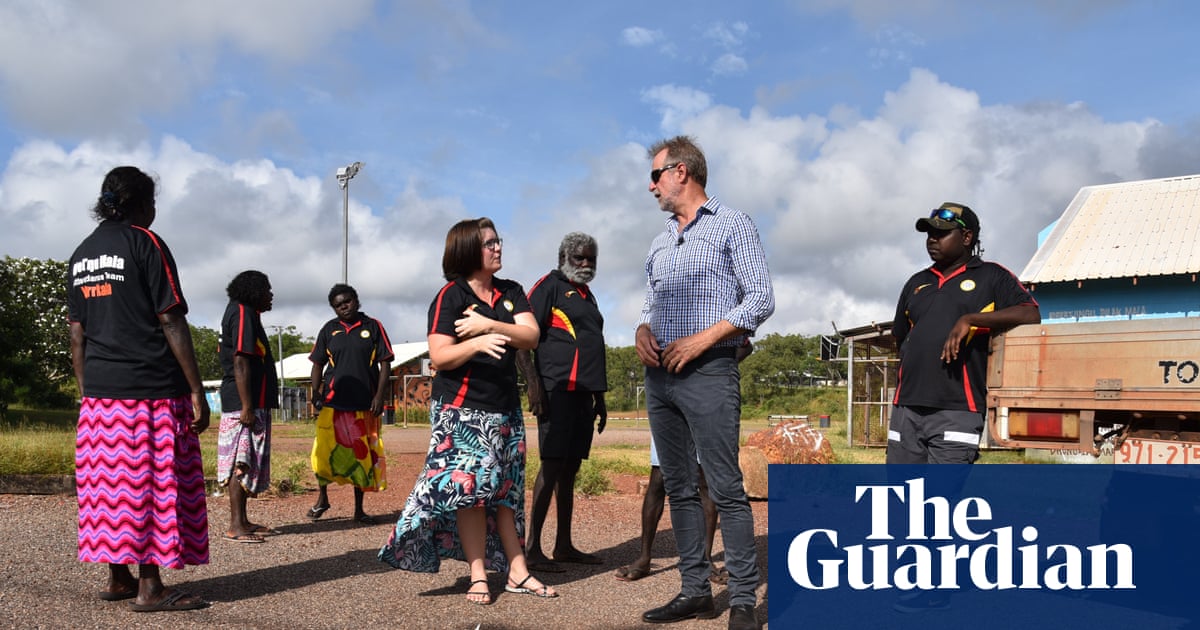
The claim refers to the **Community Development Program (CDP)**, introduced by the Coalition government in July 2015 under Indigenous Affairs Minister Nigel Scullion [1][2].
**Key factual elements verified:**
1. **Work Requirements**: Under the CDP, participants in remote communities were required to work up to **25 hours per week, 52 weeks per year** (50 hours per fortnight, five days a week) to receive welfare payments [3][4].
* * * * 已 yǐ 核實 hé shí 的 de 關鍵 guān jiàn 事實 shì shí 要素 yào sù : : * * * *
This significantly exceeded city-based Work for the Dole requirements under Jobactive, which required a maximum of 30 hours per fortnight and only for six months of the year [1][5].
2. **Indigenous Demographics**: Approximately **84% of CDP participants were Aboriginal or Torres Strait Islander** people living in remote communities [3][6].
The program operated in 60 remote communities across Queensland, Northern Territory, Western Australia, South Australia, and New South Wales [1].
3. **Effective Hourly Rate**: If participants received the Newstart Allowance (approximately $260-$280 per fortnight for a single person in 2015-2016) and worked 50 hours per fortnight, the effective hourly rate was approximately **$5.20-$5.60 per hour** [5][7].
這明顯 zhè míng xiǎn 超過 chāo guò 了 le 城市 chéng shì 地區 dì qū Jobactive Jobactive 旗下 qí xià 「 「 為 wèi 救濟 jiù jì 而 ér 工作 gōng zuò ( ( Work Work for for the the Dole Dole ) ) 」 」 的 de 要求 yāo qiú , , 後 hòu 者 zhě 每 měi 兩週 liǎng zhōu 最多僅 zuì duō jǐn 需 xū 30 30 小時 xiǎo shí , , 且 qiě 每年 měi nián 僅需 jǐn xū 六個 liù gè 月 yuè [ [ 1 1 ] ] [ [ 5 5 ] ] 。 。
This was significantly below the minimum wage (approximately $17.29/hour in 2015).
4. **Penalties**: The CDP imposed severe financial penalties for non-compliance.
The claim omits several critical pieces of context:
1. **Historical Precedent**: The CDP replaced the **Remote Jobs and Communities Program (RJCP)**, which was introduced by the **Gillard Labor government in July 2013** [6][8].
The RJCP itself had replaced the long-standing **Community Development Employment Projects (CDEP)**, which began under the **Fraser Coalition government in 1977** [6][9].
The CDEP provided part-time publicly-funded employment of approximately 15 hours per week [9].
2. **Labor's Equivalent Program**: The RJCP (2013-2015) was Labor's version of remote employment services, designed to accommodate remote community circumstances with an anticipated 85% Indigenous client base [8].
The Coalition's CDP was essentially a continuation and intensification of a model that both major parties had been evolving for decades.
3. **Government's Stated Rationale**: The Coalition government defended the CDP as necessary to increase employment and activity in remote areas.
The government strongly believed that "all Australians can make a contribution to their community and that the best form of welfare is practical support to find a job" [5].
Minister Nigel Scullion dismissed criticism as partisan attacks [5].
4. **Disproportionate Impact**: The claim doesn't explain *why* this affected Indigenous people disproportionately.
The program's design applied mainstream employment services to remote contexts where formal employment opportunities are scarce [4].
5. **Subsequent Changes**: In 2021, the requirement to undertake work-for-the-dole activities became voluntary (though other obligations remained), and the program was fully replaced by the Remote Australia Employment Service (RAES) in November 2025 [3][10].
**New Matilda** (the original source) is an independent online publication founded in 2004 that describes itself as "independent journalism at its best" [11].
- **Bias Assessment**: According to third-party assessments, New Matilda has an **anti-establishment bias** and particularly focuses on critical coverage of Coalition governments [12].
The publication "seeks out and concentrates on articles with an anti-establishment bias especially those involving the current Liberal/National Coalition government" [12].
- **Credibility**: While New Matilda has published legitimate investigative journalism, readers should be aware of its editorial stance favoring critical perspectives on conservative governments.
- **Article Date**: The cited article is from December 2014, published before the CDP was fully implemented (July 2015), meaning it was reporting on proposed changes rather than actual implementation outcomes.
**Did Labor do something similar?**
Search conducted: "Labor government RJCP remote indigenous employment program"
**Finding**: Yes.
* * * *
The **Gillard Labor government introduced the Remote Jobs and Communities Program (RJCP) in July 2013**, which was the immediate predecessor to the CDP [6][8].
**Key comparisons:**
1. **Program Continuity**: The RJCP (Labor, 2013-2015) → CDP (Coalition, 2015-2021) → RAES (Labor, 2025-present) represents an evolving but continuous approach to remote Indigenous employment by both major parties [3][6].
2. **Scale and Scope**: The CDEP program (which both parties modified) had approximately 35,000 participants at its peak in 2016, with around 84% being Aboriginal or Torres Strait Islander [3].
3. **Labor's 2022 Commitment**: In the 2022 election, Labor promised to "abolish the punitive Community Development Program," calling it "broken and discriminatory" [3].
This suggests Labor acknowledged the intensification of requirements under the Coalition's version, while maintaining their own version of remote employment services (RJCP) when last in office.
4. **Historical Context**: Both parties have struggled with effective employment policy in remote Indigenous communities.
* * * * 發現 fā xiàn * * * * : : 是 shì 的 de 。 。
The Fraser government's original CDEP (1977) was considered innovative for its time, providing 15 hours per week of community-based work [9].
**While critics argue:**
- The CDP was racially discriminatory in effect, requiring Indigenous people in remote areas to work far more hours than city-based jobseekers for the same welfare payment [1][5]
- Participants were 27 times more likely to receive financial penalties than city-based equivalents [1]
- The program caused "real harm to people" and drove communities into poverty, with people "begging outside supermarkets" [1][5]
- The ACTU called it a "racist work-for-the-dole scheme" that forced workers to work without OHS protections, leave entitlements, superannuation, or worker's compensation [5]
- A Federal Court class action filed in 2025 seeks compensation for approximately 20,000 Aboriginal and Torres Strait Islander participants [1][2]
**The government stated:**
- All Australians should contribute to their communities
- The program was designed to increase employment and activity in remote areas
- Criticism was dismissed as partisan attacks from Labor and Greens [5]
- Changes were made over time, including making work-for-the-dole voluntary in 2021 [3]
**Independent analysis suggests:**
- The CDP was indeed significantly more demanding than equivalent city-based programs [1][4]
- The program design created perverse incentives for providers to issue penalties rather than support participants [1]
- The issue was systemic: both major parties have struggled to create effective employment services for remote Indigenous communities
- The Coalition intensified requirements that existed under Labor's RJCP, but both operated within a "work for the dole" framework
**Key context:** This is **NOT unique to the Coalition** - both major parties have implemented and evolved remote Indigenous employment programs since 1977.
The CDP represented an intensification of work requirements that began under previous governments, but the fundamental model (work-for-dole in remote communities) has been maintained by both Labor and Coalition governments for decades.
The claim accurately describes the work requirements (25 hours/week, 52 weeks/year) and the effective hourly rate (approximately $5/hour) under the CDP.
The CDP was a continuation of the RJCP introduced by the Gillard Labor government in 2013, which itself evolved from the CDEP established by the Fraser Coalition government in 1977 [6][8][9].
The claim accurately describes the work requirements (25 hours/week, 52 weeks/year) and the effective hourly rate (approximately $5/hour) under the CDP.
The CDP was a continuation of the RJCP introduced by the Gillard Labor government in 2013, which itself evolved from the CDEP established by the Fraser Coalition government in 1977 [6][8][9].