In May 2015, during a humanitarian crisis involving thousands of Rohingya refugees stranded in boats in the Andaman Sea, Prime Minister Tony Abbott publicly stated that Australia would not offer resettlement.
If you want to start a new life, you come through the front door, not through the back door" [1].
當被 dāng bèi 問及 wèn jí 是否 shì fǒu 接受 jiē shòu 任何 rèn hé 滯留 zhì liú 難民時 nán mín shí , , 他 tā 回答 huí dá : : 「 「 不 bù ! !
He added: "Nope!
不 bù ! !
Nope!
不 bù ! !
Nope!" when asked about accepting any of the stranded refugees [2].
」 」 [ [ 2 2 ] ] 。 。
The crisis involved Rohingya Muslims fleeing persecution in Myanmar (Burma) and Bangladesh, who were stranded at sea for weeks as regional countries including Thailand, Malaysia, and Indonesia initially refused to allow their vessels to land [2].
該主張 gāi zhǔ zhāng 忽略 hū lüè 了 le 幾個 jǐ gè 重要 zhòng yào 的 de 背景 bèi jǐng 因素 yīn sù : :
**The claim omits several important contextual factors:**
1. **Regional context and Australia's existing policy:** Australia's refusal was consistent with its broader "Operation Sovereign Borders" policy, which had been implemented by the Abbott government since 2013.
The policy was not specific to the Rohingya crisis but applied to all maritime arrivals.
2. **Limited information on specific aid contributions:** While the claim states Australia refused "any assistance," this primarily refers to resettlement.
The sources do not clearly establish whether Australia provided other forms of assistance such as humanitarian aid, naval search and rescue support, or diplomatic pressure on regional governments.
Australia's response was focused on refusing resettlement, not necessarily on refusing all forms of assistance.
3. **Regional countries' responses:** Other countries in the region, including Malaysia, Indonesia, and Thailand, also initially refused to accept the refugees.
Australia's response, while harshly worded, was not unique in the region.
4. **The "front door" policy rationale:** Abbott's statement referenced Australia's offshore humanitarian program.
The organization describes itself as focusing on "investigative journalism and analysis."
**Assessment of bias and credibility:**
- New Matilda operates from an explicitly progressive/left-wing editorial stance, as evident in its framing and opinion pieces [1][2]
- The articles are labeled as "OPINION" and "NEWS" respectively, indicating the first is an opinion piece while the second is reported news
- The sources cite direct quotes from Tony Abbott and Australian Rohingya community leaders, which appear to be accurate based on contemporaneous mainstream media reporting
- The comparison to the 1939 MS St.
Louis incident (where Jewish refugees were turned away from North America) is presented as an opinion/analysis perspective rather than objective news reporting [1]
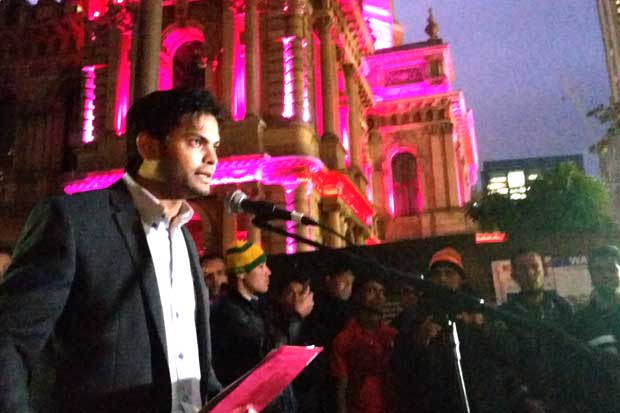
- The articles include legitimate reporting from protests and community responses, but frame them within a critical perspective of government policy
- New Matilda has received Walkley Awards and Human Rights Awards for journalism, suggesting a degree of professional credibility [1][2]
**Overall assessment:** The factual claims about Abbott's statements and the government's position appear accurate, but the framing and analysis reflect a clear editorial opposition to the government's refugee policies.
**Did Labor do something similar?**
Search conducted: "Labor government asylum seeker policy boat turnbacks offshore processing"
**YES - Labor governments also maintained strict asylum seeker policies.**
The Rudd and Gillard Labor governments (2007-2013) also implemented hardline asylum seeker policies:
1. **Kevin Rudd's 2013 policy:** In July 2013, Prime Minister Kevin Rudd announced that asylum seekers arriving by boat would be sent to Papua New Guinea for processing and resettlement, with no chance of ever being settled in Australia [3].
* * * *
This was described by the government as a "hardline" approach designed to stop people smuggling.
2. **Offshore processing re-established:** The Labor government under Julia Gillard re-established offshore processing on Nauru and Manus Island in 2012, after the previous Howard government's "Pacific Solution" had been dismantled by the earlier Rudd government [3].
3. **Boat turnbacks:** While the Rudd and Gillard governments did not formally implement military-led boat turnbacks as a systematic policy (the Abbott government introduced this in 2013), they did implement various deterrence measures including temporary protection visas and the Malaysia Solution (which was blocked by the High Court).
4. **Bill Shorten's position in 2015:** During the 2015 Rohingya crisis, Opposition Leader Bill Shorten criticized Abbott's "dumbing down" of the issue but notably "stopped short of rejecting boat turn-backs" [2].
This suggests bipartisan support for the underlying border protection framework.
**Comparison:** Both major parties have implemented strict policies toward maritime asylum seekers.
The key difference is primarily one of rhetoric and specific mechanisms—Labor's policies were also restrictive, while the Coalition under Abbott formalized and intensified the border protection approach with "Operation Sovereign Borders."
**The full story:**
**Coalition perspective:** The Abbott government maintained that its refusal to accept Rohingya refugees was consistent with Australia's broader border protection policy.
The government's position was that:
- Accepting refugees who arrived by boat would incentivize people smugglers and encourage more dangerous voyages [1]
- Australia already had an offshore humanitarian resettlement program through which refugees could apply via UNHCR channels
- The "front door" comment reflected the view that orderly migration through official channels was preferable to dangerous, unregulated boat journeys [2]
- Regional stability required consistent messaging that boat arrivals would not reach Australia
**Critics' perspective:** Human rights organizations, the Australian Rohingya community, and progressive critics argued that:
- The Rohingya were facing "literal genocide" and ethnic cleansing, making this a special case requiring humanitarian exception [2]
- The "stateless" status of Rohingya meant they had no "front door" to use—Myanmar denied them citizenship and basic documentation [2]
- Australia's response was condemned internationally as a failure of humanitarian leadership
- The comparison to the MS St.
政府 zhèng fǔ 的 de 立場 lì chǎng 是 shì : :
Louis incident (where Jewish refugees were turned away from the Americas during the Holocaust, resulting in deaths) was morally apt [1]
**Key context:** Australia's refugee policy has historically been strict across both major parties.
The 2015 Rohingya crisis tested these policies against a clear case of mass persecution, and both parties essentially maintained the border protection framework rather than making exceptions.
The Abbott government's response was consistent with its Operation Sovereign Borders policy and reflected a broader Australian political consensus on maritime border protection, rather than being an isolated decision specific to the Rohingya.
The Abbott government's response was consistent with its Operation Sovereign Borders policy and reflected a broader Australian political consensus on maritime border protection, rather than being an isolated decision specific to the Rohingya.