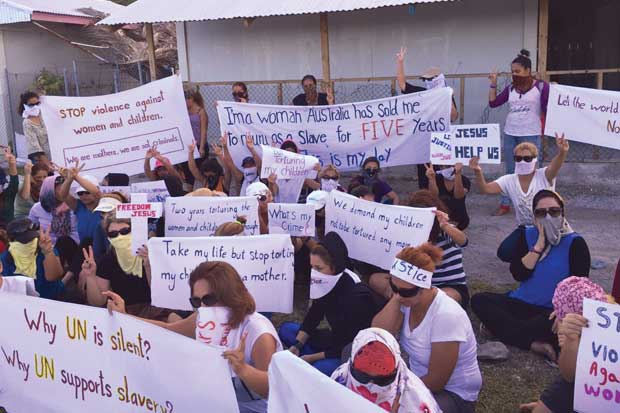
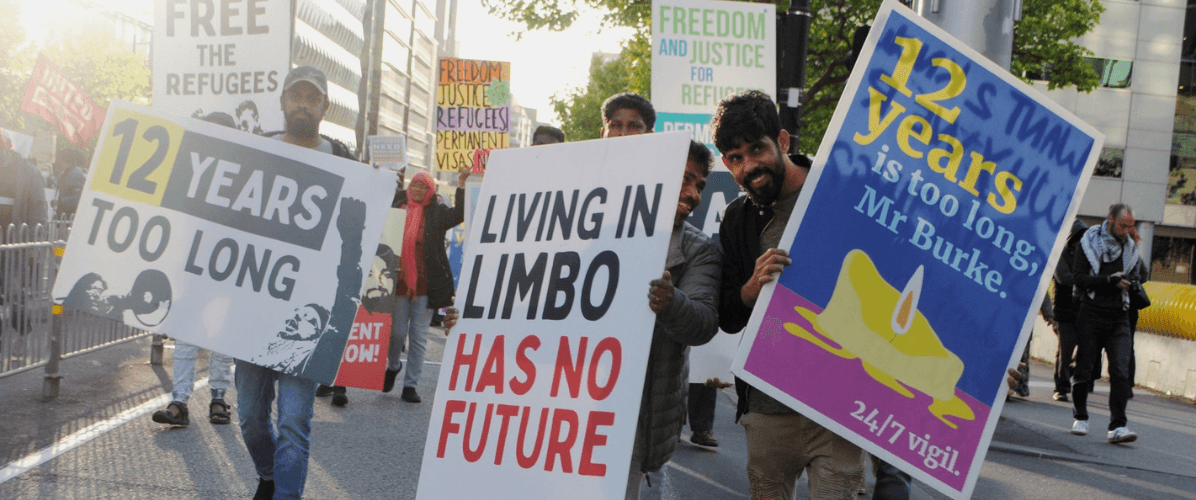
**The claim is TRUE.** In mid-2015, the Department of Immigration and Border Protection (DIBP) implemented a policy whereby asylum seekers who arrived by boat on or after 13 August 2012 and who were barred from applying for protection visas would have their Freedom of Information (FOI) requests returned unprocessed [1].
The policy specifically targeted asylum seekers in the "no advantage" cohort—a group barred from lodging protection visa applications under a policy that created a backlog of approximately 30,000 unprocessed claims [1].
The DIBP informed stakeholders that FOI requests from these individuals would not be processed until it was "close to their turn" to have their asylum claims considered [1].
DIBP DIBP 告知 gào zhī 利益 lì yì 相关 xiāng guān 方 fāng , , 来自 lái zì 这些 zhè xiē 个人 gè rén 的 de FOI FOI 请求 qǐng qiú 将 jiāng 不会 bú huì 被 bèi 处理 chǔ lǐ , , 直到 zhí dào 他们 tā men 的 de 庇护 bì hù 申请 shēn qǐng 被 bèi 考虑 kǎo lǜ 时 shí " " 接近 jiē jìn 轮 lún 到 dào 他们 tā men " " [ [ 1 1 ] ] 。 。
The FOI requests in question were primarily for entry interview records containing critical personal information including: names, dates of birth, family structure, travel history, citizenship, ethnicity, religion, work history, education history, and initial claims made upon arrival [1].
The timing created a procedural Catch-22: asylum seekers in this cohort would be given only 28 days to lodge their protection visa claims once invited to apply, but FOI requests must be processed within 30 days under the FOI Act, meaning applicants might not receive their documents before their deadline [1].
**The policy was administrative, not legislative.** The FOI restriction was implemented as a departmental policy change rather than through amendments to the FOI Act itself [1].
The government did not alter FOI legislation; instead, DIBP exercised administrative discretion in handling requests from specific categories of asylum seekers.
**The backlog was inherited from Labor.** The "no advantage" policy that created the 30,000-person backlog was introduced by the Gillard Labor government on 13 August 2012—not by the Coalition [1].
This policy barred boat arrivals from having their asylum claims processed, creating the situation that the Coalition inherited when elected in September 2013.
The FOI restriction was applied to this Labor-created backlog.
**Part of broader "Fast Track" processing.** The FOI restriction was one component of the Coalition's "Fast Track" processing system introduced in 2014, which was designed to clear the backlog by streamlining (critics would say rushing) the assessment process [2].
This system included the 28-day application deadline, limited appeal rights through the Immigration Assessment Authority, and reduced access to legal assistance [2].
**The rationale—such as it was.** The DIBP website stated that applicants "should wait until it is close to their turn to be processed to seek that information" [1].
However, critics noted that the Department provided no mechanism to inform asylum seekers when they were "close to their turn," making compliance impossible [1].
The original source, **New Matilda**, requires contextual understanding:
- **Political orientation:** New Matilda is an independent online publication with a documented left-wing/progressive editorial stance.
Media Bias/Fact Check identifies it as "left-wing independent Australian website of news, analysis, and satire" [3].
- **Independence:** The outlet describes itself as "independent journalism at its best" and is owned by Walkley Award-winning journalist Chris Graham [1].
- **Methodology in this article:** The article relied on an interview with Katie Wrigley, Principal Solicitor at the Refugee Advice and Casework Service (RACS), a legitimate legal service provider for asylum seekers [1].
The article also referenced an actual DIBP email to stakeholders announcing the policy change [1].
- **Potential bias:** While the factual reporting about the policy appears accurate, the article employs advocacy-oriented framing, characterizing the change as an "assault" on asylum seekers and describing it as "outrageous and unprecedented" through Wrigley's quotes [1].
The sensationalized language and sympathetic sourcing from refugee advocates should be read with awareness of the publication's advocacy journalism orientation.
**Did Labor do something similar?**
Search conducted: "Labor government asylum seekers FOI policy precedent" and "Gillard Labor 'no advantage' policy asylum seekers"
**Finding: The root cause was Labor policy.**
The Gillard Labor government implemented the "no advantage" policy on 13 August 2012, which barred asylum seekers arriving by boat from having their protection visa claims processed [1].
* * * *
This created the approximately 30,000-person backlog that the Coalition inherited.
搜索 sōu suǒ 内容 nèi róng : : " " Labor Labor government government asylum asylum seekers seekers FOI FOI policy policy precedent precedent " " 以及 yǐ jí " " Gillard Gillard Labor Labor ' ' no no advantage advantage ' ' policy policy asylum asylum seekers seekers " "
The FOI restriction applied specifically to this Labor-created cohort.
**Labor's subsequent position:** When in opposition, Labor vowed to abolish the Fast Track system [2].
After being elected in 2022, the Albanese Labor government ended the Fast Track process in 2024 and established a new Administrative Review Tribunal [2].
* * * *
However, as of early 2025, over 7,000 people who were failed by the Fast Track system remained barred from applying for permanent visas [2].
**No direct Labor equivalent on FOI restrictions:** There is no evidence that the previous Labor government (2007-2013) restricted FOI rights for asylum seekers.
**The criticisms are legitimate.** The FOI restriction created significant procedural disadvantages:
- Asylum seekers could not access their own entry interview records, which contain factual information they provided to the government upon arrival [1]
- Legal representatives described these documents as "invaluable" for preparing accurate and complete protection visa applications [1]
- The 28-day deadline coupled with the 30-day FOI processing requirement created a structural impossibility for applicants wanting to review documents before lodging claims [1]
- The policy removed a right previously available to all persons in Australia, treating this specific cohort "much less favourably" according to legal practitioners [1]
**The government's position—such as stated.** The DIBP provided minimal public justification, simply advising applicants to wait until "close to their turn" [1].
* * * * FOI FOI 限制 xiàn zhì 造成 zào chéng 了 le 重大 zhòng dà 程序 chéng xù 劣势 liè shì : :
The implicit logic appears to have been administrative efficiency—processing FOI requests only when necessary for imminent applications.
- - 寻求 xún qiú 庇护 bì hù 者 zhě 无法 wú fǎ 获取 huò qǔ 自己 zì jǐ 的 de 入境 rù jìng 面谈 miàn tán 记录 jì lù , , 其中 qí zhōng 包含 bāo hán 他们 tā men 抵达 dǐ dá 时向 shí xiàng 政府 zhèng fǔ 提供 tí gōng 的 de 事实 shì shí 信息 xìn xī [ [ 1 1 ] ]
However, the implementation failed to provide the necessary notification system to make this workable.
**This was part of a broader deterrence approach.** The Fast Track system, including the FOI restriction, was designed to make the asylum process more difficult—a deterrence strategy the Coalition explicitly pursued [2].
While the humanitarian criticisms are valid, the policy coherence with the government's broader border protection approach should be acknowledged.
**A systemic issue across governments.** Both major parties have implemented restrictive asylum policies:
- Labor created the "no advantage" policy and the offshore processing regime
- The Coalition implemented the Fast Track system with FOI restrictions
- Both parties have used boat turnbacks
The FOI restriction was an administrative intensification of an already-restrictive system, rather than a unique departure from bipartisan consensus on asylum policy.
The Coalition government, through the Department of Immigration and Border Protection, did implement a policy in 2015 that denied FOI requests from asylum seekers in the "no advantage" cohort (those arriving by boat on or after 13 August 2012 who were barred from lodging protection visa applications).
Was later abolished when Labor returned to government in 2022
While technically true, the claim omits that this was a targeted administrative restriction rather than a blanket denial of FOI rights to all asylum seekers, and that the underlying situation resulted from Labor's previous policy decisions.
The Coalition government, through the Department of Immigration and Border Protection, did implement a policy in 2015 that denied FOI requests from asylum seekers in the "no advantage" cohort (those arriving by boat on or after 13 August 2012 who were barred from lodging protection visa applications).
Was later abolished when Labor returned to government in 2022
While technically true, the claim omits that this was a targeted administrative restriction rather than a blanket denial of FOI rights to all asylum seekers, and that the underlying situation resulted from Labor's previous policy decisions.