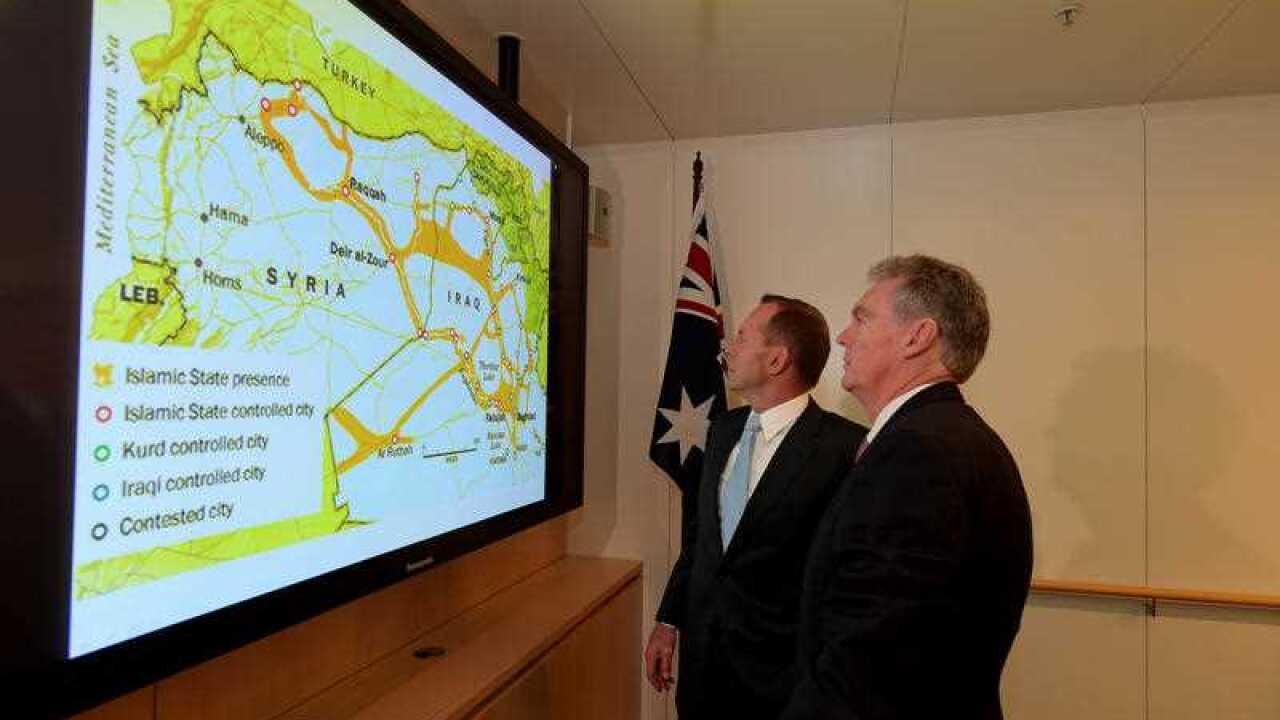
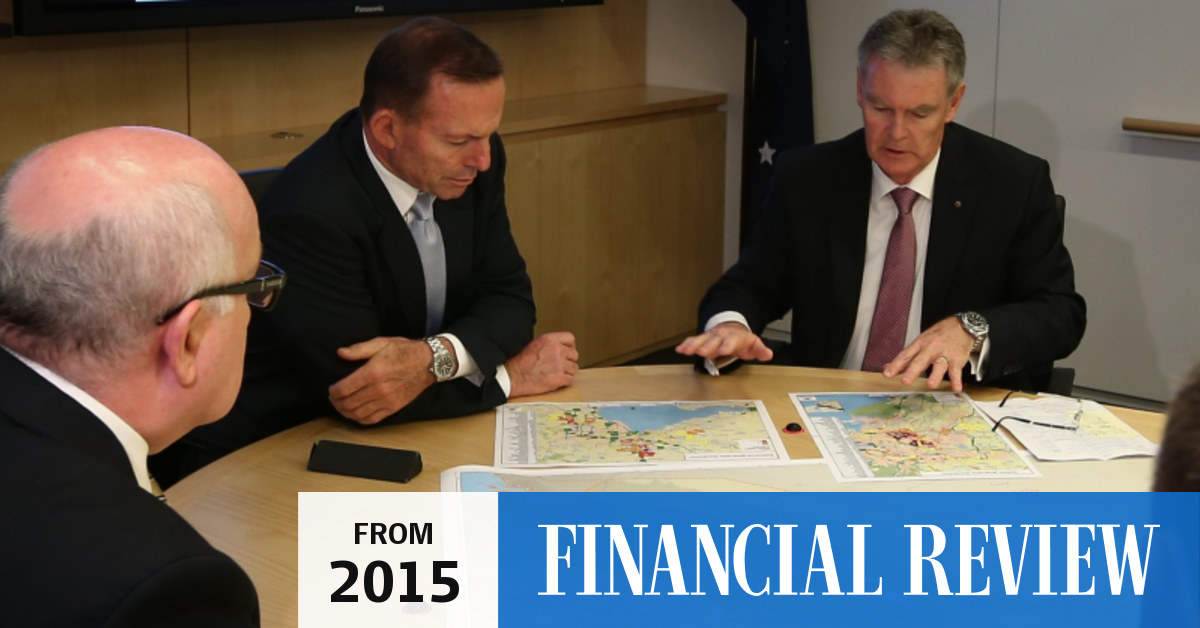
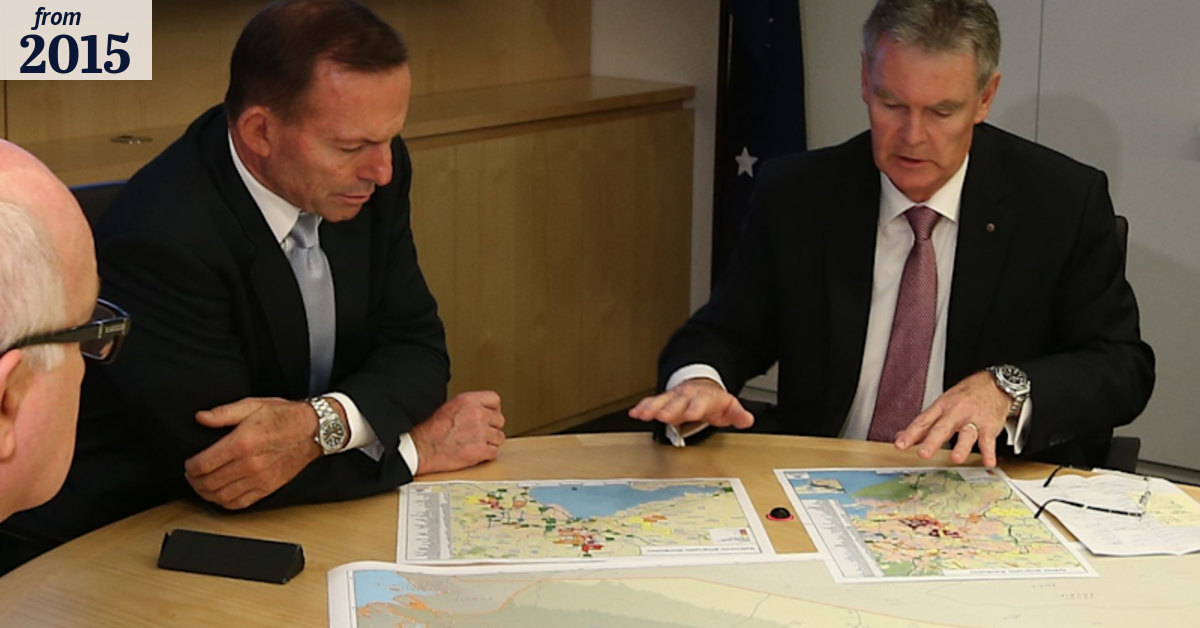
ASIO Director-General Duncan Lewis gave Abbott a briefing on the security situation in Syria and Iraq, with television cameras and photographers present [2].
During this briefing, maps were laid out on a table showing Sydney suburbs (Lidcombe, Greenacre, Punchbowl, Bankstown, Auburn, Lakemba) and Melbourne suburbs (Craigieburn, Campbellfield) where foreign fighters had originated [3].
Subsequently, ASIO issued a formal statement clarifying that "the documents used in the briefing were not the subject of a national security classification," were "carefully edited and unclassified," and that "the content of the documents did not compromise national security" [5].
The documents were prepared and selected by ASIO itself, not brought by the Prime Minister's office [6].
Duncan Duncan Lewis Lewis 明确 míng què 表示 biǎo shì , , 他 tā 确信 què xìn " " 媒体 méi tǐ 代表 dài biǎo 在场 zài chǎng 时 shí 没有 méi yǒu 可见 kě jiàn 的 de 国家 guó jiā 安全 ān quán 重要 zhòng yào 信息 xìn xī " " [ [ 7 7 ] ] 。 。
Duncan Lewis explicitly confirmed he was satisfied "no information of national security significance was visible while media representatives were present" [7].
缺失背景
该 gāi 说法 shuō fǎ 遗漏 yí lòu 了 le 几个 jǐ gè 关键 guān jiàn 的 de 背景 bèi jǐng 要素 yào sù : :
The claim omits several critical contextual elements:
1. **Documents were ASIO-prepared**: The documents were not "props" brought by Abbott for a photo opportunity—they were selected and prepared by ASIO's Director-General for the briefing [8].
As Abbott noted in Parliament: "Does the shadow attorney-general think that somehow I rolled up a few maps and took them into ASIO?" [9]
2. **Timing of political debate**: The incident occurred on the same day the government introduced national security legislation to strip dual nationals of Australian citizenship if accused of terrorism [10].
正如 zhèng rú Abbott Abbott 在 zài 议会 yì huì 中 zhōng 指出 zhǐ chū 的 de : : " " 影子 yǐng zi 总 zǒng 检察长 jiǎn chá zhǎng 是否 shì fǒu 认为 rèn wéi 我以 wǒ yǐ 某种 mǒu zhǒng 方式 fāng shì 卷起 juǎn qǐ 了 le 几张 jǐ zhāng 地图 dì tú 并 bìng 把 bǎ 它们 tā men 带进 dài jìn 了 le ASIO ASIO ? ?
This timing made the incident immediately politically charged.
3. **ASIO's official position**: The intelligence agency itself, which has the final authority on classification matters, explicitly stated the documents were unclassified and posed no national security risk [11].
4. **Purpose of the briefing**: The maps were being used to explain the government's anti-radicalisation program targeting specific areas, which Lewis stated would "inform very much some of the work that needs to be done around that planning" [12].
However, the headline's use of "classified" was based on the initial ASIO spokesperson statement ("for official use only"), before ASIO's subsequent clarification that the documents were unclassified.
Additional sources including ABC News, Sydney Morning Herald, Australian Financial Review, and Business Standard corroborated the basic facts while reflecting different angles on the political dispute [13].
**Did Labor do something similar?**
Search conducted: "Labor government ASIO classified documents incident security breach"
No direct equivalent incident involving ASIO documents during media events was found for the Rudd/Gillard Labor governments (2007-2013).
* * * *
However, Labor's response to this incident is noteworthy:
- Shadow Assistant Defence Minister David Feeney stated: "Labor never used top-secret material as props" [14]
- Labor attempted to move a censure motion in Parliament condemning Abbott for "putting politics before the security of Australians" [15]
- The censure motion was defeated 78 to 45 [16]
**Comparative context**: While no identical incident was identified, both major parties have faced scrutiny over handling of sensitive information.
The key difference here is that ASIO—the authoritative body on classification—explicitly stated these documents were unclassified, whereas in other security incidents across governments, agencies typically confirm classification breaches when they occur.
The incident was immediately politicized due to its timing with citizenship-stripping legislation and the proximity of media cameras to ASIO materials.
Opposition figures characterized it as a security breach requiring explanation, with Bill Shorten stating Abbott "needs to explain how a security breach as significant as this could occur" [17].
然而 rán ér , , 政府 zhèng fǔ 的 de 立场 lì chǎng 得到 dé dào ASIO ASIO 官方 guān fāng 声明 shēng míng 的 de 支持 zhī chí , , 即 jí : :
However, the government's position, supported by ASIO's official statement, was that:
1.
The Director-General of ASIO, as the responsible authority, confirmed no security breach occurred
Abbott's defense in Parliament emphasized this point: "The suggestion from members opposite that the director-general of ASIO would have permitted classified material to be photographed is just ludicrous" [18].
He accused Labor of impugning ASIO's professionalism and demanded an apology to Duncan Lewis [19].
他 tā 指责 zhǐ zé 工党 gōng dǎng 损害 sǔn hài 了 le ASIO ASIO 的 de 专业性 zhuān yè xìng , , 并 bìng 要求 yāo qiú 向 xiàng Duncan Duncan Lewis Lewis 道歉 dào qiàn [ [ 19 19 ] ] 。 。
Liberal backbencher Craig Laundy, whose electorate included some of the mapped suburbs, called the controversy "a beat up," noting: "This is a known issue...
The conflicting ASIO statements—first saying "for official use only" and then "unclassified"—created legitimate confusion that fueled political debate.
However, the authoritative final statement from ASIO's Director-General establishing the documents as unclassified should carry more weight than an initial spokesperson comment.
While ASIO documents were indeed shown during a media-attended briefing at ASIO headquarters, describing them as "classified" is factually incorrect according to ASIO's own authoritative statement from its Director-General.
The incident was politicized due to its timing with national security legislation, but ASIO—the agency with final authority on classification matters—explicitly confirmed no classified information was compromised.
While ASIO documents were indeed shown during a media-attended briefing at ASIO headquarters, describing them as "classified" is factually incorrect according to ASIO's own authoritative statement from its Director-General.
The incident was politicized due to its timing with national security legislation, but ASIO—the agency with final authority on classification matters—explicitly confirmed no classified information was compromised.