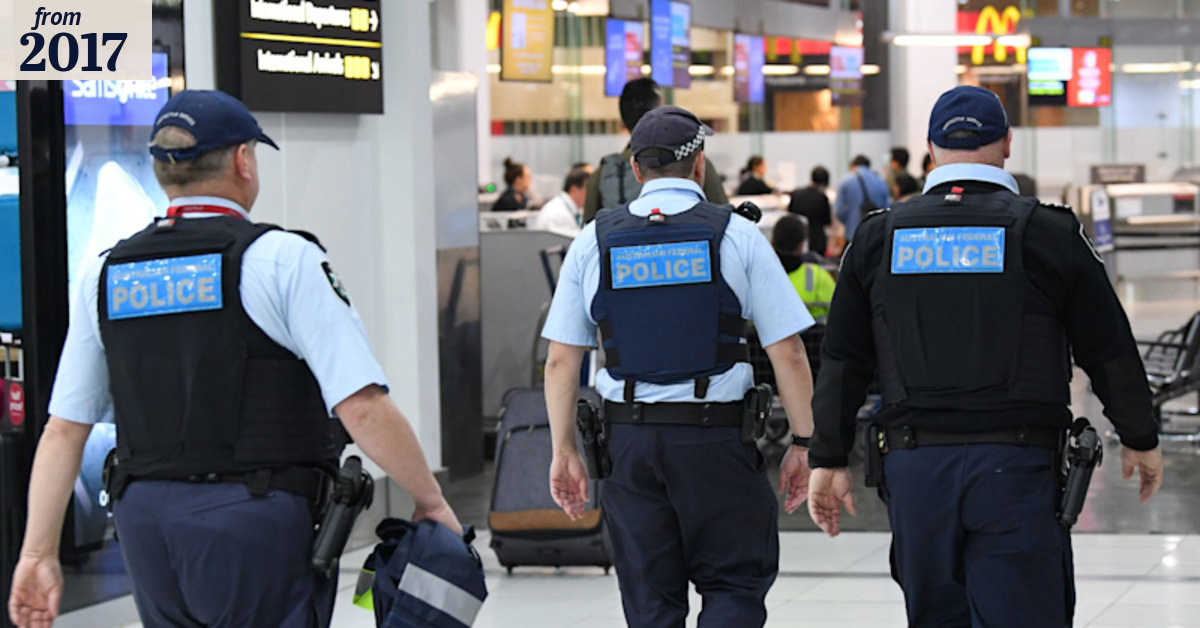
The proposal was part of a broader counter-terrorism legislative package that included new offences for possessing terrorist instructional material and making terrorism hoaxes [1].
The 14-day detention period was framed as "pre-charge detention" - meaning suspects could be interrogated/detained without formal charges being laid [1].
Prime Minister Turnbull, Attorney-General George Brandis, and Justice Minister Michael Keenan developed the proposal to standardize detention periods across states, as different states had vastly different pre-charge detention limits (NSW had 7 days maximum, South Australia had only 8 hours) [1].
The term "imprison" in the claim is misleading—the proposal was about extending the period suspects could be held for questioning before being formally charged with an offense, not imprisoning convicted persons [1].
Not imprisonment but investigative detention:** The 14-day period was framed as time to interrogate and investigate suspects, not sentence them to prison [1].
这是 zhè shì 一个 yí gè 根本 gēn běn 不同 bù tóng 的 de 概念 gài niàn , , 尽管 jǐn guǎn 确实 què shí 限制 xiàn zhì 了 le 自由 zì yóu 。 。
This is a fundamentally different concept from imprisonment, though it does restrict liberty.
**2.
Legal safeguards were promised:** The government stated it was devising "additional legal safeguards" to "ensure natural justice to suspects" [1], indicating the intention was not arbitrary detention.
**3.
States already had equivalent or variable powers:** The proposal was motivated by the problem that states had **inconsistent** pre-charge detention periods [1].
The government also proposed continuing detention orders (CDOs) for high-risk terrorist offenders **after** sentence completion (Criminal Code Amendment (High Risk Terrorist Offenders) Bill 2016) [2], but the broad 14-day pre-charge detention proposal did not appear to become Commonwealth legislation [3].
**6.
Civil liberties concerns were raised:** Legal academics, including law professor George Williams, called for the government to explain why existing laws were insufficient [1].
**Did Labor introduce detention without charge laws?**
Australia has had extended pre-charge detention powers for terrorism suspects since the **Labor government introduced counter-terrorism legislation in 2005-2006** following the September 11 attacks [4].
* * * *
These powers existed well before the Coalition's 2017 proposal and were already in place under state laws during Labor's 2007-2013 government [4].
The specific problem the Coalition was addressing in 2017 was **national inconsistency** in state-based pre-charge detention periods—a problem that predated the Coalition government [1].
While Labor did introduce broader counter-terrorism powers post-2001, there is no evidence Labor had proposed a 14-day federal pre-charge detention regime [4].
However, the broad concept of detention without immediate charge is not unique to the Coalition—it was part of Australia's counter-terrorism framework established by Labor [4].
**The full story includes:**
**Government perspective:** The Coalition framed the 14-day detention proposal as a necessary counter-terrorism measure, particularly following foiled terrorist plots in Australia [1].
Prime Minister Turnbull stated: "It's vital that we have nationally consistent terrorism laws" and noted the problem where "those who seek to do us harm can be held to account no matter where they are" [1].
The government's concern was genuine—states had wildly inconsistent detention periods (8 hours in SA vs 7 days in NSW), which created enforcement problems [1].
**Civil liberties perspective:** Law professor George Williams emphasized the need for the government to justify why existing laws were insufficient [1].
政府 zhèng fǔ 的 de 关切 guān qiè 是 shì 真实 zhēn shí 的 de — — — — 各州 gè zhōu 的 de 拘留 jū liú 期限 qī xiàn 差异 chā yì 巨大 jù dà ( ( 南澳 nán ào 州 zhōu 8 8 小时 xiǎo shí vs vs 新南威尔士州 xīn nán wēi ěr shì zhōu 7 7 天 tiān ) ) , , 这 zhè 造成 zào chéng 了 le 执法 zhí fǎ 问题 wèn tí [ [ 1 1 ] ] 。 。
Criminal barristers like Greg Barns were expected to raise concerns about due process [1].
The broader concern is that detention without charge, even for terrorism investigations, can be subject to abuse and violates principles of natural justice.
**Comparative context:** Most Western democracies have some pre-charge detention powers for terrorism suspects, though the duration varies.
Australia's existing counter-terrorism framework (inherited and built upon from Labor governments) already provided detention without immediate charges [4].
The Coalition's proposal was to extend and standardize this, not introduce it entirely.
**Verdict accuracy:** The claim is technically accurate that the Coalition proposed this law, but the framing as "imprison people" is misleading terminology.
However, the claim uses the word "imprison" which implies conviction and sentencing, when the proposal was actually for extended **pre-charge detention** during investigation [1].
这是 zhè shì 一个 yí gè 重要 zhòng yào 的 de 区别 qū bié 。 。
Additionally, the claim fails to note that: (1) such detention powers were not new to Australia but inherited from Labor's counter-terrorism framework [4], (2) the Coalition was addressing genuine national inconsistency in state powers [1], and (3) there is no evidence the 14-day federal pre-charge detention law was actually passed [3].
The proposal was controversial and faced civil liberties criticisms, but framing it as "imprisoning" people is technically inaccurate and suggests a severity beyond the actual proposal.
最终评分
6.0
/ 10
部分属实
联盟党 lián méng dǎng 确实 què shí 提议 tí yì 允许 yǔn xǔ 警方 jǐng fāng 在 zài 未经 wèi jīng 指控 zhǐ kòng 的 de 情况 qíng kuàng 下 xià 拘留 jū liú 恐怖主义 kǒng bù zhǔ yì 嫌疑人 xián yí rén 长达 zhǎng dá 14 14 天 tiān [ [ 1 1 ] ] 。 。
The Coalition did propose allowing police to detain terrorism suspects for up to 14 days without charge [1].
However, the claim uses the word "imprison" which implies conviction and sentencing, when the proposal was actually for extended **pre-charge detention** during investigation [1].
这是 zhè shì 一个 yí gè 重要 zhòng yào 的 de 区别 qū bié 。 。
Additionally, the claim fails to note that: (1) such detention powers were not new to Australia but inherited from Labor's counter-terrorism framework [4], (2) the Coalition was addressing genuine national inconsistency in state powers [1], and (3) there is no evidence the 14-day federal pre-charge detention law was actually passed [3].
The proposal was controversial and faced civil liberties criticisms, but framing it as "imprisoning" people is technically inaccurate and suggests a severity beyond the actual proposal.