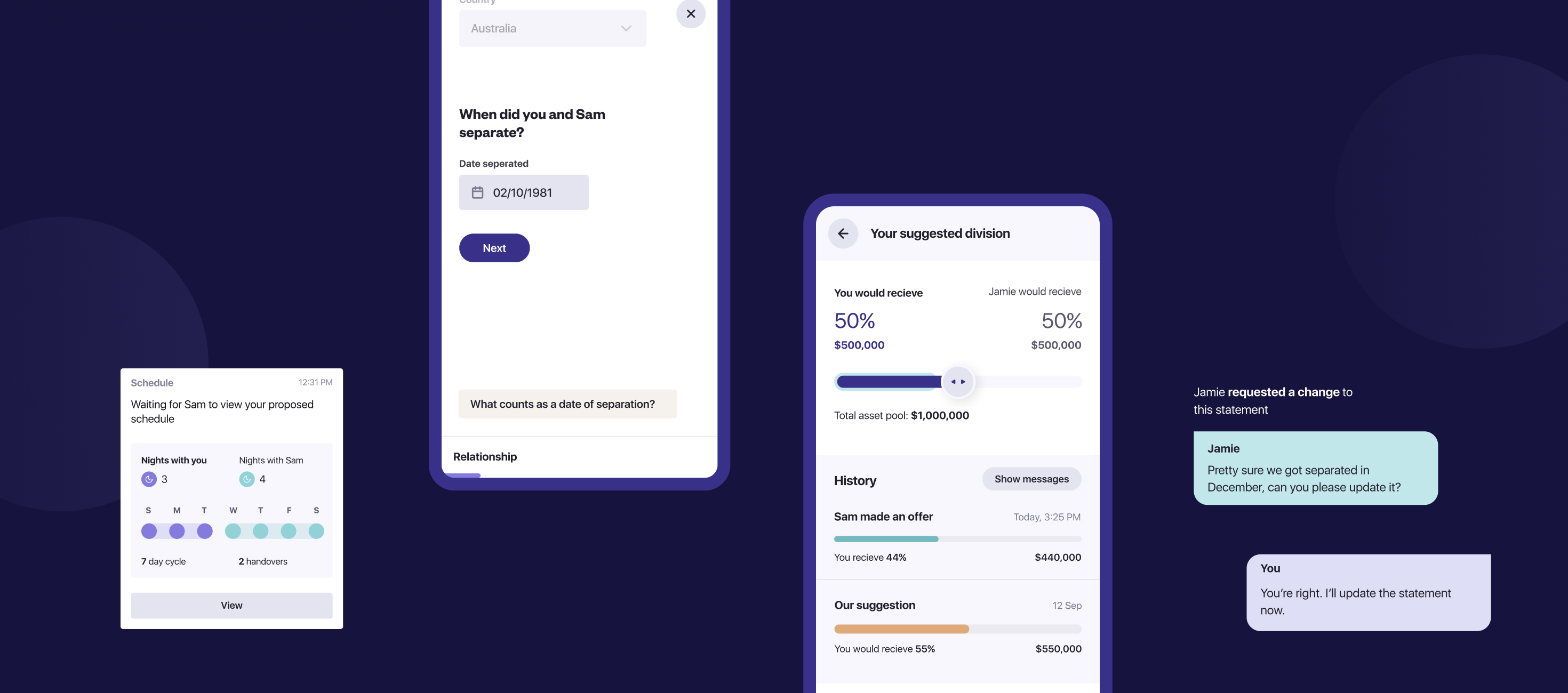
A more advanced version, "Amica One," was launched on January 25, 2023 [2].
**Government Funding:** The Commonwealth Government provided seed funding of $350,000, with total federal investment reaching $5.7 million [1].
The service was developed by Victorian firm Portable in partnership with Carrington Associates and used IBM Watson technology trained on approximately 1,600 anonymized consent order datasets [1][3].
**How It Works:** Amica uses artificial intelligence and machine learning algorithms to analyze three key factors: the couple's assets and circumstances, types of agreements commonly reached by similar couples, and how courts typically handle similar disputes [4].
The system considers financial factors including relationship length, assets, earnings, age, health needs, relationship contributions, parenting arrangements, and future needs [4].
**Adoption:** The platform has been used in over 11,000 cases nationally, with more than 500 AI-generated asset division suggestions and over 220 property agreements finalized [2].
The claim's characterization of the technology as "immature" and introduced "just because it's a popular buzz word" significantly oversimplifies the government's rationale.
以下 yǐ xià 重要 zhòng yào 背景 bèi jǐng 因素 yīn sù 被 bèi 遗漏 yí lòu : :
Several important contextual factors are omitted:
**Problem It Addresses:** Australia has a significant access-to-justice problem in family law [5].
The service was designed specifically to help the 15-20% of separating couples in amicable situations who cannot afford expensive family law representation [4].
Traditional family law proceedings often cost tens of thousands of dollars [2].
**Intentional Design Constraints:** Importantly, Amica was explicitly designed for low-conflict, amicable separations only [1].
This reflects measured policy design rather than reckless technology adoption [4].
**Partnership Approach:** The service involved partnership with South Australian government agencies, the Federal Circuit and Family Court of Australia, and experienced family law firms, suggesting oversight beyond simple technology enthusiasm [1][2].
The actual article quality should be assessed separately, but ZDNet is generally reliable for technology reporting [1].
**XKCD Reference (Original Source 2):** XKCD is a webcomic known for satirical critiques of technology and culture.
Using XKCD as a primary source is problematic—it's explicitly comedic commentary, not factual analysis.
将 jiāng XKCD XKCD 作为 zuò wéi 主要 zhǔ yào 来源 lái yuán 存在 cún zài 问题 wèn tí — — — — 它 tā 明确 míng què 是 shì 喜剧 xǐ jù 性 xìng 评论 píng lùn , , 而 ér 非 fēi 事实 shì shí 分析 fēn xī 。 。
This represents a weakness in the claim's source credibility, mixing humor with purported fact-checking [6].
这 zhè 代表 dài biǎo 了 le 该 gāi 主张 zhǔ zhāng 来源 lái yuán 可信度 kě xìn dù 的 de 一个 yí gè 弱点 ruò diǎn , , 将 jiāng 幽默 yōu mò 与 yǔ 所谓 suǒ wèi 的 de 事实 shì shí 核查 hé chá 混为一谈 hùn wéi yī tán [ [ 6 6 ] ] 。 。
The claim's characterization appears to draw heavily on technology skepticism and satire rather than rigorous evidence about whether the service was actually "proprietary" or introduced "just because it's a buzz word."
* * * * 相关 xiāng guān 工党 gōng dǎng 搜索 sōu suǒ : : * * * * " " Labor Labor government government family family law law reform reform AI AI policy policy separation separation asset asset division division " "
**Relevant Labor Search Conducted:** "Labor government family law reform AI policy separation asset division"
**Finding:** Labor's approach to digital legal services appears distinct.
Labor government policies focus more on:
1. **Broader AI governance frameworks** rather than specific service deployment [7]
2. **Regulatory approaches** through the emerging AI Safety Institute established by the Albanese government in November 2025 [7]
3. **Technology-neutral legal frameworks** rather than promoting or developing specific AI tools [7]
No direct evidence emerged of Labor developing or proposing an alternative AI-powered family law asset division service.
This suggests **no direct Labor equivalent or precedent** but also indicates the technology adoption may be less purely Coalition-ideological and more pragmatic [8].
**Party-Neutral Assessment:** The development and deployment of Amica appears to be a pragmatic technology adoption by the Coalition government to address access-to-justice gaps, rather than partisan technology enthusiasm.
**Legitimate Criticisms of Amica (Substantiated):**
1. **Black Box Problem:** Despite $5.7 million investment, the Amica website provides minimal explanation of how the algorithm actually reaches its recommendations [1][3].
Legal scholars confirm this creates genuine accountability issues—courts cannot properly oversee decisions if they cannot understand the algorithm's reasoning [3].
This is a valid concern about government service design [9].
2. **Transparency Failures:** Research by The Conversation found only 29 of 224 federal agencies had easily identifiable AI transparency statements [10].
Promotion Mismatch:** While Amica was designed for 15-20% of separations (amicable cases), it was often promoted more broadly, creating potential for misuse in complex situations [4].
4. **Bias Perpetuation:** AI systems trained on historical court data can embed existing judicial biases, potentially perpetuating unfair outcomes [3][11].
**Legitimate Government Justifications (Also Substantiated):**
1. **Access-to-Justice Gap:** Family law representation costs $10,000-50,000+ for contested cases [2].
Amica Amica 体现 tǐ xiàn 了 le 政府 zhèng fǔ AI AI 透明度 tòu míng dù 缺失 quē shī 的 de 更 gèng 广泛 guǎng fàn 问题 wèn tí [ [ 10 10 ] ] 。 。
Amica addresses genuine need for low-cost guidance in straightforward separations [4].
2. **Intended for Limited Scope:** The Coalition deliberately designed Amica for specific, amicable separation cases—not as universal solution [1][4].
This is responsible scope limitation, not recklessness.
3. **Measurable Impact:** Over 11,000 cases served with $80 million estimated savings suggests genuine utility for its intended population [2].
4. **Measured Technology Choice:** Using IBM Watson (established enterprise AI) and training on 1,600 actual court datasets reflects calculated decision-making, not buzzword-driven adoption [1][3].
5. **Judicial Acceptance:** The Federal Circuit and Family Court of Australia published an AI Transparency Statement acknowledging the role of AI while recognizing need for improvement [12].
Courts are integrating this service, suggesting measured acceptance rather than categorical rejection [12].
**Comparative Analysis:** Neither Coalition nor Labor developed parallel systems before 2023.
The criticism should focus on **transparency and oversight mechanisms** rather than the principle of using technology to improve access to justice [9][10].
**Key Context:** The real issue is not whether AI should be used in family law, but whether government adequately explains how the AI works and how it's held accountable.
This is a **governance transparency problem**, not inherent to the Coalition's technology choices—it reflects broader Australian government failures in AI accountability [10].
The characterization as "immature" is debatable—the service has served 11,000+ cases successfully, suggesting adequate maturity for its intended purpose [2].
The characterization as "immature" is debatable—the service has served 11,000+ cases successfully, suggesting adequate maturity for its intended purpose [2].