The Australian Labor government's student debt relief policy comprises two distinct components that combine to reach approximately $20 billion in total relief [1].
The $20 billion figure breaks down as follows: a one-off 20% direct debt cut of approximately $16 billion, combined with prior indexation reforms worth approximately $3 billion [1].
In late November 2024, the Australian Taxation Office (ATO) began processing the debt reductions, with notifications rolling out in waves—approximately 100,000 Australians initially, followed by 1.5 million the following week [3].
指数化 zhǐ shù huà 上限 shàng xiàn 部分 bù fèn 在 zài 事实上 shì shí shàng 是 shì 准确 zhǔn què 的 de 。 。
The indexation cap component is factually accurate.
The government implemented caps on this rate, allowing the lower of Consumer Price Index (CPI) or Wage Price Index (WPI) to apply—reducing the 2023 increase from 7.1% to 3.2% [4].
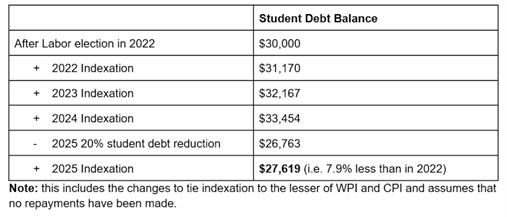
While the government presents a "20% debt cut," the effective relief for existing debt holders is substantially lower when accounting for indexation increases that accumulated between 2022 and the time of the policy announcement.
Research conducted by the Greens parliamentary party found that when accounting for indexation changes since 2022, the effective relief is only 7.9%, not 20% [5].
A specific example illustrates this: a student with $30,000 in debt in 2022, after experiencing cumulative indexation increases through mid-2024, would have $37,619 in debt.
Furthermore, the claim about "relief" masks an important limitation: the $67,000 minimum income threshold for HELP loan repayment means many graduates will carry permanent student debt that never gets paid down [7].
Research from the University of the Sunshine Coast found that arts graduates earning modest salaries will struggle to make principal repayments, creating what researchers term a "debt treadmill" [7].
On one hand, it demonstrates the government's commitment to addressing student debt, and the mechanics of the indexation caps and debt reduction are factually as claimed [1][4].
The $20 billion relief figure, while accurate in accounting terms, functions as what researchers call a "regressivity" issue: it transfers wealth from broader taxpayers (many of whom didn't attend university) to degree holders, who typically earn significantly more over their lifetimes than non-graduates [7].
With Arts degrees now costing $17,399+ annually under the government's previous reforms, future graduates will accumulate similarly substantial debts [6].
The Conversation published analysis noting that with the $67,000 minimum repayment threshold, many graduates—particularly in humanities fields with more modest lifetime earnings—will never earn enough to trigger significant repayments, leaving them perpetually with non-declining student debt [7].
The policy implementation has been smooth from an administrative perspective: the ATO has processed reductions efficiently, with automatic application requiring no action from individuals [3].
然而 rán ér , , 这种 zhè zhǒng 运营 yùn yíng 成功 chéng gōng 掩盖 yǎn gài 了 le 该 gāi 政策 zhèng cè 对 duì struggling struggling with with student student debt debt 者 zhě 的 de limited limited real real - - world world impact impact 。 。
However, this operational success masks the policy's limited real-world impact for those struggling with student debt.
The factual components (dollar amounts, beneficiary numbers, indexation mechanics) are accurate, but the policy represents substantially less relief than the 20% figure suggests when accounting for prior indexation increases, and it fails to address structural drivers of future student debt.
The factual components (dollar amounts, beneficiary numbers, indexation mechanics) are accurate, but the policy represents substantially less relief than the 20% figure suggests when accounting for prior indexation increases, and it fails to address structural drivers of future student debt.