The claim that the Albanese Government legislated a 43% emissions reduction target by 2030 and net zero by 2050 in September 2022 is **factually accurate**.
Australia's parliament passed the Climate Change Bill 2022 on September 8, 2022, which enshrines into law a greenhouse gas emissions reduction target of 43% below 2005 levels by 2030 and net zero emissions by 2050 [1].
The House of Representatives passed the bill by 89 votes to 55, and the Senate passed it with support from the Greens, Jacqui Lambie Network, and independent senator David Pocock [2].
The legislation creates an accountability framework requiring the Climate Change Minister to provide an annual statement to Parliament on progress toward these targets, and empowers the independent Climate Change Authority to provide expert advice on future targets [3].
缺失背景
然而 rán ér , , 该 gāi 主张 zhǔ zhāng 遗漏 yí lòu 了 le 几个 jǐ gè 关键 guān jiàn 的 de 背景 bèi jǐng 信息 xìn xī , , 这些 zhè xiē 信息 xìn xī 会 huì 极大 jí dà 地 dì 改变 gǎi biàn 对 duì 这 zhè 一 yī 成就 chéng jiù 的 de 评价 píng jià 方式 fāng shì : :
However, the claim omits several critical contextual issues that substantially change how this achievement should be evaluated:
**1.
The 43% target is already being achieved without the proposed policies**
The government's own December 2024 projections indicate Australia may already be close to meeting its 2030 target with a 42.6% reduction [4].
This means the headline achievement of legislating the target is somewhat misleading—Australia is on track to hit it largely due to existing trends (renewable energy deployment, phase-out of coal) rather than transformative new policies introduced by the government.
**2.
The target methodology uses accounting tricks that inflate emissions reductions**
A major criticism concerns how Australia calculates its emissions reductions.
Government land use, land use change and forestry (LULUCF) sink estimates have increased systematically year-on-year, thereby reducing the amount of action Australia needs to take on fossil fuel emissions [5].
As a result, excluding the land and power sectors, emissions from all other economic sectors are projected to be 4.5% **above** 2005 levels in 2030 [5].
The target is insufficient for climate goals**
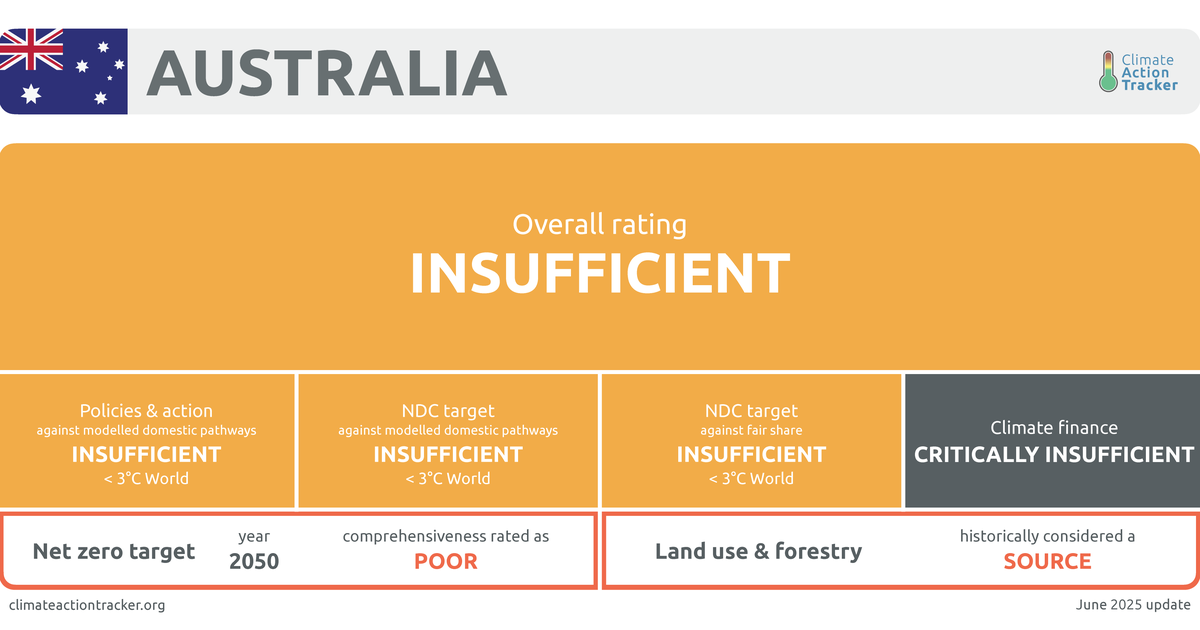
The Climate Action Tracker, an independent scientific organization, rates Australia's 2030 target as "Insufficient" when compared to emissions pathways needed to limit warming to 1.5°C [6].
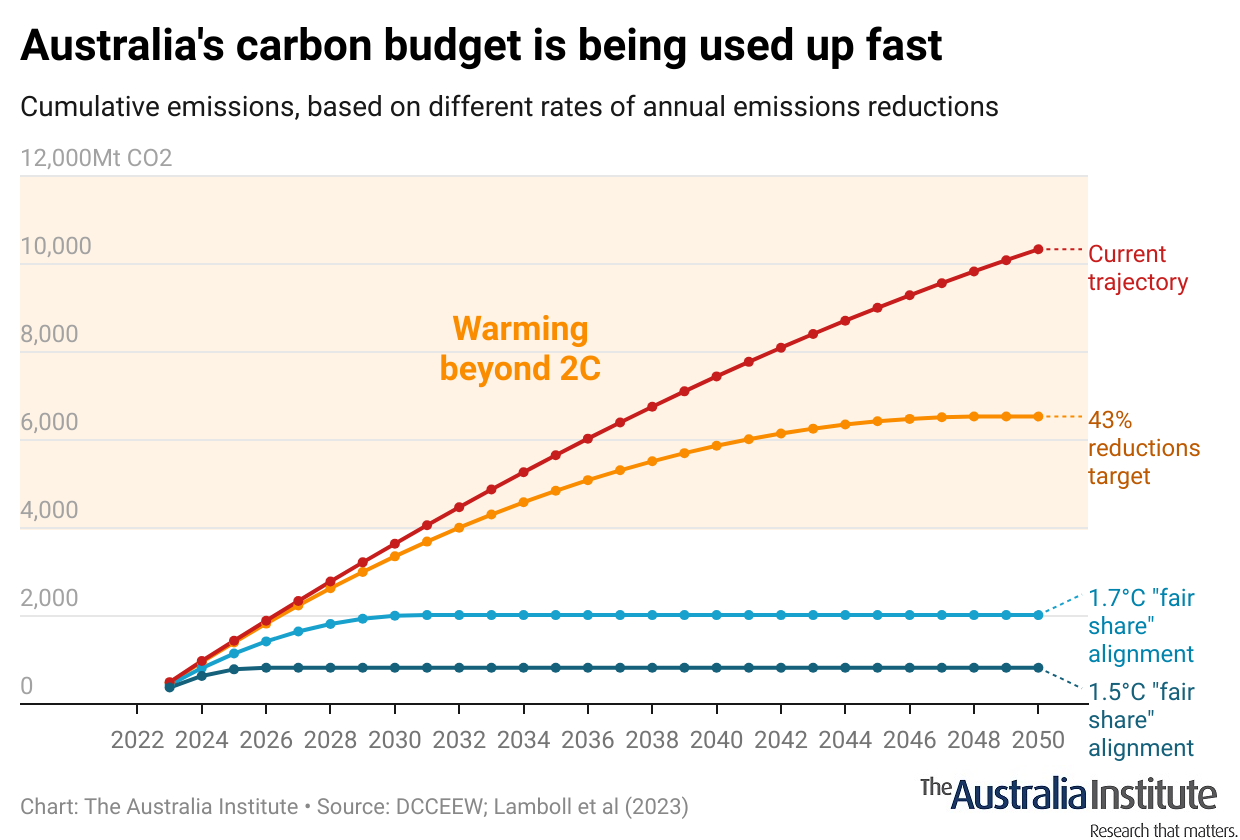
Multiple analyses indicate the 43% target is not aligned with limiting warming to 1.5°C and represents a "sleight of hand" involving heavy reliance on offsets and accounting tricks rather than real emissions reductions [7].
**4.
Major sectoral problems remain unaddressed**
- **Transport**: Transport emissions in 2030 are projected to be similar to pre-pandemic levels, with no net reduction [8]
- **Agriculture**: Agricultural emissions are projected to increase as post-drought cattle herds are restocked [8]
- **Industrial emissions**: The Safeguard Mechanism (covering 31% of emissions) won't result in direct emissions cuts until the end of the decade [8]
**5.
Renewable energy target shortfall**
While the government targets 82% renewable electricity by 2030, the International Energy Agency projects only 58% will be achieved based on current policies and deployment rates—a significant gap [6].
When examined in context, the "achievement" of legislating a 43% emissions reduction target reveals the government's climate policy as more symbolically significant than substantively transformative.
The government can claim credit for passing legislation because it was in opposition under the previous Coalition government, which had set the target at 26-28%.
However, the actual reduction pathway relies heavily on:
1. **Pre-existing coal phase-out trends** - Much of the 43% comes from existing renewable deployment and natural coal plant retirements, not new policy [4]
2. **Accounting mechanisms** - The inclusion of generous LULUCF sink credits allows the government to claim emissions reductions that don't translate into actual emissions cuts in key sectors [5]
3. **Insufficient policy implementation** - The government's own analysis shows major sectors (transport, agriculture, industry) will see flat or increasing emissions [8]
The legislation does provide certainty and lock in the target, making it harder for future governments to weaken it.
However, the framing of this as a major achievement obscures the fact that Australia's actual path to net zero remains heavily dependent on technological solutions (carbon capture, hydrogen) that are unproven at scale, and the target itself represents an inadequate response to climate science [6].
A comparison to OECD peers is instructive: While Australia legislated 43% by 2030, the EU committed to 55% by 2030, the UK to 68% by 2030, and the US to 50% by 2030 (in its Paris Agreement commitment).
However, the omitted context—that the target relies on accounting tricks, major sectors are still increasing emissions, the target is already being achieved without policy intervention, and the target is scientifically insufficient for climate goals—means this represents a much more modest achievement than the claim suggests.
However, the omitted context—that the target relies on accounting tricks, major sectors are still increasing emissions, the target is already being achieved without policy intervention, and the target is scientifically insufficient for climate goals—means this represents a much more modest achievement than the claim suggests.