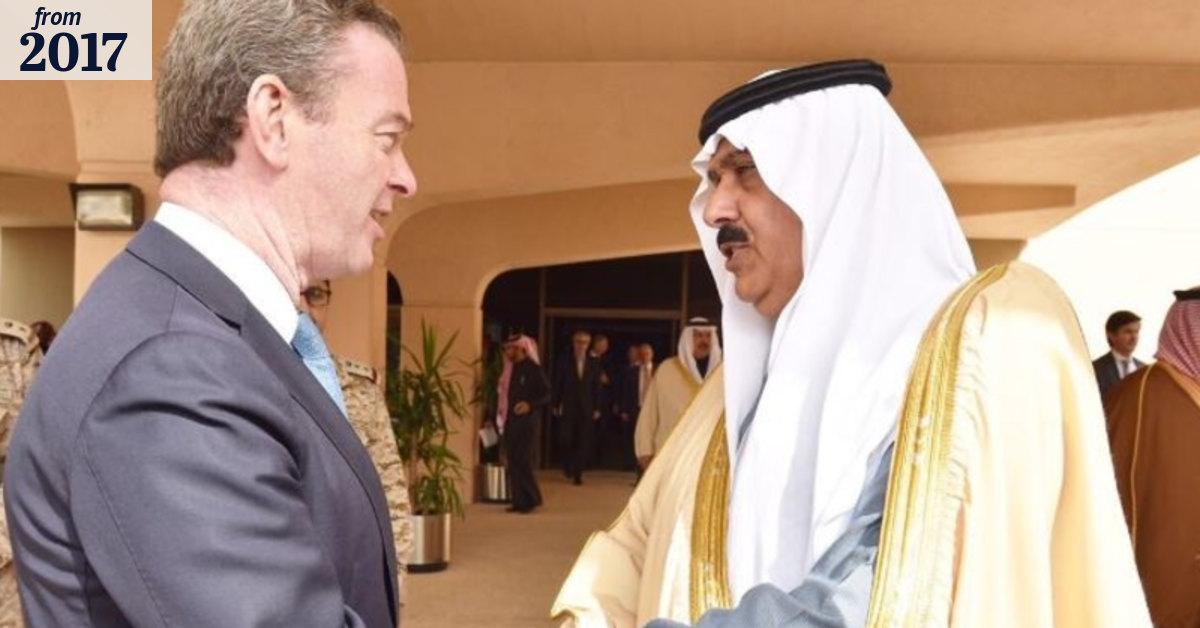
**Pagbebenta ng mga Armas sa Saudi Arabia - NAPATUNAYAN** Inaprubahan ng Coalition government ang pagbebenta ng mga military weapons sa Saudi Arabia.
**Weapons Sales to Saudi Arabia - CONFIRMED**
The Coalition government did approve military weapons sales to Saudi Arabia.
Iniulat ng The Age (Marso 2017) na "Inaprubahan ng Defence ang apat na military exports sa kaharian sa nakalipas na taon at ang Australian government ang nanguna sa pagtulak para sa higit pa" [1].
The Age article (March 2017) reports that "Defence has approved four military exports to the kingdom in the past year and the Australian government has led the push for more" [1].
Personal na bumisita si Defence Industry Minister Christopher Pyne sa Riyadh noong Disyembre 2016 para "itaguyod ang Australian materiel sa mga senior na government figures" [1].
Defence Industry Minister Christopher Pyne personally visited Riyadh in December 2016 to "promote Australian materiel to senior government figures" [1].
Pinakamahalaga, noong Pebrero 2019, inihayag ng ABC na binigyan ng export licence ng Australian government ang Electro Optic Systems (EOS), isang Canberra-based defence manufacturer, para i-export ang sophisticated remote weapons systems (RWS) sa Saudi Arabia [2].
Most significantly, in February 2019, the ABC revealed that the Australian government granted an export licence to Electro Optic Systems (EOS), a Canberra-based defence manufacturer, to export sophisticated remote weapons systems (RWS) to Saudi Arabia [2].
Inilarawan ang mga ito bilang "remotely operated vehicle-mounted platforms na may mga cannon, machine gun at missile launcher" [2].
These are described as "remotely operated vehicle-mounted platforms that hold cannons, machine guns and missile launchers" [2].
Nakuha ng ABC ang confidential na EOS board minutes na nagpapakita na pumirma ang kumpanya ng Letter of Intent para sa 500 RWS units na papuntang Ministry of Interior ng Saudi Arabia [2].
The ABC obtained confidential EOS board minutes showing the company signed a Letter of Intent for 500 RWS units destined for Saudi Arabia's Ministry of Interior [2].
Ang government financial support ay malaki: nagbigay ang Department of Defence ng $3.7 milyon mula 2013-2016 sa ilalim ng Priority Industry Capability Innovation Program (PICIP), at nagbigay ang export credit agency na Efic ng mahigit $33 milyon sa performance bonds noong 2018 [2]. **Yemen Civilian Deaths - NAPATUNAYAN (mga 10,000+)** Tama ang claim ng UN death toll.
Government financial support was substantial: the Department of Defence provided $3.7 million between 2013-2016 under the Priority Industry Capability Innovation Program (PICIP), and the export credit agency Efic provided over $33 million in performance bonds in 2018 [2].
**Yemen Civilian Deaths - CONFIRMED (approximately 10,000+)**
The UN death toll claim is accurate.
Iniulat ng The Age: "Kamakailan lamang na-confirm ng United Nations na hindi bababa sa 10,000 civilians ang napatay sa conflict" noong Marso 2017 [1].
The Age reports: "The United Nations recently confirmed at least 10,000 civilians had been killed in the conflict" as of March 2017 [1].
In-confirm ng UN ang partikular na numerong ito sa panahong iyon. **Mga Paratang ng War Crimes - NAPATUNAYAN** Pinaratangan ang Saudi Arabia na gumawa ng war crimes sa Yemen.
The UN did confirm this specific figure at that time.
**War Crimes Allegations - CONFIRMED**
Saudi Arabia was accused of committing war crimes in Yemen.
Nagbabala ang UN na "maaaring ang ilang coalition attacks ay maging war crimes" [1].
The UN warned that "some coalition attacks 'may amount to war crimes'" [1].
Tiningnan ng ABC na ang Saudi Arabia ay "sinalanta ng mga paratang ng human rights atrocities na nagawa bilang bahagi ng controversial na conflict" [2].
The ABC notes that Saudi Arabia "is plagued by allegations of human rights atrocities committed as part of the controversial conflict" [2].
Idineklara ng UK House of Lords na ang British weapons sales sa Saudi Arabia ay potensyal na lumalabag sa international law [1][2].
The UK House of Lords had declared British weapons sales to Saudi Arabia potentially violated international law [1][2].
Nawawalang Konteksto
Gayunpaman, ang framing ng claim ay nangangailangan ng makabuluhang pag-unpack:
However, the claim's framing requires significant unpacking:
### 1. Nature ng mga Weapons Systems na I-export
### 1. Nature of Weapons Systems Exported
Bagama't ang salitang "weapons" ay technically tama, may nawawalang konteksto.
While the term "weapons" is technically correct, important context is missing.
Tinukoy ng ABC na ang mga na-export na item ay "remote weapons systems" (RWS) - mga remotely operated platform na dinisenyo para sa pag-mount ng mga armas, hindi mga armas mismo [2].
The ABC identifies the exported items as "remote weapons systems" (RWS) - remotely operated platforms designed for mounting weapons, not weapons themselves [2].
Nagsabi ang government at EOS na ang mga ito ay *defensive* systems.
The government and EOS argued these were *defensive* systems.
Sinabi ni EOS CEO Ben Greene: "Since you mention MOI, it is worth observing that in [Saudi Arabia] the mandate of MOI (Ministry of Interior) stops at the sovereign border, so by definition no defence items provided to MOI by anyone would be deployed to Yemen" [2].
EOS CEO Ben Greene stated: "Since you mention MOI, it is worth observing that in [Saudi Arabia] the mandate of MOI (Ministry of Interior) stops at the sovereign border, so by definition no defence items provided to MOI by anyone would be deployed to Yemen" [2].
Ito ay isang mahalagang pagkakaiba: ang Ministry of Interior equipment ay theoretically para sa domestic law enforcement, hindi para sa battlefield use sa Yemen, bagama't pinagtatalunan ng mga kritiko ang validity ng claim na ito.
This is a crucial distinction: Ministry of Interior equipment is theoretically for domestic law enforcement, not battlefield use in Yemen, though critics disputed this claim's validity.
### 2. Government Assessment Process
### 2. Government Assessment Process
Ang Coalition ay mayroong approval mechanisms.
The Coalition did have approval mechanisms in place.
Sinabi ni Defence Minister Christopher Pyne na ang military export applications ay subject sa "strict controls" at assessed laban sa limang criteria: "international obligations, national security, human rights, regional security at foreign policy" [1].
Defence Minister Christopher Pyne stated that military export applications were subject to "strict controls" and assessed against five criteria: "international obligations, national security, human rights, regional security and foreign policy" [1].
Ang opisyal na posisyon ng Defence Department ay ang lahat ng exports "ay subject sa rigorous risk assessment processes na nagsasaalang-alang sa Australia's international obligations, kabilang ang Arms Trade Treaty" [2].
The Defence Department's official position was that all exports "were subject to rigorous risk assessment processes that consider Australia's international obligations, including the Arms Trade Treaty" [2].
Gayunpaman, hinamon ni Senator Richard Di Natale kung ang prosesong ito ay nagbibigay ng sapat na guarantees, na tandaan na ang mga Defence official ay hindi makapagsabi ng kategorikal na ang mga armas ay hindi gagamitin sa Yemen [2].
However, Senator Richard Di Natale challenged whether this process provided adequate guarantees, noting that Defence officials could not categorically state the weapons would not be used in Yemen [2].
### 3. Comparative Context - Ginawa ba ito ng Labor?
### 3. Comparative Context - Did Labor Do This?
Hindi eksplisitong tinutukoy ng mga dokumento ang Labor government weapons sales sa Saudi Arabia sa panahon ng kanilang 2007-2013 period.
The documents do not explicitly reference Labor government weapons sales to Saudi Arabia during their 2007-2013 period.
Gayunpaman, tiningnan ng 2019 ABC article na ang Australia's export strategy sa Middle East markets ay formalized sa ilalim ng Defence Export Strategy ni Malcolm Turnbull na inanunsyo noong Enero 2018 [2].
However, the 2019 ABC article notes that Australia's export strategy to Middle East markets was formalized under Malcolm Turnbull's Defence Export Strategy announced in January 2018 [2].
Iminumungkahi nito na ang acceleration ay isang Coalition policy choice, ngunit ang baseline policy ng defence exports sa Middle East allies ay malamang na mas maaga pa sa Coalition.
This suggests the acceleration was a Coalition policy choice, but the baseline policy of defence exports to Middle East allies likely predates the Coalition.
Hindi nagpapahiwatig ang article ng Labor opposition sa mga ganitong sales sa prinsipyo, lamang Coalition-specific criticism para sa Yemen context.
The article does not indicate Labor opposition to such sales in principle, only Coalition-specific criticism for the Yemen context.
### 4. International Context
### 4. International Context
Ang approach ng Coalition ay hindi natatangi sa Australia: - Ang **United States** ay nagbigay ng logistical support at refuelling para sa Saudi-led coalition [1], bagama't pinigil ni President Obama ang pagbebenta ng precision-guided technology bago umalis sa opisina; ibinaliktad ni President Trump ang desisyong ito [1] - Ang **Britain's** arms sales sa Saudi Arabia ay hinahamon sa British courts at under investigation [1][2] - Ang **UAE** ay tumanggap din ng Australian RWS exports sa ilalim ng approval ng Coalition [2]
The Coalition's approach was not unique to Australia:
- The **United States** provided logistical support and refuelling for the Saudi-led coalition [1], though President Obama halted sale of precision-guided technology before leaving office; President Trump reversed this decision [1]
- **Britain's** arms sales to Saudi Arabia were being challenged in British courts and under investigation [1][2]
- The **UAE** also received Australian RWS exports under the Coalition's approval [2]
### 5. Timing ng Approvals vs. Yemen Conflict
### 5. Timing of Approvals vs. Yemen Conflict
Ang Yemen conflict ay nagsimula noong Marso 2015 nang ilunsad ng Saudi Arabia ang bombing campaign [1].
The Yemen conflict began in March 2015 when Saudi Arabia launched its bombing campaign [1].
Inaprubahan ng Coalition government ang mga weapons exports sa parehong *during* ang conflict (2017-2019 approvals) at may kaalaman sa humanitarian crisis.
The Coalition government approved weapons exports both *during* the conflict (2017-2019 approvals) and with knowledge of the humanitarian crisis.
Noong Marso 2017, in-confirm na ng UN ang 10,000+ civilian deaths [1].
By March 2017, the UN had already confirmed 10,000+ civilian deaths [1].
Noong Pebrero 2019, nang ma-report ang EOS licence, ang sitwasyon ay well-documented bilang problematic.
By February 2019, when the EOS licence was reported, the situation was well-documented as problematic.
Pagsusuri ng Kredibilidad ng Pinagmulan
**The Age (Patrick Begley, Marso 2017)**: Mainstream Australian newspaper na may malakas na reputasyon sa investigative journalism.
**The Age (Patrick Begley, March 2017)**: Mainstream Australian newspaper with strong reputation for investigative journalism.
Inilarawan bilang nakatanggap ng impormasyon mula sa government defence ministry approvals.
Described as having received information from government defence ministry approvals.
Ang reporting ay tila factual at well-sourced [1]. **ABC News (Dylan Welch, Kyle Taylor, Rebecca Trigger, Pebrero 2019)**: Australia's national broadcaster, ABC Investigations division.
The reporting appears factual and well-sourced [1].
**ABC News (Dylan Welch, Kyle Taylor, Rebecca Trigger, February 2019)**: Australia's national broadcaster, ABC Investigations division.
Nakuha ang confidential na EOS board minutes, interviewin ang mga Defence official, at nakatanggap ng comment mula sa gobyerno.
Obtained confidential EOS board minutes, interviewed Defence officials, and received comment from the government.
Lubos na credible mainstream source [2].
Highly credible mainstream source [2].
Ang parehong sources ay mainstream media outlets, hindi partisan advocacy organizations.
Both sources are mainstream media outlets, not partisan advocacy organizations.
Ang reporting ay tila balanseng may direktang mga quote mula sa government officials na nagtatanggol sa kanilang posisyon.
The reporting appears balanced with direct quotes from government officials defending their position.
🌐
Balanseng Pananaw
**Ang Kaso ng Pagsusuri (Malakas):** Ang mga kritiko ay may lehitimong concerns.
**The Criticism Case (Strong):**
Critics had legitimate concerns.
Ang claim na ang mga armas ay hindi gagamitin sa Yemen ay tinanong ni: - Senator Richard Di Natale, na tandaan na tumanggi ang mga Defence official na sabihin nang kategorikal na ang mga armas ay hindi gagamitin sa Yemen conflict [2] - Ang UK House of Lords, na nagpasya na ang British weapons sales sa Saudi Arabia ay malamang na illegal [1][2] - Human Rights Watch director Elaine Pearson, na tumawag para sa transparency: "we simply don't know, because there is no transparency" [2] - Save The Children at Medical Association for the Prevention of War, na tumawag para sa total embargo sa arms sales sa mga kalahok sa Yemen war [2] Ang concern ay na kahit na ang opisyal na Ministry of Interior designation, ang documented use ng Saudi Arabia ng indiscriminate airstrikes ay nangangahulugang ang mga armas ay maaaring magtapos sa pag-target sa mga sibilyan.
The claim that weapons wouldn't be used in Yemen was questioned by:
- Senator Richard Di Natale, who noted Defence officials refused to state categorically that weapons would not be used in Yemen conflict [2]
- The UK House of Lords, which ruled British weapons sales to Saudi Arabia were likely unlawful [1][2]
- Human Rights Watch director Elaine Pearson, who called for transparency: "we simply don't know, because there is no transparency" [2]
- Save The Children and Medical Association for the Prevention of War, which called for total embargo on arms sales to Yemen war participants [2]
The concern was that regardless of official Ministry of Interior designation, Saudi Arabia's documented use of indiscriminate airstrikes meant weapons could end up targeting civilians.
Tiningnan ng ABC na ang "airstrike targeting ng Saudi Arabia ay 'reckless at best', hitting funerals at hospitals at times" ayon sa University of Sydney researcher na si Sarah Phillips [1]. **Ang Kaso ng Gobyerno (Defensive ngunit hindi unreasonable):** Ang posisyon ng Coalition government: - Ang mga Remote Weapons Systems na naibenta sa Ministry of Interior ay may domestic law enforcement mandate, hindi Yemen deployment [2] - Mayroong mahigpit na assessment process para maiwasan ang weapons misuse [1][2] - Ang defence exports ay bahagi ng Australia's strategic alliance relationships [1] - Ang mga system mismo ay hindi nagdudulot ng civilian casualties - ang kanilang paggamit ang may dulot [2] - Ang mga katulad na bansa (US, UK, UAE) ay gumawa rin [1][2] **Ang Factual Reality:** Ang core issue ay **verification uncertainty sa halip na deliberate wrongdoing**.
The ABC notes that Saudi Arabia's "airstrike targeting had been 'reckless at best', hitting funerals and hospitals at times" according to University of Sydney researcher Sarah Phillips [1].
**The Government's Case (Defensive but not unreasonable):**
The Coalition government's position:
- Remote Weapons Systems sold to Ministry of Interior have domestic law enforcement mandate, not Yemen deployment [2]
- Strict assessment processes exist to prevent weapons misuse [1][2]
- Defence exports are part of Australia's strategic alliance relationships [1]
- The systems themselves don't cause civilian casualties - their use does [2]
- Similar countries (US, UK, UAE) were doing the same [1][2]
**The Factual Reality:**
The core issue is **verification uncertainty rather than deliberate wrongdoing**.
Ang gobyerno ay may mga system upang maiwasan ang misuse, ngunit: - Ang mga system ay hindi makapag-guarantee ng non-deployment sa Yemen [2] - Ang Saudi Arabia ay may documented history ng civilian casualties mula sa airstrikes [1] - Ang Ministry of Interior claim, bagama't technically possible, ay hindi independiyenteng ma-verify - Walang ebidensya na lumitaw na ang mga armas ay talagang *ginamit* sa Yemen (bagama't ang absence na ito ay hindi nagpapatunay ng non-use) **Pangunahing Komplikasyon:** Noong 2019, nang maging public ito, ay alam na na ang US House of Representatives ay bumoto para tapusin ang military assistance sa Saudi Arabia [2] at ang UK House of Lords ay nagpasya na ang British sales ay malamang na illegal [2].
The government had systems in place to prevent misuse, but:
- Those systems could not guarantee non-deployment to Yemen [2]
- Saudi Arabia had a documented history of civilian casualties from airstrikes [1]
- The Ministry of Interior claim, while technically possible, was not independently verifiable
- No evidence has emerged that the weapons were actually *used* in Yemen (though this absence doesn't prove non-use)
**Key Complication:** By 2019, when this became public, it was already known that US House of Representatives had voted to end military assistance to Saudi Arabia [2] and the UK House of Lords had ruled British sales potentially unlawful [2].
Ang desisyon ng Coalition na magpatuloy sa mga bagong approvals sa kontekstong ito ay mas mahirap ipagtanggol kaysa sa 2017 approvals, nang mas kaunting international scrutiny.
The Coalition's decision to proceed with new approvals in this context is more difficult to defend than the 2017 approvals, when international scrutiny was less developed.
BAHAGYANG TOTOO
6.0
sa 10
Ang mga facts na naglalarawan sa claim ay talagang accurate: - ✅ Inaprubahan ng Coalition government ang weapons sales sa Saudi Arabia: TOTOO [1][2] - ✅ Nangyari ang mga sales sa panahon ng Yemen conflict: TOTOO [1][2] - ✅ Pinaratangan ang Saudi Arabia ng war crimes sa Yemen: TOTOO [1][2] - ✅ ~10,000 civilian deaths na-confirm ng UN: TOTOO [1] **Gayunpaman, ang framing ng claim ay misleading sa tatlong paraan:** 1. **Sinasadya nito ang nature ng mga weapons**: Ang mga ito ay remote weapons *systems* (platforms), hindi standalone weapons, at nagsabi ang government na ang mga ito ay defensive/domestic law enforcement tools, hindi offensive Yemen weapons 2. **Inuulit nito ang knowing complicity**: Inihihiwatig ng claim na ang Coalition ay knowingly approved weapons "para sa" war crimes.
The facts underlying the claim are essentially accurate:
- ✅ Coalition government approved weapons sales to Saudi Arabia: TRUE [1][2]
- ✅ Sales occurred during Yemen conflict: TRUE [1][2]
- ✅ Saudi Arabia accused of war crimes in Yemen: TRUE [1][2]
- ✅ ~10,000 civilian deaths confirmed by UN: TRUE [1]
**However, the claim's framing is misleading in three ways:**
1. **Oversimplifies the weapons nature**: These were remote weapons *systems* (platforms), not standalone weapons, and the government argued these were defensive/domestic law enforcement tools, not offensive Yemen weapons
2. **Implies knowing complicity**: The claim suggests the Coalition knowingly approved weapons "for" war crimes.
Ang realidad ay inaprubahan ng Coalition ang mga armas para sa isang controversial ally habang sinasabing ang mga assessment process ay nagpapaligtas sa misuse—isang risk decision sa halip na deliberate facilitation 3. **Hinahayaan nito ang core issue na verification**: Ang tunay na scandal ay hindi na ang Australia ay nagbenta ng weapons systems (gumawa din ang iba pang democracies), kundi na nagbigay ang Australia ng mga armas sa isang actor na may documented civilian casualty issues habang hindi makapag-guarantee ng non-deployment sa conflict zones **Ang mas accurate na claim ay:** "Inaprubahan ang military export licences sa Saudi Arabia sa panahon ng Yemen conflict sa kabila ng documented civilian casualties at international concern tungkol sa war crimes, habang hindi makapag-guarantee na ang mga armas ay hindi ide-deploy sa Yemen." Ito ay kritikal pa rin ngunit mas precise at kinikilala ang nuance ng desisyon.
The reality is the Coalition approved weapons for a controversial ally while claiming assessment processes prevented misuse—a risk decision rather than deliberate facilitation
3. **Ignores that the core issue is verification**: The real scandal isn't that Australia sold weapons systems (other democracies did), but that Australia provided weapons to an actor with documented civilian casualty issues while unable to guarantee non-deployment to conflict zones
**The more accurate claim would be:** "Approved military export licences to Saudi Arabia during the Yemen conflict despite documented civilian casualties and international concern about war crimes, while unable to guarantee the weapons would not be deployed to Yemen."
This is still critical but more precise and acknowledges the nuance of the decision.
Huling Iskor
6.0
SA 10
BAHAGYANG TOTOO
Ang mga facts na naglalarawan sa claim ay talagang accurate: - ✅ Inaprubahan ng Coalition government ang weapons sales sa Saudi Arabia: TOTOO [1][2] - ✅ Nangyari ang mga sales sa panahon ng Yemen conflict: TOTOO [1][2] - ✅ Pinaratangan ang Saudi Arabia ng war crimes sa Yemen: TOTOO [1][2] - ✅ ~10,000 civilian deaths na-confirm ng UN: TOTOO [1] **Gayunpaman, ang framing ng claim ay misleading sa tatlong paraan:** 1. **Sinasadya nito ang nature ng mga weapons**: Ang mga ito ay remote weapons *systems* (platforms), hindi standalone weapons, at nagsabi ang government na ang mga ito ay defensive/domestic law enforcement tools, hindi offensive Yemen weapons 2. **Inuulit nito ang knowing complicity**: Inihihiwatig ng claim na ang Coalition ay knowingly approved weapons "para sa" war crimes.
The facts underlying the claim are essentially accurate:
- ✅ Coalition government approved weapons sales to Saudi Arabia: TRUE [1][2]
- ✅ Sales occurred during Yemen conflict: TRUE [1][2]
- ✅ Saudi Arabia accused of war crimes in Yemen: TRUE [1][2]
- ✅ ~10,000 civilian deaths confirmed by UN: TRUE [1]
**However, the claim's framing is misleading in three ways:**
1. **Oversimplifies the weapons nature**: These were remote weapons *systems* (platforms), not standalone weapons, and the government argued these were defensive/domestic law enforcement tools, not offensive Yemen weapons
2. **Implies knowing complicity**: The claim suggests the Coalition knowingly approved weapons "for" war crimes.
Ang realidad ay inaprubahan ng Coalition ang mga armas para sa isang controversial ally habang sinasabing ang mga assessment process ay nagpapaligtas sa misuse—isang risk decision sa halip na deliberate facilitation 3. **Hinahayaan nito ang core issue na verification**: Ang tunay na scandal ay hindi na ang Australia ay nagbenta ng weapons systems (gumawa din ang iba pang democracies), kundi na nagbigay ang Australia ng mga armas sa isang actor na may documented civilian casualty issues habang hindi makapag-guarantee ng non-deployment sa conflict zones **Ang mas accurate na claim ay:** "Inaprubahan ang military export licences sa Saudi Arabia sa panahon ng Yemen conflict sa kabila ng documented civilian casualties at international concern tungkol sa war crimes, habang hindi makapag-guarantee na ang mga armas ay hindi ide-deploy sa Yemen." Ito ay kritikal pa rin ngunit mas precise at kinikilala ang nuance ng desisyon.
The reality is the Coalition approved weapons for a controversial ally while claiming assessment processes prevented misuse—a risk decision rather than deliberate facilitation
3. **Ignores that the core issue is verification**: The real scandal isn't that Australia sold weapons systems (other democracies did), but that Australia provided weapons to an actor with documented civilian casualty issues while unable to guarantee non-deployment to conflict zones
**The more accurate claim would be:** "Approved military export licences to Saudi Arabia during the Yemen conflict despite documented civilian casualties and international concern about war crimes, while unable to guarantee the weapons would not be deployed to Yemen."
This is still critical but more precise and acknowledges the nuance of the decision.
Hindi tama sa katotohanan o malisyosong gawa-gawa.
4-6: BAHAGYA
May katotohanan ngunit kulang o baluktot ang konteksto.
7-9: HALOS TOTOO
Maliit na teknikal na detalye o isyu sa pagkakasulat.
10: TUMPAK
Perpektong na-verify at patas ayon sa konteksto.
Pamamaraan: Ang mga rating ay tinutukoy sa pamamagitan ng cross-referencing ng opisyal na mga rekord ng pamahalaan, independiyenteng mga organisasyong nag-fact-check, at mga primaryang dokumento.