Bahagyang Totoo

Rating: 6.0/10

Coalition
C0141

Ang Claim

“Itinago ang record-breaking na bilang ng mga gastos mula sa publiko sa isang taunang badyet, kasama ang perang ibinigay sa isang pribadong proyekto ng riles, pagpapanatili ng isang abandonadong oil rig, at legal na aksyon kaugnay ng mga base militar na nag-leak ng mga nakakalasong kemikal.”
Orihinal na Pinagmulan: Matthew Davis

Orihinal na Pinagmulan

FACTUAL NA BERIPIKASYON

Ang pangunahing claim ay **TAMA sa substance ngunit nangangailangan ng makabuluhang paglilinaw sa konteksto**.
The core claim is **TRUE in substance but requires significant context clarification**.
### Mga Record sa Budget Secrecy
### Budget Secrecy Records
Ang artikulo sa Guardian ay nag-uulat ng pagsusuri ng Australia Institute na nagpapakita na ang 2020-21 na pederal na badyet ay naglaman ng record-breaking na bilang ng mga item na minarkahan bilang "not for publication" (nfp) [1].
The Guardian article reports analysis by the Australia Institute showing that the 2020-21 federal budget contained a record-breaking number of items marked "not for publication" (nfp) [1].
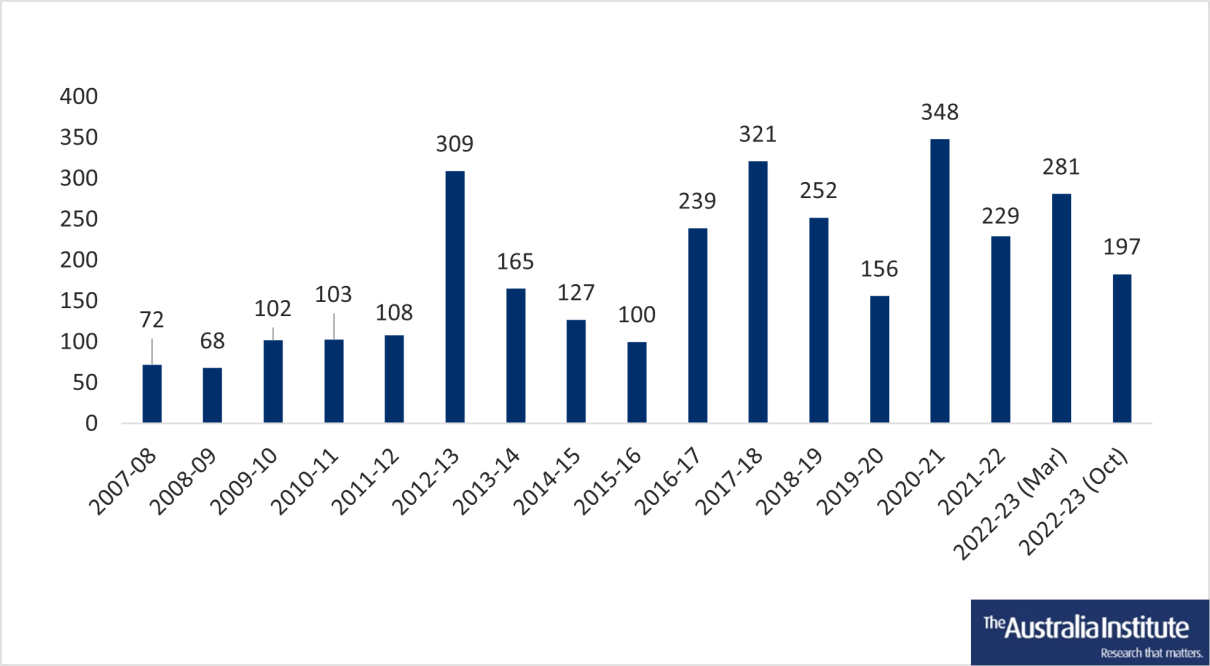
Ayon sa pananaliksik ng Australia Institute: - Ang 2020-21 badyet ay naglaman ng **348 instances** ng "not for publication" sa Budget Paper 2, na lumampas sa nakaraang record na 321 mentions sa 2017-18 badyet [2] - Ang trend ng pagtaas ng secrecy ay totoo: sa mga badyet pagkatapos ng 2008 global financial crisis, mayroong "less than 100 mentions ng 'not for publication'" ngunit ito ay tumaas sa 348 sa 2020-21 [1] - Gayunpaman, ang numerong ito ay bumaba sa 197 mentions sa 2022-23 badyet sa ilalim ng parehong Coalition na pamahalaan [3]
According to the Australia Institute's research: - The 2020-21 budget contained **348 instances** of "not for publication" in Budget Paper 2, surpassing the previous record of 321 mentions in the 2017-18 budget [2] - The trend of increasing secrecy is real: in budgets after the 2008 global financial crisis, there were "less than 100 mentions of 'not for publication'" but this rose to 348 by 2020-21 [1] - However, this number subsequently fell to 197 mentions in the 2022-23 budget under the same Coalition government [3]
### Mga Hidden Expenditure - Mga Tiyak na Halimbawa
### Hidden Expenditures - Specific Examples
**Northern Endeavour Oil Platform:** Ang claim ay tama ang pagkilala sa abandonadong oil platform sa Timor Sea bilang isang halimbawa ng hidden spending [1].
**Northern Endeavour Oil Platform:** The claim correctly identifies the abandoned oil platform in the Timor Sea as an example of hidden spending [1].
Ang ulat ng Australia Institute ay nagdokumento na: - Ang **Northern Endeavour floating production storage and offtake (FPSO) facility** ay abandonado sa Timor Sea, na permanenteng naka-anchor sa pagitan ng Laminaria at Corallina oil fields [1] - Ang platform ay iniwan sa hindi tiyak na estado pagkatapos ng liquidation ng Northern Oil CLAIM_JSON Gas Australia group [1] - Ang pamahalaan ay nakipagkasundo sa Upstream Production Solutions (UPS) para i-secure ang platform at nagbabayad sa Woodside Energy para sa payo sa pamamahala nito [1] - Ang mga gastos sa mga taxpayer ay minarkahan bilang "commercial in confidence" at **hindi inilathala sa mga budget paper** [1] - Sa Abril 2021, ang Northern Endeavour ay nagkakahalaga ng **$86 million** sa mga Australian taxpayer mula noong Pebrero 2020 [4] - Ang mga independent na estimate ay nagmungkahi na ang potensyal na clean-up costs ay maaaring umabot sa **$1 billion** [4][5] **Inland Rail Equity Injection:** Ang claim ay tumutukoy sa "cash handed to a private rail project," na tila tumutukoy sa Inland Rail project [2].
The Australia Institute report documents that: - The **Northern Endeavour floating production storage and offtake (FPSO) facility** is abandoned in the Timor Sea, moored permanently between the Laminaria and Corallina oil fields [1] - The platform was left in uncertain state after Northern Oil & Gas Australia group liquidation [1] - The government struck an agreement with Upstream Production Solutions (UPS) to secure the platform and is paying Woodside Energy for advice on its management [1] - The costs to taxpayers are marked "commercial in confidence" and **not published in budget papers** [1] - By April 2021, the Northern Endeavour had cost Australian taxpayers **$86 million** since February 2020 [4] - Independent estimates suggest potential clean-up costs could reach **$1 billion** [4][5] **Inland Rail Equity Injection:** The claim refers to "cash handed to a private rail project," which appears to reference the Inland Rail project [2].
Ang ebidensya ay nagpapakita: - Ang Australian Rail Track Corporation (ARTC) ay tumanggap ng government equity injection para sa Inland Rail project sa 2020-21 badyet [2] - Ang halaga ng equity injection ay minarkahan bilang "not for publication" sa kabila ng pagiging isang transfer sa isang government-owned corporation [2] - Ang 2020 budget papers ay naglaman ng isang hindi inihayag na equity injection; isang sumunod na anunsyo ay naglilinaw na ito ay **$5.5 billion** [6] - Ang Inland Rail ay isang 1,600-kilometre na daambakal na nagkokonekta sa Melbourne at Brisbane, na ang pinakamalaking imprastrakturang proyekto ng Australia, hindi isang pribadong proyekto ng riles [7] **PFAS Military Base Legal Action:** Ang claim ay tumpak ang pagtukoy sa mga hidden costs na kaugnay ng mga base militar at toxic chemicals [1].
Evidence shows: - The Australian Rail Track Corporation (ARTC) received a government equity injection for the Inland Rail project in the 2020-21 budget [2] - The equity injection amount was marked "not for publication" despite being a transfer to a government-owned corporation [2] - The 2020 budget papers included an undisclosed equity injection; a subsequent announcement clarified this was **$5.5 billion** [6] - Inland Rail is a 1,600-kilometre railway connecting Melbourne and Brisbane, which is Australia's largest infrastructure project, not a private rail project [7] **PFAS Military Base Legal Action:** The claim accurately references hidden costs related to military bases and toxic chemicals [1].
Tiyak: - Ang mga budget papers ay nagtago ng mga gastos na kaugnay sa "the settlement of class actions in Oakey, Williamtown at Katherine over the PFAS toxic firefighting chemical scandals linked to military bases" [1] - Ang PFAS (per- at polyfluoroalkyl substances) ay mga widely-used na firefighting chemicals na natagpuan sa mga Australian military bases na ito [8] - Ang mga kasunduang ito ay kaugnay ng mga seryosong polusyon sa kapaligiran at kalusugan [1]
Specifically: - The budget papers hid costs associated with "the settlement of class actions in Oakey, Williamtown and Katherine over the PFAS toxic firefighting chemical scandals linked to military bases" [1] - PFAS (per- and polyfluoroalkyl substances) are widely-used firefighting chemicals found at these Australian military bases [8] - These settlements relate to serious environmental and health contamination [1]

Nawawalang Konteksto

### Mahalagang Konteksto Tungkol sa Budget Secrecy
### Important Context About Budget Secrecy
**1.
**1.
Mga Lehitimong Dahilan para sa Non-Publication:** Inamin ng Australia Institute na "may mga lehitimong dahilan para sa pagpapanatili ng ilang budget measures bilang confidential" [2].
Legitimate Reasons for Non-Publication:** The Australia Institute acknowledges that "there are legitimate reasons for keeping some budget measures confidential" [2].
Ang mga item na minarkahan bilang "nfp" ay maaaring maging confidential dahil sila ay: - Nasa ilalim pa rin ng negosasyon sa ibang partido (hal. state governments) - Commercially sensitive - Nakaklassify para sa mga kadahilanang pambansa seguridad [1][2] **2.
Items marked "nfp" can be confidential because they are: - Still under negotiation with other parties (e.g., state governments) - Commercially sensitive - Classified for national security reasons [1][2] **2.
Hindi Kakaiba sa Coalition - Mas Mahabang Historical Trend:** - Ang kasanayan ng pagtatago ng mga item sa badyet ay significantly na predates ang Coalition government - Ang mga budget papers pagkatapos ng 2008 global financial crisis ay mayroong "less than 100 mentions" ng nfp, ngunit ito ay lumaki sa 348 sa 2020-21 [1] - Nagmungkahi ito na ang budget secrecy ay tumaas sa ilalim ng maraming pamahalaan sa loob ng 12+ na taon [2] - Ang problema ay structural at cross-partisan, hindi kakaiba sa Coalition [1] **3.
Not Unique to Coalition - Longer Historical Trend:** - The practice of hiding budget items predates the Coalition government significantly - Budget papers after the 2008 global financial crisis had "less than 100 mentions" of nfp, but this had grown to 348 by 2020-21 [1] - This suggests budget secrecy increased under multiple governments over a 12+ year period [2] - The problem is structural and cross-partisan, not unique to the Coalition [1] **3.
Subseqüent na Labor Government Transparency:** - Ang secret spending ay **bumaba mula sa Morrison-era peak** sa ilalim ng Labor, na ang 2022-23 badyet ay nagpapakita lamang ng 197 nfp mentions [3] - Gayunpaman, ang kontradiktoryong data ay nagpapakita na ang Albanese Labor government ay naging **mas masahol pa kaysa sa Morrison era** sa Freedom of Information (FoI) transparency, na ang fully granted na mga FoI request ay bumagsak mula 59% (2011-12) sa halos 25% (2023-24), habang ang mga pagtanggi ay halos nagdoble sa 23% [9] **4.
Subsequent Labor Government Transparency:** - Secret spending **fell from the Morrison-era peak** under Labor, with the 2022-23 budget showing only 197 nfp mentions [3] - However, contradictory data shows the Albanese Labor government has become **worse than the Morrison era** in Freedom of Information (FoI) transparency, with fully granted FoI requests plunging from 59% (2011-12) to just 25% (2023-24), while refusals nearly doubled to 23% [9] **4.
Konteksto ng Rail Project:** Ang claim ay tumutukoy sa Inland Rail bilang isang "private rail project" na tumatanggap ng "cash," ngunit ito ay mapanlinlang [6]: - Ang Inland Rail ay pagmamay-ari ng pamahalaan (ang ARTC ay isang government-owned corporation) - Ang proyekto, sa kabila ng pagiging kontrobersyal, ay sinuportahan ng Nationals (Coalition partner) at isang malaking imprastrakturang pamumuhunan, hindi corporate welfare [6][7] - Ang mga parliamentary committee ay nagpuna sa pamamahala ng proyekto at cost blow-outs ($31.4 billion), ngunit ang pangunahing paglalarawan bilang isang "private" na proyekto ay hindi tumpak [6] **5.
Rail Project Context:** The claim refers to Inland Rail as a "private rail project" receiving "cash," but this is misleading [6]: - Inland Rail is government-owned (ARTC is a government-owned corporation) - The project, while controversial, was championed by the Nationals (Coalition partner) and is a major infrastructure investment, not corporate welfare [6][7] - Parliamentary committees have criticized the project's management and cost blow-outs ($31.4 billion), but the basic characterization as a "private" project is inaccurate [6] **5.
Konteksto ng Oil Platform:** Ang sitwasyon ng Northern Endeavour ay sumasalamin: - Sa isang lehitimong private sector failure (liquidation ng Northern Oil CLAIM_JSON Gas Australia) na iniwan sa pamahalaan ang isang minanang pananagutan [1][4] - Ang platform ay hindi "abandoned" ng pamahalaan ngunit ay defunct na bago ang interbensyon ng pamahalaan [1][4] - Ang urgency sa kapaligiran at kaligtasan ay nangailangan ng aksyon ng pamahalaan upang maiwasan ang mas masahol na mga resulta [1] - Ang mga mataas na gastos ay sumasalamin sa totoong complexity ng decommissioning sa offshore na kapaligiran, hindi palaging maling pamamahala [4]
Oil Platform Context:** The Northern Endeavour situation reflects: - A genuine private sector failure (Northern Oil & Gas Australia liquidation) that left the government with an inherited liability [1][4] - The platform was not "abandoned" by the government but was already defunct before government intervention [1][4] - Environmental and safety urgency required government action to prevent worse outcomes [1] - The high costs reflect genuine decommissioning complexity in offshore environments, not necessarily mismanagement [4]

Pagsusuri ng Kredibilidad ng Pinagmulan

**Mga Orihinal na Pinagkunan:** **The Guardian** (Australian edition) [1]: - Mainstream, reputable na news organization na may established na fact-checking processes - Bahagi ng coverage ng Guardian sa Australian politics at policy - Nag-uulat sa Australia Institute analysis na may angkop na attribution - Walang halatang partisan bias sa budget secrecy reporting (ito ay factual analysis) **Australia Institute** (pinagmulan ng pananaliksik) [2]: - Independent na public policy research organization - Pinamumunuan ni Rod Campbell, isang economist na may published research at testimony sa mga malaking kaso sa korte - Ang Australia Institute ay naglathala ng left-leaning policy analysis at minsan ay inilarawan bilang mayroong progressive political orientation - Gayunpaman, ang budget secrecy analysis mismo ay isang **factual count** ng mga "nfp" item sa mga opisyal na budget papers - ang data ay objective at verifiable - Ang interpretasyon ng Institute ay nagdiriin sa mga alalahanin tungkol sa transparency at democratic accountability, na sumasalamin sa kanilang perspektibo, ngunit ang nasasaligan na data ay tumpak **Pagsusuri:** Ang Australia Institute ay may mga kilalang political leanings (progressive/left), na humuhubog sa policy interpretation ngunit hindi nakakaapekto sa accuracy ng factual count ng nfp mentions sa mga dokumento ng badyet.
**Original Sources:** **The Guardian** (Australian edition) [1]: - Mainstream, reputable news organization with established fact-checking processes - Part of The Guardian's coverage of Australian politics and policy - Reports on the Australia Institute analysis with appropriate attribution - No apparent partisan bias in the budget secrecy reporting (this is factual analysis) **Australia Institute** (original research source) [2]: - Independent public policy research organization - Led by Rod Campbell, an economist with published research and testimony in major court cases - The Australia Institute publishes left-leaning policy analysis and is sometimes characterized as having a progressive political orientation - However, the budget secrecy analysis itself is a **factual count** of "nfp" items in official budget papers - the data is objective and verifiable - The Institute's interpretation emphasizes concerns about transparency and democratic accountability, which reflects their perspective, but the underlying data is accurate **Assessment:** The Australia Institute has identifiable political leanings (progressive/left), which shapes policy interpretation but does not affect the accuracy of the factual count of nfp mentions in budget documents.
Ang nasasaligan na data (348 mentions sa 2020-21, tumataas mula sa mas mababang numero) ay independently verifiable sa pamamagitan ng pagsusuri sa mga opisyal na budget papers mismo.
The underlying data (348 mentions in 2020-21, rising from lower numbers) is independently verifiable by reviewing the official budget papers themselves.
⚖️

Paghahambing sa Labor

**KRITIKAL NA PAGKAKATUKLAS: Ang budget secrecy ay HINDI kakaiba sa Coalition**
**CRITICAL FINDING: Budget secrecy is NOT unique to the Coalition**
### Labor Government Record sa Transparency
### Labor Government Record on Transparency
**Rudd-Gillard Period (2007-2010):** - Ang ulat ng Australia Institute ay nagpapakita na ang trend patungo sa pagtaas ng mga nfp mentions ay nagsimula nang matagal bago ang 2013 na pagbabalik ng Coalition sa pamahalaan - Ang mga badyet pagkatapos ng 2008 GFC ay mayroong "less than 100 mentions," na nagtatatag sa baseline - Walang ebidensya na natagpuan na ang Labor government ay naghangad ng mas mababang transparency sa panahon ng kanilang paglilingkod **Labor sa ilalim ni Albanese (2022-kasalukuyan):** - Tulad ng nabanggit sa itaas, habang ang mga badyet "not for publication" item ay **bumaba** mula 348 sa 197 [3] - **Gayunpaman**, ang Freedom of Information transparency ay aktwal na **lumala** sa ilalim ng Labor kumpara sa Morrison era [9] - Ang mga FoI grant ay bumaba mula 59% sa 25%, na nagmumungkahi na ang Labor ay maaaring magtago ng impormasyon sa pamamagitan ng iba't ibang mga mekanismo [9]
**Rudd-Gillard Period (2007-2010):** - The Australia Institute report shows the trend toward increased nfp mentions began well before the Coalition's 2013 return to government - Post-2008 GFC budgets had "less than 100 mentions," establishing the baseline - No evidence found of Labor government pursuing less transparency during their tenure **Labor under Albanese (2022-present):** - As noted above, while budget "not for publication" items **decreased** from 348 to 197 [3] - **However**, Freedom of Information transparency actually **deteriorated** under Labor compared to Morrison era [9] - FoI grants fell from 59% to 25%, suggesting Labor may hide information through different mechanisms [9]
### Precedent para sa mga Kontrobersyal na Gastos:
### Precedent for Controversial Spending:
Ang mga Labor government ay naharap din sa puna para sa mga nakatago o kontrobersyal na gastos: - **Pink Batts Program** (2009-2010): Malawakang mga cost overruns, mga isyu sa kaligtasan, at kakulangan sa transparency na humantong sa mga audit at imbestigasyon - **School Halls Program** (2008-2012): Significantly na lumampas sa badyet ($16.2 billion vs. budgeted $14.3 billion) na may mga isyu sa transparency - Ang mga programang ito ay nagpapakita na ang parehong mga partido ay nakibahagi sa mga malalaking government spending na may mga isyu sa pamamahala at transparency **Konklusyon sa Pagkukumpara:** Ang isyu ng budget secrecy ay isang **systemic problem sa mga Australian government**, hindi kakaiba sa Coalition.
Labor governments have also faced criticism for hidden or controversial expenditures: - **Pink Batts Program** (2009-2010): Widespread cost overruns, safety issues, and lack of transparency led to audits and investigations - **School Halls Program** (2008-2012): Significantly exceeded budget ($16.2 billion vs. budgeted $14.3 billion) with transparency issues - These programs show both parties have engaged in significant government spending with management and transparency issues **Conclusion on Comparison:** The issue of budget secrecy is a **systemic problem across Australian governments**, not unique to the Coalition.
Ang parehong mga partido ay nakibahagi sa pagbabawas ng transparency, sa kabila ng iba't ibang mga mekanismo at sa iba't ibang scale.
Both parties have participated in reducing transparency, though through different mechanisms and at different scales.
Ang 348 nfp mentions ng Coalition ay nakakaalarma, ngunit ang long-term na trend ay nagpapakita na ang mga pamahalaan ay pangkalahatang gumagalaw patungo sa mas mababang transparency sa nakalipas na 15+ na taon.
The Coalition's 348 nfp mentions is alarming, but the long-term trend shows governments generally moving toward less transparency over the past 15+ years.
🌐

Balanseng Pananaw

### Kung Ano ang Tama sa Claim
### What the Claim Gets Right
1.
1.
Ang 2020-21 badyet **ay talagang ang pinakasekreto sa record** na may 348 nfp mentions, na sinira ang nakaraang record na 321 [1][2] 2.
The 2020-21 budget **was indeed the most secretive on record** with 348 nfp mentions, breaking the previous record of 321 [1][2] 2.
Ang **mga gastos sa Northern Endeavour platform ay talagang itinago** mula sa mga taxpayer at nananatiling nakaklassify bilang "commercial in confidence" [1][2] 3.
The **Northern Endeavour platform costs genuinely were hidden** from taxpayers and remain classified as "commercial in confidence" [1][2] 3. **PFAS military base settlement costs were hidden** with legitimate legal and commercial reasons, but the secrecy prevented public understanding of the environmental/health crisis [1] 4. **Inland Rail equity injection amount was initially hidden**, though it was subsequently disclosed as $5.5 billion [6]
Ang **mga gastos sa kasunduan ng PFAS military base ay itinago** na may lehitimong legal at commercial na mga dahilan, ngunit ang secrecy ay nagpigil sa pampublikong pag-unawa sa krisis sa kapaligiran/kalusugan [1] 4.
### What the Claim Obscures or Misrepresents
Ang **Inland Rail equity injection amount ay unang itinago**, sa kabila nito ay nailantad pagkatapos bilang $5.5 billion [6]
1. **"Private rail project"** - Inland Rail is government-owned (ARTC), not private [6][7].
### Kung Ano ang Nakaobscure o Mali sa Claim
This is a misleading characterization 2. **Unique to Coalition** - Budget secrecy has been increasing across governments for 12+ years, with legitimate institutional and negotiation reasons [1][2] 3. **Moral culpability** - The hidden items include: - Oil platform: inherited liability from corporate failure, requiring environmental action [1][4] - Rail project: legitimate infrastructure investment (though controversial in execution) - Legal settlements: appropriately confidential due to settlement agreements [1] 4. **Government capability** - The budget secrecy reflects: - Complex modern government with many commercial negotiations - Legitimate security and confidentiality requirements - Some genuine lack of transparency (fair criticism), but not all items warrant publication
1. **"Pribadong proyekto ng riles"** - Ang Inland Rail ay pagmamay-ari ng pamahalaan (ARTC), hindi pribado [6][7].
### Government's Perspective
Ito ay isang mapanlinlang na paglalarawan 2. **Kakaiba sa Coalition** - Ang budget secrecy ay nagtaas sa mga pamahalaan sa loob ng 12+ na taon, na may lehitimong institutional at negotiation na mga dahilan [1][2] 3. **Moral na pananagutan** - Ang mga nakatagong item ay kabilang: - Oil platform: minanang pananagutan mula sa corporate failure, na nangangailangan ng aksyon sa kapaligiran [1][4] - Rail project: lehitimong imprastrakturang pamumuhunan (sa kabila ng pagiging kontrobersyal sa pagpapatupad) - Legal settlements: angkop na confidential dahil sa mga kasunduan sa settlement [1] 4. **Kakayahang ng pamahalaan** - Ang budget secrecy ay sumasalamin: - Komplikadong modernong pamahalaan na may maraming commercial na negosasyon - Mga lehitimong security at confidentiality requirements - Ilan sa mga tunay na kakulangan sa transparency (makatarungang puna), ngunit hindi lahat ng item ay karapat-dapat sa paglathala
The Coalition government's rationale for secrecy included: - Many items still "under negotiation" (legitimate reason for temporary confidentiality) - Commercial-in-confidence provisions necessary for EFIC, rail projects, and platform management - National security considerations for some measures - Settlement confidentiality requirements in legal disputes [1][2] **However**, critics legitimately argue: - The **trend** toward increasing secrecy is concerning and undermines democratic accountability [1] - Some commercially-sensitive items (e.g., rail project equity injection amount) could be disclosed after negotiations complete - **Environmental costs** (Northern Endeavour) are matters of significant public interest that justify disclosure despite commercial sensitivity [1]
### Perspektibo ng Pamahalaan
### Expert Assessment
Ang pangangatwiran ng Coalition government para sa secrecy ay kabilang: - Maraming item ay "under negotiation" pa rin (lehitimong dahilan para sa pansamantalang confidentiality) - Ang mga commercial-in-confidence provision ay kailangan para sa EFEC, mga proyekto ng riles, at pamamahala ng platform - Mga pambansang seguridad na pagsasaalang-alang para sa ilang mga hakbang - Mga requirement ng confidentiality ng settlement sa mga legal na hidwaan [1][2] **Gayunpaman**, ang mga kritiko ay makatarungang nagmungkahi: - Ang **trend** patungo sa pagtaas ng secrecy ay nakakaalarma at sumisira sa democratic accountability [1] - Ang ilang commercially-sensitive na item (hal. rail project equity injection amount) ay maaaring mailantad pagkatapos makumpleto ang mga negosasyon - Ang **mga gastos sa kapaligiran** (Northern Endeavour) ay mga bagay ng makabuluhang pampublikong interes na karapat-dapat sa paglalantad sa kabila ng commercial sensitivity [1]
The Australia Institute's critique - that transparency is being systematically reduced - has merit [1][2].
### Pagsusuri ng Eksperto
The organization's acknowledgment that "there may be legitimate reasons for keeping some budget measures confidential" while criticizing the overall trend is a balanced assessment [2].
Ang puna ng Australia Institute - na ang transparency ay sistematikong binabawasan - ay may meryt [1][2].
Ang pagkilala ng organisasyon na "maaaring may mga lehitimong dahilan para sa pagpapanatili ng ilang budget measures bilang confidential" habang tumututol sa pangkalahatang trend ay isang balanseng pagtatasa [2].

BAHAGYANG TOTOO

6.0

sa 10

**Pangangatwiran:** Ang claim ay factual na tumpak na: - Ang 2020-21 badyet ay ang pinakasekreto sa record na may record-breaking na nakatagong gastos [1] - Ang tatlong tiyak na halimbawa (oil platform, rail funding, military base legal costs) ay talagang itinago [1][2] **Gayunpaman**, ang claim ay makabuluhang kulang sa konteksto sa pamamagitan ng: 1.
**Justification:** The claim is factually accurate that: - The 2020-21 budget was the most secretive on record with record-breaking hidden expenses [1] - The three specific examples (oil platform, rail funding, military base legal costs) were indeed hidden [1][2] **However**, the claim significantly lacks context by: 1.
Pagmumungkahi na ito ay kakaiba sa Coalition samantalang ang budget secrecy ay nagtaas sa mga pamahalaan sa loob ng 12+ na taon [1][2] 2.
Suggesting this is unique to the Coalition when budget secrecy has been increasing across governments for 12+ years [1][2] 2.
Maling paglalarawan sa Inland Rail bilang isang "private" na proyekto samantalang ito ay pagmamay-ari ng pamahalaan [6][7] 3.
Mischaracterizing Inland Rail as a "private" project when it's government-owned [6][7] 3.
Hindi pagkilala sa pagitan ng mga lehitimong confidentiality na mga dahilan (ongoing negotiations, settlement agreements) at hindi angkop na secrecy 4.
Not distinguishing between legitimate confidentiality reasons (ongoing negotiations, settlement agreements) and inappropriate secrecy 4.
Hindi pagbanggit na ang Labor ay bumaba ang mga nfp mentions (sa kabila nito, sa pamamagitan ng mga FoI mechanism, ang transparency ay hindi umunlad) [3][9] Ang nasasaligang alalahanin tungkol sa erosion ng budget transparency ay wasto at mahalaga, ngunit ang paghahabi ng claim ay nagmumungkahi na ito ay isang Coalition-specific na problema sa halip na isang systemic na isyu na nakakaapekto sa maraming pamahalaan.
Not noting that Labor subsequently reduced nfp mentions (though through FoI mechanisms, transparency hasn't improved) [3][9] The underlying concern about erosion of budget transparency is valid and important, but the claim's framing suggests this is a Coalition-specific problem rather than a systemic issue affecting multiple governments.

📚 MGA PINAGMULAN AT SANGGUNIAN (9)

  1. 1
    Australian federal budget found to be the most secretive ever produced - The Guardian (October 9, 2020)

    Australian federal budget found to be the most secretive ever produced - The Guardian (October 9, 2020)

    Australia Institute analysis finds the term ‘not for publication’ or ‘nfp’ appears 384 times in the budget

    the Guardian
  2. 2
    Not For Publication: declining transparency in the federal budget - The Australia Institute (October 2020)

    Not For Publication: declining transparency in the federal budget - The Australia Institute (October 2020)

    Budgets are a key part of Australia’s democratic system, with budget papers giving the public a valuable opportunity to see how much money is spent and on

    The Australia Institute
  3. 3
    Not for publication: Secret spending in the Budget - The Australia Institute (2023)

    Not for publication: Secret spending in the Budget - The Australia Institute (2023)

    Secret spending in the Budget has fallen from a Morrison-era peak, but the long-term trend towards concealment should concern Australians who care about transparency.

    The Australia Institute
  4. 4
    Northern Endeavour oil platform clean-up could cost taxpayers $1 billion - ABC News (April 14, 2021)

    Northern Endeavour oil platform clean-up could cost taxpayers $1 billion - ABC News (April 14, 2021)

    The vessel in the Timor Sea has already cost Australian taxpayers $86 million but Senator Rex Patrick fears we're nowhere near the bottom of the money pit.

    Abc Net
  5. 5
    Spraying cash around: Northern Endeavour decommissioning head for $1 billion - Baird Maritime

    Spraying cash around: Northern Endeavour decommissioning head for $1 billion - Baird Maritime

    This week, we look at the two cases where cash is being splashed, and one where splashing cash has been declared illegal, plus news that a prominent celebrity h

    Baird Maritime / Work Boat World
  6. 6
    Inland Rail enhancements funded through $5.5bn equity injection - Rail Express (2020)

    Inland Rail enhancements funded through $5.5bn equity injection - Rail Express (2020)

    The federal government has confirmed that enhancements to Inland Rail will be funded through a $5.5 billion equity injection into the ARTC.

    Rail Express
  7. 7
    Inland Rail - Wikipedia

    Inland Rail - Wikipedia

    Wikipedia
  8. 8
    PFAS contamination at Australian military bases - The Guardian/Environmental reporting

    PFAS contamination at Australian military bases - The Guardian/Environmental reporting

    Latest news, sport, business, comment, analysis and reviews from the Guardian, the world's leading liberal voice

    Theguardian
  9. 9
    Albanese government worse than Morrison era at producing documents - Centre for Public Integrity (July 2025)

    Albanese government worse than Morrison era at producing documents - Centre for Public Integrity (July 2025)

    The alarming deterioration in transparency is deeply troubling.” – Geoffrey Watson, Centre for Public Integrity

    The Centre for Public Integrity

Pamamaraan ng Rating Scale

1-3: MALI

Hindi tama sa katotohanan o malisyosong gawa-gawa.

4-6: BAHAGYA

May katotohanan ngunit kulang o baluktot ang konteksto.

7-9: HALOS TOTOO

Maliit na teknikal na detalye o isyu sa pagkakasulat.

10: TUMPAK

Perpektong na-verify at patas ayon sa konteksto.

Pamamaraan: Ang mga rating ay tinutukoy sa pamamagitan ng cross-referencing ng opisyal na mga rekord ng pamahalaan, independiyenteng mga organisasyong nag-fact-check, at mga primaryang dokumento.