Bahagyang Totoo

Rating: 6.0/10

Labor
6.2

Ang Claim

“$20 bilyong tulong sa utang ng estudyante sa pamamagitan ng pag-aayos sa indexation at 20% na pagbawas sa utang para sa mahigit 3 milyong Australian”
Orihinal na Pinagmulan: Albosteezy

Orihinal na Pinagmulan

FACTUAL NA BERIPIKASYON

Ang patakaran ng gobyernong Australian Labor para sa tulong sa utang ng estudyante ay binubuo ng dalawang magkakaibang bahagi na nagkakaloob ng humigit-kumulang $20 bilyon sa kabuuang tulong [1].
The Australian Labor government's student debt relief policy comprises two distinct components that combine to reach approximately $20 billion in total relief [1].
Ang $20 bilyong halaga ay nahahati sa mga sumusunod: isang beses na 20% direktang pagbawas sa utang na humigit-kumulang $16 bilyon, kasama ang mga nakaraang reporma sa indexation na nagkakahalaga ng humigit-kumulang $3 bilyon [1].
The $20 billion figure breaks down as follows: a one-off 20% direct debt cut of approximately $16 billion, combined with prior indexation reforms worth approximately $3 billion [1].
Tinataya ng gobyerno na mahigit 3 milyong Australian ang makikinabang sa mga hakbang na ito [2].
The government estimates that more than 3 million Australians will benefit from these measures [2].
Sa huling bahagi ng Nobyembre 2024, nagsimulang magproseso ang Australian Taxation Office (ATO) ng mga pagbawas sa utang, na may mga notipikasyong inilabas sa mga wave—humigit-kumulang 100,000 Australian sa simula, sinundan ng 1.5 milyon sa susunod na linggo [3].
In late November 2024, the Australian Taxation Office (ATO) began processing the debt reductions, with notifications rolling out in waves—approximately 100,000 Australians initially, followed by 1.5 million the following week [3].
Ang bahagi ng indexation cap ay téknikal na tama.
The indexation cap component is factually accurate.
Noong 2023, ang mataas na implasyon ay nagtulak sa indexation na umabot sa 7.1% (ang pinakamataas na rate simula 1990) [4].
In 2023, high inflation pushed indexation to 7.1% (the highest rate since 1990) [4].
Nagpatupad ang gobyerno ng mga cap sa rate na ito, na nagpapahintulot sa mas mababa sa Consumer Price Index (CPI) o Wage Price Index (WPI) na mailapat—na pinaliit ang pagtaas noong 2023 mula 7.1% patungong 3.2% [4].
The government implemented caps on this rate, allowing the lower of Consumer Price Index (CPI) or Wage Price Index (WPI) to apply—reducing the 2023 increase from 7.1% to 3.2% [4].
Ang indexation rate noong 2024 ay gayundin na-cap mula 4.7% patungong 4.0% [4].
The 2024 indexation rate was similarly capped from 4.7% to 4.0% [4].
Ang mga pagbabagong ito ay ibinalik sa 1 Hunyo 2023, at ang mga kredito ay awtomatikong inilapat ng ATO [4].
These changes were backdated to 1 June 2023, and credits were applied automatically by the ATO [4].

Nawawalang Konteksto

Gayunpaman, ang pagpahayag ay hindi naglalaman ng kritikal na konteksto na makabuluhang nagbabago sa pag-unawa sa halaga ng tulong.
However, the claim omits critical context that substantially alters the perception of the relief amount.
Bagama't inihahain ng gobyerno ang "20% na pagbawas sa utang," ang epektibong tulong para sa mga kasalukuyang may hawak ng utang ay makabuluhang mas mababa kapag isinasaalang-alang ang mga pagtaas ng indexation na naipon mula 2022 hanggang sa oras ng pagpahayag ng patakaran.
While the government presents a "20% debt cut," the effective relief for existing debt holders is substantially lower when accounting for indexation increases that accumulated between 2022 and the time of the policy announcement.
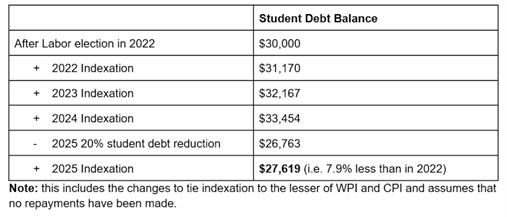
Natuklasan ng pananaliksik na isinagawa ng parliamentary party ng Greens na kapag isinasaalang-alang ang mga pagbabago sa indexation simula 2022, ang epektibong tulong ay 7.9% lamang, hindi 20% [5].
Research conducted by the Greens parliamentary party found that when accounting for indexation changes since 2022, the effective relief is only 7.9%, not 20% [5].
Nagpapakita ang isang tiyak na halimbawa nito: ang isang estudyante na may $30,000 na utang noong 2022, pagkatapos makaranas ng mga kumulatibong pagtaas ng indexation hanggang kalagitnaan ng 2024, ay magkakaroon ng $37,619 na utang.
A specific example illustrates this: a student with $30,000 in debt in 2022, after experiencing cumulative indexation increases through mid-2024, would have $37,619 in debt.
Pagkatapos mailapat ang 20% na pagbawas, ang utang na iyon ay magiging $30,095—mas mababa lamang ng $4,905 mula sa punto noong 2022, o 7.9% lamang na tulong [5].
After the 20% cut is applied, that debt becomes $30,095—just $4,905 below the 2022 starting point, or only 7.9% relief [5].
Ang patakaran ay hindi rin mabisa na naka-target upang tugunan ang mga kasalukuyang o hinaharap na presyon sa utang ng estudyante.
The policy is also not well-targeted to address current or future student debt pressures.
Ang hakbang ay nalalapat lamang sa mga kasalukuyang utang ng HELP mula 1 Hunyo 2025 [6].
The measure applies only to existing HELP debts as of 1 June 2025 [6].
Ang mga estudyanteng kasalukuyang naka-enroll o mga hinaharap na batch ay walang natatanggap na istruktural na reporma sa saligang sistema na lumilikha ng kanilang utang [6].
Students currently enrolled or future cohorts receive no structural reform to the underlying system that generates their debt [6].
Ang mga estudyante ng sining, halimbawa, ay sinabihang umasa ng pagbaba sa bayarin sa kalaunang batas, ngunit walang ibinigay na timeline [6].
Arts students, for example, were told to expect fee reductions in later legislation, but no timeline was provided [6].
Higit pa, ang pagpahayag tungkol sa "tulong" ay nagkukubli ng isang mahalagang limitasyon: ang $67,000 na minimum na threshold ng kita para sa pagbabayad ng utang sa HELP ay nangangahulugang maraming gradweyt ang magdala ng permanenteng utang sa estudyante na hindi kailanman mababayaran [7].
Furthermore, the claim about "relief" masks an important limitation: the $67,000 minimum income threshold for HELP loan repayment means many graduates will carry permanent student debt that never gets paid down [7].
Natuklasan ng pananaliksik mula sa University of the Sunshine Coast na ang mga gradweyt ng sining na may katamtamang sweldo ay mahihirapang magbayad ng prinsipal, na lumilikha ng tinatawag ng mga mananaliksik na "debt treadmill" [7].
Research from the University of the Sunshine Coast found that arts graduates earning modest salaries will struggle to make principal repayments, creating what researchers term a "debt treadmill" [7].

💭 KRITIKAL NA PANANAW

Ang patakaran ay kumakatawan sa isang halo-halong tagumpay.
The policy represents a mixed achievement.
Sa isang banda, nagpapakita ito ng pangako ng gobyerno na tugunan ang utang ng estudyante, at ang mga mekaniko ng indexation caps at pagbawas sa utang ay ayon sa pagpahayag [1][4].
On one hand, it demonstrates the government's commitment to addressing student debt, and the mechanics of the indexation caps and debt reduction are factually as claimed [1][4].
Sa kabilang banda, inihayag ng ilang kritikal na pagsusuri na ang patakaran ay mas makitid at mas kaunting epekto kaysa sa iminumungkahing headline figure.
On the other hand, several critical analyses reveal the policy is narrower and less impactful than the headline figure suggests.
Ang $20 bilyong pigura ng tulong, bagama't tama sa mga termino ng accounting, ay gumagana bilang tinatawag ng mga mananaliksik na "regressivity" na isyu: inililipat nito ang kayamanan mula sa mas malawak na mga nagbabayad ng buwis (karamihan sa kanila ay hindi pumasok sa unibersidad) patungo sa mga degree holder, na karaniwang kumikita ng makabuluhang higit sa kanilang buong buhay kaysa sa mga hindi gradweyt [7].
The $20 billion relief figure, while accurate in accounting terms, functions as what researchers call a "regressivity" issue: it transfers wealth from broader taxpayers (many of whom didn't attend university) to degree holders, who typically earn significantly more over their lifetimes than non-graduates [7].
Sa pamamaraang ito, ang patakaran ay baliktad na redistribusyon—mula sa mas mababang kita na hindi pumasok sa unibersidad patungo sa mas mataas na kikitain na mga gradweyt [7].
By this logic, the policy is upside-down redistribution—from lower-income non-university attendees to higher-earning graduates [7].
Napansin ng mga ekonomista na ang patakaran ay nabigong tugunan ang mga istruktural na nagtutulak sa utang ng estudyante [7].
Economists have noted that the policy fails to address the structural drivers of student debt [7].
Sa mga degree sa Sining na nagkakahalaga ngayon ng $17,399+ taun-taon sa ilalim ng mga nakaraang reporma ng gobyerno, ang mga hinaharap na gradweyt ay mag-iipon ng mga katulad na malalaking utang [6].
With Arts degrees now costing $17,399+ annually under the government's previous reforms, future graduates will accumulate similarly substantial debts [6].
Walang nagagawa ang patakaran para sa mga hinaharap na batch na ito; ito ay tahasang isang beses na hakbang para sa mga kasalukuyang may utang [6].
The policy does nothing for these future cohorts; it is explicitly a one-off measure for existing debtors [6].
Isang mas malalim na problema na natuklasan ng mga akademiko ay ang "debt treadmill" para sa mga mas mababang kikitain na gradweyt [7].
A deeper problem identified by academics is the "debt treadmill" for lower-earning graduates [7].
Naglathala ang The Conversation ng pagsusuri na nagsasabing sa $67,000 na minimum na threshold ng pagbabayad, maraming gradweyt—lalo na sa mga larangan ng humanities na may mas katamtamang kita sa buong buhay—ay hindi kailanman kikita ng sapat upang mag-trigger ng makabuluhang pagbabayad, na nag-iiwan sa kanila ng permanente sa di-nagbabawas na utang sa estudyante [7].
The Conversation published analysis noting that with the $67,000 minimum repayment threshold, many graduates—particularly in humanities fields with more modest lifetime earnings—will never earn enough to trigger significant repayments, leaving them perpetually with non-declining student debt [7].
Ito ay kumakatawan sa isang anyo ng pangmatagalang bitag ng kahirapan na nakabihis bilang pag-access sa edukasyon.
This represents a form of long-term poverty trap disguised as educational access.
Kumpara sa istruktural na katulad na mga patakaran sa ibang bansang OECD, ang pamamaraan ng Australia ay kapansin-pansing hindi kumpleto.
Compared to structurally similar policies in other OECD countries, Australia's approach is notably incomplete.
Ang Germany, halimbawa, ay lubos na inalis ang utang ng estudyante para sa mga hinaharap na estudyante sa pamamagitan ng patakaran ng libreng unibersidad [8].
Germany, for example, eliminated student debt entirely for prospective students through free university policy [8].
Nagpakilala ang UK ng mga kwalipikasyong teknikal na walang bayad [8].
The UK introduced fee-free technical qualifications [8].
Ang pamamaraan ng Australia—isang beses na tulong nang walang istruktural na reporma—ay tumutugon sa mga sintomas sa halip na sa mga sanhi [8].
Australia's approach—one-off relief without structural reform—addresses symptoms rather than causes [8].
Ang pagpapatupad ng patakaran ay maayos mula sa pananaw ng administrasyon: ang ATO ay maayos na nagproseso ng mga pagbawas, na may awtomatikong aplikasyon na hindi nangangailangan ng aksyon mula sa mga indibidwal [3].
The policy implementation has been smooth from an administrative perspective: the ATO has processed reductions efficiently, with automatic application requiring no action from individuals [3].
Gayunpaman, ang tagumpay na ito sa operasyon ay nagkukubli sa limitadong totoong epekto ng patakaran para sa mga nahihirapan sa utang ng estudyante.
However, this operational success masks the policy's limited real-world impact for those struggling with student debt.

BAHAGYANG TOTOO

6.0

sa 10

Ang mga factual na sangkap (mga halaga ng dolyar, bilang ng mga benepisyaryo, mekanismo ng indexation) ay tama, ngunit ang patakaran ay kumakatawan sa makabuluhang mas kaunting tulong kaysa sa 20% na pigura na iminumungkahi kapag isinasaalang-alang ang mga naunang pagtaas ng indexation, at nabigo itong tugunan ang mga istruktural na salik ng hinaharap na utang ng estudyante.
The factual components (dollar amounts, beneficiary numbers, indexation mechanics) are accurate, but the policy represents substantially less relief than the 20% figure suggests when accounting for prior indexation increases, and it fails to address structural drivers of future student debt.

📚 MGA PINAGMULAN AT SANGGUNIAN (8)

  1. 1
    ministers.education.gov.au

    More than three million Australians about to receive 20 per cent student debt cut

    Ministers Education Gov

  2. 2
    pm.gov.au

    More than three million Australians about to receive 20 per cent student debt cut

    More than 3 million Australians will have their student debt cut by 20 per cent by the end of next week, wiping almost $16 billion in total.Today alone, more than 1.5 million Australians will see their student debts cut by 20 per cent. That’s around half of all people with a student debt.It continues the ATO’s roll out of the Albanese Labor Government’s cut to student debt.For someone with the average HELP debt of $27,600 this will see around $5,520 wiped from their debt.

    Prime Minister of Australia
  3. 3
    au.finance.yahoo.com

    Date that millions of Aussies will receive HECS debt relief revealed: 'Will get a text message'

    Au Finance Yahoo

  4. 4
    ministers.education.gov.au

    Legislation passes to wipe $3 billion of student debt for 3 million Australians

    Ministers Education Gov

  5. 5
    Labor's student debt reduction amounts to only 7.9%

    Labor's student debt reduction amounts to only 7.9%

    Analysis conducted by the Parliamentary Library shows that Labor’s much-touted 20% student-debt cut collapses to a mere 7.9% once indexation since their election in 2022 is accounted for.

    The Australian Greens
  6. 6
    Labor has promised fast action to cut student debt, but there's a catch

    Labor has promised fast action to cut student debt, but there's a catch

    If you’re among the three million Australians with a HECS-HELP debt, it’s about to be cut by 20%, with no repayments until you earn $67,000. But there is one downside.

    Monash Lens
  7. 7
    Labor's new bill would cut HELP loans by 20%. But it also risks locking some graduates into a 'debt treadmill'

    Labor's new bill would cut HELP loans by 20%. But it also risks locking some graduates into a 'debt treadmill'

    The debt changes will deliver major benefits to recent graduates, but much less to current students and nothing to future students.

    The Conversation
  8. 8
    The good news is the government plans to cancel $3 billion in student debt. The bad news is indexation will still be high

    The good news is the government plans to cancel $3 billion in student debt. The bad news is indexation will still be high

    The federal government has announced plans to change the way debts are indexed. But it may not help students over the long term.

    The Conversation

Pamamaraan ng Rating Scale

1-3: MALI

Hindi tama sa katotohanan o malisyosong gawa-gawa.

4-6: BAHAGYA

May katotohanan ngunit kulang o baluktot ang konteksto.

7-9: HALOS TOTOO

Maliit na teknikal na detalye o isyu sa pagkakasulat.

10: TUMPAK

Perpektong na-verify at patas ayon sa konteksto.

Pamamaraan: Ang mga rating ay tinutukoy sa pamamagitan ng cross-referencing ng opisyal na mga rekord ng pamahalaan, independiyenteng mga organisasyong nag-fact-check, at mga primaryang dokumento.