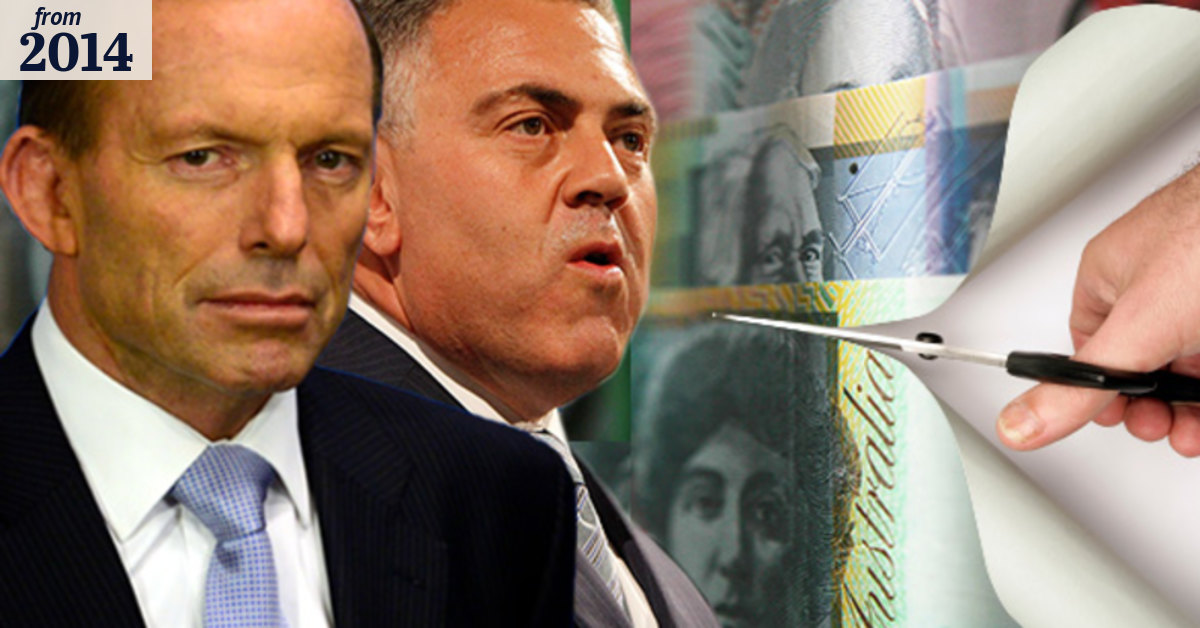
The budget featured significant changes to welfare, including:
**Family Payments:**
- Family Tax Benefit Part B income threshold reduced to $100,000 [3]
- Family Tax Benefit rates frozen for two years [3]
- Families cease being eligible for Family Tax Benefit Part B when their youngest child turns six [3]
- The Schoolkids Bonus was abolished [2]
**Pension Changes:**
- From September 2017, pension increases would be linked to inflation rather than male average earnings [2]
- Asset and income test thresholds would be indexed until 2017, then remain fixed for three years [3]
- The pension age would gradually increase to 70 by 2035 (building on Labor's previous increase to 67 by 2023) [2][3]
- The annual Seniors Supplement was abolished from 1 July 2014 [2]
**Youth and Student Welfare:**
- Newstart Allowance would not be available to people under 25 [2]
- Unemployed people under 30 would have to wait six months before receiving unemployment benefits [2][3]
- The First Home Saver Accounts scheme was abolished, saving $134.3 million [2]
- Higher education funding was cut by $4.7 billion over four years [2]
- HECS repayment thresholds lowered and interest rates changed [2]
While the specific "$3 billion" figure is difficult to verify from primary sources, the budget papers indicate total budget repair efforts of $36 billion over five years, with more than three-quarters coming from spending cuts [2][4].
* * * * 家族 nounKazoku 手当 nounTeate : : * * * *
Welfare changes were a significant component of these savings.
The claim omits several important contextual factors:
**Budget Context:**
The government inherited a projected deficit of $49.9 billion for 2013-14 and gross debt projected to reach $667 billion [3].
The budget measures were framed as necessary to address what the government described as a structural budget problem [3].
**The "Budget Emergency" Controversy:**
The government's characterisation of a "budget emergency" was disputed by 63 leading economists who signed the "Economists' Statement on Commonwealth Budgetary and Economic Priorities" in September 2014 [5][6].
The economists argued that "Australia's debt and deficit is closer to trivial than dangerous" when compared to other OECD countries [5].
**Comparative Economic Position:**
Australia's net public debt at approximately 15% of GDP was significantly lower than many comparable nations.
As economist Saul Eslake noted, Britain faced a deficit of 10% of GDP and net public debt exceeding 60% of GDP in 2010 - to apply similar "crisis" terminology to Australia's position was "to abuse the English language" [6].
**Some Higher Income Earners Also Affected:**
The budget introduced a 2% "Temporary Budget Repair Levy" on individuals earning over $180,000, expected to raise $3.1 billion over four years [2][3].
The specific article referenced (from 2014) would need to be verified for its reporting accuracy.
**The Guardian Australia:**
The second source is The Guardian Australia, which has a centre-left editorial stance.
Both sources appear to be mainstream media outlets rather than partisan advocacy organisations, though readers should be aware of their respective editorial leanings.
**Did Labor do something similar?**
The Rudd/Gillard Labor governments (2007-2013) also implemented significant welfare changes and cuts:
1. **Single Parent Welfare Cuts (2013):** The Gillard government moved approximately 80,000 single parents from the Parenting Payment Single onto the lower Newstart Allowance, saving an estimated $728 million over four years [7].
* * * *
This affected single parents when their youngest child turned eight.
2. **University Funding Cuts:** The Gillard government cut $2.3 billion from universities in 2013 to fund the Gonski school reforms [7].
3. **Aged Pension Changes:** The Gillard government increased the pension age from 65 to 67, to be phased in between 2017 and 2023 [8].
The Abbott government built on this by extending the increase to age 70 by 2035.
4. **Welfare Payment Indexation:** The Gillard government froze some welfare payment indexation during the 2012-13 budget to save $1 billion [9].
5. **Historical Pattern:** Both major parties have implemented welfare cuts when in government.
The Howard government (1996-2007) also made significant changes to welfare eligibility and payments.
**Key Difference:** The scale and scope of the 2014 budget welfare changes were more extensive than most previous changes, and they came after explicit pre-election promises that "no-one's fortnightly pension or benefit will go down" [1].
The 2014 budget welfare changes must be viewed in the context of both the government's stated objectives and their actual impact:
**Government Justification:**
- The government argued the changes were necessary to make the welfare system "sustainable and affordable for decades to come" [3]
- They pointed to inherited deficits of $123 billion and debt rising to $667 billion [3]
- Treasurer Joe Hockey declared "the age of entitlement is over" [2]
- The government argued that without change, the budget would remain in deficit for at least a decade [3]
**Criticisms and Concerns:**
- Treasury analysis indicated the budget would disproportionately hit low-income households compared to wealthier ones [2]
- The Australian Council of Social Service (ACOSS) warned the cuts could "destroy the social safety net" [2]
- The budget broke multiple pre-election promises including "no change to pensions" [1][2]
- The "six-month wait" for Newstart was widely criticised as unfair to young unemployed people
**Comparative Context:**
While the 2014 welfare cuts were significant, they followed a pattern where both major Australian parties have implemented welfare cuts when in government.
The economists' statement suggests that while budget repair was a legitimate policy goal, the "emergency" framing used to justify the cuts was overstated given Australia's relatively strong economic position compared to other developed nations [5][6].
The claim that the Coalition government "cut $3 billion in welfare for students, the elderly and families" is partially accurate but lacks important context.
The 2014 budget did contain significant welfare cuts affecting these groups, though the specific "$3 billion" figure is difficult to verify precisely from official budget documents.
The "budget emergency" framing used to justify the cuts was disputed by 63 leading economists
The welfare cuts were real and significant, but they should be understood in the broader context of both the government's fiscal justification and the historical pattern of welfare changes by governments of both major parties.
The claim that the Coalition government "cut $3 billion in welfare for students, the elderly and families" is partially accurate but lacks important context.
The 2014 budget did contain significant welfare cuts affecting these groups, though the specific "$3 billion" figure is difficult to verify precisely from official budget documents.
The "budget emergency" framing used to justify the cuts was disputed by 63 leading economists
The welfare cuts were real and significant, but they should be understood in the broader context of both the government's fiscal justification and the historical pattern of welfare changes by governments of both major parties.