**TRUE** - ASIO did raid the office of Bernard Collaery, the lawyer representing East Timor in an international case against Australia, and seized documents and electronic files related to the case [1][2].
On December 3, 2013, ASIO agents, accompanied by Australian Federal Police, raided Collaery's Canberra law office and seized documents and electronic data [1].
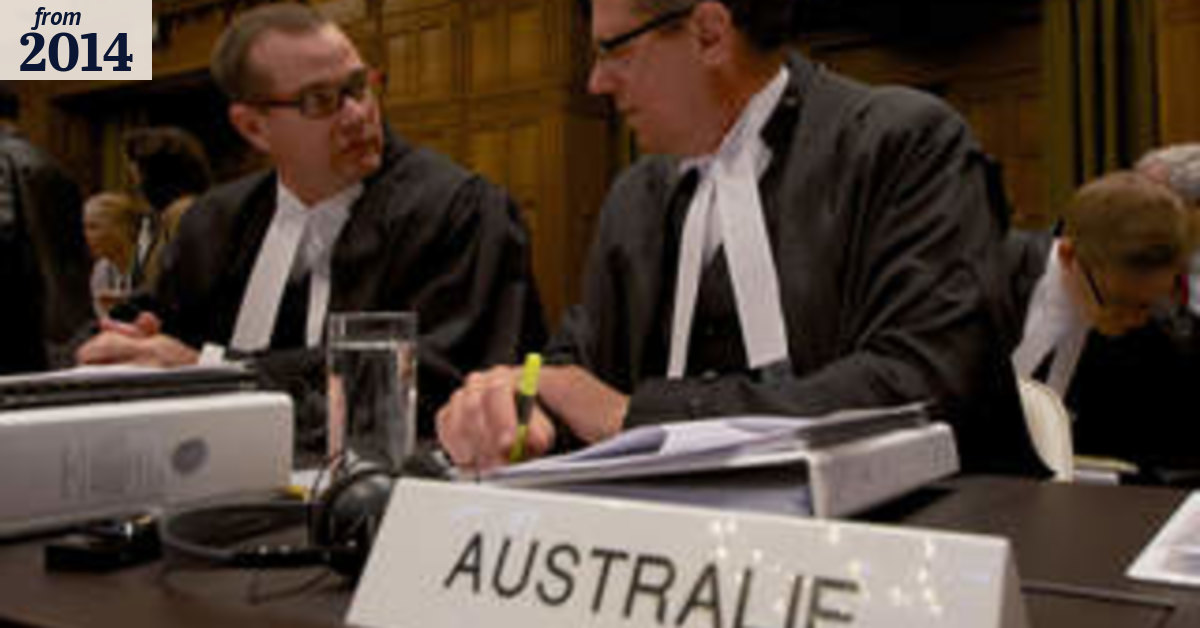
The raid occurred just days before hearings were scheduled to begin at the Permanent Court of Arbitration in The Hague, where East Timor was challenging the Certain Maritime Arrangements in the Timor Sea (CMATS) treaty [1][2].
The seized material included:
- Legal documents related to the Timor Sea Treaty negotiations [3]
- Electronic files containing evidence of Australia's alleged spying [1]
- A statement by a former ASIS agent (known as "Witness K") alleging Australia bugged East Timor's cabinet room during 2004 treaty negotiations [3][4]
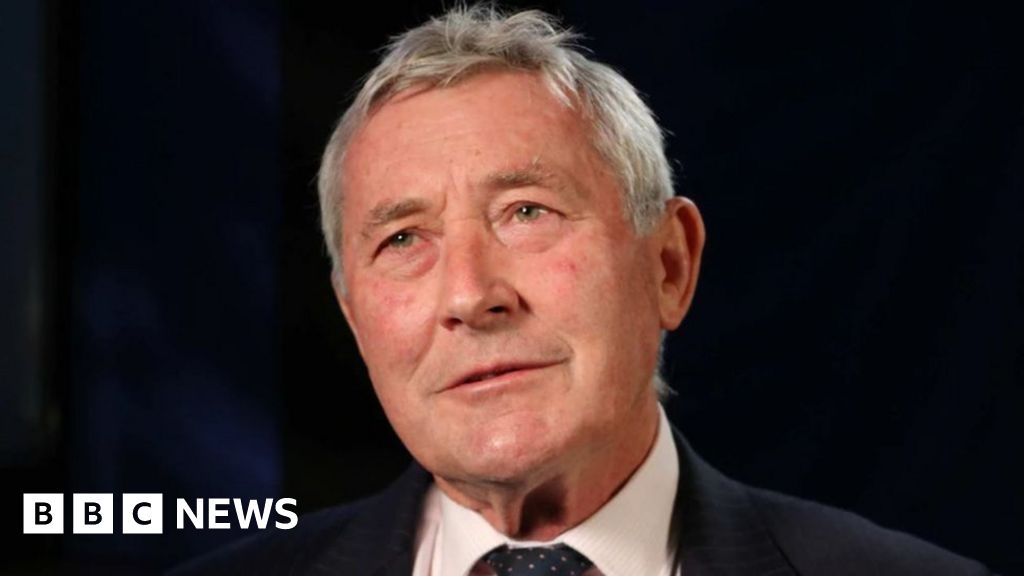
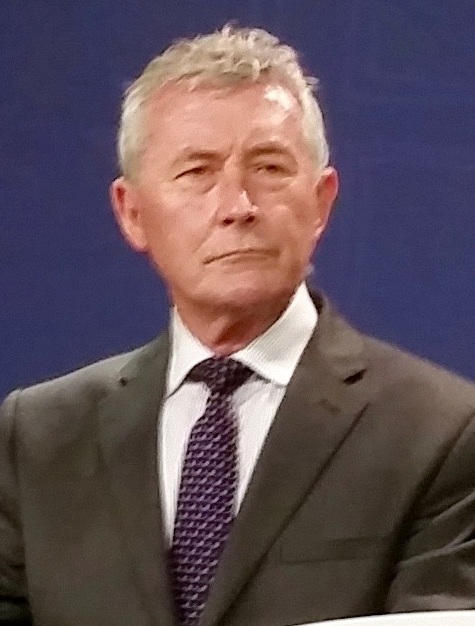
Attorney-General George Brandis confirmed he authorized the search warrants, stating they were issued "on the grounds that the documents contained intelligence related to security matters" [1].
In March 2014, the International Court of Justice (ICJ) ordered Australia to seal all documents and data seized in the raid and not to access them, marking the first time the court had imposed restrictions on the spy agencies of a Five Eyes state [3][5].
Australia subsequently admitted before the ICJ that it intended to object to Witness K giving evidence at the arbitral tribunal, fearing the former agent "would make further disclosures that Australia could not confine" [6].
**The claim omits several critical facts:**
1. **The spying itself occurred in 2004 under the Howard government** - The alleged bugging of East Timor's cabinet offices during treaty negotiations occurred in 2004 under the Coalition's John Howard, not during the Abbott government when the ASIO raid occurred [2][4].
2. **The raid's stated justification** - The government claimed the raid was necessary to protect national security and prevent the exposure of Australian intelligence officers and tradecraft [6].
Solicitor-General Justin Gleeson defended the action citing risks to "endanger" spies and expose technical capabilities [6].
3. **Witness K's passport was cancelled** - The former ASIS agent had his passport cancelled, preventing him from traveling to The Hague to give oral evidence [6].
4. **Australia and East Timor eventually reached a new treaty** - In 2018, Australia and East Timor signed a new maritime boundary treaty that was more favorable to East Timor [2].
5. **The prosecutions were eventually dropped** - In July 2022, Labor Attorney-General Mark Dreyfus withdrew support for the prosecution of Collaery, ending a nearly decade-long legal saga [4][7].
6. **Legal privilege was breached** - The raid seized material subject to lawyer-client privilege, an unprecedented action that drew condemnation from legal experts [2][8].
Additional sources consulted (ABC News, BBC, The Sydney Morning Herald, Wikipedia, and ICJ documents) are authoritative and provide consistent factual accounts of the events [1][2][3][4][5].
The reporting is corroborated by:
- Attorney-General George Brandis's own statement confirming the raid [1]
- ICJ official case documentation [5]
- Multiple mainstream media outlets across the political spectrum
**Did Labor do something similar?**
Search conducted: "Labor government ASIO intelligence operations spying foreign countries"
Finding: **Partial equivalent with important distinctions:**
1. **The original spying operation occurred under Coalition government (2004)** - The alleged bugging of East Timor's cabinet occurred under the Howard government (Coalition), not Labor [2][4].
2. **Labor was aware but took no action** - East Timor first raised the spying allegations with then-Prime Minister Julia Gillard (Labor) in late 2012, but no action was taken [6].
* * * *
The Labor government maintained the position that the 2004 operation was a legitimate intelligence activity.
3. **Labor eventually dropped the prosecutions** - In July 2022, the Albanese Labor government dropped the prosecution of Bernard Collaery through Attorney-General Mark Dreyfus, acknowledging it was not in the public interest to continue [4][7].
4. **Labor shelved inquiry promise** - Despite pre-election promises to hold an inquiry into the ASIS operation and subsequent prosecution, the Labor government shelved this commitment in 2023 [4].
5. **Broader context on intelligence operations** - Australian intelligence agencies have conducted foreign spying operations under governments of both parties.
The 2004 East Timor operation was unusual primarily in that it allegedly targeted a friendly nation for commercial advantage rather than national security purposes [2][8].
**Comparison:** While the raid itself occurred under a Coalition government, the broader pattern of protecting intelligence operations and resisting transparency has been consistent across both major parties.
This case represents one of the most controversial intelligence-related episodes in Australian history, involving allegations of improper spying on a friendly neighbor for commercial advantage, followed by actions that appeared designed to prevent disclosure of those activities.
**Criticisms of the government's actions:**
1. **Timing of the raid** - The December 2013 raid occurred just two days before The Hague proceedings were to begin, leading to accusations it was designed to disrupt East Timor's case [6].
Bernard Collaery described it as a "blatant, disgraceful attempt to impede justice" [1].
2. **Commercial motivation** - The alleged 2004 bugging appeared motivated by securing favorable terms in oil and gas treaty negotiations worth an estimated $40 billion, rather than genuine national security concerns [2][8].
3. **Breach of legal privilege** - Raiding a lawyer's office and seizing client materials is extraordinarily rare and undermines the legal profession's ability to represent clients effectively [2][8].
4. **Secrecy overreach** - The subsequent prosecution of Collaery and Witness K under the National Security Information Act, with attempts to hold secret trials, was criticized by legal experts as damaging to open justice [4][8].
5. **Political prosecution concerns** - The delay between the 2013 raid and 2018 charges, coinciding with a change in Attorney-General from George Brandis to Christian Porter, raised questions about political motivation [4].
**Government's stated justifications:**
1. **National security** - The government maintained the raid was necessary to protect classified information and prevent exposure of intelligence officers and methods [6].
2. **Legal basis** - Attorney-General Brandis stated the warrants were properly issued on national security grounds and instructed ASIO that the seized material should not be communicated to those conducting Australia's defense at The Hague [1].
3. **Preventing further disclosures** - The government feared Witness K would make "further disclosures that Australia could not confine" [6].
4. **Rule of law** - Supporters of the prosecution argued that disclosing classified information is a serious offense, regardless of the whistleblower's motives.
**Expert assessments:**
Senior Australian legal figures, including barrister Geoffrey Watson SC and constitutional law expert Rebecca Ananian-Welsh, described the prosecution as inappropriate and damaging to public confidence in justice [2][8].
The ACT Court of Appeal ultimately ruled that the open hearing of criminal trials was important because it "deterred political prosecutions" and allowed public scrutiny [4].
**Key context:** This episode is **not typical** of Australia-East Timor relations, which have generally been close since Australia led the INTERFET intervention in 1999.
The case highlighted tensions between national security, commercial interests, and international law - with the ICJ's intervention suggesting Australia's actions crossed international legal boundaries [3][5].
However, the framing as "theft" is technically imprecise - the raid was conducted under legal warrants authorized by the Attorney-General, albeit warrants that the ICJ later effectively found improper in the international context.
The more accurate characterization would be that Australia conducted an improperly motivated raid to seize legally privileged material for the apparent purpose of disrupting a foreign nation's legal case against it.
However, the framing as "theft" is technically imprecise - the raid was conducted under legal warrants authorized by the Attorney-General, albeit warrants that the ICJ later effectively found improper in the international context.
The more accurate characterization would be that Australia conducted an improperly motivated raid to seize legally privileged material for the apparent purpose of disrupting a foreign nation's legal case against it.