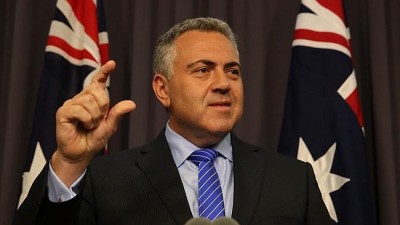
**VERIFIED TRUE.** On May 2, 2014, then-Treasurer Joe Hockey made these exact comments during a radio interview on 2GB's Macquarie Radio with Alan Jones [1].
Speaking about his drive from Sydney to Canberra, Hockey stated: "I drive to Canberra to go to Parliament... and I must say I find those wind turbines around Lake George to be utterly offensive.
**The specific context was budget discussions and personal aesthetic preference, not government policy.** Hockey made these comments in response to questions about whether the government would target clean energy programs for budget cuts [1].
He was signaling the government's intent to reduce climate-related agency spending and cut "massive duplication" in environmental programs [2].
**Hockey was not proposing to shut down existing wind farms.** He explicitly acknowledged he could not stop the Lake George turbines: "We can't knock those ones off because they're into locked-in schemes and there is a certain contractual obligation I'm told associated with those things" [1].
**The Abbott government had a broader pattern of anti-wind rhetoric.** Prime Minister Tony Abbott made similar comments in June 2015, telling Alan Jones that wind farms are "visually awful" and have a "potential health impact" [4].
The Abbott government appointed a "wind farm commissioner" in 2015 to investigate complaints about turbines, a move the wind industry criticized as part of a "relentless anti-renewables campaign" [5].
**Public opinion on wind farms was generally positive.** The Clean Energy Council noted at the time that "upwards of 75 per cent" of Australians supported renewable energy from wind, sun, and waves [2].
The Bungendore Chamber of Commerce even featured wind turbines in its logo [2].
**Health claims were scientifically disputed.** A National Health and Medical Research Council (NHMRC) report in February 2015 found "no consistent evidence" that wind farms have adverse effects on human health [4].
The report identified over 4,000 studies but found only 13 met sufficient scientific standards, and those were of poor quality due to small sample sizes and potential bias [4].
While the article accurately reported Hockey's comments, the publication's political alignment should be noted when assessing the framing of energy policy debates.
The claim's accuracy is independently verified by multiple mainstream sources including ABC News (Australia's public broadcaster), Sydney Morning Herald, and other reputable outlets [1][2].
**Did Labor have a different position on wind energy?**
Search conducted: "Labor government wind farm policy Australia renewable energy"
Finding: The Labor Party generally supported wind energy development and renewable energy targets.
* * * *
In their dissenting report to a Senate inquiry on wind turbines, Labor senators stated: "Australia's wind energy industry remains small in comparison both with its potential size and with the total size of wind energy installed around the world.
However, to date it has played a vital role in abating the greenhouse gas emissions of Australia's electricity generation sector" [7].
**Comparison:** While Labor supported wind energy broadly, both parties had internal tensions regarding specific wind farm locations.
The SMH article notes divisions within the NSW Coalition government between Planning Minister Pru Goward (anti-wind) and Environment Minister Rob Stokes (pro-wind) [2].
The Abbott government's position was notably more hostile to wind energy than the previous or subsequent Labor governments, with Abbott himself calling wind farms "visually awful" and actively seeking to reduce their numbers through the Renewable Energy Target reduction from 41,000 to 33,000 gigawatt-hours [4].
**Personal aesthetic preference vs. energy policy.** Hockey's comments reflected his personal reaction to the visual impact of wind turbines rather than a technical assessment of their energy value.
This personal preference influenced but did not solely determine government policy.
**Legitimate concerns about visual impact exist.** While polls showed majority support for renewable energy, local communities often oppose specific wind farm developments due to visual amenity concerns.
This tension between national climate goals and local community preferences affects both sides of politics.
**Economic arguments were also presented.** Liberal MP Angus Taylor, whose electorate includes the Lake George wind farms, argued against wind farms on economic grounds rather than aesthetic ones: "The economics don't work.
Right now wind requires massive subsidies over and above other means of reducing carbon emissions" [1].
**However, the government's approach was criticized as inconsistent.** Shadow Minister for Climate Change Mark Butler called Abbott "short-sighted" and "out of touch," noting that "renewable energy is enormously popular in Australia" [4].
**Comparative context:** The Abbott government's hostility to wind energy was stronger than typical across Australian governments.
The establishment of a dedicated "wind farm commissioner" was unusual and viewed by critics as singling out one renewable energy technology for special scrutiny.
However, the claim should be understood in context: these were personal aesthetic comments made during budget discussions, not a formal policy position, and Hockey acknowledged contractual obligations prevented shutting down existing turbines.
The Abbott government did subsequently reduce the Renewable Energy Target and appointed a wind farm commissioner, indicating broader institutional skepticism toward wind energy than reflected in this single quote [4][5].
However, the claim should be understood in context: these were personal aesthetic comments made during budget discussions, not a formal policy position, and Hockey acknowledged contractual obligations prevented shutting down existing turbines.
The Abbott government did subsequently reduce the Renewable Energy Target and appointed a wind farm commissioner, indicating broader institutional skepticism toward wind energy than reflected in this single quote [4][5].